

KSS Founder Kun Chil Paik
Alternately: Baek Geun-chil / Paik, Kun Chil / 백근칠.
KSS Founder Kun Chil Paik
Alternately: Baek Geun-chil / Paik, Kun Chil / 백근칠.

Above: Mr. Kun Chil Paik, (Director) Korea Social Service (Korea), and F. Lund Nielsen, (Director) Adoption Center (Denmark)
Source: AC Children’s Aid PDF - Supplemental material from the 2024 Danish Appeal Board Report / Denmark
”Adoption mediation from the individual countries.
KOREA
In the report for 1983, the problems arising from a significant decline in mediation figures during the year were described. At that time, there was fear that this situation could mark the beginning of a decline in adoptions from Korea.
Mr. Kun Chil Paik, Korea Social Service, and F. Lund Nielsen, Adoption Center
Negotiations with Korea Social Service provided assurance that adoption mediation could continue in 1984, albeit with fewer children than before. These agreements have been strictly adhered to. The office manager visited Korea in September for renewed negotiations, thereby ensuring that the mediation figures from 1984 could be maintained.”
*Trigger warning: Upsetting content.
Timeline of KSS Founder Kun Chil Paik:
See the full KSS Timeline here.
Trigger Warning: Upsetting content.
In the only known video we have of him, KSS Founder Kun Chil Paik (mistakenly called Mr. Park) appears at the 18:04 mark in this Dutch video about Korean Adoption in the 1970s(see screenshot below this section).
Kun Chil Paik born 1922.
Kun Chil Paik graduated from Gyeonggi High School in 1940.
Kyunggi High School (Korean: 경기고등학교; Hanja: 京畿高等學校) is the oldest modern high school in Korea, located in Gangnam-gu, Seoul. The school is an all-boys school, and its counterpart is Kyunggi Girls' High School [ko], also located in Gangnam-gu, Seoul.
Kyunggi High School has educated many leaders of the South Korean society. It is the "K" in the so-called "K-S mark," an informal reference to educational credentials said to ensure career success, with the "S" standing for Seoul National University.[1][2] Before the abolition of the high-school entrance exams in 1974, it was the highest-ranked school in the country.
Alumni associations for the school are widespread throughout Korea and abroad. Famous alumni may be found in all sectors of society and include many past and present politicians (as well as four Prime Ministers), high-ranking government officials, award-winning scientists and scholars, business executives and national athletes.
History
The school was established by an edict of Emperor Gojong on April 4, 1899, and opened its doors on November 10, 1900. The school's original name was Gwallib Middle School (관립중학교). Its establishment was part of a general program of educational modernization. This effort at modernization was swallowed up by the Japanese annexation in 1910, but the school itself survived. Originally chartered as a middle school, it became a high school in 1906, though it continued to offer middle-school classes until 1971.
In 2000, the South Korean government issued a commemorative 170-won stamp, marking the school's 100th anniversary.[3]
September 1st, 1906: Renamed to National Hansung High School.
November 1st, 1910: Annexed Hansung Foreign Language School and renamed to Kyungsung High School.
April 1st, 1911: Opened a one-year course for producing teachers and renamed to Kyungsung First Middle School.
April 1st, 1938: Renamed to National Kyunggi Middle School.
June 4th, 1938: Set the school's flag.
October 1st, 1945: Lee Hun-gu (이헌구) was the 15th principal of the school and was also the first ethnic Korean to be a school principal since World War II began.
Revised Romanization: Gyeonggi Godeung Hakgyo
McCune–Reischauer: Kyŏnggi Kodŭng Hakkyo
Source: Wikipedia
Kun Chil Paik was a public official at the Kyung-gi (Gyeonggi) provincial government and his position in 1949 was the head of the notoriousSeongam Academy (선감학원 ). Trigger Warning: Very Upsetting content.
ImportantUpdate: Please note that we do not know the exact nature of what Seongam Academy was like in the 1940s when KSS Founder Kun Chil Paik (alternately: Baek Geun-chil / Paik, Kun Chil / 백근칠), was Vice President and later President of Seongam Academy. We have recently learned that Seongam Academy may have been at its most notorious in the 1970s, which is decades after KSS Founder Baek Gun Chil was in charge of Seongam Academy. At this time we do not have any documentation to support this claim. When that becomes available, we will include it here.
Kun Chil Paik went to Minnesota to obtain his Master's Degree in Social Work at the University of Minnesota in 1954 and came back to Korea in 1957.
In 1964, Kun Chil Paik established KSS.
In 1973, according to the Love Suwon journal article, Kun Chil Paik’s nephew, Kim Won-young established Kyung-gi Social Service (The Kyonggi (Gyeonggi) Social Service Center in Suwon).
February 3rd, 1985: Kun Chil Paik’s death. He apparently died in the Netherlands during a visit. He died at 63 years of age.

In the only known video we have of him, KSS Founder Kun Chil Paik (mistakenly called Mr. Park) appears at the 18:04 mark in this Dutch video about Korean Adoption in the 1970s. The video was apparently shot in 1970 aboard a flight from Korea to the Netherlands.
+
ChatGPT translation of the Dutch article:
'Doe mij maar zo'n Koreaantje!'
“I’ll Have One of Those Little Koreans!”
Episode: 27 minutes
Reading time: 17 minutes
‘“Even if you save just one.”
These six words mark the beginning of international adoption in the Netherlands. They are spoken by writer Jan de Hartog during a television interview with Mies Bouwman in 1967.
After the Korean War (1950–1953), thousands of American soldiers remained behind as an occupying force under the UN flag. De Hartog speaks about the inhumane circumstances in which the children of these American soldiers and their Korean mothers lived. They were rejected by their families and had no future in their own country.
Watch Video
27 min
Motivated by idealism, thousands of Dutch families respond to De Hartog’s appeal and express their desire to adopt a Korean child. The “Korean adoption child” becomes a craze. Between 1970 and 1988, more than four thousand Korean children came to the Netherlands.
Unprepared, full of enthusiasm but also extremely naïve, the first generation of foreign adoptees—now numbering around 35,000—were welcomed. The wave of adoptions from Korea came to an abrupt end in 1988, when the Olympic Games were held in Seoul and the Korean government preferred to appear in the media with a more modern image rather than as an “exporter of children.”
Andere Tijden speaks with people who were involved from the very beginning: Marjory de Hartog, the writer’s wife; parents; children; and social workers. It is a program about the idealism, amateurism, and rosy optimism of the early years of international adoption.
Korean Child
The Adoption Wave
“I’ll Have One of Those Little Koreans!”
“Even if you save just one.” It is the spontaneous appeal for adoption made by bestselling author Jan de Hartog while sitting on Mies Bouwman’s sofa. Together with images of his Korean daughters in 1968, the statement triggers a genuine adoption wave.
Thanks to the power of television, the Netherlands becomes captivated by the disadvantaged “Third World orphan,” and the taboos surrounding adoption disappear like snow in the sun. The new phenomenon is infused with the idealism of the flower-power era. But the rosy cloud does not last long...
This year marks fifty years since adoption became legally possible in the Netherlands. But despite the introduction of the Adoption Act in 1956, the taboos remained. An adopted child who knew about their status was the exception rather than the rule. Anything was considered permissible to conceal the fact that, in many cases, the adoptive parents could not have children of their own.
That changed when, in the early 1970s, adopting children from Third World countries became fashionable. These were children whose appearance made their origins impossible to hide.
Jan de Hartog with Mies
“Even if you save just one”
The immediate catalyst for a genuine adoption wave is popular writer Jan de Hartog’s appearance on Mies Bouwman’s television program Mies en scène. A film crew has traveled to the United States because of the successful Broadway musical I Do! I Do!, an adaptation of De Hartog’s play The Fourposter. An interview with the “writer in residence” himself is scheduled afterward.
But the recording takes an unexpected turn. A few days earlier, the writer and his wife had taken responsibility for two Korean orphans, and De Hartog suddenly calls for help for the many thousands of abandoned and orphaned children in Southeast Asia.
Vietnam captures everyone’s imagination, but South Korea, too, still has a desperate situation, he seems determined to impress upon television viewers in the Netherlands.
Thousands of American soldiers remained in the region after the war (1950–1953) to maintain the status quo. Their years of stationing had consequences: a substantial increase in the number of “mixed-race” children. These babies were rejected.
“They were not only discriminated against; they simply did not exist,” says Liesbeth Graatsma, a social worker who served as a liaison for Korea in the 1970s. “Koreans did not have a population-registration system like we did here, but rather a family-registration system managed by the head of the family. Someone like that would never accept a child born out of wedlock. Those children simply had no future.”
The Quakers, the religious community to which De Hartog belonged, were among the driving forces behind the adoption of these children in the United States. There, the famous writer Pearl Buck set an example by adopting six children.
Marjory, Jan de Hartog’s English wife, reads a book about Buck’s adoption work. She is so impressed that, when the Vietnam War breaks out, she herself wants to help care for orphans.
“I went around to all kinds of organizations, urging them to pay attention to these children. Especially in Vietnam,” Marjory de Hartog recalls.
But peace is not signed in Vietnam until 1975, and before then very few people have access to the country. The couple becomes involved with Buck’s volunteer organization. Before they know it, the De Hartog household has two Korean sisters.
Not long afterward, the Korean girls Eva and Julia appear on Mies Bouwman’s program. Two cheerful toddlers in a sun-drenched American suburb. There could hardly be better advertising for adoption.
But De Hartog’s impassioned argument also helps. “Even if you save just one” becomes one of those statements that has an impact.
And then something happens that nobody anticipated. The telephone at the VARA broadcasting organization does not stop ringing after the program.
“We didn’t know when it was going to be broadcast, but suddenly, in the middle of the night, the telephone rang. Mies was hysterical on the line,” Marjory de Hartog recalls. “She didn’t know what to do with all those phone calls: ‘What do we tell these people? Can they call you?’ she asked.”
That evening and in the days that followed, more than a thousand people called asking for “a little Korean.”
Sang and An de Klonia
Vietnam, the Pill, and the Welfare Act
Plenty of Reasons to Want a Child from Abroad
How can a spontaneous statement on a single television program trigger such a massive response?
In 1967, growing criticism of the Vietnam War dominates the era. Television brings the war into people’s living rooms, and millions of families witness its horrors. Images of overcrowded orphanages and neglected, malnourished children are particularly shocking.
Meanwhile, the number of adoptions within the Netherlands is falling due to the introduction of the contraceptive pill in 1962, which reduces the number of unwanted pregnancies, and the new General Assistance Act of 1963. This guarantee of a minimum standard of living for every citizen leads to a decline in the number of children being relinquished for adoption.
Increasingly, social workers advise young unmarried mothers to raise their children themselves.
The Adoption Act of 1956, introduced relatively late in the Netherlands, essentially meant that an adopted child became, legally, the full child of the adoptive parents. Nevertheless, until 1978 the biological parents retained the right to reverse the relinquishment of their child through the courts.
According to F. ten Siethoff, then secretary of the Adoption Council, an advisory body to the Ministry of Justice and the courts, this was one of the reasons people turned abroad.
“There was the threat that the biological parent could create an obstacle. With a child from far away, the family is also somewhat farther away.”
As the consequences of the wars in Southeast Asia for tens of thousands of displaced children gradually become clear, little more is needed than an emotional appeal from a popular public figure. A new social phenomenon makes its entrance: the adoption of Third World children.
In a Korean Hut
Dutch Idealism
“Full Is Full”
An action committee is established with the aim of getting aid underway for children in need. International adoption is only one of the means.
But politically, the efforts are sensitive.
“In the Netherlands, the argument was that the country was too full. There was a serious fear of a wave of immigration,” says Marjory de Hartog.
F. ten Siethoff, former secretary of the Adoption Council, also remembers resistance at the Ministry of Justice.
“Guidelines were drawn up. Among other things, they stated that you could not take in a child if it was not certain that the relinquishment had been properly arranged. There was also a whole bureaucracy involved. In practice, this meant that it was difficult to keep those children here. So a brake was put on their uncontrolled arrival.”
But the ministry also had moral objections. There was concern that bringing children from a completely different culture to the Netherlands would lead to all kinds of problems. The transition could be too great, and various difficulties in the upbringing situation were predicted. There were also fears of child trafficking.
Ten Siethoff:
“In retrospect, society presented us with a fait accompli. There were already all these private initiatives. Reality had overtaken us. Nothing had been arranged. People simply arrived with these children. And you couldn’t send them back.”
“I remember a compound consisting of rows of little houses. It was primitive. I slept on a mat, and if there was any food at all, we ate rice—nothing but rice.
“I remember being perfectly happy there until Grandma became ill and could no longer take care of me. Then I had to cook for her.
“There was sometimes a woman who came by, and people said she worked in Seoul. I think she was my mother. But if you ask me whether I knew at the time that this woman was my mother, I would say no. She came too rarely.
“I never knew my father. He had probably already returned to the United States before I was born.”
The speaker is Sang de Klonia, now thirty-nine, and one of the first hundred children from South Korea to be adopted in the Netherlands. He is four years old when he arrives.
“I was in a car for the first time and on an airplane for the first time. It was really an outing with other children. A fun day until we arrived in the arrivals hall at Schiphol. I thought, something isn’t right here. Something is wrong.”
Social worker Liesbeth Graatsma accompanied the flights during this period.
“The journey took almost 32 hours. You spent a long time with those children, so you developed a bit of a bond. Often the children had played wonderfully during the journey, but at Schiphol they would suddenly panic.
“We tried to calm them down, but if a child kept panicking, there was only one solution: get the children and parents into the cars as quickly as possible.”
As easily as the first children were pushed into a new life once they arrived at Schiphol, their arrival was treated with caution by the authorities. Ultimately, political pressure forced the government to relent.
Erie den Doolaard personified this lobbying effort. She was the wife of De Hartog’s close friend and fellow writer A. den Doolaard.
The writers’ stay on the Veluwe served as a temporary mailing address for the many letters that poured in following De Hartog’s appeal. Mies Bouwman also received loads of letters from parents offering themselves as prospective adoptive parents.
One of them was An de Klonia, Sang’s adoptive mother:
“Dutch children weren’t available, and then this came our way and we thought, bingo! So we signed up and waited to see what would happen. Because at that time they weren’t even allowed into the Netherlands. We already had one child, but we were convinced that we had to do something to save at least one.”
Long Waiting Times
In 1971, Marcel van Dam is the VARA ombudsman. After receiving many letters from complaining parents, he devotes several episodes to the complicated adoption procedure, which also causes an uproar in the Dutch parliament.
The Ministry’s position is a thorn in the side of D’66 Member of Parliament Bert Schwarz, as shown by a parliamentary debate in January 1972:
“The Netherlands is relatively wealthy and absolutely full, like a tram can be full, in which everyone is admitted normally and without discrimination. But when the tram is full, nobody else can get on. (…) The government has done virtually nothing to slow immigration by foreign workers. Yet the Ministry of Justice is contributing to restricting the flow of immigration in a way I do not appreciate, namely by limiting the admission of foreign foster children.”
In 1967, the year De Hartog makes his appeal on Mies Bouwman’s program, more than 80 percent of all adopted children are still of Dutch origin.
Eight years later, almost half of placed children are of foreign origin, and more than one-third are Korean.
But demand exceeds supply. Parents have to wait endlessly before they can adopt a child. First there is the waiting period for the family assessment, followed by the waiting period for the actual adoption. In some cases, the total wait can reach seven years.
An de Klonia has to wait three and a half years for Sang.
“Yes, the waiting—that was a difficult period. The age difference with our first child began to play a role. That’s why we preferred a somewhat older child. Then the age difference with our first child wouldn’t be as great.”
Korea
Exporter of Babies
In the following years, Korea’s international adoption program becomes extremely popular.
What began as an initiative to rescue children of mixed race who had been rejected gradually develops into a last resort for childless middle-class parents in Europe and the United States.
The Vietnam War puts the plight of Third World children on the public agenda. An de Klonia and her husband also participate in protests against the war.
“We were anti-militarist, yes. We were there from the very first demonstrations,” says De Klonia. “It’s damn well always the military that causes the children. That happened in the Netherlands too, with the Germans and the Canadians.”
Vietnam, however, does not grant access until after 1975, when peace has been signed. So people turn to another country.
During these years, international adoption becomes almost synonymous with adoption from Korea, where the lines of communication are short and the authorities are cooperative.
But the country does not want to do business with Erie den Doolaard.
“Because she was ‘a housewife on the Veluwe,’” Will Schütte recalls. “That wasn’t official enough. A proper organization had to be established.”
Will Schütte is instructed to establish the Foundation for Intercountry Adoption (SIA). Until then, she has worked for FIOM, the Federation of Institutions for Unmarried Mother Care, which had previously been responsible for adoption. For a long time, after all, adoption had been inherently connected with care for unmarried mothers.
But times are changing, and Schütte’s boss asks her:
“Would you like to get started with SIA?”
He adds:
“But then you’ll have to arrange the financing yourself.”
Schütte lobbies throughout her husband’s network—he is a senior civil servant at the Ministry of Defence—as well as her own network.
At KLM, she says she arranges a generous deal to bring the children to the Netherlands as cheaply as possible. She also manages to exert her influence at the Ministry of Justice.
“I think those men thought, well, that little woman needs something to do too. At first, everything was really done in a very amateurish way. Nobody knew how it was supposed to work.”
She rents an attic on Schoolstraat in The Hague. She brings the wicker chairs from her own home. A “friend” gives her folders, and at KLM she arranges a generous deal to fly the children over as cheaply as possible.
Schütte:
“We were able to get into places everywhere, and often we left meetings with major commitments. They thought it was a whim of bored housewives. Adoption today, something else next year. But it turned out differently.”
Sang as a Teenager
The Disillusionment of the 1980s
“Completely Out of Control in a Cell”
That the criticized reluctance of the Ministry of Justice also had another, more legitimate reason becomes clear over the course of the 1980s.
By then, more than 13,000 children from the Third World had been adopted by Dutch parents. The babies and toddlers from the boom years have become teenagers in the 1980s.
Through the media, an image of problem cases emerges, as disillusioned parents of children who have been removed from the home seek publicity.
Sang is also removed from his home.
“At a certain point things went wrong. Petty crime and things like that,” An recalls.
She turns to Sang:
“Until you were completely out of control in a cell and the police came to our door. That really was the final straw. That’s when they arranged an emergency placement.”
Sang:
“I was impossible and unmanageable. Looking back, it had everything to do with my adoption. People underestimate what it means to come here from an Eastern culture. The assumption was and still is that you automatically have a better life here.”
Nevertheless, Liesbeth Graatsma, who had been involved with SIA as a social worker from the very beginning, emphasizes that in many cases things did go well.
But she acknowledges that there was too much optimism in the early years about how the adoptions would turn out.
“We all thought these children were trapped and that there were no solutions in their country of origin. We did have solutions here. So we wanted to help those children.
“We thought: it will take some getting used to, but it will work out. With patience and love, you’ll get there. That is what later came to be called the ‘rosy cloud.’”
Korean Baby at Schiphol
The 1988 Olympic Games
The Final Straw
With the negative coverage in the media, the positive image of international adoption begins to change, and the number of adoption applications consequently falls sharply. Between 1980 and 1989, it falls by as much as 60 percent.
Alongside the critical voices in the press, the first findings from adoption research identify particular parenting challenges for adoptive parents.
Economic circumstances are also becoming less favorable: the government’s first major round of austerity measures begins.
But it is not only demand that declines; supply falls as well.
In Asian countries, political attitudes toward adoption are changing. Rising prosperity in Korea—from $248 per capita in 1970 to $2,268 in 1987—goes hand in hand with growing national self-confidence.
Domestic adoption is encouraged, and calls grow stronger for an end to the “export of babies.”
In Korea, this trend is symbolized by the 1988 Olympic Games.
A year before the world’s spotlight turns to Korea, a political transformation takes place. In June 1987, student protests, strikes, and a massive popular uprising bring 25 years of military rule to an end.
The new freedom of expression creates room for critical voices, but adoptions continue unabated.
One year later, during the Games in Seoul, Korea proudly presents itself as a newly industrialized democracy.
But Western journalists seize the opportunity to present a different image of the country, portraying Korea as the world’s largest exporter of children.
This is the final straw.
During the Games, not a single child leaves the country through international adoption. The following year, the number of adoptions drops significantly.
In the Netherlands, the number of placements falls from 107 in 1988 to 13 in 1989.
Korea appears to have escaped its image as a baby exporter.
Over the course of the 1990s, the number of adoption applications in the Netherlands gradually experiences a slight revival. By then, China has become the leading country of origin.
But every year, a limited number of Koreans still await a new life in the Netherlands.
Sang de Klonia
The Numbers
Research into Behavioral Problems
In 1979, the first Dutch research into the adoption of foreign children is presented.
Professor René Hoksbergen, a professor specializing in adoption, identifies specific parenting problems in his book Adoption of Children from Distant Countries. But firm conclusions are impossible because the children in question have not yet lived in the Netherlands long enough.
Only at the end of the 1980s does the first major nationwide study appear, conducted by child psychiatrist Frank Verhulst.
His findings reveal the problems unequivocally: compared with “ordinary children,” foreign adoptees come into contact with the police and justice system four times as often, attend special education three times as often, are placed outside the home six times as often, and one-quarter require professional assistance.
Researchers nevertheless disagree with one another.
One example is Professor Femmie Juffer, herself an adoptive parent, who presented research findings the previous year intended to dispel many of the myths surrounding the subject.
She argues that although foreign adoptees have more behavioral problems than non-adopted children, the differences are small.
Professor Hoksbergen, by contrast, regularly seeks publicity to emphasize the “scale and intensity of behavioral and parenting problems.” According to him, these are “many times greater than among children born in the Netherlands.”
He continues to advocate better aftercare.
But the people who truly know what it is like are the nearly 35,000 foreign children who have by now been, or are being, raised by Dutch parents.
Of these, 4,099 come from Korea.
Sang de Klonia, one of the first, is asked:
Is it pleasant to have been adopted?
“Not for me. It wouldn’t have been necessary. They should have left me there.
“What would have happened then is a difficult question. I would probably have died.
“But the question is: what is worse—dying of hunger or dying of sorrow?”’
Text and research: Ariane Kleijwegt
Direction: Hein Hoffmann
Final editing: Laura van Hasselt
Translated Article About KSS Founder Kun Chil Paik (Alternately: Baek Geun-chil / Paik, Kun Chil / 백근칠).
Original Article Link (In Korean)- see page 35.
+
Update! ChatGPT has provided a better translation of the above article:
"Children should be raised and nurtured in homes for their growth." Laying the Foundation for the 'Cheongryu Training Center' - Baek Geun-chil, studying in the United States to learn advanced welfare systems...
Article by Kim Beom-su, Professor at Mongolia Huretae University, Director of the Institute of Social Welfare History Studies.
Chairman Baek Geun-chil (白根七), born on February 16, 1922, at 175 Joeup-ri, Seobuk-myeon, Geumcheon-gun, Hwanghae Province, was the youngest of two sons and two daughters of his father, Baek Bok-man, and his mother, Yoo Song-jeong. He passed away at the age of 63 on February 3, 1985. Alongside Kim Hak-mook and Ha Sang-rak, who were known as the three figures in the social work field in the 1950s, how did Baek Geun-chil establish an independent position in the social work field in Korea? This curiosity was answered during an interview with Im Myeong-rim, the Chairman of the Korean Historical Society, Kim Jong-hee, the Director of the Cheongryu Training Center (Baek Geun-chil's wife), and Kim Won-young, the Chairman of the Gyeonggi Province Volunteer Association, conducted at the Cheongryu Training Center established by Baek Geun-chil in Jungri, Hwaseong City in 1977 when he was 55 years old. Baek Geun-chil, who graduated from Gyeonggi High School in 1940, followed his older brother who graduated from Yeonhee College and entered the Keijo Medical College with hopes of becoming a doctor. At that time, the admission ratio for medical colleges was 50% for Korean students and 50% for Japanese students under the internalization policy during the period of Japan's colonial rule. During the three years of studying medicine, Baek Geun-chil fell into deep contemplation because medicine did not match his aptitude. It was a difficult decision to give up medical school, which would have provided a socially stable life after graduation, but Baek Geun-chil left Keijo Medical College against the strong opposition of his parents. Afterward, Baek Geun-chil experienced a period of distress, wandering in Manchuria and other regions, feeling disillusioned with the Japanese colonial rule during the period of Japan's imperial rule. He returned to Korea and lived in hiding with the Salvation Army until he entered the first phase of the U.S. military government period at the Military English School on August 15, hoping for a new path in life. After completing the Military English School, Baek Geun-chil expanded his activities due to the introduction of U.S. military supplies and increased foreign aid organizations with the outbreak of the Korean War on June 25. When the armistice was reached in 1953, he was selected as a research student dispatched abroad with the support of the UN Technical Assistance Program and the government, and participated in a social work training course at Oxford University in the UK for eight months, transferring to a nearby university. He completed his university studies. During the training, the field that interested him the most was group work, which allowed adolescents to solve their own problems based on their experiences with peers. After completing his studies in the UK and returning to Korea, Baek Geun-chil began to take an interest in the education and independence of the numerous orphaned adolescents wandering the streets and living as beggars after losing their parents due to the Korean War. He was presented with an opportunity to study social work.
+
Below: Older paid translation (the ChatGPT translation above is better).
A glowing article about KSS Founder Kun Chil Paik (called Baek Guen-Chil in the translation below):
English translation paid for by Paperslip
Please Note that we have added in our own notes throughout the article, which are not part of the original publication.
“The children must be nurtured and grow up in homes with their families”
“Baek Guen-Chil - who learnt the modern social service system while studying in USA, he laid the first brick for the Green Hill Youth Center.
Chairman Guen-Chil Baek was born in February 16th, 1922.
So how did he become a prominent figure in Korea Social Service?
This question was answered during the interview with Wonyoung Kim, who is the chairman of the institution that Baek Geun Chil founded when he was 55 years old.
When Baek Geun Chil graduated from Kyoung-gi high school in 1940, he wanted to join his brother and join medical school to become a doctor. At that time, according to the rules set by the occupying Japanese government’s policy, medical schools had to accept as their students, 50% Japanese and 50% Korean. While studying there for 3 years, Baek Geun Chil, who was always very much active, realized that medical study was not for him. Even though graduating from his medical school would’ve surely secured his future, and despite his parents’ fierce objection, he dropped out of his medical school.
(Paperslip Note: this article neglects to mention that Baek Geun Chil / Kun Chil Paik was a public official at the Kyung-gi (Gyeonggi) provincial government and his position in 1949 was the head of the notoriousSeongam Academy (선감학원), following the end of Japanese occupation in 1945. Trigger Warning: Very Upsetting content.
ImportantUpdate: Please note that we do not know the exact nature of what Seongam Academy was like in the 1940s when KSS Founder Kun Chil Paik (alternately: Baek Geun-chil / Paik, Kun Chil / 백근칠), was Vice President and later President of Seongam Academy. We have recently learned that Seongam Academy may have been at its most notorious in the 1970s, which is decades after KSS Founder Baek Gun Chil was in charge of Seongam Academy. At this time we do not have any documentation to support this claim. When that becomes available, we will include it here).
Afterwards, exhausted from Japanese colonial ideas and imperialism, Baek Geun Chil had a period of soul searching wandering around Manchuria in China. Once he returned to Korea, he hid himself in the Korean salvation army till 8.15 independence day (Paperslip Note: This is referring to the National Liberation Day of Korea on August 15th, 1945, when Korea was liberated from Japan). And his new life begins as he enters American Military English School, eventually finishing his course.
Once the Korean War started on June of 25th, (1950) Baek Geun Chil immediately started working to help with receiving military supplies from the US and to reach out to other foreign supports.
Once the war settled in 1953, he was selected as a part of the research team under the support of UNTAB (UN Technical Assistance Board) and the Korean government. Baek Geun Chil was invited by Oxford University’s social science program and participated in the program during the next 8 months, which eventually led him to finish his degree at a nearby university. One particular field he was interested in during his study was a group-work theory about how young teenagers resolve their problems based on their own experiences with others.
Once Baek Geun Chil returned (to Korea from the UK), he saw countless orphans and young teenagers who had lost their parents to the war, wandering around the streets, living without shelters. He took an interest in the education and independence of young teenagers. Fortunately, to Baek Geun Chil - who was deeply interested in night school for young adults and their independence, his PhD program (Paperslip Note: we think he later received a Masters degree in Social Work, not a PhD, from the University of Minnesota) gave him an opportunity to study and work in social service.
USFOA (United States Foreign Operations Administration) was working to recover Korea’s socioeconomic condition. As a part of the program, the University of Minnesota and the Seoul National University initiated the ‘Minnesota Project’ which aimed to produce (within the fields of agriculture, engineering, medicine and social science) educational and research leaders. To promote this program, the head of (the University of Minnesota’s) School of Social Work Director,John Kidneigh participated in the vetting process for the candidates, and Baek Geun-chil, Kim Hak-mook, Ha Sang-lak were selected.
With the scholarship from the Unitarian Service Committee and the help of U of M (University of Minnesota), these 3 could study abroad. Ha Sang-lak who completed his masters in 1958, was employed as an assistant professor at Seoul National University. Baek Geun-chil and Kim Hak-mook also worked as full-time professors. However, Baek Geun Chil wanted to work in the field to help the youth so he gave up on the offer to work as a professor at Jungang Christian School (currently Gangnam University) and decided to go where he could work directly with the people.
First, he was a pioneer in helping in Youth assistance program and Adoptees Social Service program. He took a lot of pride in studying ‘Group Work’ which was the core theory for the youth leadership program he was in. He believed that, as much as rebuilding the roads and establishing the medical system were important priorities in rebuilding the country, giving the lost youth an opportunity to educate themselves, with scholarship aids, was crucial.
As such, another area he took an interest in was adoption work. The history of Korea’s adoption process can be said to have started in 1954, when the government founded ‘Korea Children Welfare’. At the time, there was a strong voice to move KWS from the government branch to the private sector. In 1961, October, the organization changed the name to Korea Social Committee (currently known as Korean Welfare Service) and Baek Geun Chil was invited to become the first civilian chairman of the organization.
~
(Paperslip Note - Trigger Warning / Upsetting Content:
A trusted source has told us that major adoptions took place from the notorious (Trigger Warning) Brothers Home Orphanage in Busan through KWS - Korea Welfare Services (SWS). The head of KSS, Baek Geun Chil / Kun Chil Paik, used to be the first civilian chairman of KWS.
The head of KSS, Kun Chil Paik (alternately: Baek Geun-chil / Paik, Kun Chil / 백근칠) used to work for 탁연택 (Head of KWS).
“Some adoptions went through the normal adoption process where Adoption Agencies handled the matching of adoptive parents to a child and there would also have been cases where children were adopted directly by Westerners who wanted them, as in “named case” or “named” adoptions. I think the “named case” jargon would have been used broadly between Adoption Agencies, not just KWS (SWS), although it is on a KWS paper that I saw it. When that “named case” adoption fell through, KWS processed it through the usual route.
And yes, you are correct that Adoption Agencies relied more on orphanages and other institutions (Nam Kwang and many more) until the 1970s, before agencies completed their network of “foster homes” that would keep the procured babies until they were ready to be flown to the US.”
”From documents and what former workers told me, KWS (SWS) seemed to have worked fairly closely with Brothers Home, but I do know for a fact that Holt and Eastern adopted from that facility too. No one has been able to confirm a KSS adoption from Brothers Home yet. It has been years since KSS stopped processing international adoptions (in 2012), so the government is even less willing to force them to open up (even when getting three different lawmakers to pressure the Health Ministry, the ministry couldn’t get any confirmation from KSS about adoptions from Brothers Home).”
Paraphrased from our trusted source -
“After KWS - Kun Chil Paik established KSS (in 1964). Most of the adoptions of Brothers Home were through KWS. Often adoptions from such places as Brothers Home would be “named adoptions” where a name of a child would be scribbled down, and a foreign visitor would pick up a child from the orphanage directly. In such “named adoptions”, Adoption agencies would just set up a visa and send the child away for adoption. If one type of adoption fell through, it would be processed through KWS. US evangelical people visited Brothers Home - it was pretty easy to adopt back then. Until the 1970s, Adoption Agencies would have relied on Choon Hyun Babies Home in Gwangju and Nam Kwang Orphanage in Busanas sources of children. They were the major orphanages and hospitals who supervised the birth by unwed mothers in the 1970s. In the 1970s, Adoption Agencies became more reliant on orphanages. From the 1980s onward, Adoption Agencies hired neighborhood moms to be foster moms. The reliance on orphanages reduced after the 1980s. In US adoption paperwork, there was usually no Korean address apart from KSS in Seoul - in other words, the original source of the children was obscurred / erased. *Please note that to date, no one has been able to confirm an adoption from Brothers Home Orphanage in Busan through KSS. However, Brothers Home likely destroyed most of its files relating to adoption).”
~
Baek Geun Chil struggled and felt sad whenever he’d hear people say “We have no food and are starving. The more children we send to be adopted overseas, the more food would go around here”.
Baek Geun Chil would often claim, saying that “Our current socioeconomic state is bad so we are in this adoption business, but it’s nonetheless a business that has to be stopped once Korea’s economy recovers.” And he’d always emphasize on having a fair adoption process. (Paperslip Note: See the Academic Papers page for more information about actual KSS adoption practice and KSS’ emulation of Holt adoption procedure which aimed “to process the maximum numbers of children with minimal protection”).
In February of 1964, at age of 42, Baek Geun Chil founded KSSand initiated the Youth Scholarship Program and Adoption Program, finally at the scale he wanted. The children he especially looked after were kids that were ‘mixed’ - who were discriminated against severely. Many of them had harsh lives living in Korea. Baek Geun Chil would visit 동두천, 파주 법원리 용주골, 송탄 쑥고개, 성환 탄약고, 평택 안정리 (Paperslip’s Translator’s Note: all addresses) to find the displaced mixed children and would help them with the adoption process.
(Paperslip’s Translator’s Note: 동두천 Dongducheon, 파주 법원리 용주골 Yongjugol, Paju-si. 성환 탄약고, Seonghwan-eup, 평택 안정리 Anjeong-ri, Pyeongtaek
*Many of these places are known for their red-light districts, especially in the 1970s.
Dongducheon and Pyeongtaek were both next to US military bases*).
Secondly, he was a de-institutionalist. He voiced strongly against the idea of expanding more adoption facilities. The fact was that, after the war, the numbers of buildings built for orphans were increasing very quickly. Baek Geun Chil would voice against this trend whenever there were conferences or meetings, saying “the children were not born to live in the facilities. They must be nurtured and grow in families”. Many people took this in the wrong way, saying “what an arrogant fool, he thinks he knows better because he studied a little in the USA”.
In 1960, an American professor Joseph Halpern put forward his theory on deinstitutionalization which caused a big impact even in USA. The claim was that institutions were only necessary evils so that only the absolute necessity should be built. Baek Geun Chil believed that no well-equipped institutions can provide better environments than a home with a family but he was met with fierce resistance. His nickname at the time was ‘Orphanage killer’.
In 1964, starting from the Unitarian Service Committee of Canada (USC Canada), the numbers of social service centers in Mokpo-city, Mapo-district, Incheon-city and Icheon-si were founded while the debate on deinstitutionalization was going on.
Third, he founded the base for Green Hill Youth Center. In 1977, at age 55, KSS purchased an area within Greenbelt Forest in Dongtan-myeon, Hwaseong-si. For the next 8 years, Baek Geun Chil would direct the workers on site to build the foundation for the center. Unfortunately, after attending an international conference in the Netherlands in 1985, Baek passed away due to overwork at the age of 63. 3 years after his passing, Green Hill Youth Center opened in May of 1988.
KSS which was founded in 1964, in the memory of Baek Geun Chil’s vision, decided to stop the overseas adoption process first in 2011. (PaperslipNote: It’s much more likely that KSS ceased overseas adoption operations because it was far less profitable in the wake of the massive slowdown of international adoption from Korea following negative press coverage during the 1988 Olympics in Seoul). KSS currently is dedicated to help and assist the adoptees, single-moms, youth center programs and local welfare business.”
*
Green Hill Youth Center
https://www.instagram.com/greenhilltraining/
https://kssghtc.modoo.at
Notable Info. Related To The Article Above About KSS Founder Kun Chil Paik (Alternately: Baek Geun-chil / Paik, Kun Chil / 백근칠).
John Kidneigh of the University of Minnesota School of Social Work
”Biographical Sketch of John C. Kidneigh (1907-1986)John Christopher Kidneigh was born on April 28, 1907 in Nyssa, Oregon. He earned his bachelor's degree from the University of Utah and his master's in social work from the University of Denver. He joined the faulty at the University of Minnesota as associate director of the School of Social Work in 1946. In 1949 he was promoted to director and professor of social work. Before coming to Minnesota, Kidneigh worked in community service organizations, was a supervisor in pubic welfare in Utah and Colorado and was a consultant and director of the Social Security Board in Minneapolis. He retired from the University of Minnesota as professor emeritus in 1975.
Professor Kidneigh was a leader in the social work movement and freely gave of his time to national organizations, including serving as president of the National Association of Social Workers (1959-1961) and of the American Association of Schools of Social Work (1949-1951). He was involved in various committees and advisory groups, many of which he served as chair. In Minnesota, he was president of Group Health Association (1969-1971) and a board member (1966-1971). In addition, Professor Kidneigh conducted research, taught or consulted social work programs in Canada, Korea, Mexico and South Africa. John Kidneigh died on July 5, 1986.”

Screenshot of Original Article Link (In Korean) - see page 35.

Photo of KSS Founder Kun Chil Paik - Alternately: Baek Geun-chil / Paik, Kun Chil / 백근칠.
This photo is apparently at the gravesite of KSS Founder Kun Chil Paik - Alternately: Baek Geun-chil / Paik, Kun Chil / 백근칠.

Gravesite of KSS Founder Kun Chil Paik Alternately: Baek Geun-chil / Paik, Kun Chil / 백근칠. You can see his photo on the plaque in the upper photo.
We are not sure of the exact location of the gravesite of KSS Founder Kun Chil Paik - Alternately: Baek Geun-chil / Paik, Kun Chil / 백근칠.
We believe that this is the location of the grave on Mubongsan Mountain in Dongtan.
Image Link
Date of Death: February 3rd, 1985
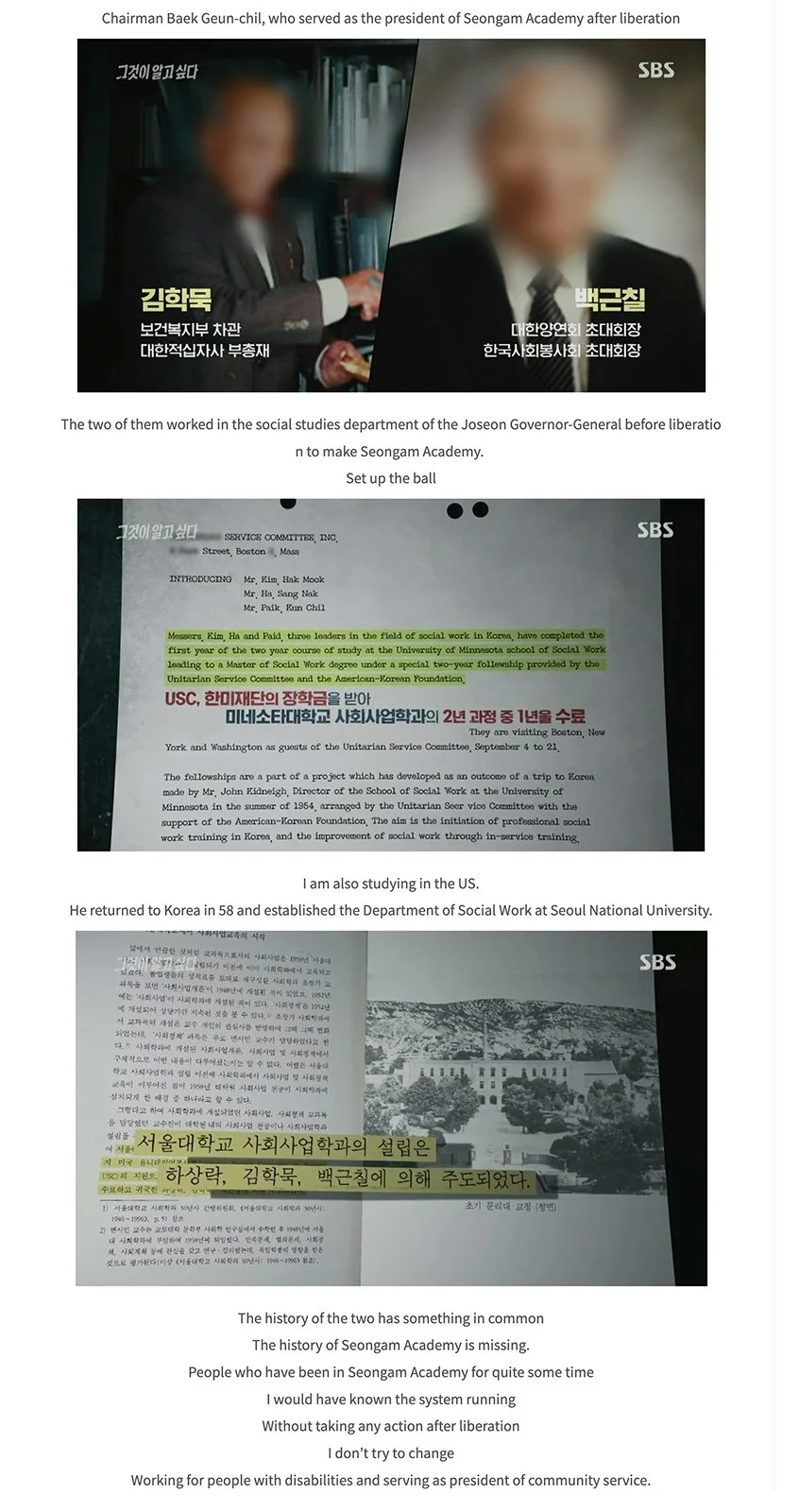
Trigger warning: Upsetting content. There is a documentary by SBS on Seongam Academy called 그것이 알고 싶다 (“I want to know about it”) on YouTube. Please note that this is extremely upsetting content.
Important Update: Please note that we do not know the exact nature of what Seongam Academy was like in the 1940s when KSS Founder Kun Chil Paik (alternately: Baek Geun-chil / Paik, Kun Chil / 백근칠), was Vice President and later President of Seongam Academy. We have recently learned that Seongam Academy may have been at its most notorious in the 1970s, which is decades after KSS Founder Baek Gun Chil was in charge of Seongam Academy. At this time we do not have any documentation to support this claim. When that becomes available, we will include it here.
Above are stills from the documentary, which show the (blurred) photo of KSS Founder Kun Chil Paik - Alternately: Baek Geun-chil / Paik, Kun Chil / 백근칠. You can see that the photo used in the SBS documentary is the same photo of Kun Chil Paik on his gravesite.
Under Construction.


KSS Founder Kun Chil Paik (alternately: Baek Geun-chil / Paik, Kun Chil / 백근칠), Kim Hak-mok, and Ha Sang-rak.
KSS Founder Kun Chil Paik (alternately: Baek Geun-chil / Paik, Kun Chil / 백근칠), Kim Hak-mok, and Ha Sang-rak.
All 3 of these men were Seoul National University (SNU) Social Work students who were invited to study at the University of Minnesota as part of the Minnesota Project. Prior to studying at the University of Minnesota, all three worked at the notorious (Trigger Warning: Very Upsetting content) Seongam Academy (선감학원).
Important Update: Please note that we do not know the exact nature of what Seongam Academy was like in the 1940s when KSS Founder Kun Chil Paik (alternately: Baek Geun-chil / Paik, Kun Chil / 백근칠), was Vice President and later President of Seongam Academy. We have recently learned that Seongam Academy may have been at its most notorious in the 1970s, which is decades after KSS Founder Baek Gun Chil was in charge of Seongam Academy. At this time we do not have any documentation to support this claim. When that becomes available, we will include it here.
All three became high ranking in the field of Social Work after returning to Korea following the Korean War. One established the graduate department of Social Work at Seoul National University; another became high ranking within the Korean Government (possibly the Ministry of Justice). Of course, Kun Chil Paik (alternately: Baek Geun-chil / Paik, Kun Chil / 백근칠) founded KSS in 1964.

Image source: From the “Midland Cooperator” - Minneapolis, Minnesota, September 5, 1955
”These three Koreans asked how cooperatives tell their story to former (?) employees. They saw publications of Midland Cooperator Inc. last week as part of a two-week study. The three are graduate students in social work at University of Minnesota.
Left to right: Kim, Hang Muk, a former newspaper reporter; Ha, Sang Nam, and Paik, Kun Chil. All are from Seoul.”

The Close Relationship of KSS Founder Kun Chil Paik (alternately: Baek Geun-chil / Paik, Kun Chil / 백근칠)to KSS “Feeder Orphanages”.
A Tight Network of KSS “Feeder Orphanages”.
KSS Founder Kun Chil Paik (alternately: Baek Geun-chil / Paik, Kun Chil / 백근칠) reportedly had a close relationship with its network of “Feeder Orphanages”. Not until the 1980s did KSS begin to work with Foster Mothers, at least, not according to KSS. According to a trusted source, KSS had the physical space to house children in “Feeder Orphanages” on its own prior to the 1980s and KSS’ Founder, Kun Chil Paik, preferred to rely on “Feeder Orphanages” rather than Foster Mothers to take care of children.

KSS Founder Kun Chil Paik (alternately: Baek Geun-chil / Paik, Kun Chil / 백근칠) at Choon Hyun Babies Home in Gwangju (Jeolla Province).
Caption reads: ”The opening ceremony of the Chunghyeon (Choon Hyun Babies Home) Children's Hospital in 1976. Jeollanam-do Governor Go-gun and Chairman Baek Geun-chil.” *We believe that Chairman Baek Geun-chil is pictured on the LEFT.
Read more about KSS’ Feeder Orphanage Choon Hyun Babies Home here.
Won S. Paik, KSS Founder Kun Chil Paik’s Son.
Won S. Paik, KSS Founder Kun Chil Paik’s Son.
We know very little about Won S. Paik, the son of KSS Founder Kun Chil Paik (alternately: Baek Geun-chil / Paik, Kun Chil / 백근칠). We know that Won S. Paik was Director of KSS at some point, but not the specific dates he was Director. We know that Won S. Paik is deceased and this his wife, Kun Chil Paik’s daughter-in-law, currently owns KSS. Kun Chil Paik’s daughter is rumored to live in the US.

Left: KSS Founder Kun Chil (alternately: Baek Geun-chil / Paik, Kun Chil / 백근칠)
Right: Kun Chil Paik’s son Won S. Paik.

Kun Chil Paik’s son Won S. Paik at center. This photo was taken at Won S. Paik’s mansion outside of Seoul. You can see that it is surrounded by lush grounds.
Mr. Young Hee KIM, KSS Director (1975 - 1994 or 1995?).
Below: Photos.
Photos of Mr. Young Hee KIM who was KSS Director from 1975 to around 1994 or 1995. Prior to his becoming Director of KSS in 1975, he was a Social Worker at KSS (we don’t know when he first began working there). He is now deceased.

