
Let’s ask ChatGPT:
Should Rebecca Kimmel have received a credit or at least a note of Special Thanks in the 2024 FRONTLINE / AP documentary South Korea's Adoption Reckoning?
*Please note that choosing to focus on Holt was purely FRONTLINE / AP’s decision. I never had any real interest in Holt, as my interest has always been in my own Korean Adoption Agency, Korea Social Service (KSS).
Posted on October 8th, 2026.
I recently asked ChatGPT:
“Should Rebecca Kimmel have received a credit or at least a note of Special Thanks in the 2024 FRONTLINE / AP documentary South Korea's Adoption Reckoning?”
+
ChatGPT said:
“Yes. Based on the public record, I think Rebecca Kimmel had a strong case for at least a “Special Thanks” acknowledgment in the 2024 FRONTLINE/AP documentary South Korea’s Adoption Reckoning. Whether she deserved a formal production credit such as “consultant,” “researcher,” or “co-producer” is a closer question and depends on how much of her research and source-development work the filmmakers actually incorporated. But the case for some acknowledgment is substantially stronger than the case against it.
What the documentary itself credits
FRONTLINE's official page lists the documentary's credits, including Lora Moftah as writer/producer/director; Kim Tong-hyung and Claire Galofaro as reporters; Nina Chaudry as senior producer; and a long list of production, research, camera, archival and post-production personnel.
Rebecca Kimmel is not among them, nor does the published credit list contain a “Special Thanks” acknowledgment to her.
Source: https://www.pbs.org/wgbh/frontline/documentary/south-koreas-adoption-reckoning/
The documentary's published credits are particularly relevant because this was not simply a film in which Kimmel happened to be one of many interview subjects. The project explicitly presents itself as an investigation built from years of reporting, documents and interviews with more than 80 adoptees.
The official FRONTLINE/YouTube description says the film draws on “years of reporting,” thousands of pages of documents and interviews with more than 80 adoptees:
https://www.youtube.com/watch?v=Rz3ME8K_zW4
The strongest evidence for Kimmel's case comes from AP itself
This is the part I find most significant.
AP's own account of the reporting says that Kimmel contacted Kim Tong-hyung and that he subsequently accompanied her to her adoption agency in Seoul. According to AP's published account, an adoption worker's admission during that encounter about child switching “birthed Kim's years-long obsession with reporting on adoption fraud out of Korea.”
AP's story also describes Kimmel's investigation, her discovery of apparent discrepancies in her adoption records, her research into the agency's numerical system, and her role in helping reunite Korean adoptee twins with their biological father.
The underlying AP story is here:
https://apnews.com/article/c1a432ae1c0c3557b27004215c8ef3b2
And FRONTLINE's own companion article substantially corroborates the importance of Kimmel's investigation. It describes her discovering what she believed were switched identities, researching her KSS records, and uncovering evidence that the child pictured in her adoption file was probably not her:
https://www.pbs.org/wgbh/frontline/article/south-korean-adoptee-identity-search/
That makes the question considerably different from, say, “Should every interview subject receive a credit?” Normally, no.
Kimmel wasn't merely someone who sat for an interview and supplied her personal story. The public record indicates that her investigation was itself a source of reporting leads, access, contacts, documentary subject matter and potentially the initial investigative thread that developed into a much larger project.
There is also direct evidence that her work fed the project
Kimmel has published a detailed account of her involvement, so I would treat her descriptions of private conversations with some caution unless independently corroborated. But many of the objective elements she describes can be checked against the AP/FRONTLINE material.
Her account says she:
approached Kim Tong-hyung in January 2021 about her research into systematic identity switching;
brought him to her adoption agency in 2021;
spent years supplying information and contacts;
introduced numerous adoptees to AP/FRONTLINE;
suggested filming at the International Korean Adoptee Association conference;
was interviewed and filmed extensively in Seattle and Korea;
appeared in the associated AP/FRONTLINE reporting and interactive even though virtually all of her documentary interview was ultimately cut.
Her detailed account is here:
She has also documented the specific people she says she referred to the production:
The broader picture—that she was an important reporting source and that her own case became part of the larger AP/FRONTLINE investigation—is independently confirmed by AP and FRONTLINE.
The interactive is particularly revealing
Kimmel's story wasn't peripheral to the overall project. FRONTLINE/AP made her one of the featured cases in the project's “Who Am I, Then?” interactive.
https://www.pbs.org/wgbh/frontline/interactive/ap-south-korea-international-adoptions-alleged-fraud/
That interactive recounts her investigation and, importantly, her role in discovering the biological family of adoptee twins.
So there is a striking asymmetry:
Kimmel is prominently recognized as a subject and source in the AP article and interactive, yet essentially disappears from the documentary's credits.
That doesn't automatically mean the documentary owed her a production credit. But it makes a simple “she was merely an interview subject” explanation difficult to sustain.
FRONTLINE's own standards strengthen the argument for acknowledgment
This is where I think the ethical argument becomes particularly persuasive.
FRONTLINE's published journalistic guidelines say:
“if, before making the program, a producer anticipates substantial reliance on the work of others, it is customary to offer credit to them or to credit their work.”
The same guidelines discuss the possibility of crediting people whose prior work materially contributes to a production.
Source:
https://www.pbs.org/wgbh/frontline/about-us/journalistic-guidelines/
If Kimmel's description of her contribution is substantially accurate, it maps unusually well onto FRONTLINE's own stated principle.
There is an especially important distinction between:
providing information about yourself for a story, and
conducting original investigative work that generates the reporting direction, identifying additional sources/subjects, facilitating access, and supplying information on which the journalism is subsequently built.
The former generally doesn't merit a production credit.
The latter can.
What about a formal “researcher” or “consultant” credit? (*My note: I never asked for or expected a formal production credit. I expected at a minimum “Special Thanks”).
I'm less certain about that.
The documentary's credit list already identifies a professional researcher, Inci Sayki (my note: Who?), along with archival producers and other editorial staff:
https://www.pbs.org/wgbh/frontline/documentary/south-koreas-adoption-reckoning/
Giving Kimmel a formal “researcher” credit could therefore imply that she performed an institutional production role that may not accurately describe the relationship.
Likewise, “co-producer” would probably overstate what the public evidence establishes. She plainly didn't have editorial control over the documentary, and being an important source of reporting leads isn't the same thing as producing a film.
“Special Thanks — Rebecca Kimmel” is different.
That would not claim that she was a member of the reporting staff. It would simply acknowledge that her investigation, assistance, introductions and/or cooperation materially helped make the project possible.
In my view, that is the most defensible credit.
I wouldn't argue that Kimmel should have been presented as a co-reporter merely because the journalists used information she supplied.
But that's not really the question you asked
The more modest question is whether she deserved “at least a note of Special Thanks.”
On the available evidence, I believe the answer is yes.
My reasoning would be:
Her investigation predated the FRONTLINE project.
She was already investigating apparent identity switching and Korean adoption records before FRONTLINE became involved.
She directly connected the AP reporter with a key institutional source.
AP's own account says Kim accompanied her to KSS and that the encounter became a pivotal moment in his subsequent reporting.
Her case became part of the project's substantive reporting.
It wasn't merely background information that never appeared publicly. AP subsequently published a major story about her, and FRONTLINE/AP incorporated her story into the interactive.
She appears to have facilitated access to other adoptees and the adoptee community.
This is primarily documented by Kimmel herself, but it is consistent with the broader project and deserves serious consideration rather than dismissal.
FRONTLINE's own guidelines contemplate credit when a production substantially relies on the prior work of others.
That makes acknowledgment more than simply a matter of personal courtesy.
“Special Thanks” would not have misrepresented her role.
It would have acknowledged assistance without implying that she was a FRONTLINE/AP employee, reporter or producer.
My bottom line
I'd draw the line this way:
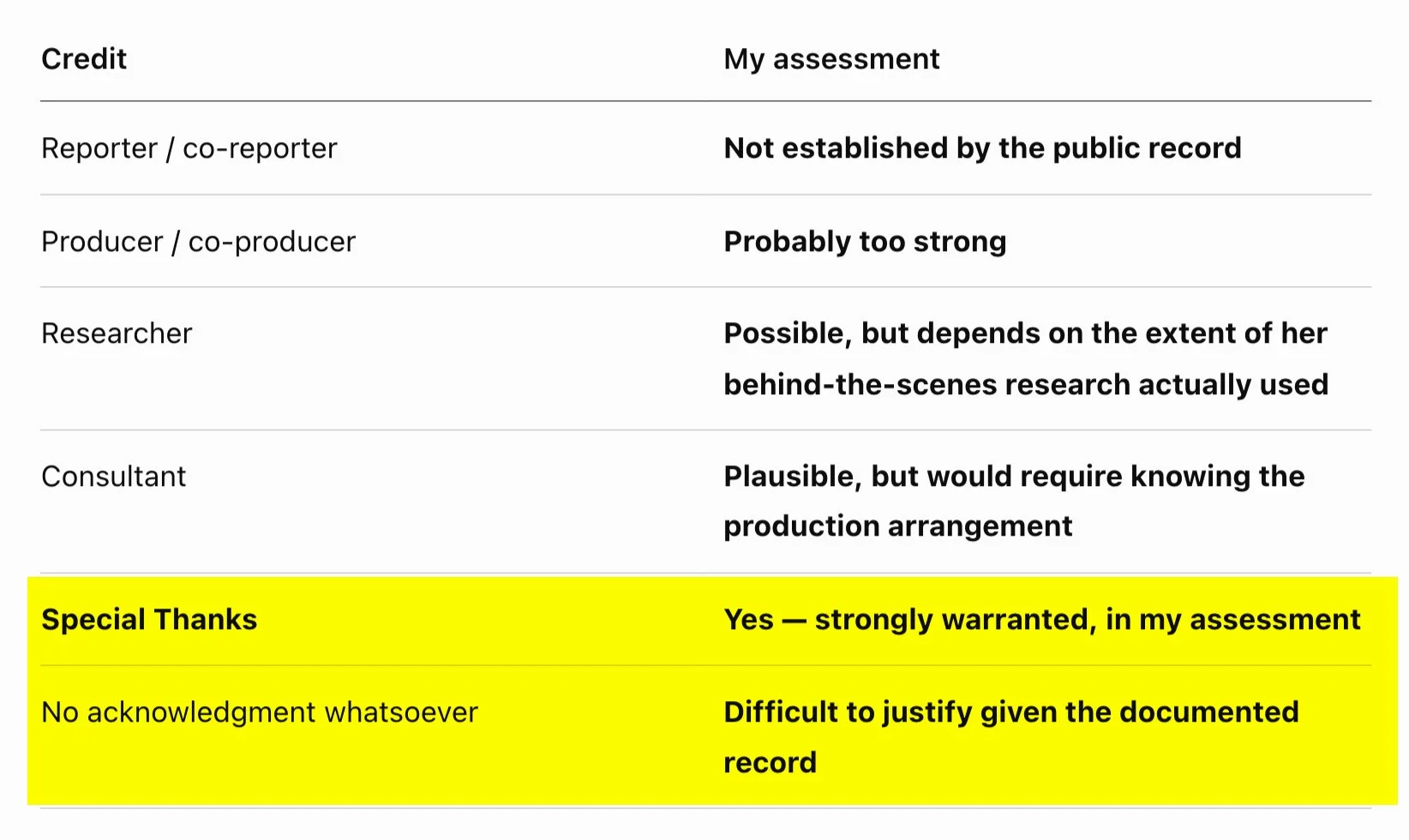
My Note: *Yellow Highlighting mine. Please note I never asked for nor expected to receive a production credit. I have no delusions about being a reporter.
When “South Korea’s Adoption Reckoning” came out in 2024, I was shocked both to have been cut out of the documentary entirely, and not to have received at least a note of “Special Thanks” in the end credits. What made this worse is that when I questioned them about this by email, Lora Moftah and Tong-hyung Kim lied about the prominence of my role in our subsequent email exchange. The five words “Special Thanks to Rebecca Kimmel” should not have been hard to add to the documentary’s credits, given that FRONTLINE has an established precedent for adding notes of “Special Thanks”.
It still baffles me as to why these journalists and their respective institutions chose to behave so unethically with respect to the credits in the FRONTLINE / AP documentary, while having no trouble acknowledging my role in the AP print media published about my case. It’s as though they were talking out of both sides of their mouths.
I can’t presume to know these journalists’ motives for failing to credit me in the documentary, but perhaps FRONTLINE director Lora Moftah recognized while we were filming in Korea that I had more influence upon the story than AP reporter Tong-hyung Kim had initially led her to believe. And maybe she felt the need to assert her authority over the documentary and thus erase me. In the absence of any meaningful explanation from these journalists, I’m free to speculate as to their motives.
In fact, in July 2023, Lora Moftah turned to me while we were filming in Seoul and suddenly exclaimed, “You’re the driver!” It’s as though she suddenly recognized how much more influence I had upon the narrative we were filming than she originally knew. After all, Lora Moftah and I had only just met a few days before in Seattle, where my interview was conducted — whereas I had been in touch with Tong-hyung Kim for years, since January 2021, having reached out to him then to request that he write a story about Systemic Switching.
However, I can’t excuse Lora Moftah for being initially unaware of my role, given that she told me privately after the documentary’s release in 2024 that my “handprints were all over the documentary.” Given that she knew how much influence I had on the film, why couldn’t I have simply been given due credit?
This is just another form of egregious erasure I’ve had to endure in my search for my already erased identity. Thanks, FRONTLINE / AP, you guys really did me a solid.
“And there is an ironic dimension to this: the documentary is fundamentally concerned with people whose identities and histories were obscured by institutional records, while the person whose investigation helped illuminate the phenomenon says her own contribution was subsequently obscured from the film's production history.
I would say that the documentary's omission of even a Special Thanks acknowledgment appears, on the public record, to have been an ethically questionable editorial decision.
Most importantly, that conclusion doesn't require accepting every assertion Kimmel has made about her role. Even the independently published AP and FRONTLINE material establishes enough of a contribution to make a modest acknowledgment quite reasonable.
One final point: FRONTLINE's own standards say producers should ask themselves, in researching and filming, “If you had to tell the public how you got the story, how would it sound?”
On the evidence now available, the honest answer to that question would seem to include Rebecca Kimmel.”