
NCRC Work Report Excerpt:
”Need to Improve the Preservation Environment for Adoption Records”
Posted to Paperslip on January 15th, 2026.
Originally posted in Korean on NCRC’s Korean Website on January 14th, 2026.
Thank you to a Paperslip Contributor for the link.
Translation via ChatGPT.

Image credit: Sisyphus in Ouroboros – The Philosopher's Shirt
+
Paperslip Note:
Essentially this little excerpt just confirms what we already knew — that NCRC (National Center for the Rights of the Child) has signed an MOU (Memorandum of Understanding) with the Seongam Branch of the National Archives to begin the SECOND transfer of ALL former Korean Adoption Agency files. This SECOND transfer could take place in the first half of 2026.
The FIRST transfer of ALL former Korean Adoption Agency files, which was initiated on July 19th, 2025 and which is probably far from being sorted out by NCRC’s tiny handful of workers assigned to this monumental task, was from the 4 major Korean Adoption Agencies to NCRC’s current temporary storage facility in Goyang, Gyeonggi-do.
This SECOND transfer being discussed is from NCRC’s current temporary storage facility in Goyang, Gyeonggi-do to the Seongam Branch of the National Archives. While on some levels this may be “good” news from the standpoint of (hopefully) better preservation of the former Korean Adoption Agencies’ files, on other levels, this likely 2026 transfer is just another setback for Adoptees who must endure more delays and uncertainty as regards the birth family search process in Korea.
Currently, the birth family search process in Korea must go through NCRC via the KAS (Korea Adoption Services) website. What the birth family search process looks like DURING and AFTER the likely second movement of files in 2026 from NCRC’s temporary storage facility in Goyang, Gyeonggi-do to the Seongam Branch of the National Archives remains to be seen. NCRC and the National Archives are housed under different Korean Government Ministries, and thus the future processes for birth family search has yet to be determined.
Unsurprisingly, the Korean Government has already denied the budget for this SECOND transfer of files. The eternal playbook of the Korean Government as regards adult Korean Adoptee issues is to propose something which sounds good on paper — and then to deny the budget to execute the plan.
(This eternal Sisyphean Uroboros of taking two steps forward and ten steps back as regards Korean Adoptee activism is why we so strongly recommend that Korean Adoptees with any interest in birth family search take ALL possible DNA tests post-haste. We don’t have forever, people).
In order for the thousands of former Korean Adoption Agency files to be moved from NCRC’s temporary storage facility in Goyang, Gyeonggi-do to the Seongam branch of the National Archives, these files must be treated for bugs / pests, per the higher records storage standards of the National Archives. Depending on the methodology of treatment, this process could take months or YEARS. However, since the Korean Government has conveniently failed to provide a budget for this process, no one really knows how this will all play out.
So while a Facebook apology by S. Korea’s current President to Adoptees might seem somewhat meaningful, it actually means nothing in the face of the Korean Government’s repeated failures to properly fund NCRC’s birth family search division or anything meaningful which might help adult overseas Adoptees.
As we have previously pointed out, this first and second transfer of ALL Korean Adoption Agency files — firstly to the Korean Public Institution NCRC and now potentially secondly to the National Archives — seems like awfully convenient literal moves to make in the midst of the likely upcoming TRC 3 investigation into overseas adoption.
As we have previously discussed, each transfer of these precious Korean Adoption Agency files — containing the information of around 250,000 Korean Adoptees — causes significant setbacks and delays to the birth family search processes of Adoptees, and risks of loss or damage to these precious and irreplaceable files. There are also unanswered questions regarding Adoptees’ access to the files once they are moved to the Seongam branch of the National Archives.
Finally, it’s important to note that while NCRC is housed under the Ministry of Health and Welfare (MOHW), the National Archives are housed under the Ministry of Interior and Safety (MOIS). This may complicate Adoptees’ access to their records. This remains to be seen.
+
Please see related Paperslip articles
(in descending chronological order):
Budget For File Transfer From Temporary Storage Facility To National Archives Denied - *Shocker*
Question Regarding Access to Adoption Files if Transferred by NCRC to the National Archives
"S. Korean Government to Relocate Adoption Records Archive Just 3 Months After Setup”
ALL Adoptees Start Here! General Birth Family Search Steps Through NCRC — Overview
Address and Contact Info For Important Locations Related To Birth Family Search Through NCRC
+
Original NCRC Korean Announcement:
“[Korea National Center for the Rights of the Child] Ministry of Health and Welfare Public & Affiliated Agencies Work Report Materials
Author: External Cooperation & Public Relations Team
Date: January 14, 2026
“Hello, this is the Korea National Center for the Rights of the Child. Regarding the Ministry of Health and Welfare public and affiliated agencies work report held on Wednesday, January 14, 2026, we are disclosing the work report materials of the Center as attached.
Thank you.
Attachment:
[Korea National Center for the Rights of the Child] Ministry of Health and Welfare Work Report Materials.pdf”
+
Note: The most relevant excerpt for Korean Adoptees is on the very bottom of the very last page (page 11) of the PDF linked above.
This excerpt concerns the likely 2026 (second) transfer of ALL former Korean Adoption Agency files from their current location at NCRC’s Temporary Storage Location in Goyang, Gyeonggi-do to the Seongam Branch of the National Archives.
Our ChatGPT translation is below. Bolds and red highlighting ours.
“Need to Improve the Preservation Environment for Adoption Records (Demin, Newstapa)
ㅇ (Key Details)
Concerns were raised regarding the preservation environment of the temporary repository at the Korea National Center for the Rights of the Child when storing and managing adoption records.
When the management responsibility for original adoption records was transferred from adoption agencies to the Center, a temporary repository was established to store the records. However, issues with the preservation environment were pointed out by adoptees, the standing committee, and the media.
Examples of issues: inappropriate sprinkler system, inadequate facilities for persons with disabilities, reduced accessibility.
ㅇ (Improvement Plan)
Strengthen preservation and management of adoption records by entrusting them to the National Archives (specialized preservation facility).
Implement entrusted preservation at the Seongnam branch of the National Archives* to ensure safe and systematic management of adoption records. This establishes a national-level professional management system, improves the preservation system for adoptees’ records, and secures personnel and budget to enhance adoptees’ right to know.
MOU signed (Oct. 2025), advisory meetings with preservation experts held (Dec. 2025 onward), entrusted preservation at the National Archives planned (early 2026)”
+
Below: Our ChatGPT translation of the entire NCRC report.
*Please note that the majority of this report is far less relevant for adult Korean Adoptees.
Some Bolds and red highlighting of information relevant to adult Korean Adoptees ours.
“Business Report of the Korea National Center for the Rights of the Child
January 2026
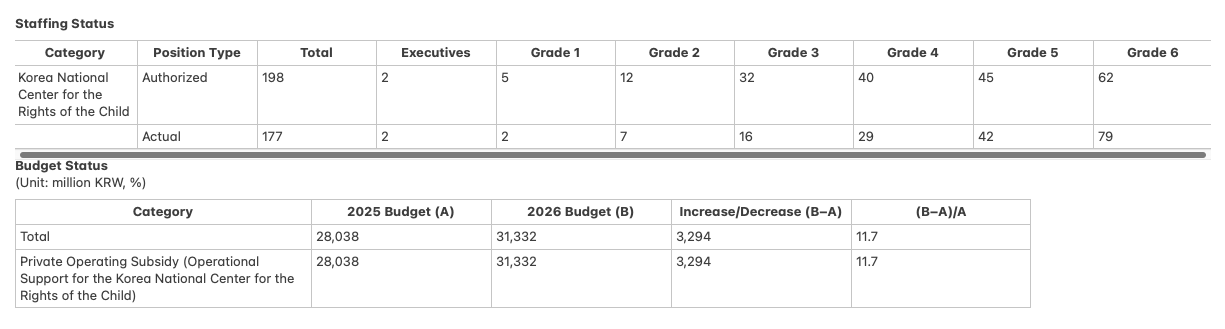
Organization and Structure Status
(5 Headquarters, 12 Departments, 2 Teams)
2025 Key Performance Outcomes
□ (Operation of the Public Adoption System)
Following the full restructuring (July 2025) to a system in which the state assumes responsibility for carrying out adoptions, efforts were made to support stable operation of the system.
ㅇ (Information Disclosure Requests)
Improved convenience by centralizing the application and issuance of adoption-related documents previously handled by individual adoption agencies, and standardized 업무 through the development and distribution of an information-disclosure request manual.
Adoption Information Disclosure Request Form; Certificate of Adoption Confirmation; Certificate of Eligibility for DNA Testing for Adoptees with No Known Relatives
ㅇ (Support for Adoptees)
Provided employment linkage for adoptees and their families (3 individuals), housing in adoptees’ preferred regions, and established a foundation for collaboration with local governments.
□ (Strengthening the Child Protection System)
Supported the determination and implementation of the most appropriate protective measures for children under protection.
ㅇ (Expansion of Tailored Parenting Support)
Strengthened caregiving capacity by expanding the provision of a parenting coaching program (12 sessions) for high-risk grandparent-led foster families (3 locations, 90 families in 2025).
ㅇ (Enhanced Communication)
Addressed on-site challenges by gathering feedback through meetings with policy stakeholders (policy participation groups of foster children and parents, the National Association of Foster Care Support Centers, etc.).
Including inspections and improvements of foster parent conditions, issuance of Foster Care Verification Certificates via Government24, and granting foster parents limited legal guardian authority.
ㅇ (Public Guardianship Support)
Expanded public guardianship support projects for children under protection without parents or guardians (from Gyeonggi to Seoul and Incheon); published and distributed the Manual on Minor Guardianship for Children under Protection (September 2025); and conducted practical training for guardianship support (December 2025).
ㅇ (Capacity Building of Professional Staff)
Strengthened the expertise of child protection officers by supporting training programs for local government child protection specialists, holding on-site meetings to enhance communication and respond to complex cases, and revising the 2025 Child Protection Service Operations Manual.
ㅇ (Support for Crisis Pregnancy and Protected Birth)
Through proactive promotion to ensure stable system operation, the cumulative number of counseling cases increased (901 in 2024 → 2,923 as of December 2025).
Expanded cooperation with private-sector resources, including MOUs with companies (Hanjin Express, Starbucks) to support family-of-origin caregiving.
□ (Prevention of Child Abuse)
Supported the implementation of policies for preventing child abuse and protecting victimized children.
ㅇ (Strengthening the Child Abuse Response System)
Expanded inter-agency communication (with the National Police Agency) to strengthen responses to serious child abuse cases; held meetings between central and local governments to prevent similar incidents and to identify improvement measures.
Revised guidelines to improve consistency in child abuse–related death cases; developed procedural guidelines for responding to death cases.
ㅇ (Support for Victimized Children)
Completed designation of 17 metropolitan-level specialized medical institutions for child abuse; strengthened prevention of blind spots and psychological support functions by expanding on-site communication through case seminars and meetings.
ㅇ (Improvements in Abuse Prevention)
Improved parenting awareness through the provision of positive-parenting practice content; enhanced compliance with recommended standards for media reporting related to abuse, including reduced use of family suicide-related expressions (103 cases in 2024 → 132 cases in 2025).
□ (Childcare and Independence Support)
Provided stable childcare services and strengthened independence support for youth formerly under protection.
ㅇ (Strengthening Community Childcare Service Systems)
Addressed care gaps through surveys of demand for extended nighttime care and promoted customized services based on user characteristics.
Increased user participation by conducting satisfaction surveys on multilingual translation support and providing promotional videos for children from multicultural families, who account for 23.4% of all service users (as of 2023).
ㅇ (Independence Support)
Improved case management manuals for youth preparing for independence and enhanced financial education content, laying the foundation for service quality improvement and standardization.
ㅇ (Strengthening Preventive Measures)
Shared case management for children providing family care through operation of Dream Start councils (four meetings in April/September 2025); published and distributed a best-practice casebook (December 2025).
ㅇ (Child Asset-Building Support)
As the number of participating children, sponsors, and donations continued to grow, work efficiency was improved through the introduction of a new donation management service (October 2025), thereby strengthening the donation management system.
□ (Promotion of Children’s Rights)
Supported policy participation by children as rights-holders and fostered a sustainable environment for guaranteeing children’s rights.
ㅇ (Activation of Child Participation, etc.)
Expanded opportunities for child participation by linking internal and external participation activities, including the operation of child participation bodies (up 7.1% year-on-year); established channels for hearing children’s participation experiences and opinions, as well as feedback mechanisms, through the introduction of the first Participation Case-Sharing Forum.
ㅇ (Advocacy for Children’s Rights)
Held an AI-based children’s rights promotion idea contest; built and operated a nationwide platform mapping children’s events and play information through cooperation with companies (453 cases, including T Map); and systematically supported international children’s rights convention engagement by monitoring implementation of the UN Convention on the Rights of the Child.
Areas for Improvement
ㅇ During the initial phase of implementing the public adoption system, on-site confusion and waiting times in operating the information disclosure request system occurred, indicating the need to strengthen operational foundations to ensure early stabilization of the system.
→ (Response Measures) Establish a stable operational framework by analyzing issues and making swift adjustments through regular consultations with relevant agencies and ministries, adoptee organizations, and experts, and by strengthening practical support such as revising manuals.
Future Work Direction
□ Enhancing the Effectiveness of Public Adoption System Operations
ㅇ (Strengthening Operation of the Information Disclosure Request System)
Improve efficiency by centralizing adoption information disclosure request processes, thereby supporting the right to know of domestic and international adoptees.
Establish a foundation for permanent and systematic preservation of adoption records through entrusted preservation and management by the National Archives.
ㅇ (Public Awareness and Education on Adoption)
Support the activation of domestic adoption based on the principle of the best interests of the child through multifaceted promotion of the restructured public adoption system and by identifying and fostering high-quality prospective adoptive parents.
□ Strengthening Support for a Safe Protection System for Children under Protection
ㅇ (Foster Care System)
Continuously strengthen the discovery of foster families, enhancement of caregiving capacity, and public awareness to promote family-based care.
Expand parenting coaching programs for high-risk grandparent-led foster families: (2025) 3 sites → (2026) 6 sites.
ㅇ (Support for Crisis Pregnant Women and Children)
Enhance counselor professionalism and strengthen the operational capacity of regional counseling institutions to ensure stable operation of the system introduced in 2024.
ㅇ (Strengthening Public Guardianship Support)
Alleviate gaps in guardianship for children under protection by expanding public guardianship programs to more regions and promote related systems to improve public awareness of guardianship.
ㅇ (Strengthening Capacity of the Child Protection System)
Support and enhance training programs (basic and refresher courses) for child protection officers to improve management of complex cases involving children under protection.
□ Childcare and Independence Support for Healthy Child Development
ㅇ (Community Childcare Services)
Address after-school care gaps and provide stable childcare services by strengthening the operational capacity of community childcare facilities; operate extended nighttime childcare programs (from 2026 onward).
ㅇ (Dream Start Program)
Improve customized case management services in response to the expansion of integrated services for vulnerable children, and provide dedicated case management support for children providing family care (from 2026 onward).
ㅇ (Independence Support for Youth)
Promote meaningful independence by improving standardized independence-support programs and strengthening the identification and linkage of external resources for youth preparing for independence.
ㅇ (Asset-Building and Financial Management Support)
Support systematic asset-building and financial capacity development for children from vulnerable groups, and expand donor participation to establish a sustainable economic foundation for post-independence self-reliance.
□ Establishing a Sustainable Child Abuse Response System
ㅇ (Support for Institutional Improvements)
Promote the introduction of a system for analyzing child abuse–related death cases and establish a practical operational framework.
ㅇ (Support for Victimized Children)
Strengthen family-centered, customized case management and expand recovery support systems to enable rapid recovery of abused children and reinforce comprehensive prevention of re-abuse.
ㅇ (Promotion of Abuse Prevention)
Provide diverse promotional content to foster a culture of positive parenting, and strengthen cooperation with child and media organizations to expand adherence to recommended standards for media reporting on child abuse.
□ Creating a Social Environment that Respects Children and Promotes Children’s Rights
ㅇ (Activation of Child Participation)
Strengthen operation of child participation bodies and expand participation opportunities to develop child-related policies that reflect the views of children themselves.
ㅇ (Advocacy for Children’s Rights)
Enhance protection of children’s rights in digital environments through monitoring of children’s human rights in online broadcasting.
Support for Stabilizing the State-Responsibility Adoption System
(National Policy Task No. 87-3)
□ Establishing a Child-Centered Public Adoption System and Enhancing Integrated Service Quality
ㅇ Establish a stable operational framework covering the entire adoption process—from application to post-adoption management—and build on-site communication and training systems to enhance the professionalism of adoption practitioners.
ㅇ Promote nationwide, participatory public awareness campaigns and diversified media outreach to foster a positive adoption culture.
ㅇ Strengthen the identification and training of prospective adoptive parents by expanding and newly introducing education programs that reflect demand for training on the Special Act on Domestic Adoption and the International Adoption Act.
Basic education for prospective adoptive parents under the Special Act on Domestic Adoption (11 hours): in-person lectures, 23 sessions (twice monthly)
/ Basic education for prospective adoptive parents under the International Adoption Act (10 hours): in-person lectures, 6 sessions
□ Ensuring Safe Preservation of Adoption Records and Smooth Provision of Information Disclosure Services
ㅇ As adoption records transferred from existing adoption agencies require secure preservation, establish a cooperative framework with the National Archives, including entrusted record storage.
MOU concluded (Oct. 2025); entrusted storage with the National Archives 추진 planned for the first half of 2026; ongoing cooperation such as consultations to be maintained.
ㅇ With the transfer of adoption records placing responsibility for information disclosure services for adoptees on the public sector, pursue measures such as workforce expansion, legal and institutional improvements, and process enhancements to ensure smooth service provision.
Strengthening State Responsibility for Child Protection
(National Policy Task No. 87-3)
□ Enhancing Support for the Foster Care System to Promote Family-Based Care
ㅇ Support legislative measures and institutional improvements to nationalize the foster care program, and collect opinions from experts, practitioners, and foster parents regarding system improvements.
Strengthen centralized public awareness efforts by delivering tailored promotional messages that reflect the characteristics of actual foster parents and by utilizing diverse media channels (card news, social media, YouTube Shorts, etc.).
ㅇ Expand parenting coaching programs for high-risk grandparent-led foster families and distribute related manuals.
Expansion to 6 sites, including the Gyeongsang, Chungcheong, and Jeolla regions.
□ Expanding Public Guardianship Support for Children under Protection without Parents or Guardians
ㅇ (Program Expansion)
Expand the program to additional regions (2025: Seoul, Gyeonggi, Incheon → 2026: two additional metropolitan/provincial governments), and operate legal procedural support through linkage with legal aid organizations related to public guardianship.
Includes acting on and supporting legal procedures such as filing court petitions related to guardianship duties of the Center, and supporting activities of public guardians and guardianship supervisors.
ㅇ (Education and Public Awareness)
Refine training courses for the development of public guardians and promote nationwide public awareness campaigns through diverse channels to improve understanding and perception of public guardianship.
□ Strengthening Cooperation within the Child Protection System to Improve Service Quality
ㅇ Promote regional joint workshops and on-site meetings to strengthen communication and cooperation among child protection–related institutions*.
Cities, counties, and districts (child protection, abuse response, Dream Start); independence support agencies; foster care support centers; child protection specialized agencies; child-rearing facilities, etc.
□ Support for Crisis Pregnant Women and Protected Birth to Safeguard the Right to Life
ㅇ Strengthen targeted promotion using everyday-life media and reinforce public–private collaborative publicity; operate and manage a central-level mobile counseling channel, “Crisis Pregnancy Counseling 1308.”
Advertising at daily-life contact points; search advertising on major portal sites
Strengthening the Child Abuse Response System
(National Policy Task No. 87-3)
□ Support for Introducing a Child Abuse–Related Death Analysis System
ㅇ Support for revising subordinate laws, establishing retrospective and prospective analysis procedures, operating a 24-hour death reporting system, and collecting domestic and international data.
Draft amendment to the Child Welfare Act passed the Legislation and Judiciary Committee (Dec. 2025).
□ Strengthening Family Recovery Support for Abused Children
ㅇ Gradually expand home-visit, family recovery support programs to prevent re-abuse in households and improve operational quality through performance analysis.
(2024) 81 sites, 2,459 families → (2025) 86 sites, 2,561 families → (2026) 90 sites, 2,680 families
Strengthening Childcare and Independence Support
(National Policy Task No. 87-4)
□ Strengthening Support for the Dream Start Program
ㅇ Include children providing family care as new Dream Start case management targets, linking support for medical and caregiving services for ill parents.
ㅇ Conduct research on case management tailored to the characteristics of different Dream Start target groups, including family-care children, and disseminate results in service sites.
□ Strengthening Independence Support Programs for Children Before Leaving Care
ㅇ Research to improve standardized independence-support programs for children under care (from 2026), and diversify operational models of specialized programs for extended-care children (centralized and local-led).
□ Establishing a Resource Discovery and Linkage System for Youth Preparing for Independence
ㅇ Operate a twice-yearly employment-activation council for youth preparing for independence; support connections with private and public institutions for financial planning and career guidance (education, employment).
□ Supporting Asset-Building and Financial Management for Vulnerable Children
ㅇ Strengthen cooperative frameworks with related institutions, improve donation management services, and expand promotion and recruitment of new donors as the number of participating children, sponsors, and donations grows.
ㅇ Launch new child asset-management support projects in line with the enforcement of the amended Child Welfare Act (April 2026):
Develop asset management guidelines and manuals
Provide asset-management consulting* and enhanced financial education
Track asset-management performance
*Mandatory education and consulting required at specific times (e.g., at enrollment, at maturity/withdrawal, ages 17–23).
□ Strengthening Workforce Capacity and Improving Collaborative Systems
ㅇ Enhance staff training throughout the year, including assessment tools for evaluating risks to the safety and health of youth preparing for independence and training on case management manuals.
ㅇ Operate annual workshops for dedicated independence-support personnel to prevent burnout and strengthen support networks.
Safety and Disaster Management
ㅇ (Strengthening Safety Management)
Continuously fulfill and improve obligations under the safety and health system, including obtaining certification for the Occupational Health and Safety Management System and conducting early risk assessments.
ㅇ (Creating a Safe Work Environment)
Support a healthy and safe workplace for employees through initiatives such as new “Health-Friendly Company” certifications and customized worker safety training.
ㅇ (Strengthening Information Security)
Enhance cyber crisis response capabilities and improve information system infrastructure through administrative and technical security control checks and disaster recovery drills.
ㅇ (Personal Information Management)
Establish management systems reflecting personal information-related laws and guidelines, and create a secure environment for personal data protection.
Regional Economic Revitalization and Win-Win Efforts
ㅇ (Community Engagement)
Actively promote community co-prosperity initiatives using the institution’s operations to fulfill public social responsibility.
ㅇ (Collaboration with Partner Companies)
Strengthen cooperation and promote win-win relationships with partner companies, including mandatory review of priority purchase companies.
ㅇ (Ensuring Fairness in Contracts)
Continue efforts to establish and maintain a fair economic order.
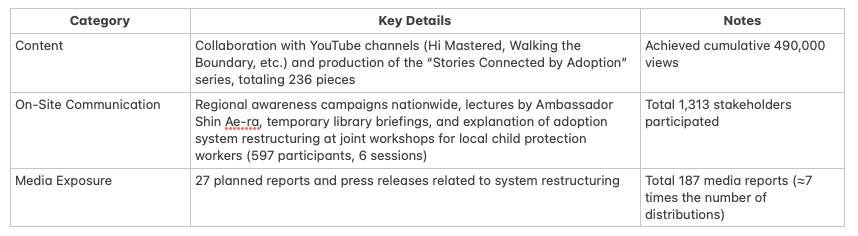
Efforts for Public Communication
ㅇ Deliver the latest policies in an easy and approachable manner*, and strengthen two-way communication to expand policy information and enhance public awareness and perception (Public Communication Index ↑73.3% compared to 2024).
ㅇ Establish a proactive media promotion system based on policies and a preemptive, active response framework for emerging issues.
*Focused policy promotion for the public restructuring of the adoption system (July 2025)
ㅇ (Strengthening Customer Satisfaction Management)
Regularly monitor customer satisfaction through surveys, apply feedback to individual programs, and practice customer-centric management by enhancing public communication and information provision.
Need to Improve the Preservation Environment for Adoption Records (Demin, Newstapa)
ㅇ (Key Details)
Concerns were raised regarding the preservation environment of the temporary repository at the Korea National Center for the Rights of the Child when storing and managing adoption records.
When the management responsibility for original adoption records was transferred from adoption agencies to the Center, a temporary repository was established to store the records. However, issues with the preservation environment were pointed out by adoptees, the standing committee, and the media.
Examples of issues: inappropriate sprinkler system, inadequate facilities for persons with disabilities, reduced accessibility.
ㅇ (Improvement Plan)
Strengthen preservation and management of adoption records by entrusting them to the National Archives (specialized preservation facility).
Implement entrusted preservation at the Seongnam branch of the National Archives* to ensure safe and systematic management of adoption records. This establishes a national-level professional management system, improves the preservation system for adoptees’ records, and secures personnel and budget to enhance adoptees’ right to know.
MOU signed (Oct. 2025), advisory meetings with preservation experts held (Dec. 2025 onward), entrusted preservation at the National Archives planned (early 2026)”