
MAIN TRC 3 INFO PAGE:
+
UPDATE:
The TRC 3 Bill Passes In The National Assembly With 168 Votes.
TRC 3 Is Expected To Begin February 26th, 2026.
There will likely be a 2 year submission period, but submissions will not likely be open right away.
You do not need to submit your case to TRC 3 through any intermediary group!
You should be able to submit your case online through the TRC website, or in person through a Korean consulate in your Western home country. We will post more info. as it becomes available.
Please see:
Taking Care Of Your Mental Health During TRC 3
The TRC 3 bill passed in the National Assembly in S. Korea with 168 votes at the U.S. equivalent time of about 10:30 pm PST / 1:30 pm EST on Wednesday, January 28th, 2026 in the US (which is Thursday, January 29th, 2026 in S. Korea).
View the relevant bill here.
Download the PDF of the TRC 3 bill (KOREAN)here.
Download Our UNOFFICIAL ChatGPT ENGLISH Translation of the TRC 3 bill here.
View a COMPLETE ChatGPT English translation of the TRC 3 bill at the bottom of this page.
+
Read an excellent synopsis of the TRC 3 bill’s passage here:
Amendment to South Korea’s Framework Act for the Settlement of Past History Clears the Way for a Third Truth and Reconciliation Commission
+
Below: The Final Votes In S. Korea’s National Assembly Which Passed The TRC 3 Bill.
Screenshots from:
The riveting National Assembly voting session on YouTube.
You can also watch the VOD on the National Assembly website here.
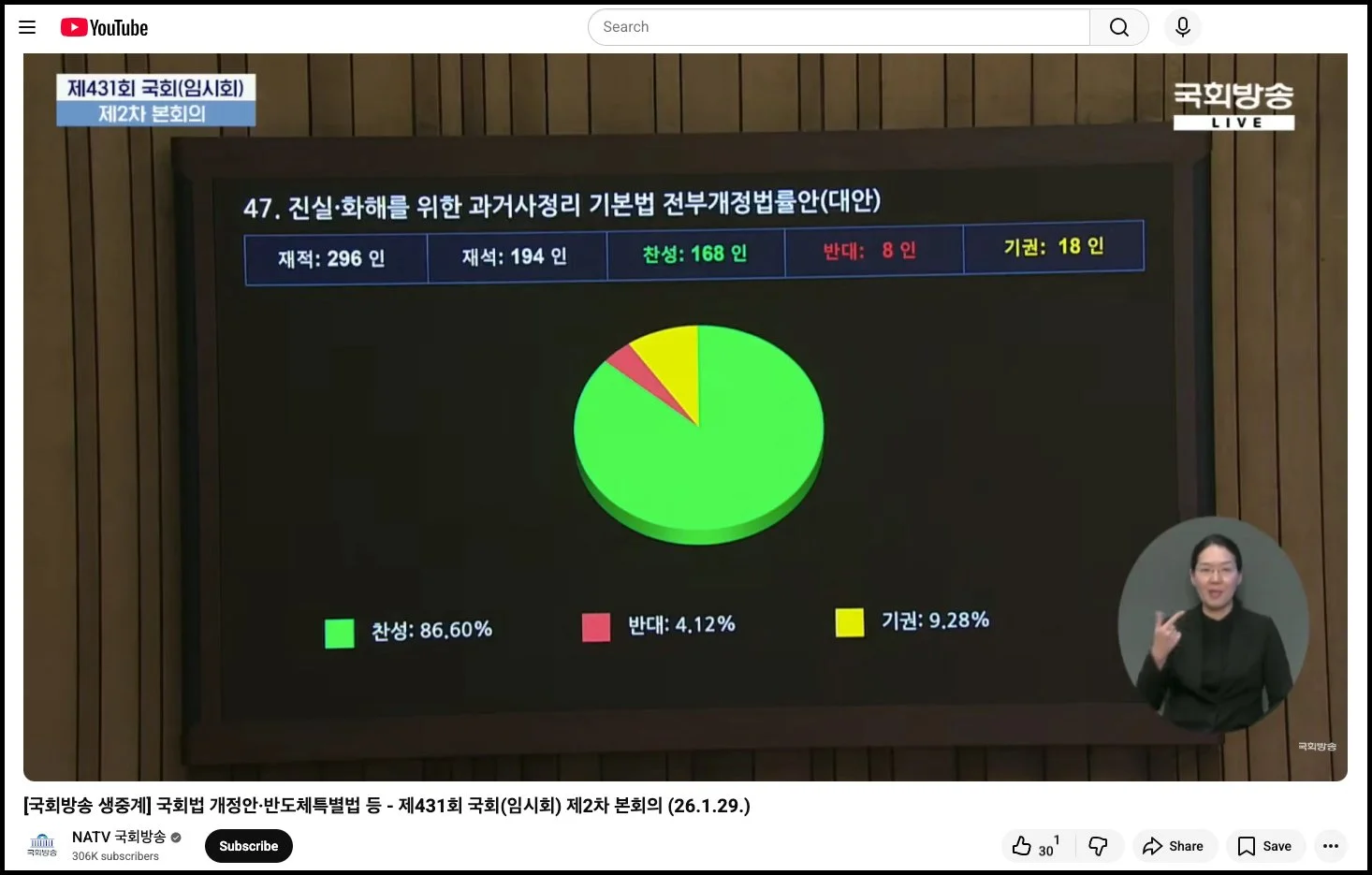
Above — The final vote of 168 in favor passes the TRC 3 Bill in the National Assembly.
(Bill) 47. Full Amendment to the Framework Act on Clearing Up Past Incidents for Truth and Reconciliation (Alternative Bill)
National Assembly Broadcasting
LIVE
Total Members: 296
Present: 194
In Favor: 168
Opposed: 8
Abstained: 18
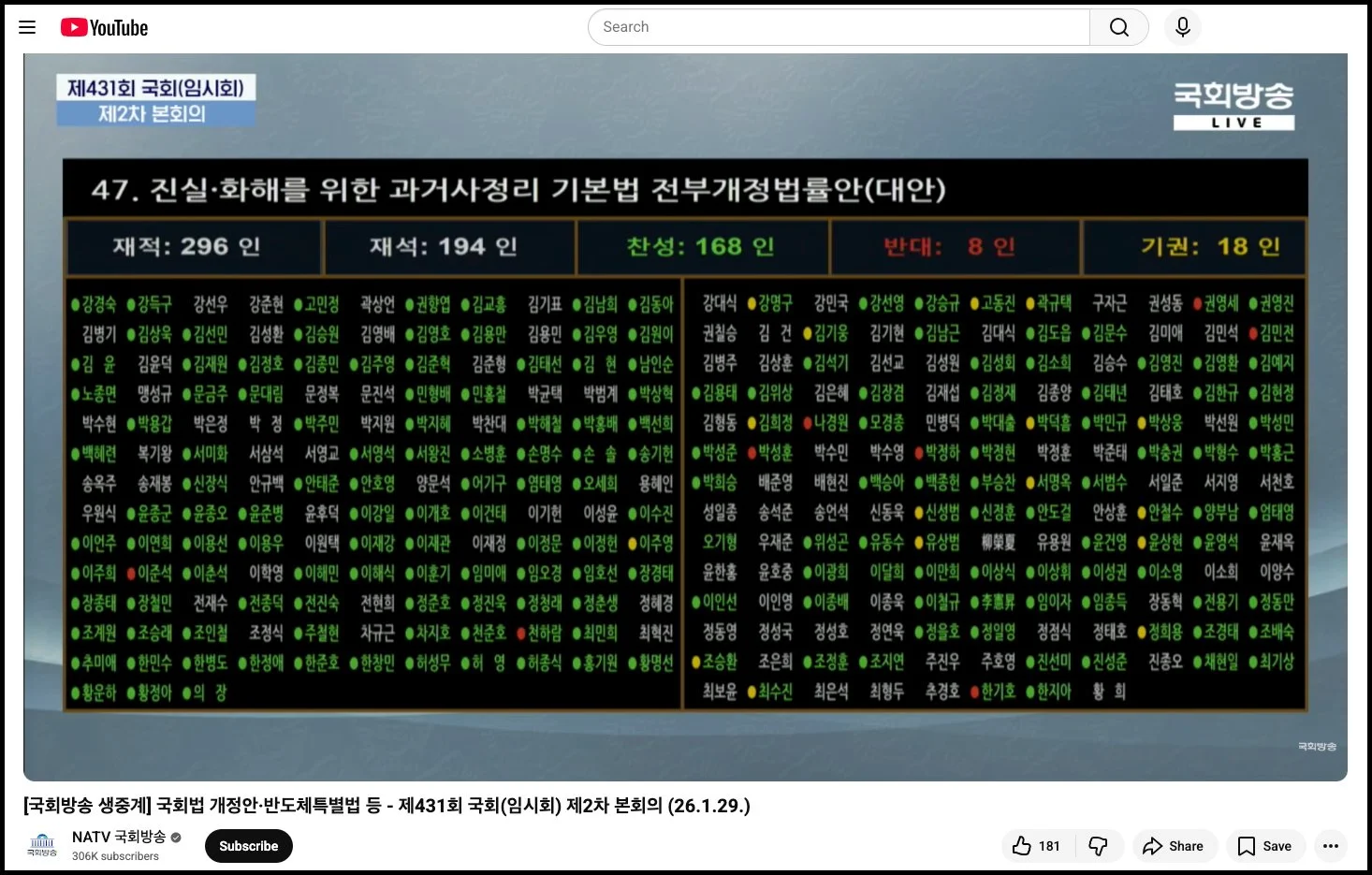
Above — The final vote of 168 in favor passes the TRC 3 Bill in the National Assembly.
(Bill) 47. Full Amendment to the Framework Act on Clearing Up Past Incidents for Truth and Reconciliation (Alternative Bill)
National Assembly Broadcasting
LIVE
Total Members: 296
Present: 194
In Favor: 168
Opposed: 8
Abstained: 18
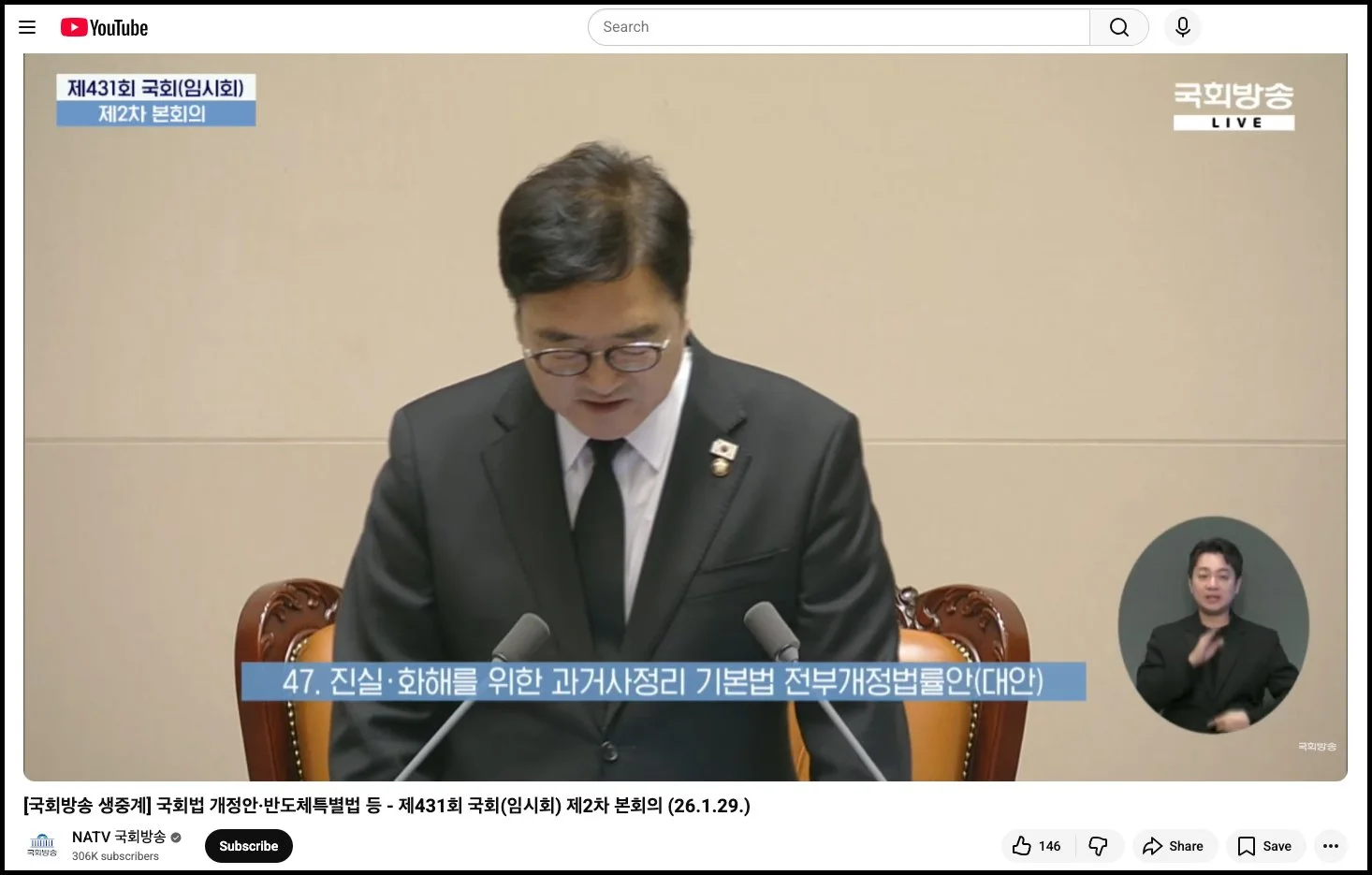
Above — S. Korean National Assembly Speaker Woo Won-shik oversees the voting at the National Assembly.
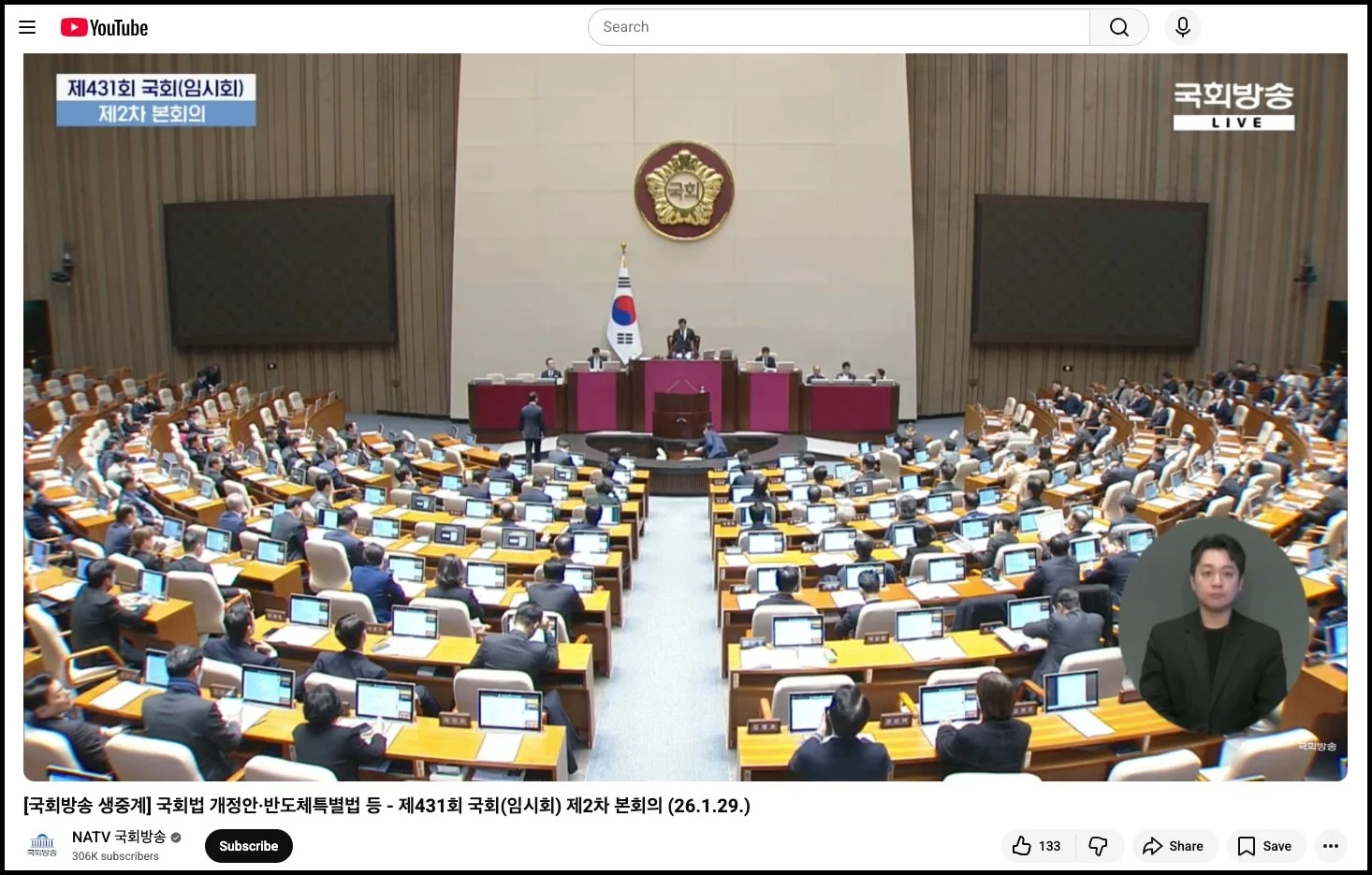
Above — The National Assembly Plenary Session.
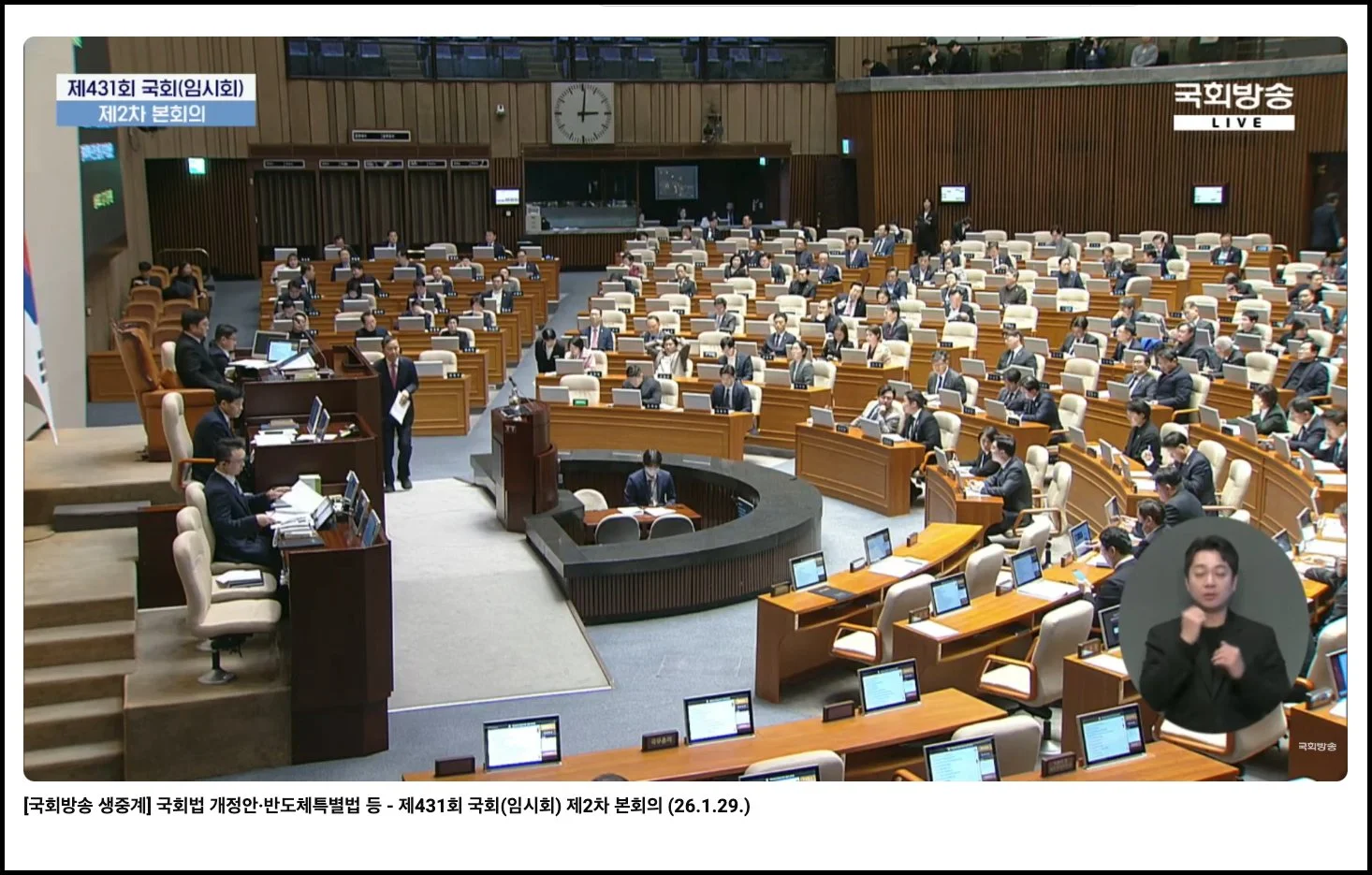
Above — The National Assembly Plenary Session.
+
Before the TRC 3 Bill Passed In S. Korea’s National Assembly, we wrote:
The Third TRC (TRC 3) Bill Will Be Introduced As The 47th Agenda Item At S. Korea’s National Assembly Plenary Session At 2:00 P.M. Thursday (KST).
(Which is Wednesday, January 28th at 9 pm PST / Midnight EST).
According to a Paperslip Contributor, the DP (Democratic Party) had the votes to pass the bill by itself, and many opposition (PPP) members were absent.
+
It will likely be determined today in Korea if the Third Truth and Reconciliation Commission (TRC 3) will commence in S. Korea in 2026.
Posted to Paperslip on Wednesday, January 28th, 2026 at 9:10 pm PST / 12:10 am EST.
Translation via ChatGPT.
Thank you to a Paperslip Contributor for the link.
You can watch the livestream of the National Assembly proceedings on YouTube here.
"[National Assembly Broadcasting Live] Amendment to the National Assembly Act, Special Semiconductor Act, etc. – 431st National Assembly (Extraordinary Session) 2nd Plenary Meeting (Jan. 29, 2026)"
+
Paperslip Note:
According to another Paperslip contributor, it’s a positive sign that both parties — the Democratic Party and the more conservative PPP — agreed to include the item on the agenda, suggesting it may have a good chance of passing.
+
*See the BOLDED item below, which is the TRC 3 bill.
“Agenda for the 2nd Plenary Session of the 431st (Extraordinary) Session:
The 431st National Assembly (Extraordinary Session), 2nd Plenary Session — Thursday, January 29, 2026, 2:00 p.m.
Motion to Decide the Session Period for the 431st National Assembly (Extraordinary Session)
Partial Amendment to the National Assembly Act (Alternative Bill)
Partial Amendment to the Military Court Act (Original Bill; Proposed by Rep. Choo Mi-ae)
Partial Amendment to the Attorney-at-Law Act (Alternative Bill)
Partial Amendment to the Act on the Establishment of Organizations for Persons of National Merit, etc. (Revised; Proposed by Rep. Kang Jun-hyeon)
Partial Amendment to the Act on Honorable Treatment of Persons of Merit for the May 18 Democratization Movement and the Establishment of Related Organizations (Alternative Bill)
Partial Amendment to the Act on Support for Patients with Agent Orange Aftereffects and the Establishment of Related Organizations (Alternative Bill)
Partial Amendment to the Act on Honorable Treatment and Support for Persons of National Merit, etc. (Alternative Bill)
Partial Amendment to the Act on Honorable Treatment of Independence Patriots (Alternative Bill)
Partial Amendment to the Act on Support for Veterans Eligible for Compensation (Alternative Bill)
Partial Amendment to the Act on Honorable Treatment of Veterans and the Establishment of Related Organizations (Alternative Bill)
Partial Amendment to the Act on Honorable Treatment of Persons of Special Missions and the Establishment of Related Organizations (Alternative Bill)
Partial Amendment to the Act on Support for Discharged Soldiers (Alternative Bill)
Partial Amendment to the Framework Act on Administrative Regulations (Revised; Proposed by Rep. Kang Jun-hyeon)
Partial Amendment to the Fair Transactions in Subcontracting Act (Alternative Bill)
Partial Amendment to the Act on Reporting and Use of Certain Financial Transaction Information, etc. (Alternative Bill)
Partial Amendment to the Act on Restriction of Special Cases Concerning State Property (Original Bill; Proposed by Rep. Kang Sun-young)
Partial Amendment to the National Finance Act (Alternative Bill)
Partial Amendment to the State Property Act (Alternative Bill)
Partial Amendment to the Export-Import Bank of Korea Act (Revised; Proposed by Rep. Jin Sung-joon)
Partial Amendment to the Act on Private Participation in Infrastructure (Revised; Proposed by Rep. Park Sung-hoon)
Partial Amendment to the National Treasury Act (Revised; Proposed by Rep. Kim Sang-hoon)
Partial Amendment to the Higher Education Act (Alternative Bill)
Partial Amendment to the Act on Fostering Local Universities and Balanced Regional Talent (Alternative Bill)
Partial Amendment to the School Health Act (Alternative Bill)
Partial Amendment to the Special Act on Student Loan Repayment After Employment (Alternative Bill)
Partial Amendment to the Act on the Establishment of National University Hospitals (Alternative Bill)
Partial Amendment to the Act on the Establishment of National University Dental Hospitals (Alternative Bill)
Partial Amendment to the Special Act on the Improvement of Teachers’ Status and Protection of Educational Activities (Revised; Proposed by Rep. Jung Sung-kook)
Partial Amendment to the Korea Teachers’ Credit Union Act (Revised; Proposed by Rep. Kim Yong-tae)
Partial Amendment to the School Meals Act (Alternative Bill)
Partial Amendment to the Framework Act on Science and Technology (Alternative Bill)
Partial Amendment to the Act on the Establishment of Safe Laboratory Environments (Alternative Bill)
Partial Amendment to the Act on the Innovation of National Research and Development (Alternative Bill)
Partial Amendment to the Nuclear Safety Act (Revised; Proposed by Rep. Choi Soo-jin)
Partial Amendment to the Special Act on the Promotion of Research and Development Special Zones (Original Bill; Proposed by Rep. Kim Sung-won)
Partial Amendment to the Act on the Establishment and Operation of the Broadcasting, Media and Communications Commission (Alternative Bill)
Partial Amendment to the Framework Act on Broadcasting and Communications Development (Original Bill; Submitted by the Government)
Partial Amendment to the Passport Act (Original Bill; Proposed by Rep. Kim Ki-woong)
Partial Amendment to the Act on Fact-Finding and Honor Restoration for Victims Abducted During the Korean War (Revised; Proposed by Rep. Kim Geon)
Partial Amendment to the Military Civilian Personnel Management Act (Original Bill; Submitted by the Government)
Partial Amendment to the Special Act on Payment of Retirement Benefits to Soldiers Retired Before December 31, 1959 (Revised; Proposed by Rep. Lim Jong-deuk)
Partial Amendment to the Special Act on Promotion of Soldiers Killed or Died in the Line of Duty (Original Bill; Proposed by Rep. Sung Il-jong)
Partial Amendment to the Military Service Act (Alternative Bill)
Partial Amendment to the Act on Public Holidays (Alternative Bill)
Partial Amendment to the Assembly and Demonstration Act (Alternative Bill)
Full Amendment to the Framework Act on Clearing Up Past Incidents for Truth and Reconciliation (Alternative Bill)
Partial Amendment to the Act on the Safety Management of Children’s Play Facilities (Alternative Bill)
Partial Amendment to the Special Act on Guaranteeing the Rights of Victims of the October 29 Itaewon Disaster, Fact-Finding, and Prevention of Recurrence (Revised; Proposed by Rep. Lee Hae-sik)
Partial Amendment to the Act on the Activation of Data-Based Administration (Alternative Bill)
Partial Amendment to the E-Government Act (Alternative Bill)
Partial Amendment to the Public Officials’ Disaster Compensation Act (Alternative Bill)
Partial Amendment to the Local Tax Collection Act (Alternative Bill)
Partial Amendment to the Framework Act on Local Taxes (Alternative Bill)
Partial Amendment to the Local Finance Act (Revised; Proposed by Rep. Mo Kyung-jong)
Partial Amendment to the Act on the Collection of Local Administrative Sanctions and Penalties, etc. (Original Bill; Submitted by the Government)
Partial Amendment to the Police Officers Act (Alternative Bill)
Partial Amendment to the Act on the Prevention of Fires and Safety Management (Original Bill; Proposed by Rep. Seo Bum-soo)
Partial Amendment to the Act on the Establishment and Operation of the National Fire Hospital (Revised; Proposed by Rep. Lim Ho-seon)
Partial Amendment to the Performance Act (Alternative Bill)
Partial Amendment to the National Sports Promotion Act (Alternative Bill)
Partial Amendment to the Copyright Act (Alternative Bill)
Partial Amendment to the Act on the Preservation and Utilization of Cultural Heritage (Original Bill; Proposed by Rep. Kim Seung-soo)
Partial Amendment to the Act on the Preservation and Utilization of Modern and Contemporary Cultural Heritage (Alternative Bill)
Partial Amendment to the Farmland Act (Alternative Bill)
Partial Amendment to the Act on Distribution and Price Stabilization of Agricultural and Fishery Products (Alternative Bill)
Partial Amendment to the Rural Development Act (Revised; Proposed by Rep. Jung Hee-yong)
Partial Amendment to the Act on Research, Development, and Promotion of Healing Agriculture (Revised; Proposed by Rep. Kim Sun-kyo)
Partial Amendment to the Mountainous Districts Management Act (Revised; Proposed by Rep. Kim Sun-kyo)
Special Act on Support for and Post-Use of the 2028 Ulsan International Garden Expo (Revised; Proposed by Reps. Kim Ki-hyun, Kim Tae-sun, and Yoon Jong-oh)
Partial Amendment to the Act on the Promotion and Management of Forestry Technology (Original Bill; Proposed by Rep. Lee Man-hee)
Partial Amendment to the Act on the Promotion of Forest Education (Original Bill; Proposed by Rep. Park Sung-hoon)
Partial Amendment to the Port Act (Revised; Proposed by Rep. Kim Sun-kyo)
Partial Amendment to the Marine Environment Management Act (Revised; Proposed by Rep. Cho Kyung-tae)
Special Act on Strengthening the Competitiveness of and Supporting the Semiconductor Industry (Alternative Bill)
Partial Amendment to the Act on the Promotion of Cooperative Win-Win Growth Between Large Enterprises and SMEs (Alternative Bill)
Partial Amendment to the Act on the Promotion of Saving and Recycling of Resources (Original Bill; Proposed by Rep. Kim Tae-sun)
Partial Amendment to the Asbestos Safety Management Act (Revised; Proposed by Rep. Park Hae-cheol)
Partial Amendment to the Waste Management Act (Revised; Proposed by Rep. Kim So-hee)
Partial Amendment to the Water Environment Conservation Act (Alternative Bill)
Partial Amendment to the Act on Equal Employment for Men and Women and Support for Work–Family Balance (Alternative Bill)
Partial Amendment to the Employment Insurance Act (Alternative Bill)
Partial Amendment to the Wage Claim Guarantee Act (Alternative Bill)
Partial Amendment to the Industrial Accident Compensation Insurance Act (Alternative Bill)
Partial Amendment to the Occupational Safety and Health Act (Alternative Bill)
Partial Amendment to the Passenger Transport Service Act (Alternative Bill)
Partial Amendment to the Automobile Management Act (Alternative Bill)
Partial Amendment to the Parking Lot Act (Alternative Bill)
Partial Amendment to the Construction Machinery Management Act (Alternative Bill)
Partial Amendment to the Special Act on the Safety and Maintenance of Facilities (Alternative Bill)
Partial Amendment to the Act on the Development of the Living Logistics Service Industry (Revised; Proposed by Rep. Kwon Young-jin)
Partial Amendment to the Certified Real Estate Agents Act (Revised; Proposed by Reps. Kwon Young-jin and Bok Ki-wang)”
The TRC 3 Bill:
"Bill for the Complete Revision of the Framework Act on the Investigation of Past Events for Truth and Reconciliation (Alternative Draft)".
Download the PDF of the TRC 3 bill here.
Download Our UNOFFICIAL ChatGPT ENGLISH Translation of the TRC 3 bill here.
Posted to Paperslip on January 29th, 2026.
+
We have translated the relevant TRC 3 bill which was passed by the S. Korean National Assembly on Thursday, January 29th, 2026 (KST) via ChatGPT below.
Please note that we have included a screenshot of our ChatGPT translation of the upper portion of the TRC 3 bill, to preserve the graphic table structure.
In some places, we have highlighted in red portions which specifically mention “adoption”.
Please click the link above for a link to the original Korean bill.
Please see the original link for PDF hyperlinks. Some BOLDS ours.
+
“Draft Act for the Complete Revision of the Framework Act on the Investigation of Past Affairs for Truth and Reconciliation (Alternative)
Bill Number: 14875
1. Background of the Proposal
Date of Proposal: December 2025
Proposer: Chairperson of the Committee on Public Administration and Security”
”Basic Information
Legislative Basic Information
Provision of information on proposal details, bill text, reasons for proposal, and main contents
Proposal Information
Chair of the Public Administration and Security Committee, Bill No. 2214875 (Dec. 4, 2025).
The 429th National Assembly (Regular Session)
Bill Text
Attached file: Bill Text (.hwp) – Download
Attached file: Bill Text (PDF) – Download
View directly: View bill text – Opens in a new window
Reasons for Proposal and Main Contents
Reason for Proposing the Alternative Bill
Following the enforcement of the Framework Act on the Settlement of Past Affairs for Truth and Reconciliation (hereinafter, the “Past Affairs Settlement Act”) on December 10, 2020, the second-term Truth and Reconciliation Commission (hereinafter, the “Commission”) was launched. Its investigation period expired on May 26, 2025. Accordingly, on November 18, 2025, the Commission announced a comprehensive report summarizing the truth-finding activities of its second term, and liquidation procedures of the Commission are scheduled to proceed until February 26, 2026.
During its second term, the Commission conducted ex officio investigations into various types of past incidents, including the participation of Zainichi Korean student volunteer soldiers in the Korean War; issued truth-finding decisions on concealed human rights violation cases such as the Seongam Academy in Gyeonggi Province and the Yeonghwaseok and Jaesaengwon facilities in Busan, which housed vagrants; promoted projects to excavate the remains of civilian victims before and after the Korean War; and reflected international norms, such as the Universal Declaration of Human Rights, in its recommendations.
However, due to the expiration of the investigation period, as many as 2,111 cases were suspended without completion. In addition, investigation requests have been made by victims who did not previously apply in cases such as the Busan Brothers Home and Deokseongwon incidents. As a result, concerns have been raised that a third-term Commission must be formed as soon as possible.
Furthermore, the current law lacks provisions on compensation and reparations, meaning that victims can seek relief only through individual lawsuits even after truth-finding decisions are made. This creates difficulties in achieving prompt recovery for victims and survivors. In some cases, state liability is denied due to the completion of statutes of limitation. Accordingly, opinions have been expressed that amendments to the Past Affairs Settlement Act are necessary to establish remedies.
Therefore, this bill seeks to comprehensively revise the Past Affairs Settlement Act by incorporating provisions to: launch the third-term Commission on February 26, 2025, the liquidation deadline of the second-term Commission, to ensure continuity; strengthen the investigative authority of the third-term Commission by introducing provisions for requesting seizure and search warrants, filing complaints, and requesting investigations; establish a legal basis for enacting a separate law to set standards for compensation or reparations for damages; and provide special provisions excluding the statute of limitations for claims for damages arising from truth-finding decisions.
Main Contents of the Alternative Bill
a. The scope of truth-finding by the Commission is expanded to include human rights violation cases that occurred in social welfare facilities, adoption agencies, and collective detention facilities operated by private entities that were directly operated, or supported, managed, or supervised by the state or local governments (Article 2).
b. Three Commission members are to be nominated by the President, and a total of ten members are to be elected by the National Assembly: one nominated by the Speaker of the National Assembly, four from negotiating parties affiliated with the President, four from other negotiating parties, and one from non-negotiating parties. In addition, provisions are established as grounds for impeachment proceedings against the Chairperson by the National Assembly (Article 5(2) and Article 8(5)).
c. The rights of victims and bereaved families are explicitly stipulated in the process of truth-finding, and deliberative public forums are to be established to collect opinions from victims and others concerned (Articles 3 and 18).
d. The application period for truth-finding is set at two years from the date this Act enters into force, with the possibility of extension by resolution of the Commission if necessary. The investigation period is set at three years from the date of the decision to commence an investigation, with up to two extensions of no more than one year each (Articles 22 and 35).
e. The requirements for initiating ex officio investigations by the Commission are eased, and when serious human rights violation cases are discovered during investigations even if no application for truth-finding has been submitted, the Commission is authorized to investigate ex officio and determine the truth (Article 25).
f. The Commission is guaranteed the authority to request the filing of applications for seizure and search warrants, to file complaints, and to request investigations. Institutions requested by the Commission to submit materials are prohibited from refusing submission on the grounds of laws such as the National Intelligence Service Act (Articles 46, 47, and Article 26(9)).
g. Standards for compensation or reparations for damages suffered by victims, survivors, and bereaved families in cases subject to truth-finding decisions are to be established through a separate law. The objective statute of limitations for claims for damages arising from truth-finding decisions is excluded. In addition, for persons who received truth-finding decisions before the enforcement of this Act and whose subjective statute of limitations has already expired, claims for damages may be exercised within three years from the enforcement date of this Act (Articles 50 and 61, and Addendum Article 5).
h. This Act shall enter into force on February 26, 2026. However, for certain provisions requiring a preparation period, such as amendments to enforcement decrees, the effective date shall be six months after promulgation. The newly established Commission shall be authorized to succeed to the investigation-suspended cases of the second-term Commission and decide to commence truth-finding investigations (Addendum Article 1 and Addendum Article 7).”
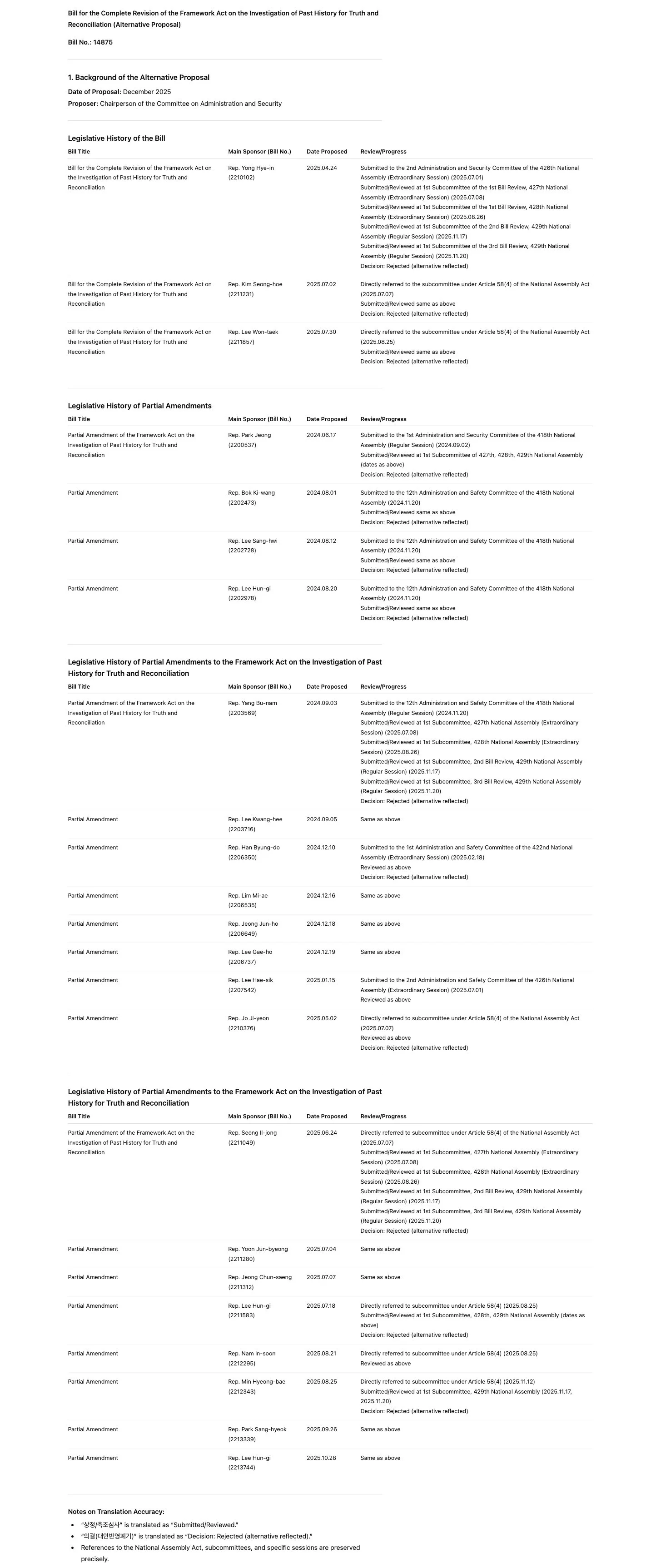
“The 1st Subcommittee on Bill Review, 3rd Session, 429th National Assembly (Regular Session) (2025.11.20), after reviewing the 23 above-mentioned bills together, decided to consolidate and coordinate them in order to prepare an alternative draft for our committee.
The 16th Committee on Administration and Security, 429th National Assembly (Regular Session) (2025.11.27), resolved that, for the 23 bills reviewed and reported by the 1st Subcommittee on Bill Review, none would be submitted individually to the plenary session, and that the alternative prepared by the subcommittee would be proposed as the committee’s draft.
2. Reason for Proposing the Alternative Draft
Following the enforcement of the Framework Act on the Investigation of Past Events for Truth and Reconciliation (“Past Events Investigation Act”) on December 10, 2020, the 2nd Truth and Reconciliation Commission (hereinafter, “the Commission”) was launched. Its investigation period ended on May 26, 2025, and the Commission released a comprehensive report summarizing its truth-seeking activities on November 18, 2025, with the dissolution process scheduled to be completed by February 26, 2026.
During the 2nd Commission’s operational period, the following achievements were made:
Conducted ex officio investigations into various historical incidents, such as the participation of Korean students in Japan’s volunteer army during the Korean War.
Issued truth-finding decisions regarding concealed human rights violations, including the Seongam Academy case in Gyeonggi Province and the Yeonghwa-suk & Jaesaengwon facilities for homeless people in Busan.
Advanced recovery of civilian remains from before and after the Korean War.
Reflected international norms, such as the Universal Declaration of Human Rights, in its recommendations.
However, the expiration of the investigation period left 2,111 cases suspended, and there are continuing requests for investigation from victims not previously applied for, such as the Busan Brothers Home and Deokseongwon cases, highlighting the need for the prompt establishment of a 3rd Commission.
Furthermore, the current law lacks provisions for compensation or restitution, meaning that relief for victims can only be sought through individual lawsuits after truth-finding decisions, creating difficulties in providing timely recovery for victims and survivors. There are also cases where state liability is denied due to the statute of limitations. Therefore, there is a need to amend the Past Events Investigation Act to establish proper measures for relief.
Accordingly, the alternative draft aims to:
Launch the 3rd Commission by February 26, 2025, the dissolution deadline of the 2nd Commission, to ensure continuity.
Strengthen investigative authority for the 3rd Commission, including provisions for requesting search and seizure warrants, filing complaints, and requesting investigations.
Provide a legal basis for establishing standards for compensation or restitution for victims in separate legislation.
Include special provisions exempting the statute of limitations for claims for damages arising from truth-finding decisions.
In sum, the alternative draft seeks a complete revision of the Past Events Investigation Act to reflect these measures.
3. Key Contents of the Alternative Draft
a. Expand the Commission’s truth-finding scope to include human rights violations that occurred in social welfare institutions, adoption agencies, and collective detention facilities that were directly operated or supported, managed, or supervised by the state or local governments (Draft Article 2).
b. The President shall appoint three members of the Commission, and the National Assembly shall elect a total of 10 members, including: one nominated by the Speaker, four from the President’s affiliated negotiating parties, four from other negotiating parties, and one from non-negotiating parties. Establish a legal basis for the National Assembly to impeach the Chairperson (Draft Article 5(2) and Article 8(5)).
c. Specify the rights of victims and bereaved families in the truth-finding process, and provide for a deliberative public forum to collect their opinions (Draft Articles 3 and 18).
d. Set the application period for truth-finding requests to two years from the enforcement date of the Act, with the possibility of extension by Commission resolution. Set the investigation period at three years from the decision to start the investigation, with the option to extend twice, each for up to one year (Draft Articles 22 and 35).
e. Relax the conditions for initiating ex officio investigations, and allow the Commission to investigate ex officio any serious human rights violations discovered during investigations, even if no truth-finding request has been submitted (Draft Article 25).
f. Guarantee the Commission’s authority to request search and seizure warrants, file complaints, and request investigations, and stipulate that institutions cannot refuse to submit requested materials citing laws such as the National Intelligence Service Act (Draft Articles 46, 47, and Article 26(9)).
g. Require that standards for compensation or restitution for victims, survivors, and bereaved families of cases receiving truth-finding decisions be established in separate legislation. Exclude the statute of limitations for claims for damages arising from truth-finding decisions, and allow individuals whose subjective statute of limitations had expired before the enforcement of this Act to exercise their right to claim damages within three years from the enforcement date (Draft Articles 50, 61, and Supplementary Provision 5).
h. Set the enforcement date of this Act to February 26, 2026, while certain provisions requiring preparation, such as amendments to enforcement ordinances, will take effect six months after promulgation. Allow the newly established Commission to inherit suspended cases from the 2nd Commission and make decisions to initiate truth-finding investigations (Draft Supplementary Provisions 1 and 7).
Law No.: [To be assigned]
Bill for the Complete Revision of the Framework Act on the Investigation of Past Events for Truth and Reconciliation
Chapter 1: General Provisions
Article 1 (Purpose)
This Act aims to investigate human rights violations, violence, massacres, and suspicious deaths caused by anti-democratic or anti-humanitarian acts, as well as actions during the anti-Japanese independence movement, in order to clarify distorted or concealed truths, prevent recurrence, establish the legitimacy of the nation, restore the honor of victims, survivors, and their families, and promote national unity and democratic development through reconciliation with the past.
Article 2 (Scope of Truth-Finding)
① The Truth and Reconciliation Commission on Past Events (hereinafter “the Commission”) established under Article 4 shall determine the truth concerning the following matters:
Anti-Japanese independence movements conducted during or immediately before the Japanese colonial period.
Overseas Korean activities conducted to protect Korea’s sovereignty and strengthen national power from the Japanese colonial period until the enforcement date of this Act (Law No. 7542).
Illegal acts against civilians, including collective deaths, murders, injuries, disappearances, torture, and unlawful detention, from August 15, 1945, to the period before and after the Korean War.
Deaths, injuries, disappearances, torture, detention, or other serious human rights violations caused by unlawful or grossly improper exercise of public authority, including acts undermining the constitutional order, from August 15, 1945, until the establishment of the National Human Rights Commission.
Terrorism, human rights violations, violence, massacres, or suspicious deaths committed by forces denying the legitimacy of the Republic of Korea or hostile to it, from August 15, 1945, to the period of authoritarian rule.
Human rights violations occurring in social welfare institutions, adoption agencies, or collective detention facilities directly operated by the state or local governments, or those operated by private institutions supported, managed, or supervised by the state or local governments, from August 15, 1945, until the establishment of the National Human Rights Commission.
Historically significant cases that the Commission deems necessary to investigate in order to achieve the purposes of this Act.
② Cases that have already received a final judgment in court are excluded from the scope of truth-finding. However, if the Commission, by resolution, determines that the case meets the grounds for retrial under the Civil Procedure Act or the Criminal Procedure Act, and truth-finding is necessary, an exception applies.
Article 3 (Rights of Victims, etc.)
① Victims and bereaved families have the right to submit their opinions during the truth-finding process concerning the cases listed in Article 2(1).
② The State shall guarantee these rights and make efforts to ensure that victims and families do not suffer additional psychological distress during the truth-finding process.
Article 4 (Establishment and Independence of the Truth and Reconciliation Commission)
① To perform the duties prescribed in this Act, the Truth and Reconciliation Commission on Past Events (hereinafter “the Commission”) is established.
② The Commission shall perform the following duties:
Selection of investigation targets and decisions to initiate investigations.
Conduct of investigations.
Decisions on truth-finding based on investigation results, and decisions of inability to determine the truth.
Recovery of remains and memorial activities for victims related to investigation cases.
Research activities to prepare reconciliation measures.
Matters regarding the preparation and correction of family registers under Article 52.
Other duties deemed necessary by the Commission.
③ The Commission shall independently perform the duties within its authority.
Chapter 2: Composition and Operation of the Commission
Article 5 (Composition of the Commission)
① The Commission shall consist of 13 members, including 4 full-time members.
② Members shall be appointed by the President as follows: 3 nominated by the President and 10 elected by the National Assembly (1 recommended by the Speaker, 4 recommended by the negotiating parties the President belongs to or belonged to, 4 recommended by other negotiating parties, and 1 recommended by a non-negotiating party). Members must meet one of the following criteria:
Persons who have served 10 or more years as a full-time professor or higher at an accredited university.
Persons who have served 10 or more years as a judge, prosecutor, military legal officer, or lawyer.
Persons who have served 10 or more years as a Grade 3 or higher public official, or belong to the Senior Civil Service.
Clergy or persons engaged in historical verification, archival compilation, or related research for 10 or more years.
Persons recognized as having expertise and experience necessary for truth-finding under Article 2(1).
③ Among the members under paragraph 2, full-time members include: 2 nominated by the President, 1 recommended by the negotiating party the President belongs or belonged to, and 1 recommended by other negotiating parties.
④ The Chairperson shall be appointed by the President from among the full-time members.
⑤ The Chairperson and full-time members are considered political appointees.
Article 6 (Term of Office of Chairperson and Members)
① The term of office of the Chairperson and members shall be 2 years, and they may be reappointed. However, if the investigation period under Article 35 expires, the term of members shall also expire 6 months after that expiration date.
② When a member’s term expires or a vacancy occurs during the term, a successor must be elected or nominated within 30 days, and the President shall immediately appoint the successor.
③ The term of office for a member appointed as a successor begins anew.
Article 7 (Formation of Subcommittees)
① The Commission may establish subcommittees to carry out part of its work, such as truth-finding.
② Matters regarding the composition, duties, and operation of subcommittees shall be determined by the rules of the Commission.
Article 8 (Duties of the Chairperson)
① The Chairperson represents the Commission and oversees its work.
② If the Chairperson is unable to perform duties for unavoidable reasons, a full-time member previously designated by the Chairperson shall act on their behalf.
③ The Chairperson may recommend the submission of proposals to the President concerning matters under their jurisdiction.
④ In performing duties related to the Commission’s budget, the Chairperson shall be regarded as the head of a central government agency under Article 6 of the National Finance Act.
⑤ The National Assembly may vote to impeach the Chairperson if they violate the Constitution or laws while performing duties.
Article 9 (Independence and Status Guarantee of Members)
① Members shall perform their duties independently, without any external instruction or interference.
② Members shall not be dismissed against their will, except in the following cases:
When physical or mental disability makes it impossible to perform duties.
When sentenced to imprisonment or higher and the sentence is finalized.
③ In the case of paragraph 2(1), the President shall dismiss the member upon recommendation by the Chairperson and resolution of two-thirds of the total members.
Article 10 (Disqualification and Grounds for Duty Exclusion)
① The following persons may not serve as members:
Non-citizens of the Republic of Korea.
Persons falling under any category of Article 33 of the State Public Officials Act.
Members of political parties.
Persons registered as candidates (including preliminary candidates) in elections under the Public Official Election Act.
Persons dismissed following an impeachment decision.
② If a member falls under any category in paragraph 1, they shall automatically retire.
Article 11 (Prohibition of Concurrent Positions, etc.)
① Members shall not hold or perform any of the following positions while serving on the Commission:
[The specific prohibited positions were not included in the provided text.]
1. Members shall not concurrently hold or perform any of the following positions while serving on the Commission:
Member of the National Assembly or a local council.
Public official of another national agency or local government (excluding educational officials).
Other positions or duties as specified by the rules of the Commission.
② Members may not join a political party or engage in political activities.
Article 12 (Recusal, Disqualification, and Avoidance of Members)
① A member shall be recused from deliberation or decision-making in the following cases:
The member, or their current or former spouse, is a perpetrator or victim in a Commission truth-finding case.
The member has a kinship relationship with a perpetrator or victim in a Commission truth-finding case under Article 777 of the Civil Code.
The member has been involved in investigation or trial of a Commission truth-finding case.
The member has testified or provided expert opinion regarding a Commission truth-finding case.
The member has acted, or is acting, as an agent or representative of a party in a Commission truth-finding case.
② Applicants or subjects of truth-finding cases may request the recusal of a member if circumstances make it difficult to expect fairness in deliberation or decision-making.
③ A member may voluntarily recuse themselves if they believe any situation in paragraph 1 or 2 applies to them.
Article 13 (Quorum and Voting in Meetings)
Meetings of the Commission and subcommittees are presided over by the respective chairperson, and unless otherwise specified, decisions are made by a majority of members present.
Article 14 (Public Nature of Deliberations)
① Deliberations of the Commission shall be public. However, if the Commission or a subcommittee deems it necessary, deliberations may be held in private.
② Public deliberation under paragraph 1 may include disclosure of minutes, public attendance, broadcast, or internet streaming.
③ Even if deliberations are not public under paragraph 1, meeting minutes must be disclosed, including reasons for non-disclosure and other matters specified in the Commission’s rules.
Article 15 (Meeting Minutes)
① The Commission shall prepare and preserve minutes recording date, place, attendees, agenda, discussions, and resolutions.
② Minutes shall be disclosed, except when the Chairperson determines that non-disclosure is necessary for public interest or other reasons, with approval of the Commission.
③ Matters regarding the preparation, preservation, disclosure, scope, method, and procedures of meeting minutes shall be determined by the Commission’s rules.
Article 16 (Establishment of Secretariat)
① A Secretariat shall be established to handle the Commission’s administrative affairs.
② The Secretariat shall have a head and other staff, with the head appointed by the President upon recommendation of the Chairperson after deliberation by the Commission.
③ Among the Secretariat staff, Grade 3 or higher public officials shall be appointed by the President on the Chairperson’s recommendation, and Grade 4 or lower officials shall be appointed by the Chairperson on the Secretariat head’s recommendation.
④ The Secretariat head shall oversee and supervise staff under the Chairperson’s direction.
⑤ Matters necessary for the organization and operation of the Secretariat shall be determined by the Commission’s rules.
Article 17 (Establishment of Advisory Bodies)
① The Commission may establish advisory bodies to provide guidance on matters necessary for its work.
② Members of advisory bodies shall be appointed by the Chairperson with Commission approval and may include historians, forensic experts, social and religious leaders, knowledgeable public officials, and representatives of relevant civil organizations.
③ Advisory bodies may be established for each subcommittee.
④ Matters concerning the composition, operation, and appointment of advisory bodies shall be determined by the Commission’s rules.
Article 18 (Collection of Opinions from Victims, etc.)
① To enhance public consensus and empathy, the Commission shall provide a forum for opinion collection (hereinafter “Deliberative Forum”) regarding composition and operation of the Commission, truth-finding processes, protection of victims’ rights, compensation, and restoration of honor.
② The Commission must ensure fair participation and opinion-gathering procedures in the Deliberative Forum.
③ Participants in the Deliberative Forum shall be recommended equally by victim organizations and full-time Commission members.
④ Other matters concerning the composition and operation of the Deliberative Forum shall be determined by Presidential Decree.
Article 19 (Status Protection of Staff)
① Commission staff cannot be dismissed, suspended, demoted, or removed against their will, except by finalized criminal sentence or disciplinary action.
② Staff (excluding seconded officials) shall have special public official status under the State Public Officials Act during the Commission’s operation period, carrying corresponding authority and responsibility.
Article 20 (Establishment of Disciplinary Committee)
① A Disciplinary Committee shall be established within the Commission to handle staff disciplinary actions.
② Matters regarding the composition, authority, procedures, types and effect of discipline shall be determined by the Commission’s rules.
Article 21 (Further Provisions on Composition and Operation)
Matters necessary for the Commission’s composition and operation not otherwise specified by this law shall be determined by Presidential Decree.
Chapter 3: Duties and Authority of the Commission
Article 22 (Application for Truth-Finding)
① Victims, the deceased’s family members, persons related by kinship to them, or those with special knowledge regarding a Commission truth-finding case may apply to the Commission for truth-finding.
② Applications under paragraph 1 must be submitted within two years from the enforcement date of this Act. However, even after that period, the Commission may extend the application period by resolution.
③ The scope of persons related by kinship or with special knowledge under paragraph 1 shall be determined by Presidential Decree.
Article 23 (Method of Application)
① Applications under Article 22 must be in written form, containing the following information. In special circumstances where written submission is not possible, oral application is allowed:
Applicant’s name and address
Purpose of the application and the facts giving rise to it
② Matters regarding procedures and methods for submitting applications under paragraph 1 shall be determined by Presidential Decree.
Article 24 (Dismissal of Applications)
① The Commission shall dismiss an application without investigation if it falls under any of the following:
The application does not fall within the Commission’s truth-finding jurisdiction.
The application is manifestly false or unreasonable on its face.
The application is a duplicate of a previously dismissed application.
However, this does not apply if the applicant submits new and significant evidence not included in the previous application.
② Even after a decision to initiate investigation, the Commission may dismiss an application if it falls under any of the cases in paragraph 1.
Article 25 (Commencement of Truth-Finding Investigation)
① If an application does not fall under the dismissal grounds in Article 24(1), the Commission shall decide to commence an investigation and promptly carry out necessary inquiries.
② The Commission may conduct preliminary investigations to determine whether to commence a full investigation.
③ If the Commission determines that a matter is historically significant or involves serious human rights violations, it may investigate ex officio. The scope of ex officio investigation shall be determined by resolution.
④ If, during an investigation, the Commission discovers a serious human rights violation not subject to a submitted application, it shall investigate ex officio and determine the truth regarding the matter.
Article 26 (Methods of Investigation)
① In conducting investigations, the Commission may take any of the following measures:
Require statements from the subject of investigation or witnesses.
Summon subjects or witnesses and hear their statements.
Request submission of relevant documents or objects from subjects, witnesses, related institutions, facilities, or organizations, and take custody of submitted items.
Request information or verification of facts from related institutions, facilities, or organizations deemed relevant to the investigation.
Appoint experts and request expert examinations.
② If necessary, the Commission may delegate these actions to a Commission member or staff.
③ The Commission may request personal information, such as resident registration or family registry data, from relevant agencies (e.g., Ministry of the Interior, Supreme Court) if necessary for investigation. Agencies must comply with such requests.
④ The Commission may, by resolution, authorize a member or staff to conduct on-site inspections of places where relevant facts occurred, related documents, objects, or institutions/facilities/organizations (“institutions, etc.”). Members or staff must carry and display identification to related parties.
⑤ When a member or staff hears statements under paragraph 1(2), Articles 147–149 and 244-3 of the Criminal Procedure Act shall apply mutatis mutandis.
⑥ Members or staff conducting on-site inspections under paragraph 4 may request the submission of relevant materials or objects, which institutions must comply with unless there is a special reason.
⑦ Requests for materials or objects under paragraph 1(3) or paragraph 6 shall be subject to Articles 110–112, 129–131, and 133 of the Criminal Procedure Act, but the institution must specify the reason if refusing to submit.
⑧ If the Commission deems the justification insufficient after reviewing the explanation under paragraph 7, it may order submission of materials or objects by resolution.
⑨ Institutions receiving orders to submit materials or objects cannot refuse citing the National Intelligence Service Act, NIS Staff Act, Military Secrets Protection Act, or Military Base & Facility Protection Act. If materials or objects do not exist, the institution must notify the Commission.
However, if disclosure of materials or objects related to military, diplomatic, or inter-Korean state secrets would seriously endanger national security, the competent minister (or head of agency under the President/Prime Minister) may request non-submission within 5 days of the order.
⑩ Notwithstanding paragraph 9, heads of institutions receiving a submission order must allow Commission members to inspect the materials or objects, but the Commission may not disclose them.
Article 27 (Recovery of Remains and Compensation for Loss)
① To conduct truth-finding, the Commission may handle the remains of victims related to investigations under Article 25 (hereinafter “victim remains”) …
Article 27 (Recovery of Remains and Compensation for Loss, continued)
① The Commission shall establish a dedicated department for the recovery of remains to carry out investigations, excavation, and identification of victims’ remains.
② The Commission may investigate and excavate lands or public waters where there is reasonable cause to believe that victims’ remains are buried (hereinafter referred to as “lands, etc.”). For the purpose of investigation and excavation, the Commission may enter or temporarily use private lands, etc., and if unavoidable, may remove or alter obstacles such as crops or trees.
③ When the Commission intends to investigate or excavate victims’ remains, it shall prepare an investigation and excavation plan in advance and notify the owners, occupants, managers, or other stakeholders of the lands, etc.
④ No one may damage, tamper with, or dispose of victims’ remains or personal belongings without authorization.
⑤ The State shall preserve recovered remains in accordance with Presidential Decree and may conduct memorial activities.
⑥ If there is reasonable cause to believe that recovered remains are those of victims, the Commission may take measures to verify identity, including collecting genetic samples. If necessary, genetic testing may be conducted on the remains and family members in accordance with the Bioethics and Safety Act.
⑦ If entry to lands, temporary use, or removal/alteration of obstacles under paragraph 2 causes loss to others, the Commission shall provide compensation. In such cases, the standards for compensation shall follow the Act on Acquisition and Compensation of Lands for Public Projects.
⑧ Matters necessary for the establishment and operation of the dedicated recovery department, the investigation and excavation of remains, and the procedure for compensation for loss shall be prescribed by Presidential Decree.
Article 28 (Accompaniment Orders, etc.)
① If a person summoned under Article 26(1)(2) fails to appear three or more times without just cause and is believed to possess decisive evidence or information regarding truth distorted or concealed by anti-democratic or human rights-violating state power, the Commission may, by resolution, issue an accompaniment order.
② The accompaniment order shall include the name and residence of the person, reason for the order, place of accompaniment, date of issuance, validity period, instructions for return of the order if not executed, and warning of fines for refusal. The order must be signed and sealed by the Commission Chairperson. If the name or residence is unclear, other identifying information may be provided (e.g., physical features), and residence may be omitted if unknown.
③ The order is executed by presenting it to the subject.
④ Execution of the order is carried out by Commission staff.
⑤ For subjects detained in prisons or detention centers (including military facilities), execution of the order is carried out by prison officials delegated by Commission staff.
⑥ Active-duty military personnel present in a base must have their unit commander cooperate with the Commission staff in executing the order.
Article 29 (Holding Hearings)
① The Commission may hold hearings by resolution to hear testimony, expert opinions, or statements from witnesses, experts, or reference persons as necessary to perform its duties.
② Hearings must not be conducted to infringe on personal privacy or to interfere with ongoing trials or investigations.
③ Hearings are not public, but may be opened by resolution of the Commission.
④ Procedures and methods for hearings shall be determined by Commission regulations.
Article 30 (Request for Attendance of Witnesses, Experts, etc.)
① The Chairperson may issue a request notice to a person or institution to submit materials or objects or to attend as a witness, expert, or reference person in connection with hearings.
② Requests may require submission in written form, electronic documents, magnetic tapes, disks, or other similar media, or as input in computer networks.
③ Requests must specify the time and place for submission or attendance, legal sanctions for noncompliance, and for witnesses/reference persons, the main points of questioning.
④ Requests must be delivered at least 7 days prior to the submission or attendance date.
⑤ Delivery of requests shall follow Civil Procedure Act rules on service of documents.
⑥ Witnesses or reference persons may submit written responses to the main points of questioning in advance.
⑦ Requests for materials or objects shall follow Articles 26(7)–(10) mutatis mutandis.
Article 31 (Obligation to Comply with Attendance or Submission Requests)
① Anyone requested to submit materials or objects or attend as a witness or expert under Article 30(1) must comply, notwithstanding other laws.
② Attendance of witnesses or experts shall follow Article 3 of the Act on Testimony and Expert Opinion before the National Assembly.
③ Public officials or former officials requested to testify …
Article 32 (Oath of Witnesses, Experts, etc.)
① When requesting testimony or expert opinions from witnesses or experts at a hearing, the Chairperson must administer an oath.
② A person appearing as a reference witness may be examined as a witness if they consent to take the oath.
③ Before taking the oath, the Chairperson must explain the purpose of the oath and inform the witness or expert of the penalties for perjury or false expert opinion.
④ Witnesses taking the oath under paragraphs 1 and 2 shall follow Article 157 of the Criminal Procedure Act.
⑤ Experts taking the oath under paragraph 1 shall follow Article 170 of the Criminal Procedure Act.
Article 33 (Protection of Witnesses, etc.)
① A witness may be accompanied by a lawyer at a hearing and receive advice on legal rights. The lawyer must provide proof of qualification.
② Witnesses, experts, and reference persons shall not be subject to any disadvantageous action other than the punishments prescribed by this Act for statements, expert opinions, or testimony given at the hearing.
Article 34 (Inspection of Evidence)
① The Commission may, by resolution, inspect materials or objects deemed related to the subject of investigation if necessary for the hearing.
② When conducting an inspection under paragraph 1, the Chairperson shall issue a notice of inspection to the manager of the materials or objects (for public institutions, this refers to the head of the institution). The notice must be delivered at least 3 days before the inspection.
③ The notice shall specify the Commission members conducting the inspection, the purpose, subject, method, date, place, and other necessary matters.
④ The provisions of Article 26(9) shall apply mutatis mutandis to inspections under paragraph 1.
⑤ Delivery of the notice shall follow the Civil Procedure Act’s rules on service of documents.
Article 35 (Investigation Period)
① The Commission shall conduct truth-revealing activities for 3 years from the date of the first investigation commencement decision.
② If it is difficult to complete the investigation within the period under paragraph 1, the Commission may, twice at most, report to the President and National Assembly at least 3 months before the expiration and extend the period by up to 1 year each time.
③ Even before the period expires, the Commission may terminate the investigation by resolution if it determines that further investigation is unnecessary.
Article 36 (Truth-Revealing Decision)
The Commission shall, upon completing an investigation that reveals the truth, adopt a resolution to decide the investigation results.
Article 37 (Decision of Inability to Reveal the Truth)
If the investigation fails or is unable to reveal the truth, the Commission shall adopt a decision stating the inability to reveal the truth and the reasons for it.
Article 38 (Notification of Decisions and Filing Objections)
① The Commission shall immediately notify the reasons for any decision under:
Article 24 (dismissal decision),
Article 25 (investigation commencement),
Article 36 (truth-revealing decision), and
Article 37 (inability-to-reveal-the-truth decision)
to the truth-revealing applicant under Article 22 and the investigation subjects or reference persons under Article 26.
② If the applicant or investigation subject is deceased or missing, notification shall be made to their spouse or lineal relatives.
③ The Commission shall inform the recipient of the procedure, period, and other requirements for filing an objection.
④ The person receiving the notice may file a written objection within 60 days from the date of notification.
⑤ The Commission shall decide on the objection within 60 days of receipt and notify the objector in writing without delay.
⑥ Procedures for objections under paragraph 4 shall be prescribed by Presidential Decree.
Article 39 (Disclosure of Decisions)
The Commission shall, in accordance with Presidential Decree, disclose the contents of dismissal decisions under Article 24, truth-revealing decisions under Article 36, and inability-to-reveal-the-truth decisions under Article 37. However, disclosure may be withheld by resolution if necessary for national security or public reconciliation.
Article 40 (Secondment of Public Officials, etc.)
① The Chairperson may request secondment of public officials and necessary support from national or local government agencies if deemed necessary for the Commission’s work. Unless the agency head can demonstrate that cooperation would seriously impede operations, they must cooperate promptly.
② Public officials seconded to the Commission shall perform their duties independently from their home agency or local government.
③ Agency or local government heads may not take personnel actions detrimental to seconded officials.
④ If a seconded official is deemed unfit or negligent, the Commission may request their replacement, and the agency must cooperate promptly.
Article 41 (Protection of Commission Members, Staff, and Advisors)
① No one shall assault or threaten a member, staff, or advisor, or obstruct their duties through coercion or intimidation.
② No one shall force, obstruct, or coerce a member, staff, or advisor to act in a particular way or resign.
③ No one shall obstruct the attendance, testimony, expert opinion, statements, or submission of materials or objects of witnesses, experts, or reference persons through assault, threats, or coercion.
④ No one shall suffer any disadvantage, such as dismissal, suspension, reduction in pay, or reassignment, for providing or attempting to provide information related to a truth-revealing case.
⑤ The Commission shall take necessary measures to protect reference persons, witnesses, and experts, secure related materials, and prevent their destruction.
⑥ The Commission may provide necessary compensation or support to persons who reveal the truth of a case or discover/submit materials important for truth-revealing, and may recommend them for pardon. The details, procedures, and other necessary matters for support or compensation shall be determined by the Commission’s rules.
Article 42 (Protection of Investigation Subjects)
① No one shall publicly disclose that a person committed a wrongful act related to any case under Article 2 solely because they held a specific position in an administrative agency, military, judiciary, organization, or group during the period covered by truth-revealing investigations under Article 2.
② The Commission shall exercise caution to avoid infringing the privacy and honor of investigation subjects and shall establish measures to protect their privacy and reputation during investigations.
Article 43 (Reporting and Opportunity to Express Opinions)
① The Commission shall prepare a report on its activities and submit it twice annually to the President and the National Assembly.
② When the Commission’s activities are fully completed, it shall prepare a comprehensive report summarizing all activities within 6 months and submit it to the President and National Assembly.
③ In investigating the actions of an investigation subject, the Commission shall provide the subject, their spouse, lineal descendants, or other interested parties with an opportunity to express opinions. These persons may request to inspect evidence materials forming the basis of the investigation report and may appoint a lawyer.
④ The report under paragraph 1 and the comprehensive report under paragraph 2 shall include recommendations regarding:
Measures the state should take to restore the damage and honor of victims and deceased persons of truth-revealing cases.
Measures the state should take regarding cases and victims where the truth could not be revealed.
Measures to prevent recurrence of truth-revealing cases.
Matters concerning correction or revision of laws, systems, policies, and practices.
Legal and political reconciliation measures for perpetrators of truth-revealing cases.
Measures the state should take for national reconciliation and democratic development.
Measures for education and promotion to cultivate historical awareness.
Any other matters the Commission determines necessary to achieve the purposes of this Act.
⑤ When reporting under paragraphs 1 and 2, the Commission shall publicly disclose the report without delay. However, disclosure may be partially withheld by resolution if deemed unavoidable for national security, reconciliation, or democratic development.
Article 44 (Obligation of State Agencies to Implement Recommendations, etc.)
① State agencies responsible for recommendations under Article 43(4) (hereafter, “responsible state agencies”) shall respect and strive to implement them.
② The Prime Minister shall monitor and manage the implementation of recommendations by responsible state agencies.
③ The head of a responsible state agency shall submit an implementation plan for recommendations within 3 months from the date the Commission reports under Article 43(1) or (2). Upon implementation, the results must also be submitted.
④ If the agency head cannot implement all or part of the recommendations, they shall submit a statement of reasons to the Prime Minister.
⑤ Matters necessary for submitting, monitoring, and managing implementation plans, results, and reasons for non-implementation shall be prescribed by Presidential Decree.
Article 45 (Obligation of Cooperation by State Agencies, etc.)
① To facilitate the Commission’s work, state agencies, local governments, and related organizations shall actively cooperate and provide necessary support for truth-revealing investigations.
Article 45 (Obligation to Provide Cooperation, Delegation of Tasks, and Special Bodies)
① Related agencies have an obligation to provide cooperation to the Commission.
② When deemed necessary for the performance of its duties, the Commission may delegate part of its duties to local governments or other related agencies, or carry out tasks jointly with them.
③ State agencies may establish separate special bodies to assist the Commission in truth-revealing efforts.
Article 46 (Request for Seizure/Search Warrants)
① When an individual or institution possesses materials or objects necessary for truth-revealing and unreasonably refuses to submit them despite the Commission’s request, the Commission may request the chief prosecutor of the competent local prosecution office to apply for a warrant for seizure, search, or inspection.
② When requesting a warrant, the Commission must specify the concrete scope necessary for the investigation and attach materials that demonstrate the necessity of the request, such as interview records or investigation reports.
③ Upon receiving such a request, the prosecutor of the competent local prosecution office, if recognizing the request as necessary for the investigation, must promptly apply to the competent court judge for a warrant. If the prosecutor decides not to request a warrant, the reason must be immediately communicated to the Commission in writing.
④ The Commission may, within the scope necessary for investigation, request the prosecutor to inspect or copy materials submitted under paragraph 1, and the prosecutor shall comply unless there is a special reason not to.
Article 47 (Filing Complaints and Requesting Investigation)
① If the truth-revealed content is confirmed as factual and there is a recognized criminal suspicion, the Commission may file a complaint with the head of the investigative agency. If the suspect is a military personnel or civilian employee of the military, the complaint may be filed with the Chief of Staff or Minister of National Defense.
② If the Commission finds a substantial likelihood of criminal suspicion from its investigation, it may request the competent investigative agency to conduct an investigation.
③ The Minister of National Defense, Chief of Staff, or investigative agency head receiving a complaint or request under paragraphs 1 and 2 must take necessary action without delay and notify the Commission of the results.
④ Upon receiving notification under paragraph 3, the Commission shall immediately inform the truth-seeking applicant in writing of the key points.
Chapter 4: Measures by the State and the Commission for Reconciliation
Article 48 (Obligations of the State and Local Governments)
① The State shall take necessary measures for the victims of truth-revealing cases, including compensation, restoration of honor, prevention of recurrence, and national reconciliation and integration.
② Local governments shall establish and implement necessary policies to restore the damage and honor of victims of truth-revealing cases.
Article 49 (Prohibition of Disadvantage)
No one shall impose disadvantages on others based on facts revealed under this Act without following legal procedures.
Article 50 (Compensation, Restoration, and Honor Recovery for Victims)
① The State shall provide compensation or reparation and measures to restore honor for victims, deceased, and their families based on the truth revealed.
② Standards, scope, and types of compensation or reparation under paragraph 1 shall be prescribed by separate law.
③ If measures under paragraph 1 or 2 are already implemented under other laws, this Act shall not apply.
Article 51 (Recommendation for Special Pardon or Reinstatement for Victims)
The Commission may recommend special pardon or reinstatement to the President for individuals who were wrongly convicted due to concealment or distortion of the truth or whose qualifications were suspended or revoked by law, and related state agencies shall respect the Commission’s decisions and recommendations.
Article 52 (Preparation and Correction of Family Relations Register)
If the family relations register for a victim at the time of the truth-revealing case was not prepared or contains incorrect records, the register may be prepared or corrected according to procedures set by Supreme Court rules based on the Commission’s decision, notwithstanding other laws.
Article 53 (Reconciliation Measures for Perpetrators Who Fully Confess the Truth)
① If a perpetrator voluntarily admits their wrongdoing during the truth-revealing process, actively cooperates, and their admission is consistent with the truth, the Commission may recommend to related agencies not to punish them or to reduce penalties in investigation or trial proceedings. If convicted under criminal procedure, the Commission may recommend special pardon or reinstatement to the President in accordance with law.
② Related state agencies shall respect the Commission’s decisions and recommendations.
Article 54 (Reconciliation between Perpetrators and Victims/Families)
The Commission and the government shall actively facilitate reconciliation between perpetrators and victims/families, promoting perpetrator remorse and victim/family forgiveness.
Article 55 (Establishment of the Historical Research Foundation, etc.)
① The government may fund a Historical Research Foundation to carry out memorial projects and the establishment, operation, and management of archives.
② Paragraph 1 does not preclude other forms of funding.
③ The Historical Research Foundation shall undertake the following projects:
Memorial projects and the establishment, operation, and management of archives.
Support for additional truth investigation projects.
Support for cultural and academic activities related to truth-revealing.
Other necessary projects.
④ The independence of the Historical Research Foundation shall be guaranteed.
Chapter 5: Supplementary Provisions
Article 56 (Promotion of Memorial and Commemorative Projects)
① The State and local governments may designate memorial or remembrance days to remember cases for which truth has been determined and to honor the victims and casualties, and may conduct various related events to commemorate persons involved in the cases.
② The State and local governments may jointly promote or delegate the implementation of memorial or commemorative projects under paragraph 1 with public institutions, private organizations, or other bodies, and may provide support within the budget.
Article 57 (Obligation to Maintain Confidentiality)
Members of the Commission, former members, Commission staff or former staff, members of advisory bodies or deliberative forums, experts or private organizations participating in investigations by Commission appointment, or experts shall not provide or disclose information, documents, materials, or objects considered confidential by the Commission to others, nor use them for purposes outside the scope of the Commission’s work.
Article 58 (Prohibition on Falsely Claiming Qualifications)
No one shall impersonate a Commission member, member of an advisory body, or staff or claim to be entrusted or jointly performing the Commission’s duties to exercise the Commission’s authority.
Article 59 (Prohibition on Using Similar Names)
Persons not belonging to the Commission shall not use the name “Truth and Reconciliation for Past Affairs Committee” or any similar designation.
Article 60 (Restriction on Organizations Claiming to Support Victims)
No one shall organize a group or carry out individual or collective activities for profit under the pretext of supporting victims or their families.
Article 61 (Special Rule on Statute of Limitations for Damage Claims)
For claims for damages arising from cases for which a truth-revealing decision has been made, Article 166(1) and Article 766(2) of the Civil Act and Article 96(2) of the State Finance Act shall not apply.
Chapter 6: Penal Provisions
Article 62 (Consideration of Non-Commission Staff as Public Officials)
Non-public Commission members or staff shall be regarded as public officials for the purpose of applying penal provisions under the Criminal Code or other laws.
Article 63 (Penalties)
① Any person who falls under any of the following shall be punished by imprisonment of up to 5 years or a fine of up to 50 million KRW:
A person who, in violation of Article 41(1), assaults, threatens, or obstructs the performance of duties of Commission members, staff, or advisory body members by deceit or coercion.
A person who, in violation of Article 41(2), assaults or threatens Commission members, staff, or advisory body members to force or prevent official acts or compel resignation.
Witnesses or experts who testify or render an opinion falsely under oath in a hearing.
② Any person who falls under any of the following shall be punished by imprisonment of up to 3 years or a fine of up to 30 million KRW:
A person who submits a false truth-seeking application under Article 22, knowing it would defame others or obstruct the Commission’s work.
A person who, in violation of Article 42(1), publicly harms the reputation of a living or deceased person.
A person who fails to comply with orders to submit materials or objects related to the hearing without a justifiable reason.
A witness who fails to appear or refuses to take an oath or testify at a hearing without justifiable reason.
An expert who refuses to take an oath or provide an opinion at a hearing without justifiable reason.
A person who obstructs the appearance of witnesses, experts, or participants, or hinders inspection without justifiable reason.
③ Any person who falls under any of the following shall be punished by imprisonment of up to 2 years or a fine of up to 20 million KRW:
A person who, in violation of Article 57, discloses or uses information considered confidential by the Commission for purposes outside its duties.
A person who, in violation of Article 58, falsely claims to be a Commission member or authorized to perform its duties.
③ A person who, in violation of Article 60, organizes a group or engages in collective or individual activities for profit.
④ A person who, in violation of Article 27(4), damages or arbitrarily disposes of the remains or belongings of a victim shall be punished by imprisonment of up to 1 year or a fine of up to 10 million KRW.
Article 64 (Joint Liability Rule)
If a representative of a corporation or organization, or an agent, employee, or other staff member of a corporation, organization, or individual commits a violation under Article 63 in relation to the business of that corporation, organization, or individual, the entity or individual shall also be fined in addition to punishing the offender.
However, this shall not apply if the corporation, organization, or individual has exercised adequate care and supervision to prevent the violation in the relevant business.
Article 65 (Mitigation or Exemption of Punishment)
① If a witness or expert who has taken an oath under this Act gives false testimony or expert opinion but confesses before the crime is discovered, the punishment may be reduced or waived.
② The confession under paragraph 1 must be made before the Commission concludes its decision on the truth-seeking case.
Article 66 (Fines for Minor Offenses / Administrative Fines)
① Any person who falls under any of the following shall be subject to an administrative fine of up to 30 million KRW:
A participant or person who provides false testimony (including submitting a false statement) or submits false materials or objects required by the Commission to obstruct its truth-seeking activities.
A person who answers falsely to an inquiry under Article 26(1)(4).
A person who fails to comply without justifiable reason with an order to submit materials or objects under Article 26(8).
② Any person who falls under any of the following shall be subject to an administrative fine of up to 10 million KRW:
A person who refuses, evades, or obstructs on-site inspections under Article 26(4) without justifiable reason.
A person who fails to comply with an accompanying order under Article 28 without justifiable reason.
A person who, in violation of Article 41(4), imposes disadvantages on someone who provided or intended to provide information related to a truth-seeking case.
A person who, in violation of Article 49, inflicts disadvantages on another person.
A person who, in violation of Article 59, uses the Commission’s name or a similar name.
③ Administrative fines under paragraphs 1 and 2 shall be imposed by the Chairperson in accordance with regulations prescribed by Presidential Decree.
Supplementary Provisions
Article 1 (Date of Enforcement)
This Act shall enter into force on February 26, 2026.
However, the amended provisions of Articles 18, 27, 39, and 44 shall take effect six months after their promulgation.
Article 2 (Preparatory Acts for Enforcement of this Act)
Preparatory acts necessary for the enforcement of this Act, such as the appointment of members and staff of the Commission, the establishment of the Secretariat or other necessary organizations, the enactment and amendment of rules of the Commission, and other acts required for implementation may be carried out before the enforcement of this Act.
Article 3 (Application of Term Commencement for Members)
The term of office of Commission members appointed under this Act shall be deemed to commence on the date of enforcement of this Act.
Article 4 (Application of Family Relations Register Creation and Correction)
The amended provisions of Article 52 shall also apply to victims of cases in which truth-seeking decisions were made by the previous Commission under prior regulations.
Article 5 (Application of Special Statute of Limitations for Claims for Compensation)
The amended provisions of Article 61 shall also apply to victims, injured parties, or their bereaved families who have already received a truth-seeking decision notification from the Commission as of the enforcement of this Act.
However, for persons who received a truth-seeking decision before the enforcement of this Act (including persons for whom the statute of limitations has been completed under Civil Code Article 766(1) or whose claims were dismissed by final judgment due to the statute of limitations), the right to claim compensation may be exercised within three years from the enforcement date of this Act (i.e., the date of enforcement of Act No. 00000, the “Framework Act on Past Affairs for Truth and Reconciliation”)
Article 6 (General Transitional Measures)
Any disposition, procedure, or other act carried out under prior regulations at the time of enforcement of this Act shall be deemed to have been carried out in accordance with the corresponding provisions of this Act, where applicable.
Article 7 (Transitional Measures for Truth-Seeking)
① For cases received by the previous Commission under prior regulations that were suspended due to investigation period limits, the Commission shall commence truth-seeking investigations under the amended provisions of Article 25.
② For cases received by the previous Commission under prior regulations in which investigations were incomplete, if the applicant requests a re-investigation and the Commission recognizes the need for additional truth-seeking, the Commission may decide to commence a truth-seeking investigation under the amended provisions of Article 25.
Article 8 (Transitional Measures Regarding Succession and Management of Records)
① Records held by the previous Commission under Article 3(2) of the Act on Public Records Management shall be succession-managed by the newly constituted Commission under this Act.
② The newly constituted Commission under this Act shall be considered the “institution succeeding the relevant affairs” under Article 25(2) of the Act on Public Records Management.
③ If the institution responsible for record management under Article 3(4) of the Act on Public Records Management receives a request from the newly constituted Commission under this Act for copies, access, or other use of records produced or collected by the previous Commission, it must actively cooperate.”