
Budget For File Transfer From Temporary Storage Facility To National Archives Denied - *Shocker*.
Segye Article:
“For Adoptees, Records Are Their ‘Roots.’ Adoption Records Must Be Preserved Well…It’s Regrettable That the Budget Wasn’t Reflected”
Posted to Paperslip on December 10th, 2025 at 2:22 pm PST / 5:22 pm EST.
Originally posted to the Korean publication Segye on December 9th, 2025.
Translation via ChatGPT.
Please see original Korean article linked above for photos.

The image above is by Paperslip and is not part of the original Korean article.
+
Paperslip Note:
Unfortunately, it remains all too easy for the S. Korean Government to outmaneuver Adoptees through their familiar tactic of citing a “lack of budget.” While a small group of Adoptee activists have been pushing for all former Korean Adoption Agency files to be moved from their current location at the NCRC’s temporary storage facility in Goyang, Gyeonggi-do—where these records have been stored since the July 19th, 2025 transfer from the four major Korean Adoption Agencies—to the Seongam branch of the National Archives, the Government has, unsurprisingly, allocated NO budget for the proposed second transfer to the National Archives.
The key takeaway here is that the files WILL still likely be moved from their current location at the temporary storage facility in Goyang, Gyeonggi-do to the Seongam branch of the National Archives — but just with the same amount of staff and budget as NCRC has already been allocated by the Korean Government. This means an already shoestring staff of NCRC workers will be handling this likely SECOND transfer of files, while at the same time handling the massive number of requests submitted to NCRC through the KAS website — which a small group of Adoptee activists pushed for — unfortunately these Adoptee activists did not take into consideration the fact that this offered NCRC yet another opportunity to tie up our files with their eternal excuse of “lack of budget”.
Unfortunately the S. Korean Government is never going to roll over and simply give Adoptees everything they want — instead they will perform little stunts like the recent half-baked apology by the S. Korean President on his Facebook page. As we previously satirically observed, he may as well have changed his Facebook relationship status with Adoptees to “It’s Complicated”.
Meanwhile, the actual reality is that the South Korean government now controls ALL former Korean Adoption Agency files through the public institution NCRC. Its recurring excuse — a “lack of budget from MOHW” (Ministry of Health and Welfare) has resurfaced yet again, this time to justify why Adoptees will face even more restricted access to their own records during this protracted period of constant transfer and reshuffling of files. How convenient for the Korean Government that this disruption coincides with the ramp-up to TRC 3, expected in early 2026 — precisely when the second major file transfer is scheduled to occur. As has been the pattern for decades of Adoptee advocacy, it feels like two steps forward and ten steps back.
It’s also unclear if Adoptees will be able to have access to their files once presumably moved to the National Archives — which according to the article below could happen as early as early next year (2026). At the current location of the files in Goyang, Gyeonggi-do, Adoptees currently do have at least a snail’s pace chance to review their files — IF they manage to snag an appointment for NCRC’s single meeting room, on one of the three days of the week NCRC is open to meet with Adoptees at the current temporary storage facility.
We unfortunately predicted this massive bottleneck would happen with the file transfer process. Color us sadly unsurprised.
Unfortunately, Adoptees seeking to conduct birth family searches through NCRC may be facing long delays—possibly 2–5-10 years or more. The records are slated for yet another (third) move, this time to a permanent archive that doesn’t exist yet and is already expected to suffer from budget problems. We predict that these repeated bureaucratic setbacks could keep Adoptee files tied up for the foreseeable future.
We predicted these bottlenecks, budget denials, administrative obstacles, and the surge in Adoptee activism as soon as we learned that the first July 2025 transfer would take place. For Adoptees—especially those whose files lack birth parent information—the repeated movement of records means that DNA testing may become the primary pathway for birth family searches. Given that the Korean Government’s processes continue to delay meaningful progress, it is essential that Adoptees act quickly and complete ALL possible DNA tests to maximize the chances of finding any blood relatives.
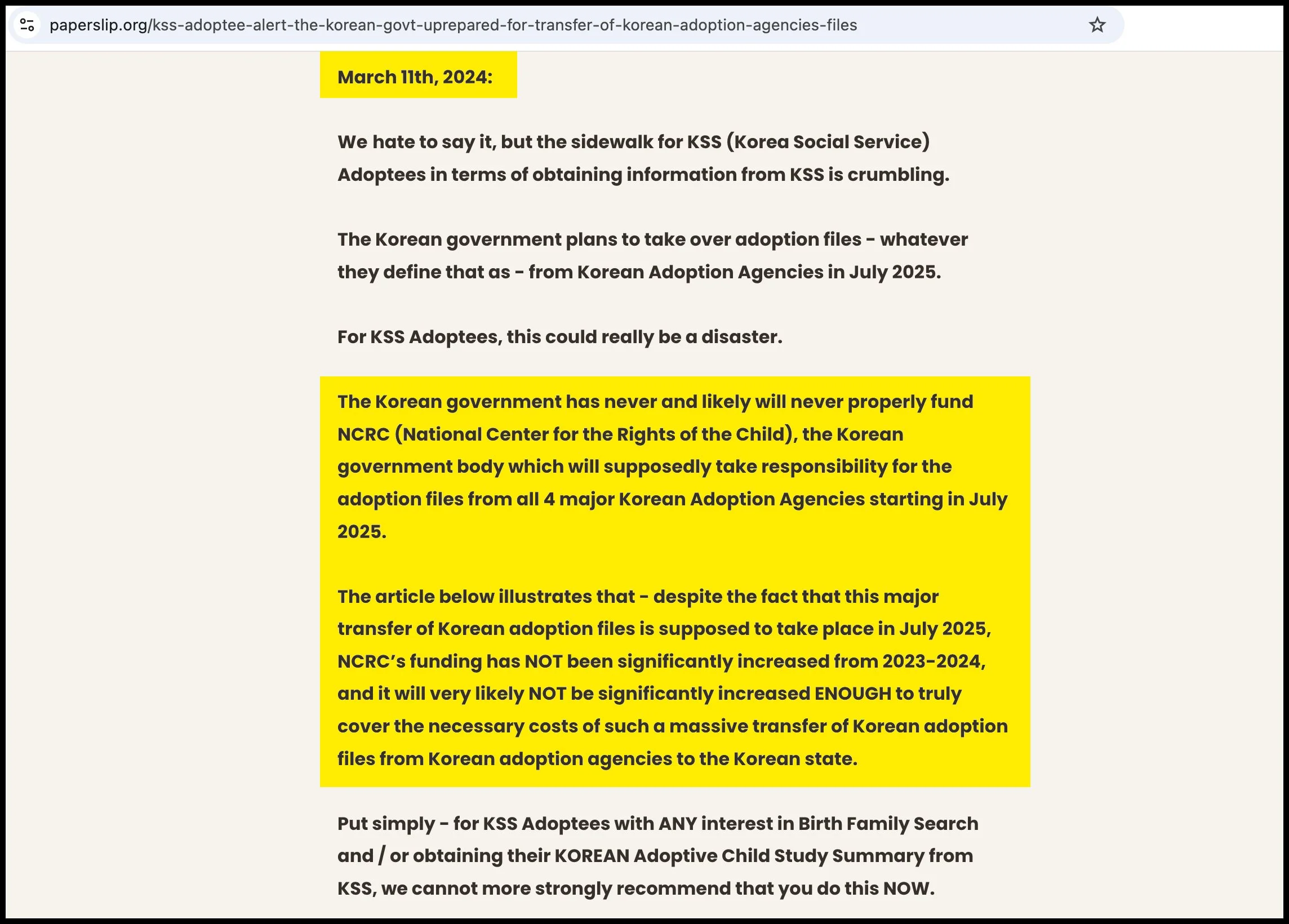
Above: Our post from March 11th, 2024, when we first began to warn KSS Adoptees publicly about the first file transfer from the 4 major Korean Adoption Agencies to NCRC. We unfortunately accurately predicted that the S. Korean Government will NEVER provide adequate budget for the file transfer process / processes.
+
*Paperslip Note: What the article translation below calls “Korea Child Rights Agency” is NCRC: National Center for the Rights of the Child.
*Bolds ours.
+
“For Adoptees, Records Are Their ‘Roots.’ Adoption Records Must Be Preserved Well… It’s Regrettable That the Budget Wasn’t Reflected”
[Over a Cup of Tea]
Related issue: Over a Cup of Tea, World Newsroom
Input: 2025-12-09 20:25:36 | Updated: 2025-12-09 22:17:10
Jang Han-seo, Reporter (jhs@segye.com)
Jeong Ik-jung, President of the Korea Child Rights Agency
Scheduled to transfer adoption records to the National Archives in 2026
Concerns over covering relocation costs within the existing budget
“Additional budget allocation and legal amendments are needed”
“Adoption records are the ‘roots’ of adoptees. We plan to move these records to the National Archives next year, but it’s deeply regrettable that the necessary budget wasn’t included.”
With adoption records currently stored in a temporary archive set to be relocated next year, Jeong Ik-jung, head of the Korea Child Rights Agency (KCRA), said, “We requested an additional budget for transferring the records, but it was ultimately not included in next year’s budget.” Regarding disclosure of adoption information, he added, “We need a basic policy that prioritizes the adoptee’s perspective,” stressing the need for legal revisions.
Jeong spoke with the Segye Ilbo on December 4 at the KCRA office in Jung-gu, Seoul. He explained: “We gathered adoption records that had long been scattered across facilities, local governments, and adoption agencies, moved them to the agency’s temporary archive, and integrated them as public records. Through this, we established a prompt and secure preservation system. With the National Archives scheduled to take over next year, we expect the expertise and stability of record preservation to improve significantly.”
However, he continued, “The budget for transferring records did not make it into next year’s budget plan. We have no choice but to carve out funds from our existing budget to keep the project moving.”
The KCRA (NCRC)—under the Ministry of Health and Welfare—took over all adoption records in July, when the government implemented a major reform that shifted adoption services into the public domain after more than 70 years of private-sector leadership. The Ministry had planned to construct a dedicated adoption records center, but the Ministry of Economy and Finance significantly cut the related budget, delaying the project.
After searching extensively, the agency ended up renting a building originally designed as a cold storage warehouse. This prompted criticism from adoptees and related civic groups: paper records are highly sensitive to temperature and humidity, and the sprinklers used in case of fire could soak the materials.
In October, the Health Ministry, the KCRA, and the National Archives signed an agreement to relocate the adoption records from the temporary facility to the National Archives’ Seongnam branch. The records may be transferred as early as early next year.
However, this required additional funding that was not approved in the National Assembly. About 2.5 billion won (KRW) requested for fumigation and transfer operations was not included.
Jeong said, “Thanks to the National Archives’ proactive response, we are now able to move the records from the temporary site,” but added, “With the expansion of responsibilities under the public adoption system, we have more work but haven’t secured additional staff or a budget for fumigation and transfer of records. A very small team is having to carry multiple responsibilities at once.”
Jeong assessed this year’s newly implemented public adoption system as “a major shift that strengthens state responsibility.” He explained, “We standardized adoption procedures—which previously varied across agencies—under a unified set of criteria. This laid the foundation for fair and transparent system operations. With the KCRA now solely responsible for handling information disclosure requests, the entire process—from application to disclosure—is standardized. We are refining manuals and systems to provide adoptees with stable, high-quality services.”
He acknowledged that “Some say the disclosure process is slower than before, but it will improve step by step.”
Jeong strongly emphasized lowering the barriers to disclosing adoption information. Currently, the disclosure process relies heavily on obtaining consent from birth parents. He explained: “To protect the privacy of birth parents, we currently send consent requests by mail. This inevitably causes delays. A bill allowing this verification to be conducted by phone has been introduced in the National Assembly, and if it passes, the process will speed up.”
He added, “We should consider making disclosure the default, and allowing parents to object—taking the matter to court only if they want nondisclosure. This is how it works in many other countries. While this requires social consensus, I hope the National Assembly will take a forward-looking approach. Adoptees had no opportunity to express their opinion at the time of adoption because they were newborns. At the disclosure stage, adoptees’ rights must be central for the system to be fair.”
Jeong also mentioned the possibility of pursuing UNESCO Memory of the World status for Korea’s adoption records. “It’s no exaggeration to say that organized overseas adoption originated in Korea,” he said. “Even today, systematic adoption is happening somewhere in the world, modeled after Korea’s past practices. These records could provide critical historical lessons about what should not be repeated.”
With its responsibilities expanding through the public adoption reform, the agency will change its name to the National Child Rights Agency on May 12 next year to clearly identify itself as a national institution. Jeong said, “There are more than 6,500 organizations nationwide with the word ‘child’ in their name. Many people still don’t know who we are. The more people know us, the more opportunities children have to seek help when needed. Raising awareness is important.”
On child abuse issues, Jeong underscored the importance of establishing a Child Abuse Fatality Review Board. A related bill to amend the Child Welfare Act is currently pending in the Legislation and Judiciary Committee. “Public awareness of child abuse has increased,” he said, “but children are still dying due to abuse. We need legally mandated staff dedicated to reviewing child abuse deaths so we can learn lessons from each case. Identifying gaps in the system is critical for prevention. Right now, only two staff members in the agency are handling all fatality reviews due to staffing shortages.”
In closing, Jeong appealed for expanded support—both budgetary and personnel—to maintain morale within the organization. “Our staff may not be perfect, but they deserve encouragement. Many of our young employees came here out of a strong sense of mission, yet the more they work, the more criticism they face. We really hope for an environment where they can do their jobs properly.”
—
Jang Han-seo, Reporter (jhs@segye.com)