
My Uncredited Interview Subject Referrals To FRONTLINE / AP For The 2024 Documentary "South Korea's Adoption Reckoning", Related Articles, and Interactive.
See Related:
The Origins Of The FRONTLINE / Associated Press (AP) documentary "South Korea's Adoption Reckoning".
I declined to discuss my work with Paperslip when FRONTLINE / AP filmed my interviews in 2023 since KSS was still open — and I did not want to jeopardize KSS Adoptees’ chances of getting their files.
+
It was already enough to have my identity — and that of my hidden, deceased twin sister — stolen by my Korean Adoption Agency. I really didn’t also need FRONTLINE and the Associated Press to erase my significant contributions to the 2024 documentary, “South Korea’s Adoption Reckoning”. I spent years exposing systemic switching and personally referred numerous interview subjects to AP’s Tong-Hyung Kim, and later to FRONTLINE’s Lora Moftah. Without that work, “South Korea’s Adoption Reckoning” would not be what it is today. Yet, despite the documentary’s Director acknowledging privately that “my handprints were all over the documentary,” I received zero credit or acknowledgement in the film.
Instead of acknowledging this ‘oversight’, Lora Moftah and Tong-hyung Kim simply doubled down on my erasure.
Posted to Paperslip on September 25th, 2025.
Edited and re-posted on October 6th, 2026.
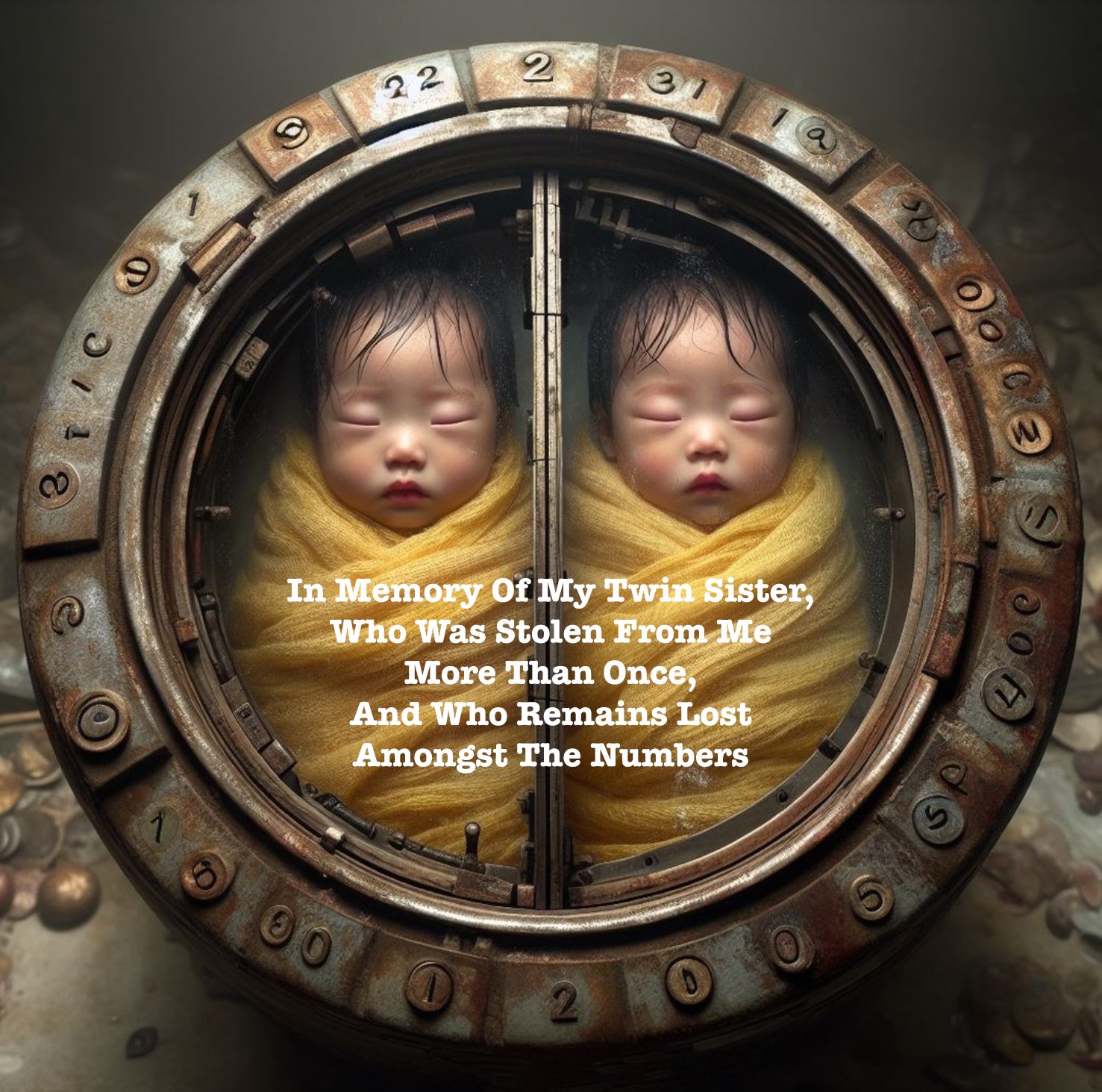
+
The 2024 FRONTLINE / AP Documentary South Korea’s Adoption Reckoning, Directed By Lora Moftah And Starring Associated Press (AP) Reporter Tong-Hyung Kim, Failed To Acknowledge My Central Role In Exposing Systemic Switching.
They Also Omitted My Central Involvement In Referring MANY Of The Interview Subjects Featured In Both The FRONTLINE / AP Documentary, Related Articles, And Interactive.
Below is a list of both direct and indirect interview subject referrals I provided to FRONTLINE Director Lora Moftah and AP journalist Tong-Hyung Kim between 2021 and 2024, along with proof that my original and groundbreaking investigation into systemic switching served as the foundation for the documentary's coverage of the topic.
+
It had been MY idea to film at IKAA. I had then connected Lora Moftah and Tong-hyung Kim to IKAA’s organizers to film at the conference (which only meets in Seoul once every three years) and pushed them to submit media requests by IKAA’s deadline.
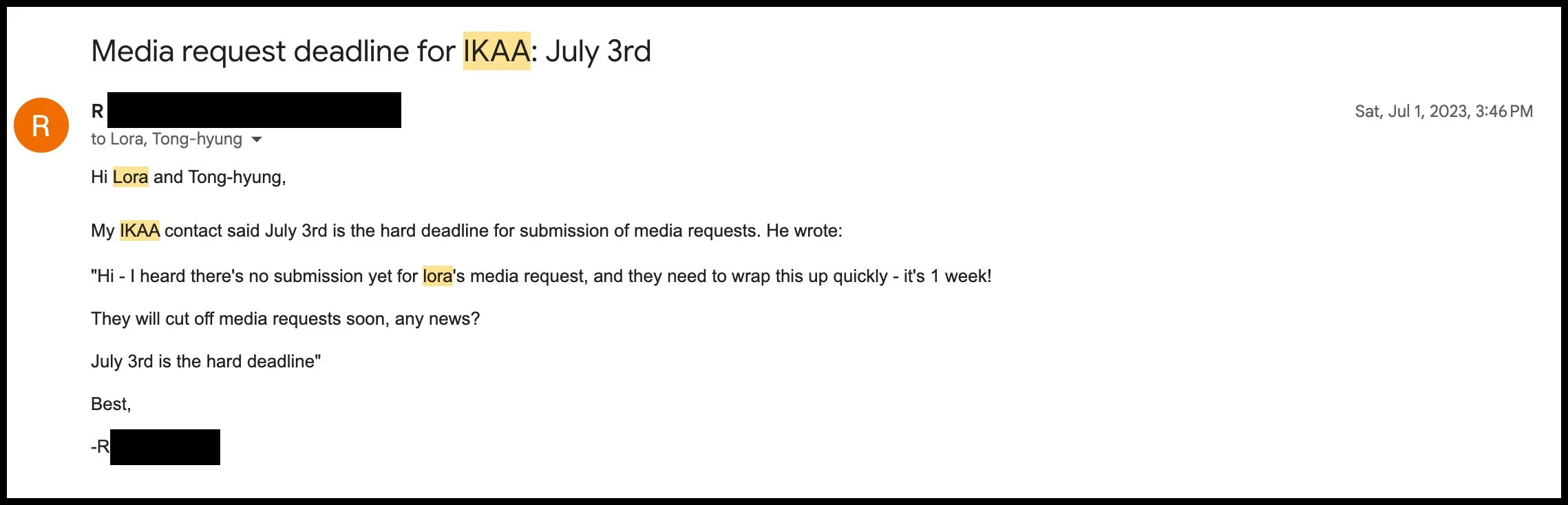
My email from July 1st, 2023 to Lora Moftah and Tong-hyung Kim says:
”Hi Lora and Tong-hyung,
My IKAA contact said July 3rd is the hard deadline for submission of media requests. He wrote:
"Hi - I heard there's no submission yet for lora's media request, and they need to wrap this up quickly - it's 1 week!
They will cut off media requests soon, any news?
July 3rd is the hard deadline"
Best,
-R”
+
The Adoptees listed below are individuals I gathered and directed to be interviewed by FRONTLINE/AP during IKAA’s “Newcomer’s Event” in Seoul, held in July 2023. While I did not know each Adoptee personally, I informed them that interviews were being filmed for the documentary at the event, and invited them to participate.
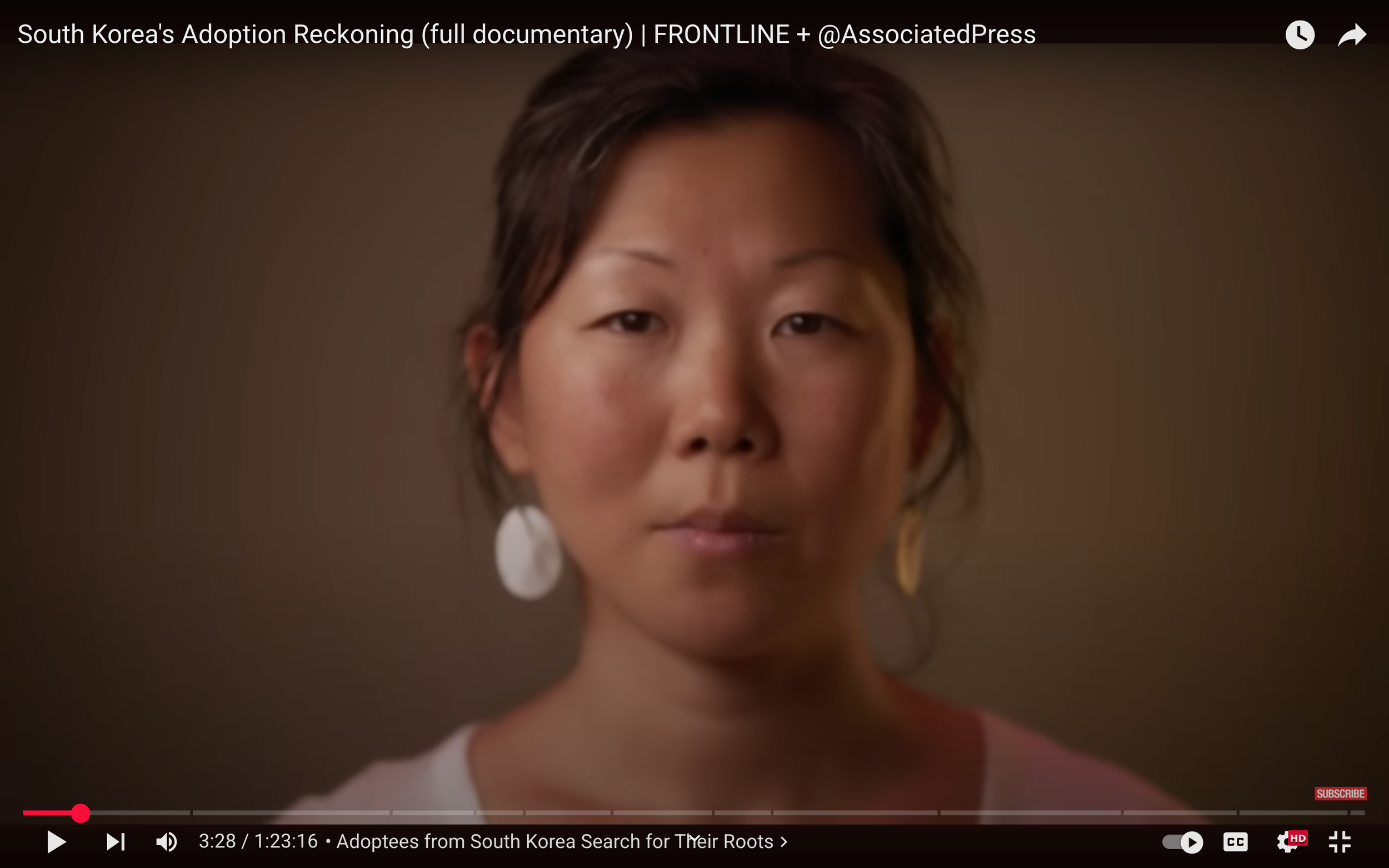
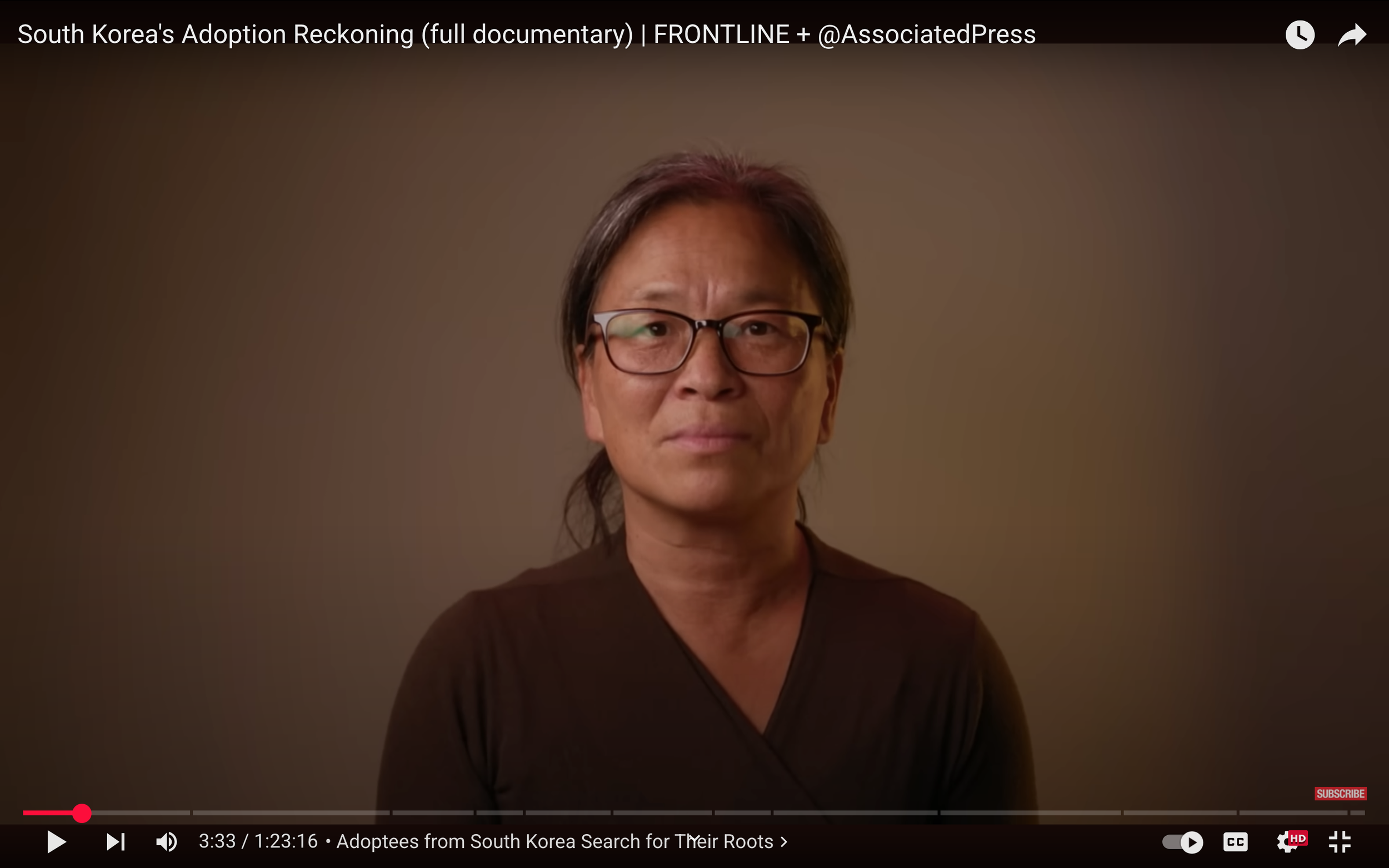
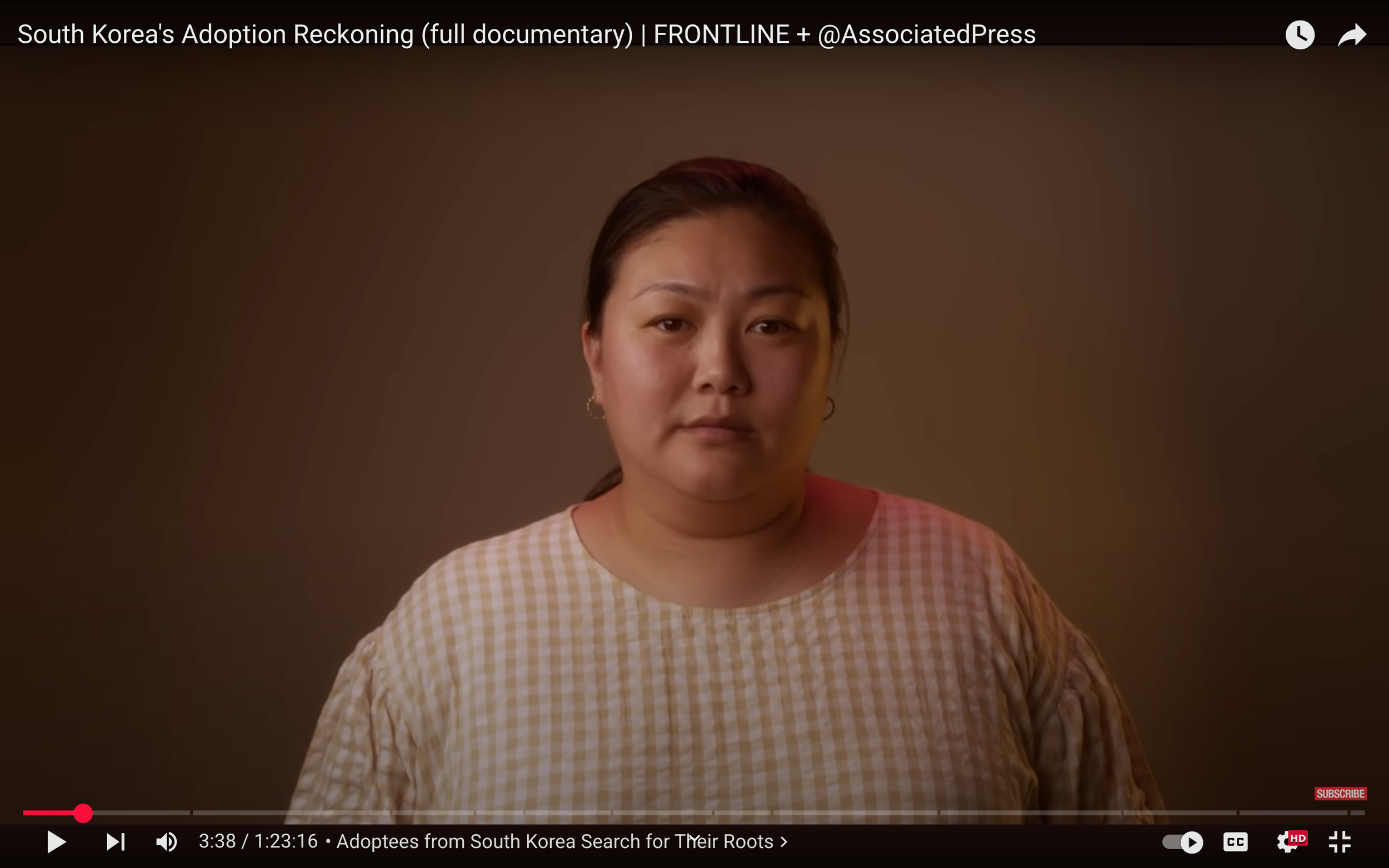
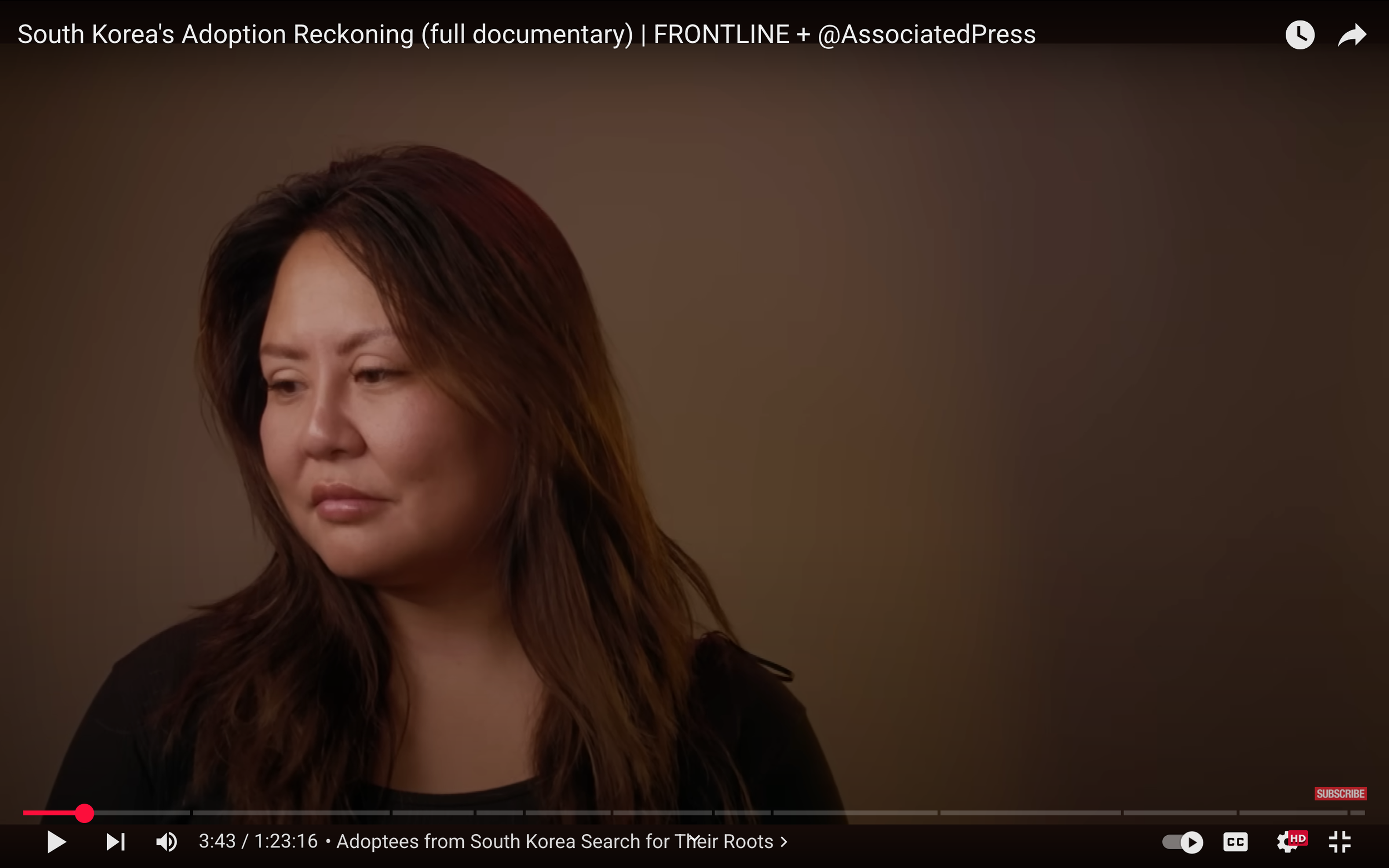
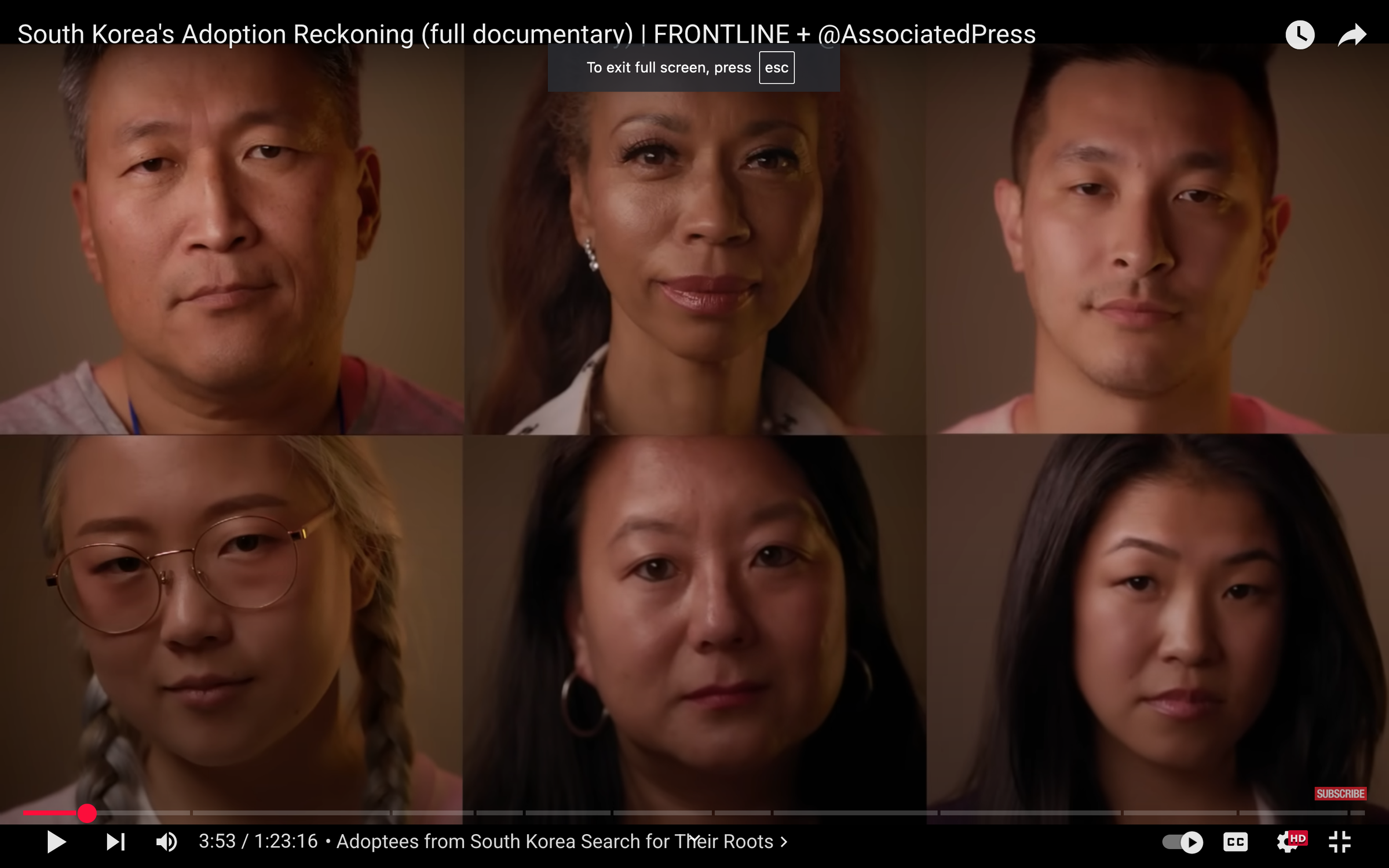
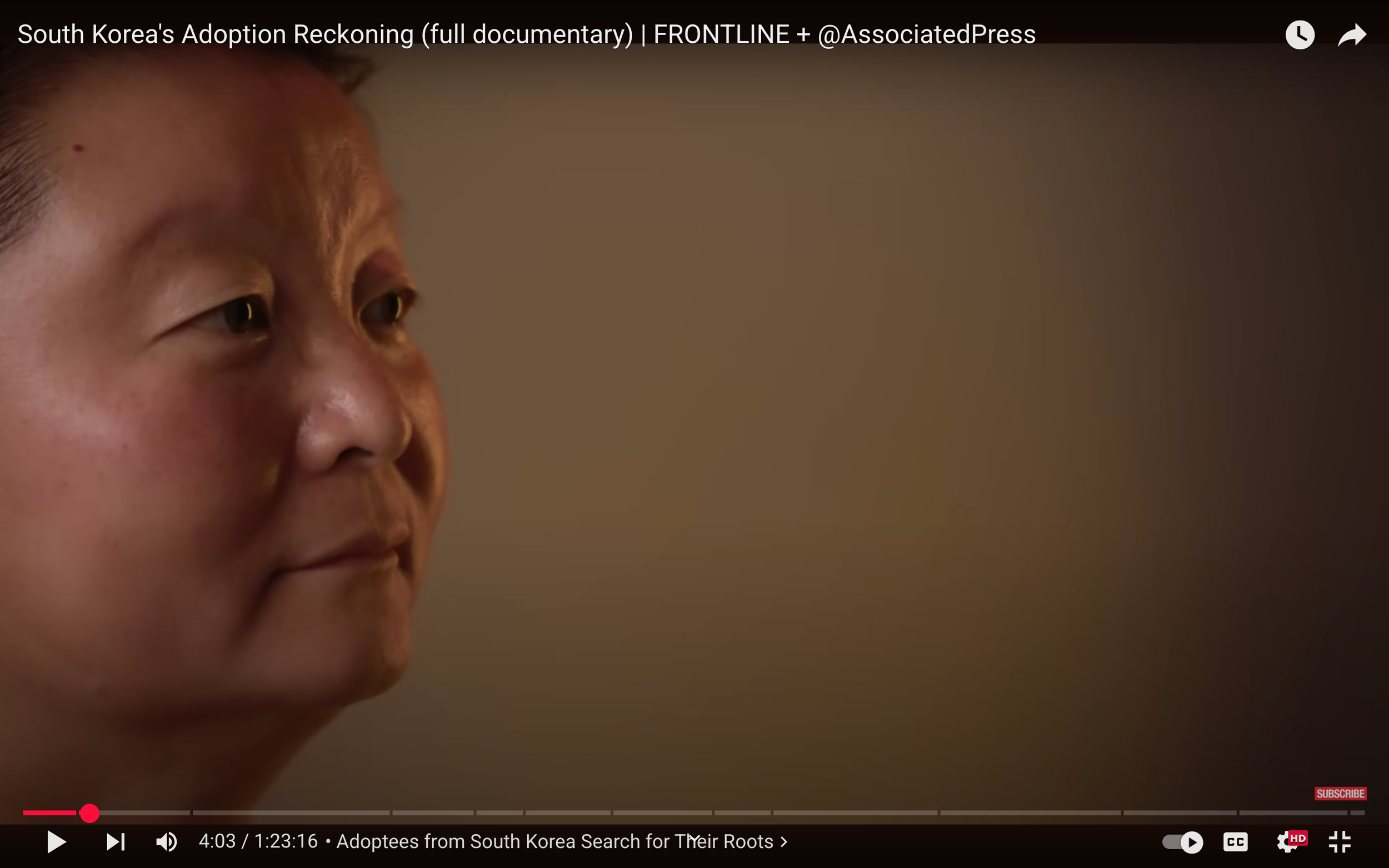
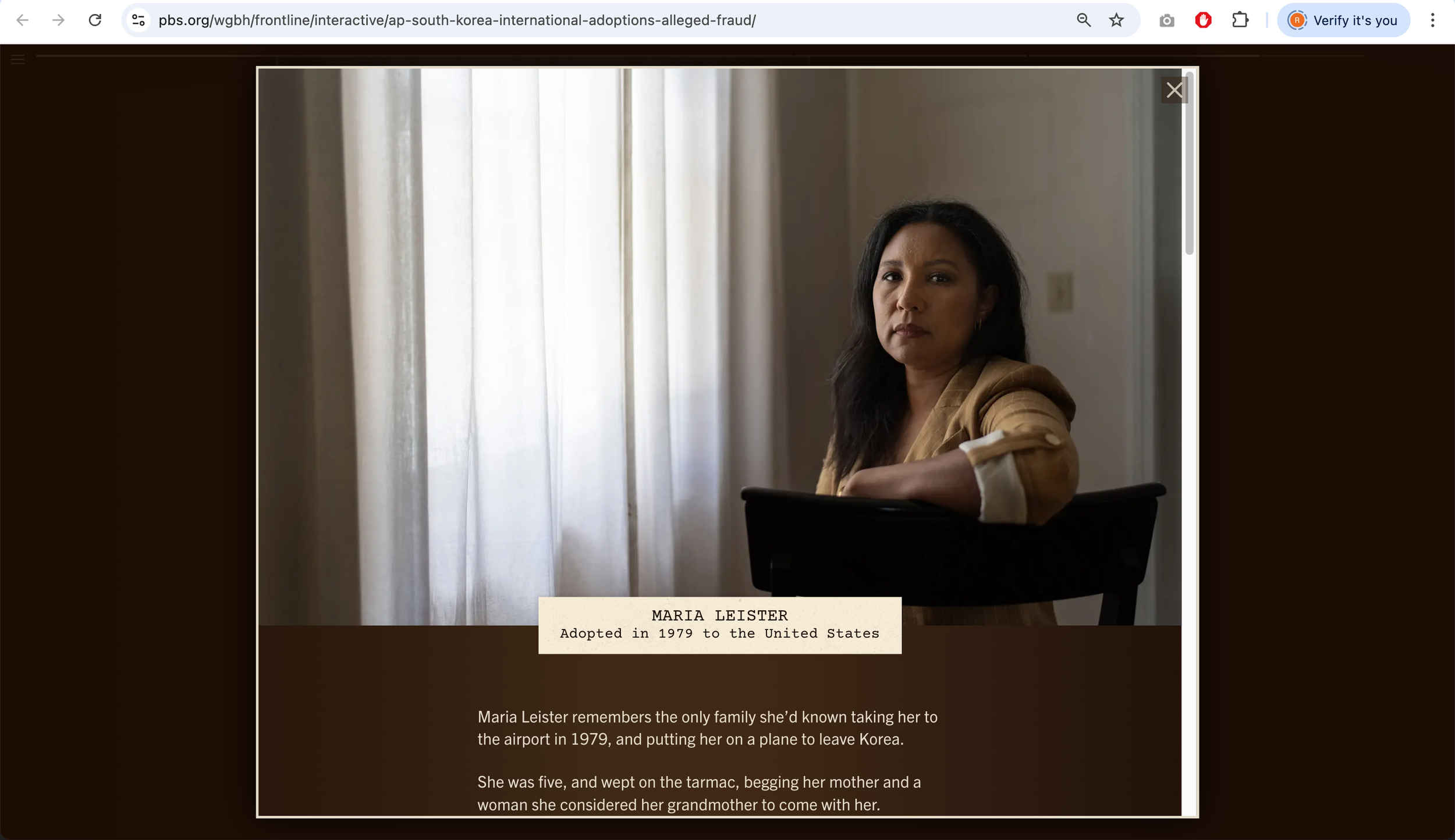
Above: FRONTLINE filmed with “M” (top middle) to whom I had introduced Lora Moftah and Tong-hyung Kim in Korea at the IKAA conference in July 2023. However, this story was not included in the final film. However, “M’s” friend Maria WAS included in the FRONTLINE / AP Interactive (see section below). So M’s friend was another indirect referral of mine.
I also attempted to get Lora Moftah to film “M” together with Alice Stephens, since they had a location in Korea in common which “M” would be visiting.
+
Main Interview Subjects of the FRONTLINE Documentary:
It should be noted that apart from the interview subjects I list below, there was only ONE Korean Adoptee interviewed in the FRONTLINE documentary that I did NOT refer.
The main interview subjects whom I did NOT refer for the documentary are:
-The birth mother featured at the beginning of the documentary and the end, and her Adoptee son (who was not interviewed and remained faceless — as such I do consider him to be an interview subject).
-The Former Eastern Social Welfare Society Korean Social Worker (whom ironically I had interviewed myself as part of the 2022 SBS documentary — though that interview did not make it to air).
-The HOLT Adoption Agency representative
-The U.S. State Dept. representative
-Dr. Kyungeun Lee
-Dr. Philsik Shin
-The European Adoptee
-The Three TRC 2 (Second Truth and Reconciliation Commission, Republic of Korea) Investigators
-Sarah Yun, the NCRC (National Center for the Rights of the Child) representative
+
APART FROM THE INDIVIDUALS LISTED ABOVE, ALL OTHER INTERVIEW MAIN SUBJECTS WERE MY DIRECT OR INDIRECT REFERRALS:
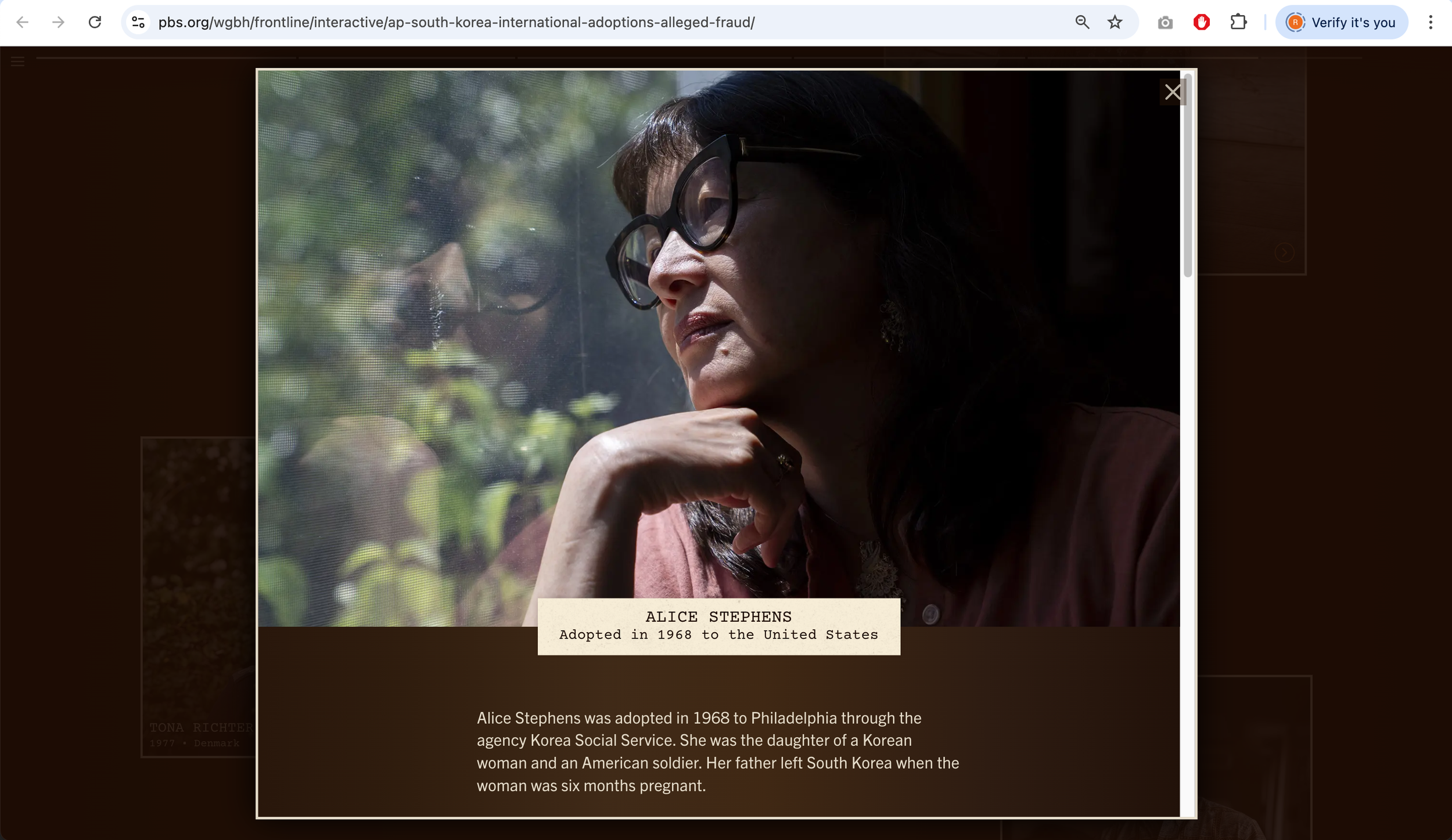
1. Korean Adoptee—Alice Stephens
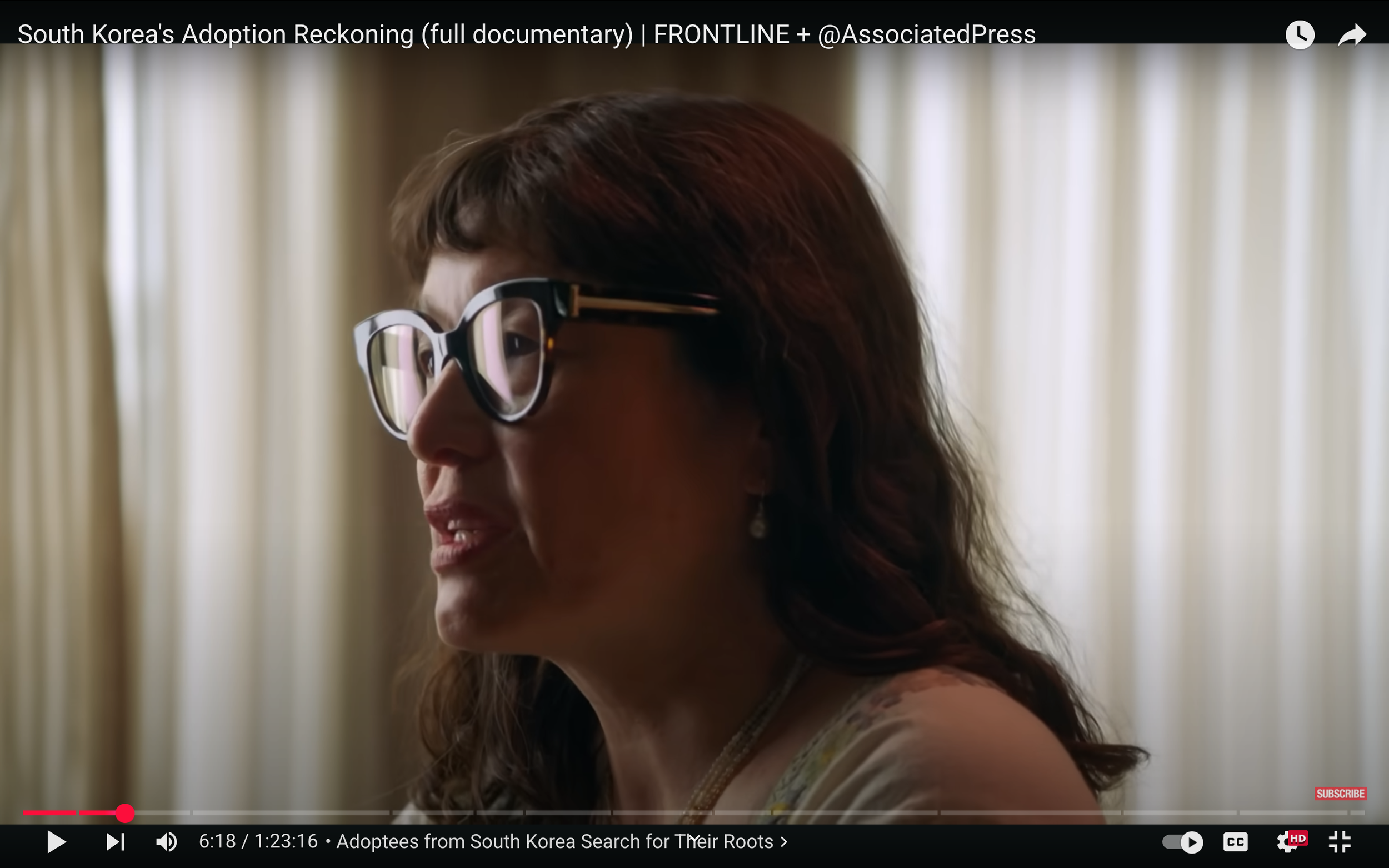
I directly introduced Alice Stephens to Lora Moftah and Tong-hyung Kim at the IKAA conference in Seoul in July 2023.
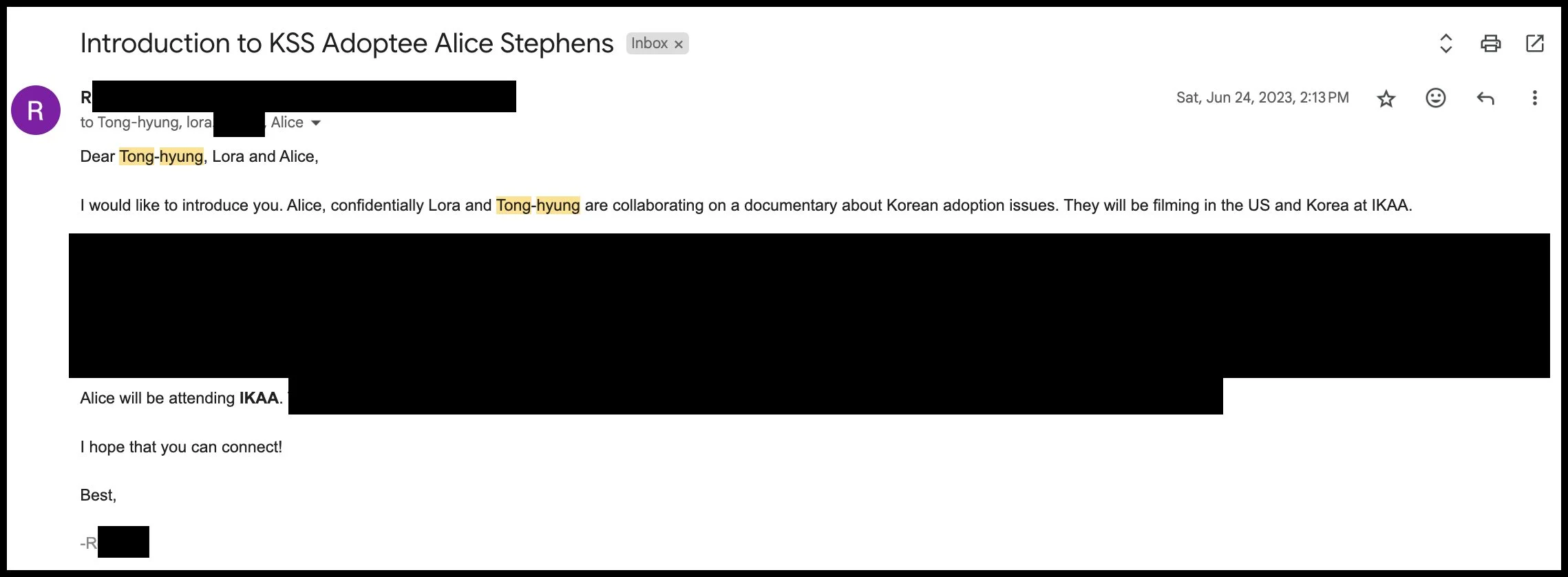
Below: My email referring Tong-hyung Kim and Lora Moftah to Alice Stephens:
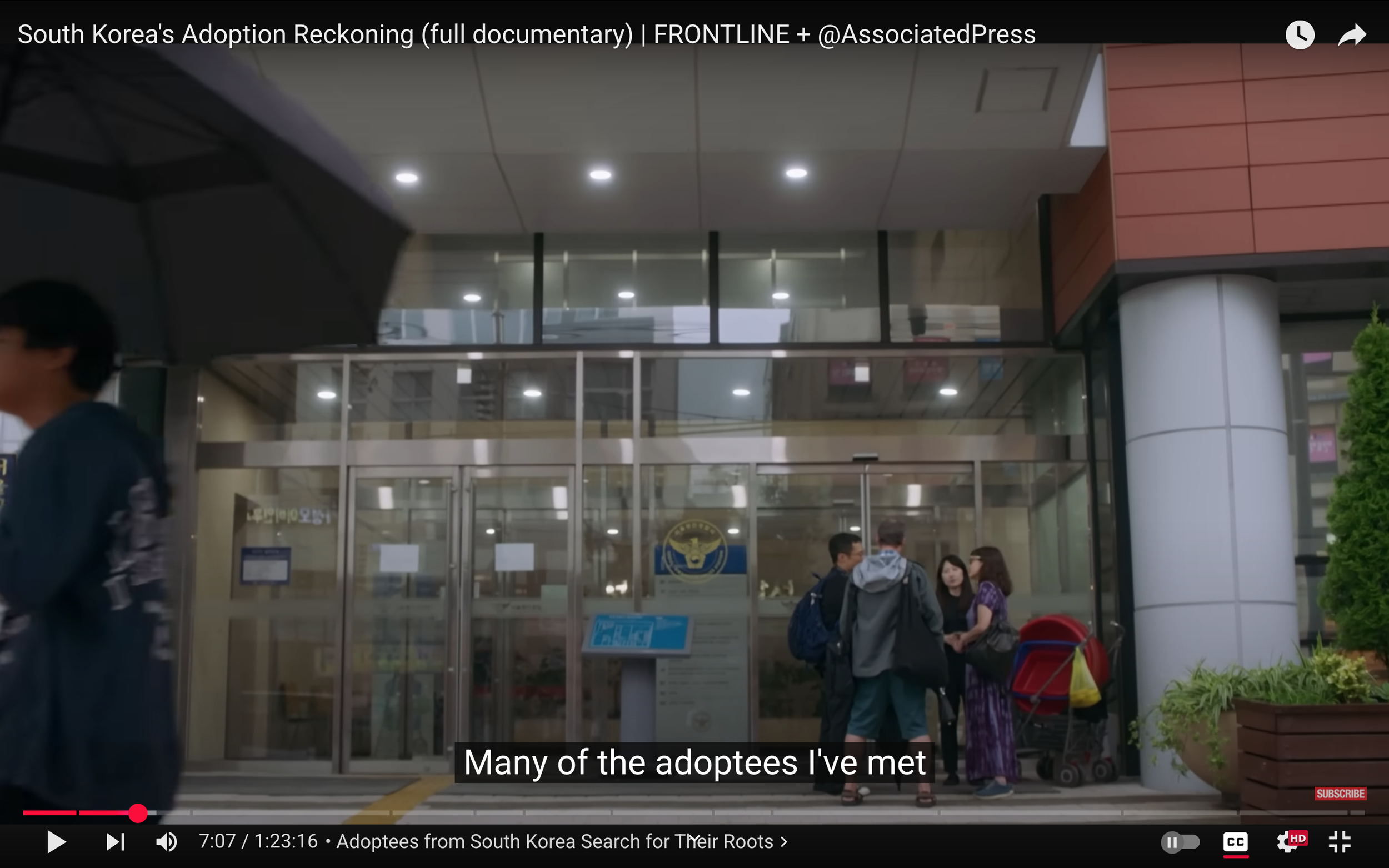
The scene filmed below by FRONTLINE / AP in Seoul with Alice Stephens would not have happened without me. I had tried to convince her for years to visit a Korean police station in Seoul to try to look up her birth mother in their national database. I had spent a significant amount of time convincing her to do this when we were in Korea at the same time for IKAA in July 2023. This is the police station which I picked out — and the group includes my translator friend, whom I had referred to help Alice Stephens. Actually, the police officer with whom we met recognized me from the 2022 SBS documentary about my case, and may even have given Alice Stephens extra assistance because of it.
However, as Alice Stephens and I were walking downstairs and into the lobby after the meeting with the police officer upstairs, Lora Moftah suddenly grabbed my arm to pull me out of the scene, saying that she did not want to “muddle” our two stories, or something to that effect.
Actually, it took me a LOT of effort to convince Lora Moftah in some heated phone conversations that it would be a bad idea to try to film inside the police station. I worried that the police would NOT help with Alice Stephens’ case if there were cameras in the room — and this could cost her an important opportunity that I had worked for years to get her to try. I was right, and as a result, the police officers did attempt to help — since I won the argument, and Lora Moftah agreed not to try to film inside the police station. This is why this scene is filmed outside the police station, after Alice Stephens and I met with Missing Persons police officers inside. I had chosen this particular police station since I had previously visited it with a Korean Adoptee friend, and the police officers there had been helpful to us.
This scene would not have happened without me, yet I was removed from it by Lora Moftah.
Below: This scene was shot at a cafe close to the police station, after Alice Stephens and I worked with the police officers. I am standing behind Lora Moftah at this point, watching the filming take place. Two things happened during the filming of this scene:
1) A man on the street recognized me, and asked a crew member if it was me.
2) Lora Moftah turned to me and exclaimed with sudden realization, “You’re the driver!” meaning, I was the one driving the narrative that we were filming. I had only just met Lora Moftah at my studio in Seattle, between June 30th - July 1st, 2023 when she and the rest of the journalists came out to film my interviews there. We had immediately flown to Korean on July 2nd, 2023, due to my suggestion that we film at IKAA. By contrast, I had been in touch with Tong-hyung Kim since January 2021. Perhaps Tong-hyung Kim had not adequately conveyed to FRONTLINE’s Lora Moftah how central I was to “his” investigation. Lora Moftah’s exclamation was her sudden recognition in the moment that I was the driver of the FRONTLINE / AP narrative.
Lora Moftah later said to me privately during a Zoom, after the FRONTLINE documentary aired, and I was not in it (apart from literally one second), that “Your handprints are all over the documentary”. She additionally said that the entire FRONTLINE team was “amazed" at how I had investigated my case. One wonders WHY — when Lora Moftah realized that I was the “driver” of the story that they were filming and that my “handprints are all over the documentary” — that I could not receive even ONE LINE OF CREDIT or note of “Special Thanks” in the final documentary.
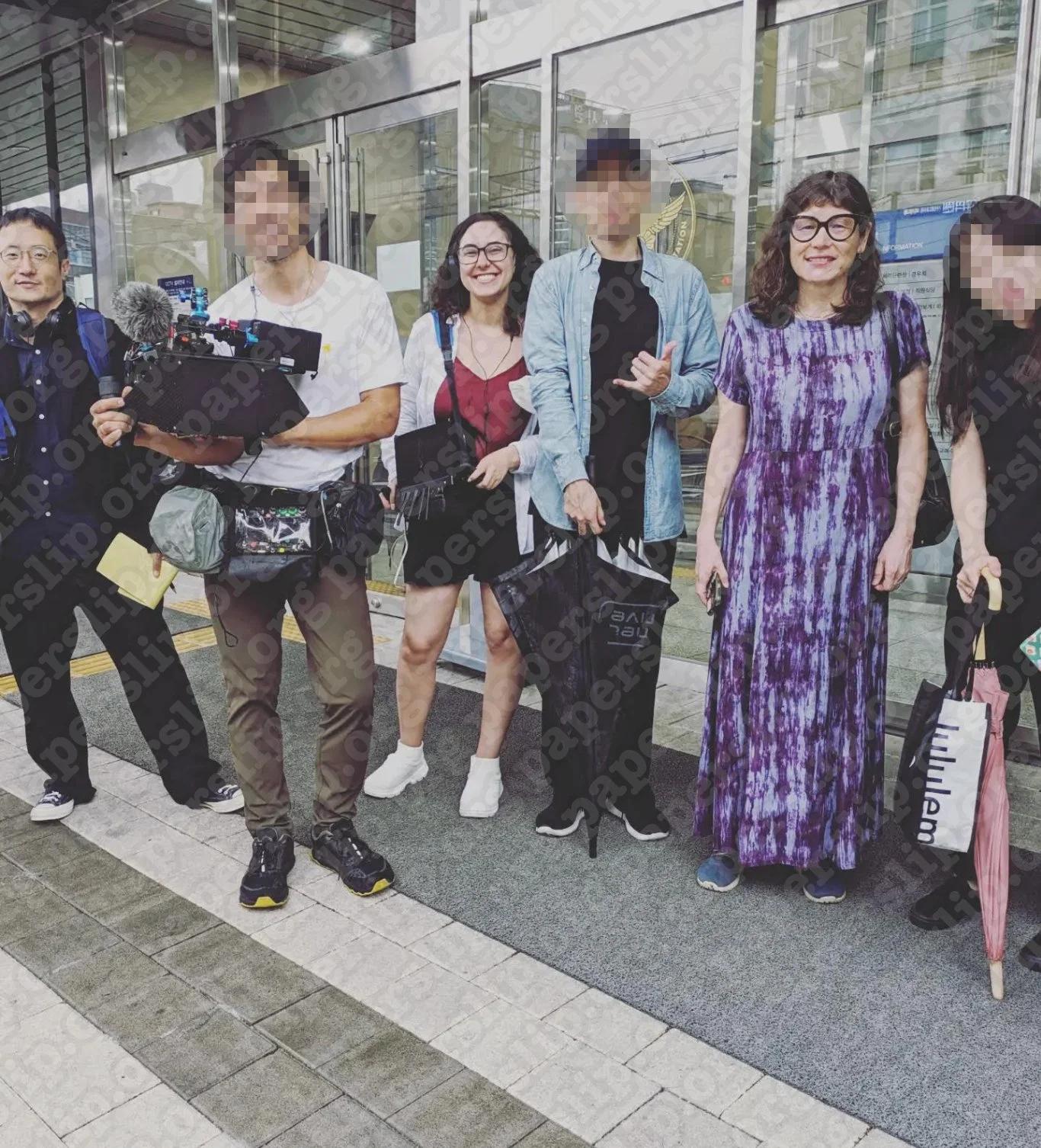
Above: AP’s Tong-hyung Kim at left, FRONTLINE’s Lora Moftah center, with my referral, KSS Adoptee Alice Stephens, in purple at right. My translator, whom I had referred to help Alice Stephens at this police station, which I had chosen to visit, is at far right.
I had accompanied Alice Stephens upstairs to talk with police officers — which had been my suggestion to do for years — but when we came downstairs together, Lora Moftah grabbed my arm and pulled me out of the frame, saying, “We don’t want to muddle the two stories.” In retrospect, I think she had already decided to cut my story out of the documentary by this point, despite the fact that my visit to KSS was filmed by FRONTLINE / AP as part of this trip to Korea.
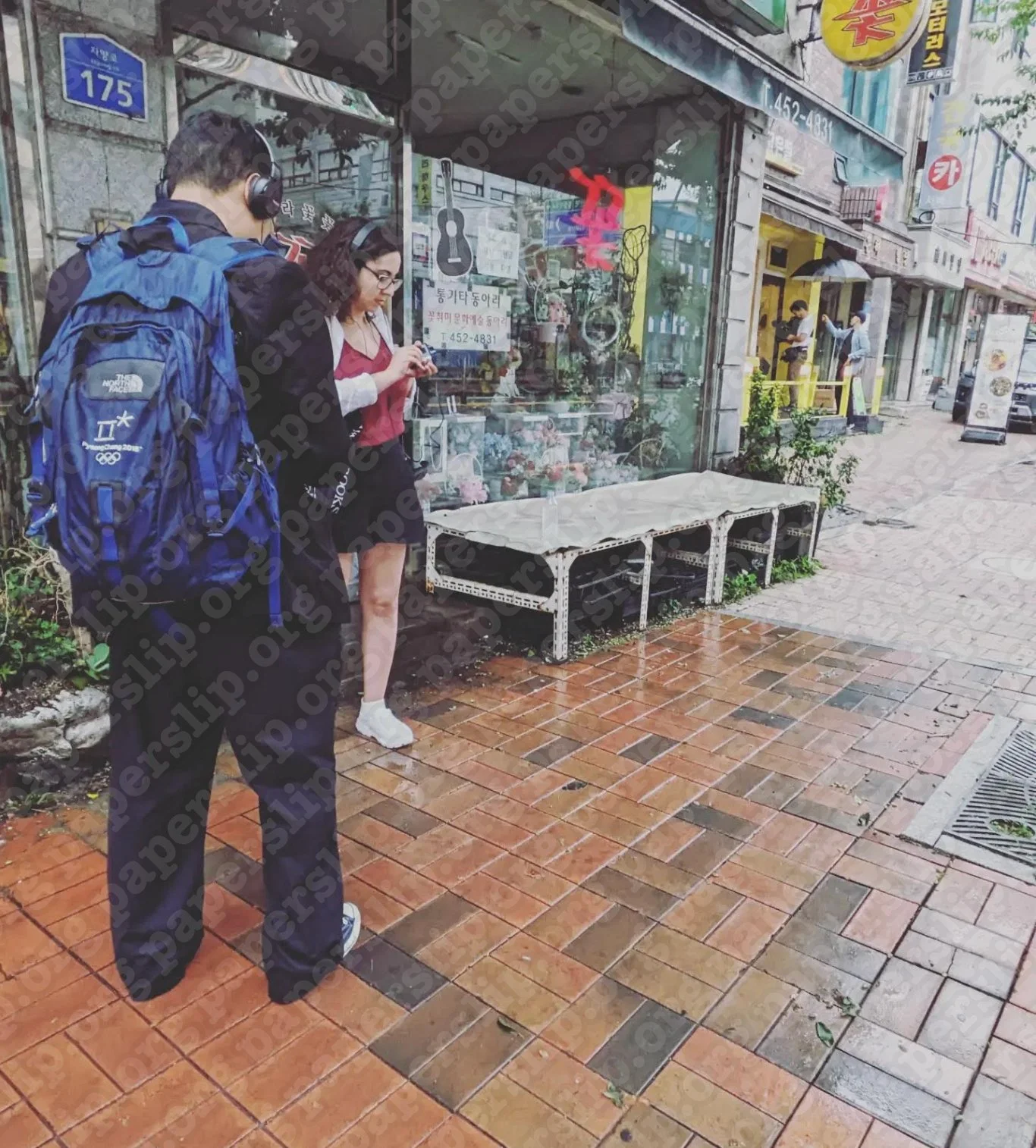
Above: AP’s Tong-hyung Kim at left, FRONTLINE’s Lora Moftah center. In the far back of this photo you can see the yellow trimmed entryway to the cafe in which B-roll of Alice Stephens and her husband were being filmed. You can see a screenshot of this final shot which appeared in the 2024 documentary below.
Two things happened while this was being filmed:
Lora Moftah looked at me with sudden realization, and exclaimed, “You’re the driver!” — as in, I was the driver of the narrative that they were filming.
Also, Lora Moftah pointed out to me that during filming, a Korean man had recognized me on the street from the 2022 SBS documentary, and had asked, “Is that Rebecca?”
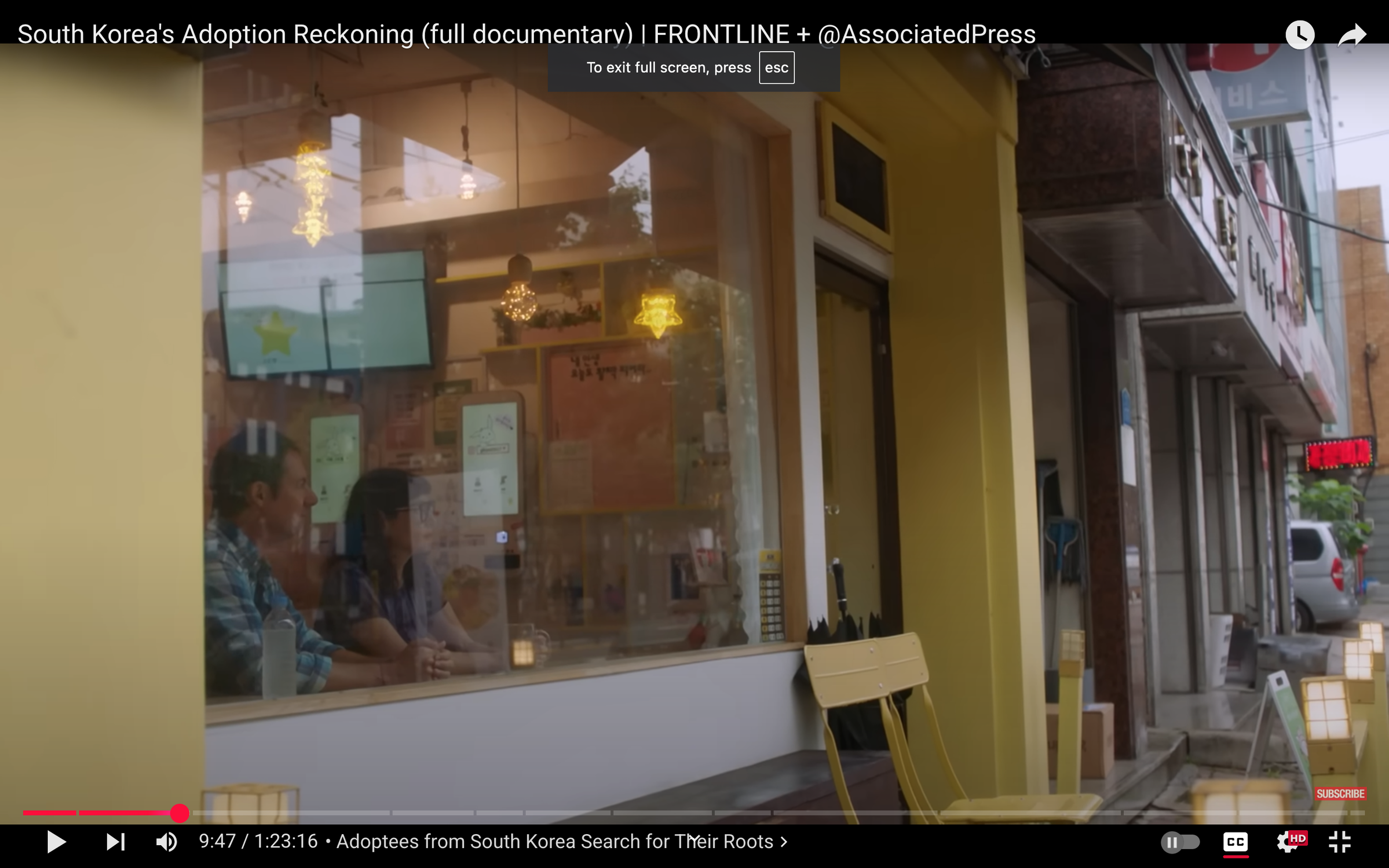
2. Non-Adoptee Korean Adoption Scholar—Eleana J. Kim
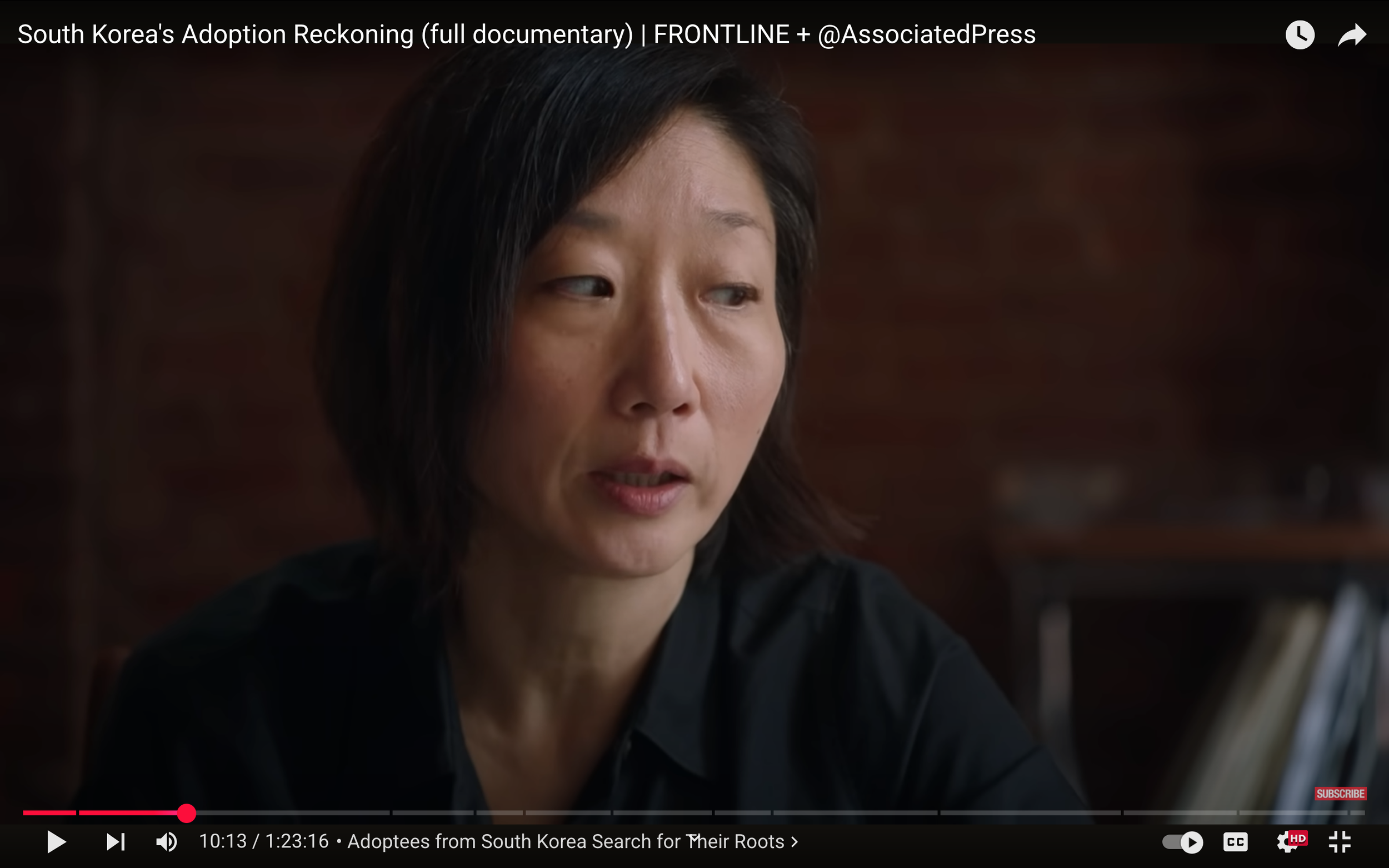
I verbally directly referred Eleana J. Kim to Tong-hyung Kim to be filmed for the FRONTLINE documentary.
I had met Eleana J. Kim in Florence, Italy in 2018, shortly after I had moved there in Fall 2018. I had told her about my switch case. We had stayed in touch on and off since that time, and she had directly witnessed a lot of my research from 2018 forward to about 2024 through a forum for switched Adoptees I had invited her to join as an observer. She did an audio interview with me in 2018 about my story. Eleana J. Kim’s book “Adopted Territory” had been an important part of my early understanding of Korean Adoption history, and so she was an obvious choice to refer to Tong-hyung Kim for the FRONTLINE documentary.
3. Korean Adoptee—Robyn Joy Park
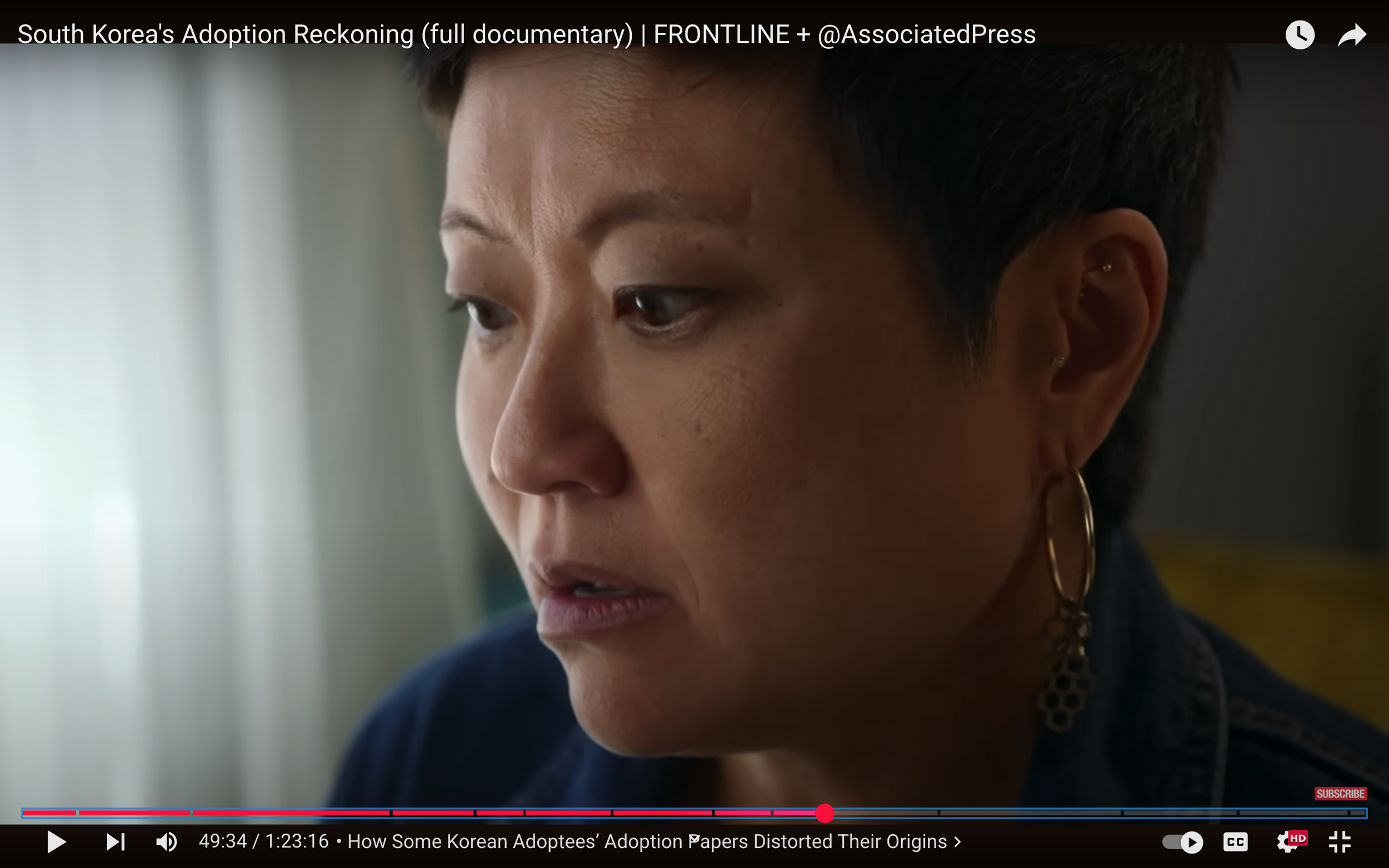
I directly referred Robyn Joy Park to Tong-hyung Kim. Her story was also included amongst the “switch case story summaries” I had submitted to the head of the TRC on December 18th, 2020, though at the time, all of our submissions were anonymous. I had known of Robyn Joy Park’s story of being in false reunion since around 2018, and we had met in person in Los Angeles around that time.
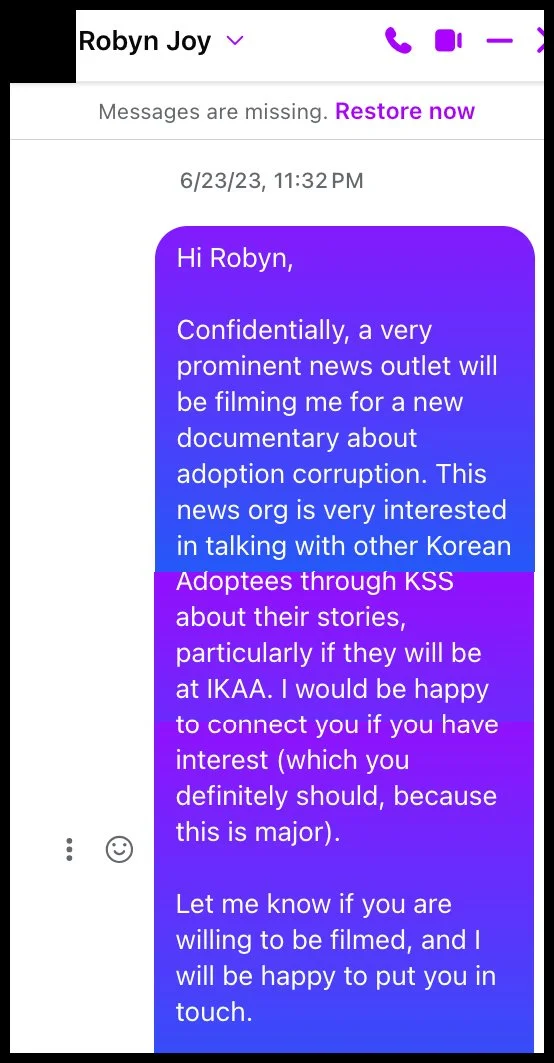
On June 23rd, 2023, I messaged Robyn Joy Park to offer to connect her to AP reporter Tong-hyung Kim and FRONTLINE Director Lora Moftah, since we would all be in Korea at the same time for the IKAA conference.
“Hi Robyn,
Confidentially, a very prominent news outlet will be filming me for a new documentary about adoption corruption. This news org is very interested in talking with other Korean Adoptees through KSS about their stories, particularly if they will be at IKAA. I would be happy to connect you if you have interest (which you definitely should, because this is major).
Let me know if you are willing to be filmed, and I will be happy to put you in touch.”
Ultimately, the only two “switched” Adoptees who appeared in the FRONTLINE documentary were Robyn Joy Park and Michaela Dietz.
Both Robyn and Michaela were also featured in the FRONTLINE / AP Interactive:
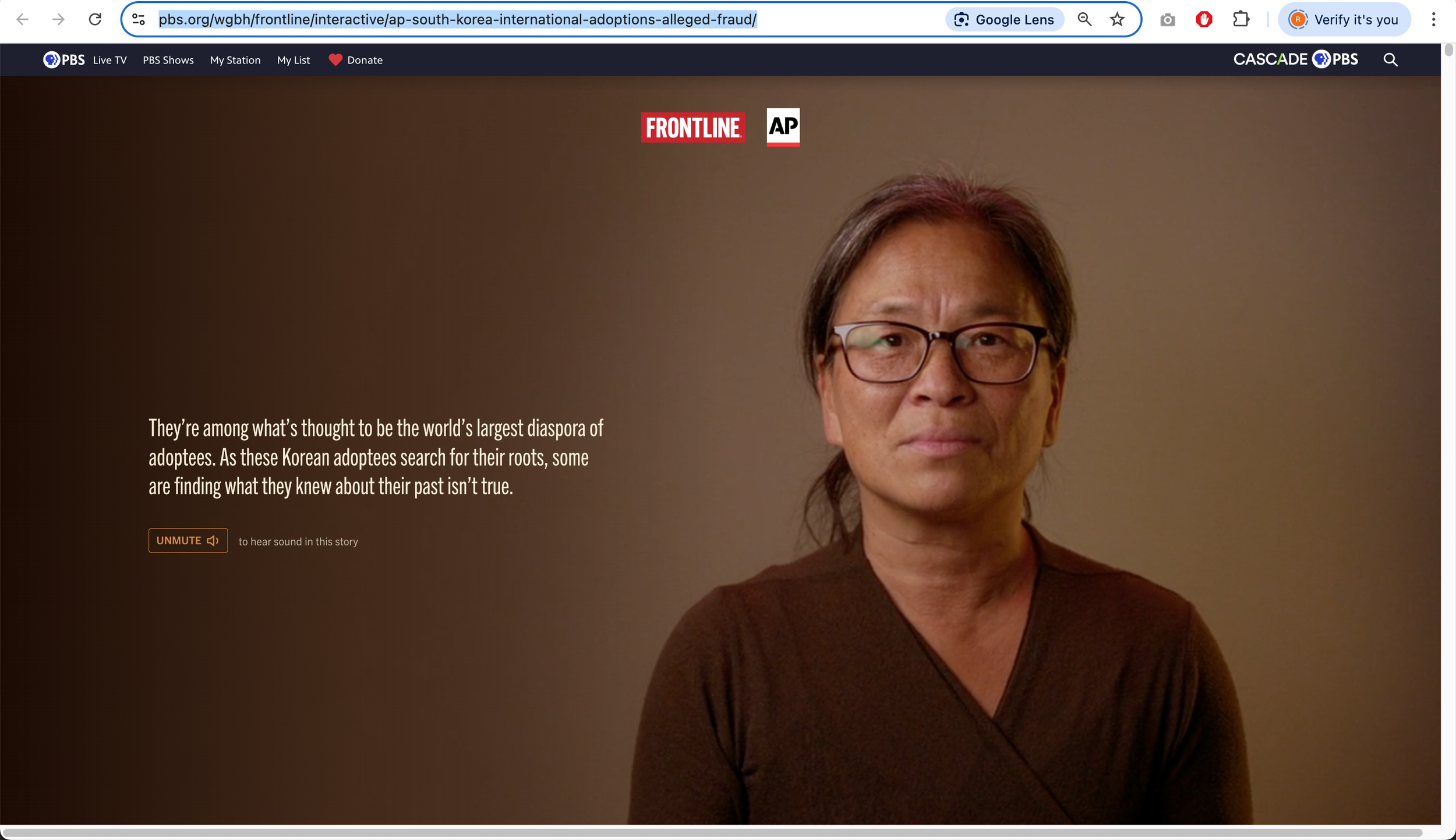
https://www.pbs.org/wgbh/frontline/interactive/ap-south-korea-international-adoptions-alleged-fraud/
4. Korean Adoptee—Michaela Dietz
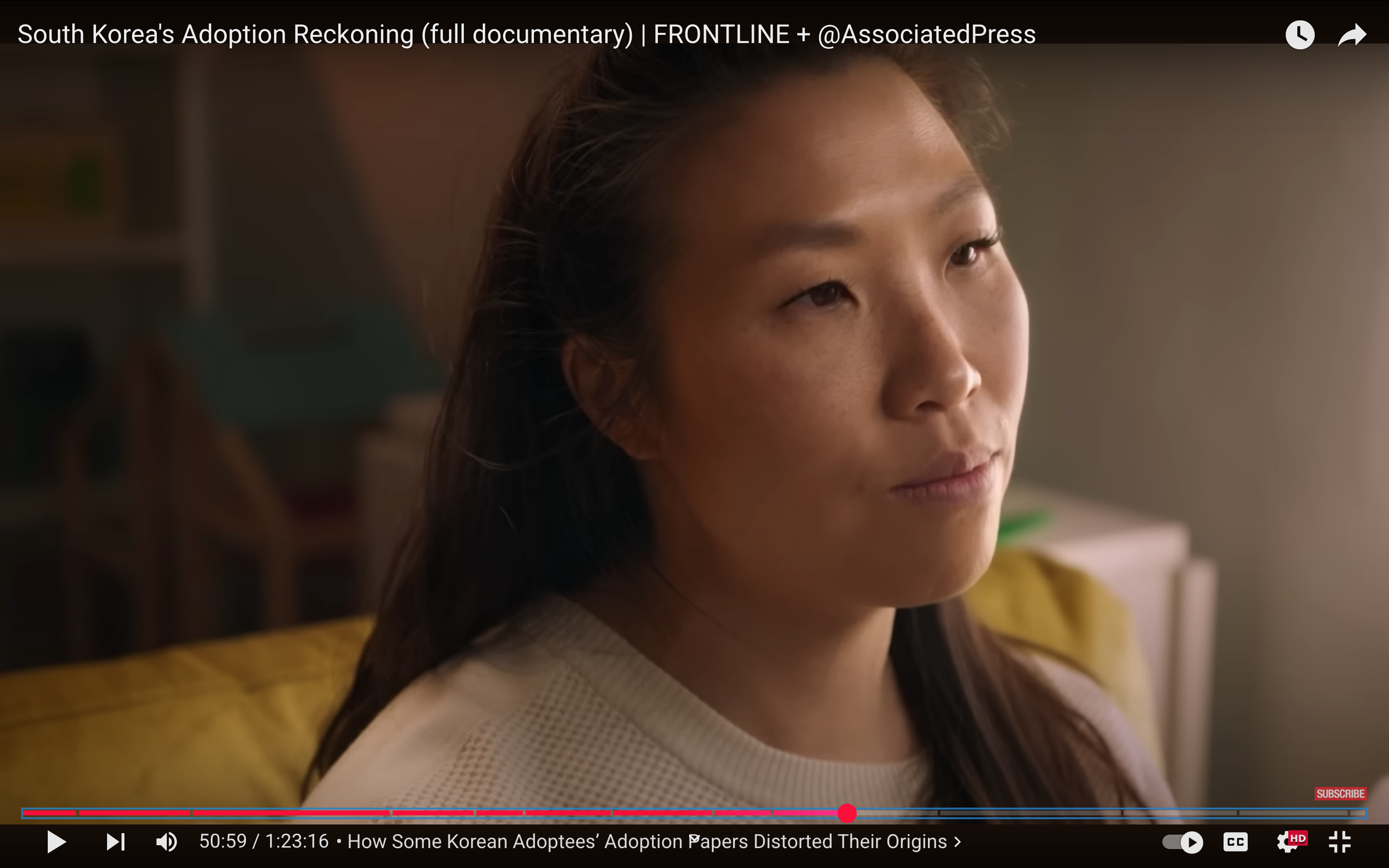
Michaela Dietz was referred to Tong-hyung Kim and Lora Moftah through Robyn Joy Park, as they are close friends. Both Robyn and Michaela’s stories were included amongst the “switch case story summaries” I had submitted to the head of the TRC on December 18th, 2020, though at the time, all of our submissions were anonymous. I had been in touch with Michaela since November 1st, 2020, when we did a Zoom so that I could hear her story. Below is my follow up email to Michaela following our Zoom. This email makes clear that we discussed her switch case, before I ever approached Tong-hyung Kim about writing a story about Systemic Switching in January 2021:
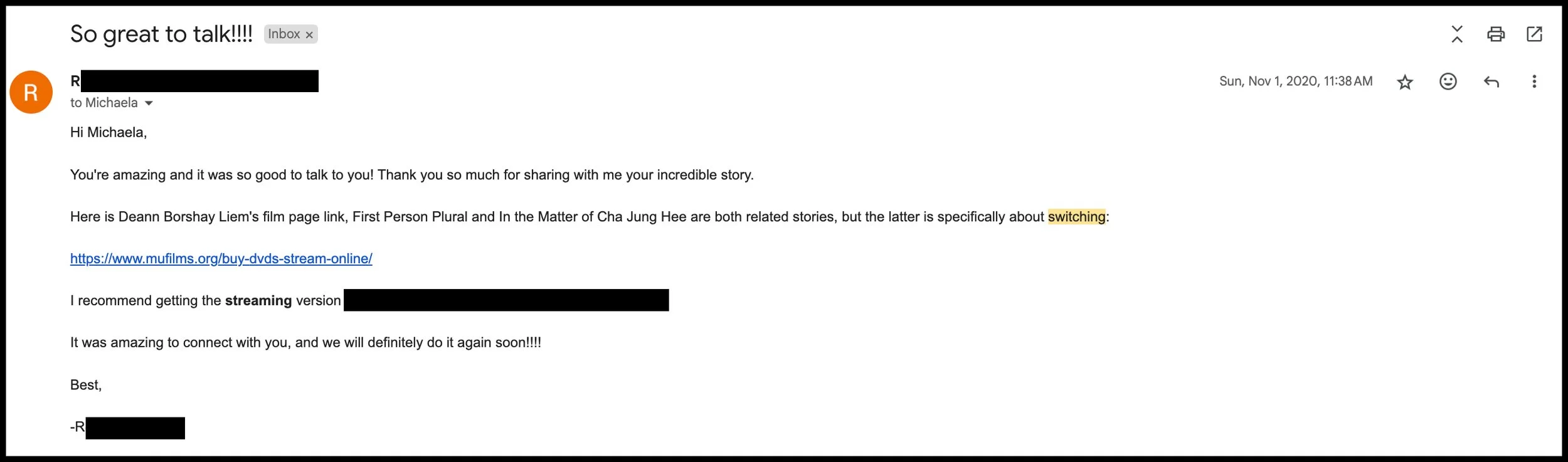
My email to Michaela Dietz on November 1st, 2020 reads:
”Hi Michaela,
You're amazing and it was so good to talk to you! Thank you so much for sharing with me your incredible story.
Here is Deann Borshay Liem's film page link, First Person Plural and In the Matter of Cha Jung Hee are both related stories, but the latter is specifically about switching:
https://www.mufilms.org/buy-dvds-stream-online/
I recommend getting the streaming version…
It was amazing to connect with you, and we will definitely do it again soon!!!!
Best,
-R”
I had been in touch with Michaela Dietz once through Zoom since November 1st, 2020. I became connected to Michaela through her good friend Robyn Joy Park, whom I had known from LA Korean Adoptee circles since around 2018. I had included both Robyn and Michaela’s switch story summaries in the cases which I submitted through a contact to the head of the TRC on December 18th, 2020.
On June 23rd, 2023, I messaged Robyn Joy Park to offer to connect her to AP reporter Tong-hyung Kim and FRONTLINE Director Lora Moftah, since we would all be in Korea at the same time for the IKAA conference. I had originally connected Robyn Joy and by extension Michaela Dietz (since they are good friends) to Tong-hyung, probably around 2021 when I first reached out to him to write a story about Systemic Switching.
5. Korean Adoptee—Robert Calabretta.
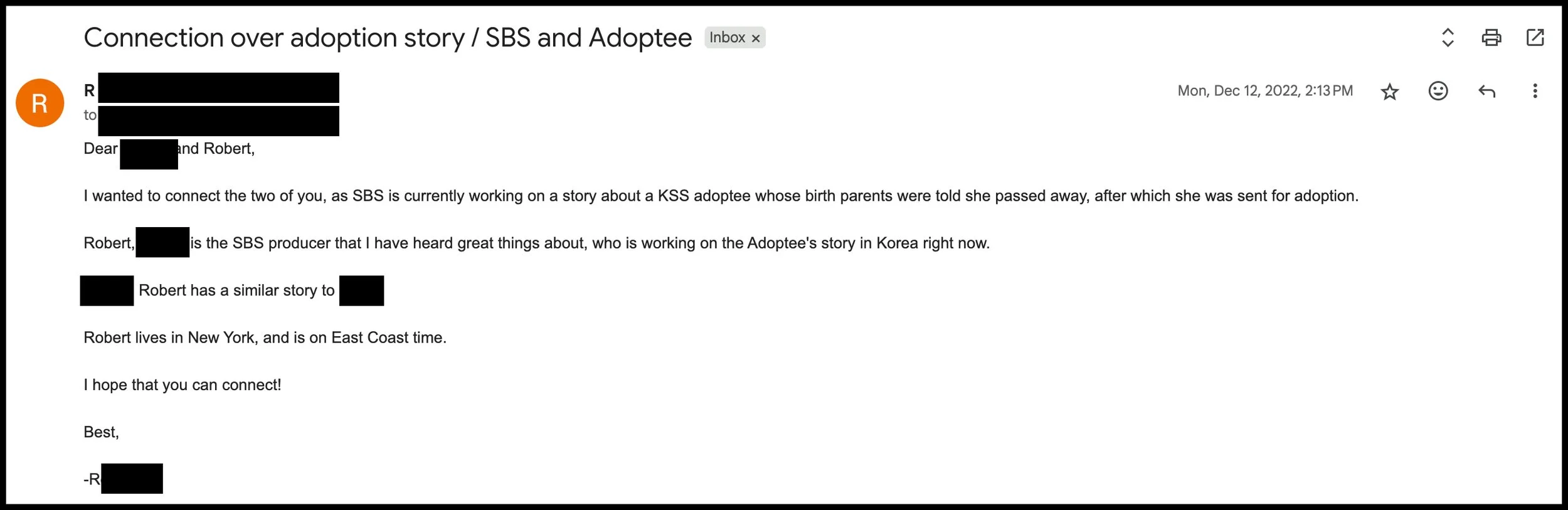
Since I introduced Tong-hyung Kim to Adoptee Robert Calabretta in person at the IKAA conference in July 2023, I do not have any written record of my having introduced them. However, this email from December 12th, 2022 shows that I had introduced Robert Calabretta to an SBS (Seoul Broadcasting System) producer I had heard about, to whom I had also referred another KSS Adoptee, “M.”, whom I also referred to Tong-hyung Kim. “M.’s” story was eventually featured both by SBS and in the FRONTLINE / AP article series. (I have included her information elsewhere on this page). This email shows that I was introducing Robert Calabretta to various journalists in 2022 — and the FRONTLINE / AP documentary came out in September 2024.
My email from December 12th, 2022 reads:
“Dear (redacted) and Robert,
I wanted to connect the two of you, as SBS is currently working on a story about a KSS adoptee whose birth parents were told she passed away, after which she was sent for adoption.
Robert, (redacted) is the SBS producer that I have heard great things about, who is working on the Adoptee's story in Korea right now.
(redacted), Robert has a similar story to (redacted).
Robert lives in New York, and is on East Coast time.
I hope that you can connect!
Best,
-R”
I directly referred Robert Calabretta to Tong-hyung Kim at the IKAA conference to be filmed by the FRONTLINE documentary.
When I saw Robert Calabretta at IKAA at a later event at a restaurant, he rose to greet me in thanks as I had already put him in touch with Tong-hyung Kim for filming at the earlier IKAA Newcomer’s event.
+
Referral Regarding Access To The BBC “Panorama” Documentary About Korean Adoption.
While not a referral of an interview subject, this footage from an archival BBC film about Korean Adoption appears in the documentary thanks to my referral of AP reporter Claire Galofaro to a Korean Adoptee whom I knew had knowledge about how to obtain access to the documentary. So this was another contribution that I made to the FRONTLINE documentary—which, like all of my numerous other contributions, remains unacknowledged.
Since Claire Galofaro was brought into the AP story so late in the game — my first of a few Zooms with her was on October 2nd, 2023 — I had to spend a lot of time getting her up to date on the story I had already spent nearly three years by that point telling to Tong-hyung Kim, with whom I had been in touch since January 2021.
Sadly, Claire Galofaro did not pursue two important leads that I mentioned would be important in the investigation of systemic switching, even though I asked her about this twice.
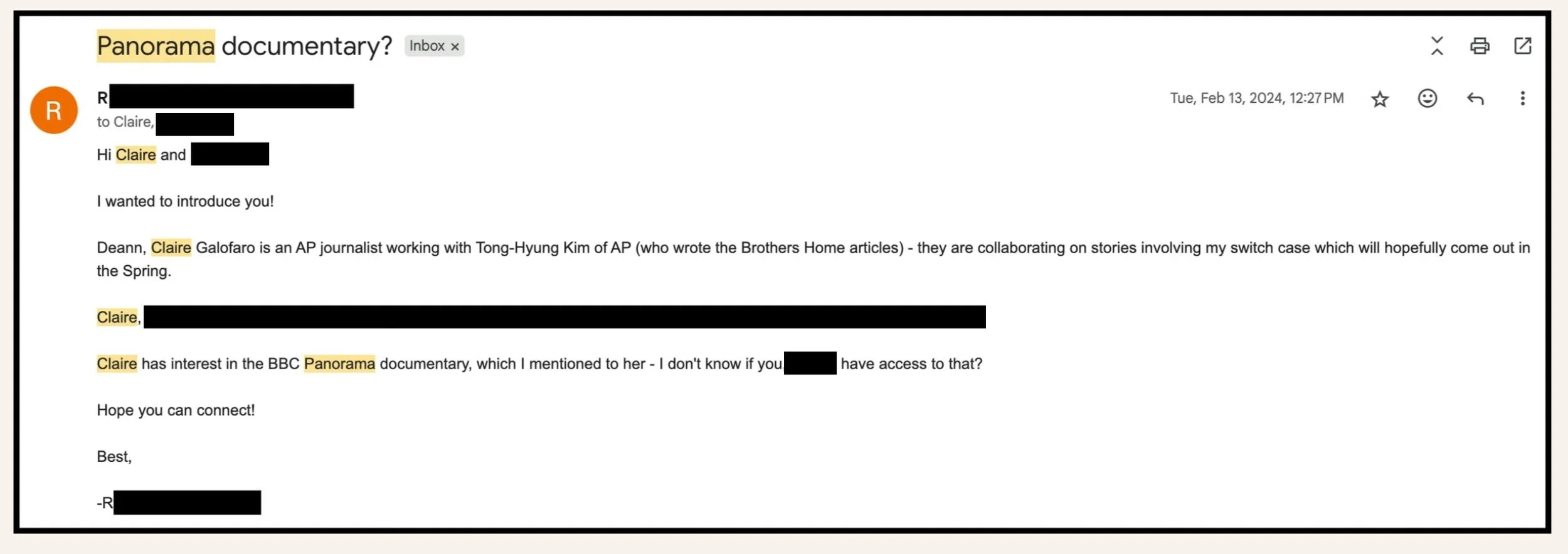
My email from February 13th, 2024 reads:
“Hi Claire and (redacted),
I wanted to introduce you!
(Redacted), Claire Galofaro is an AP journalist working with Tong-Hyung Kim of AP (who wrote the Brothers Home articles) - they are collaborating on stories involving my switch case which will hopefully come out in the Spring.
Claire...
Claire has interest in the BBC Panorama documentary, which I mentioned to her - I don't know if you, (redacted) have access to that?
Hope you can connect!
Best,
-R”
+
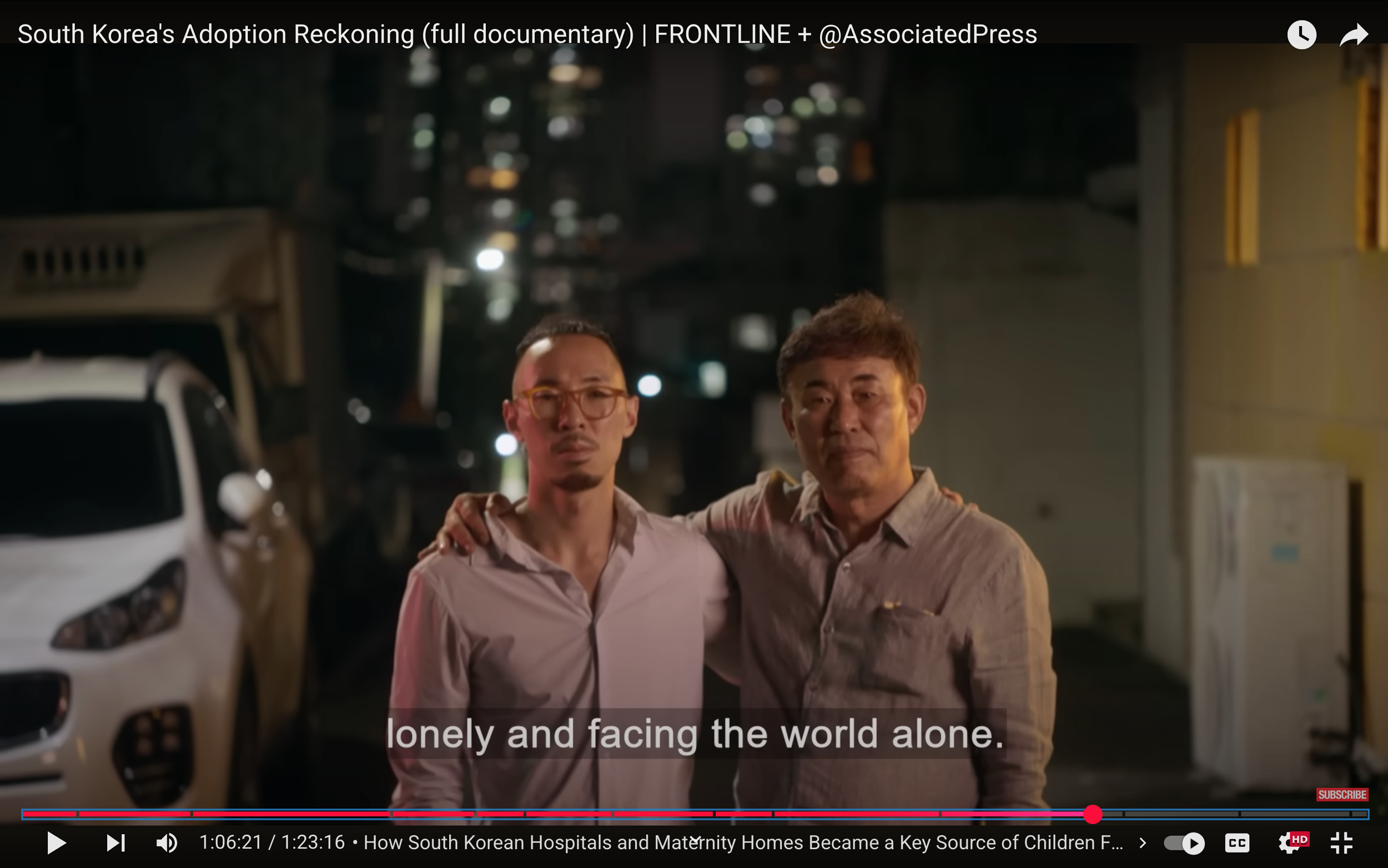
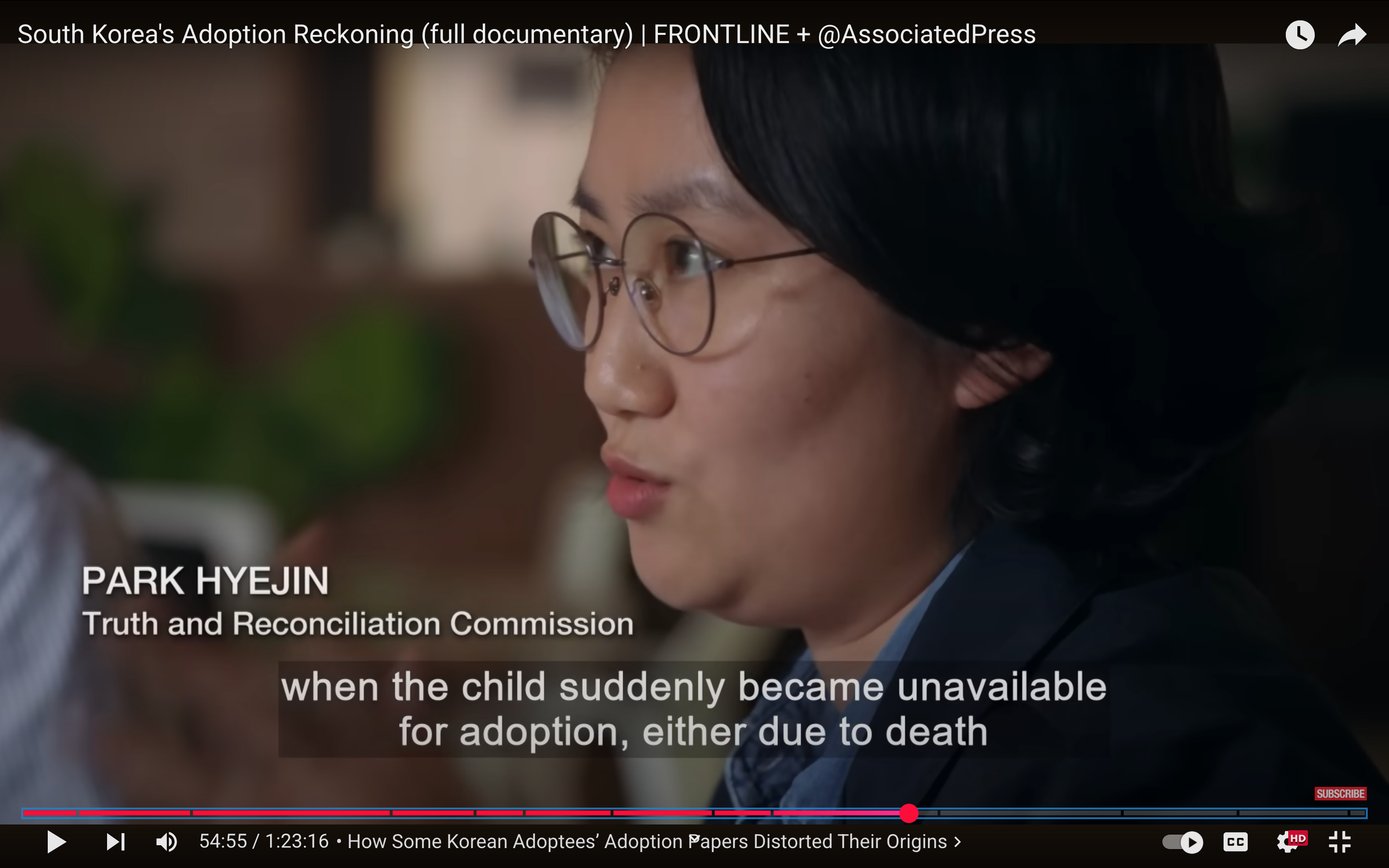
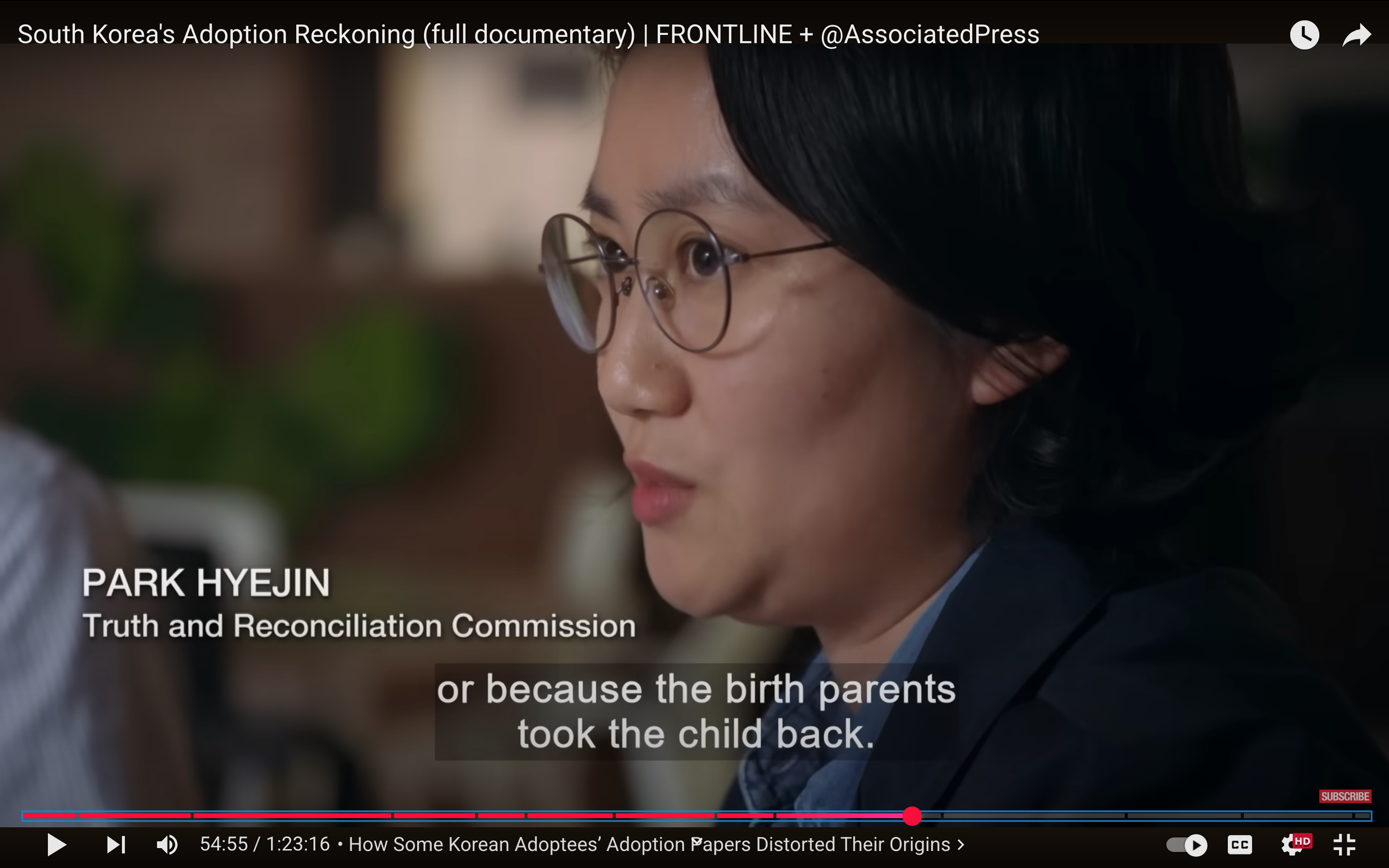
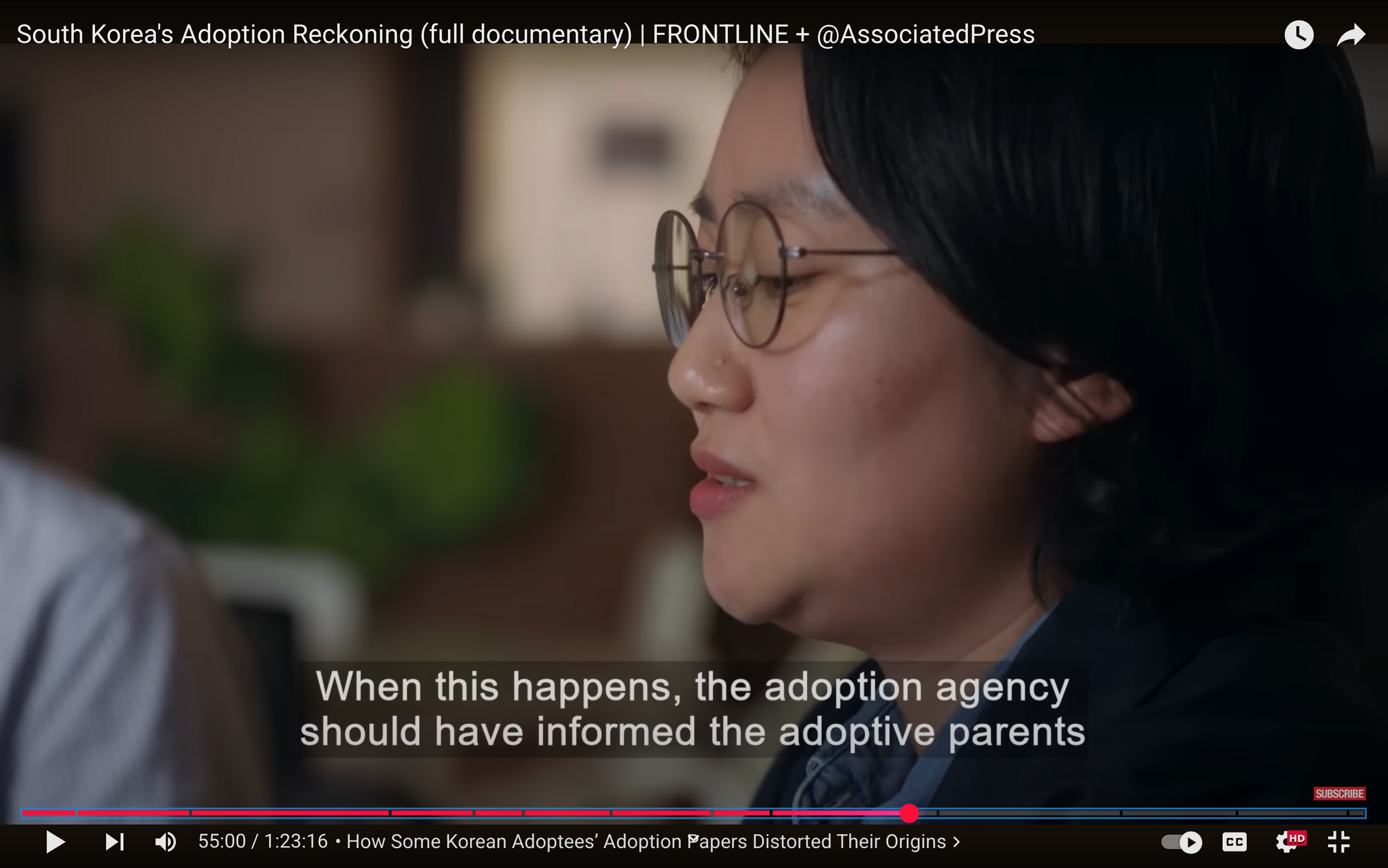
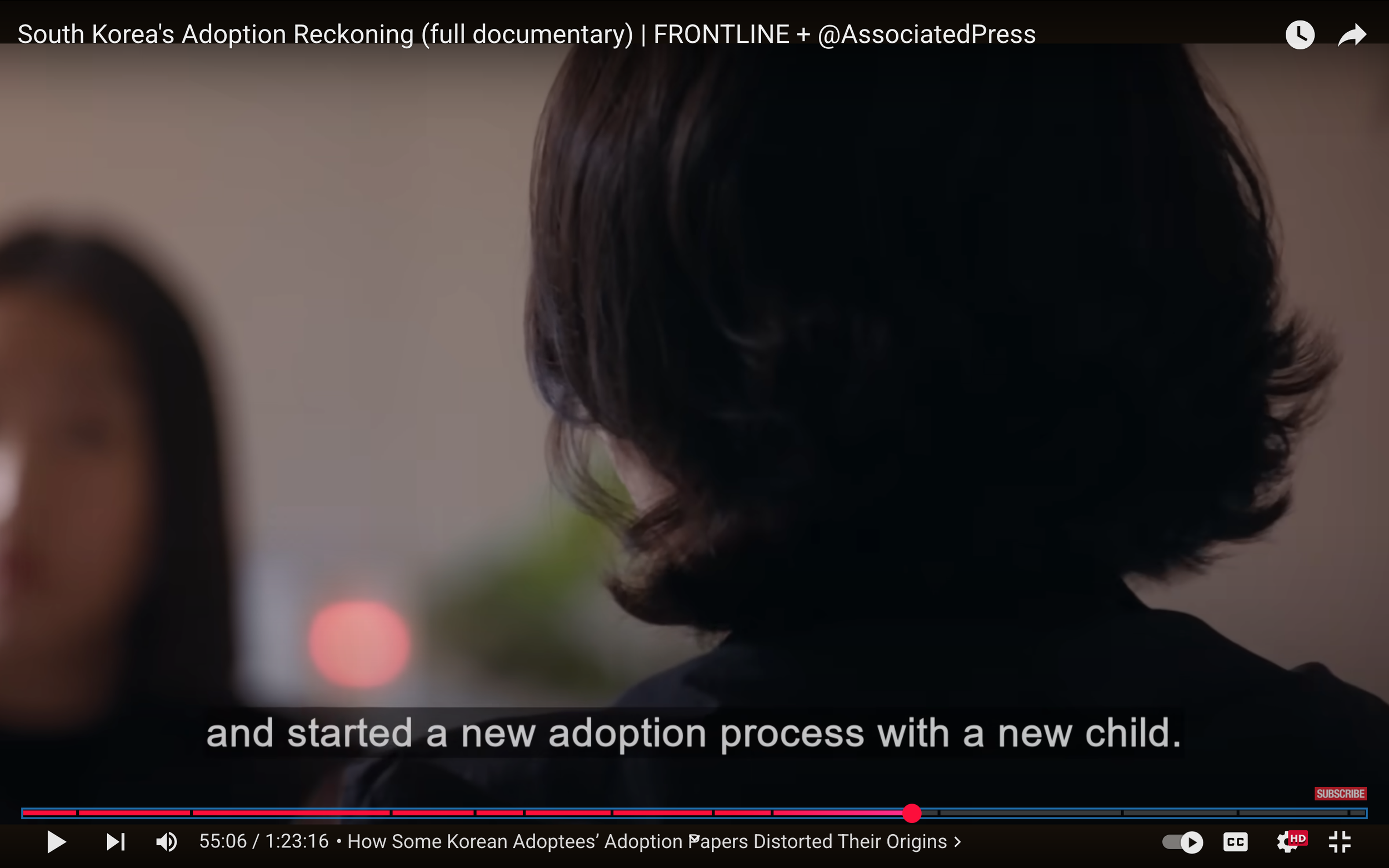
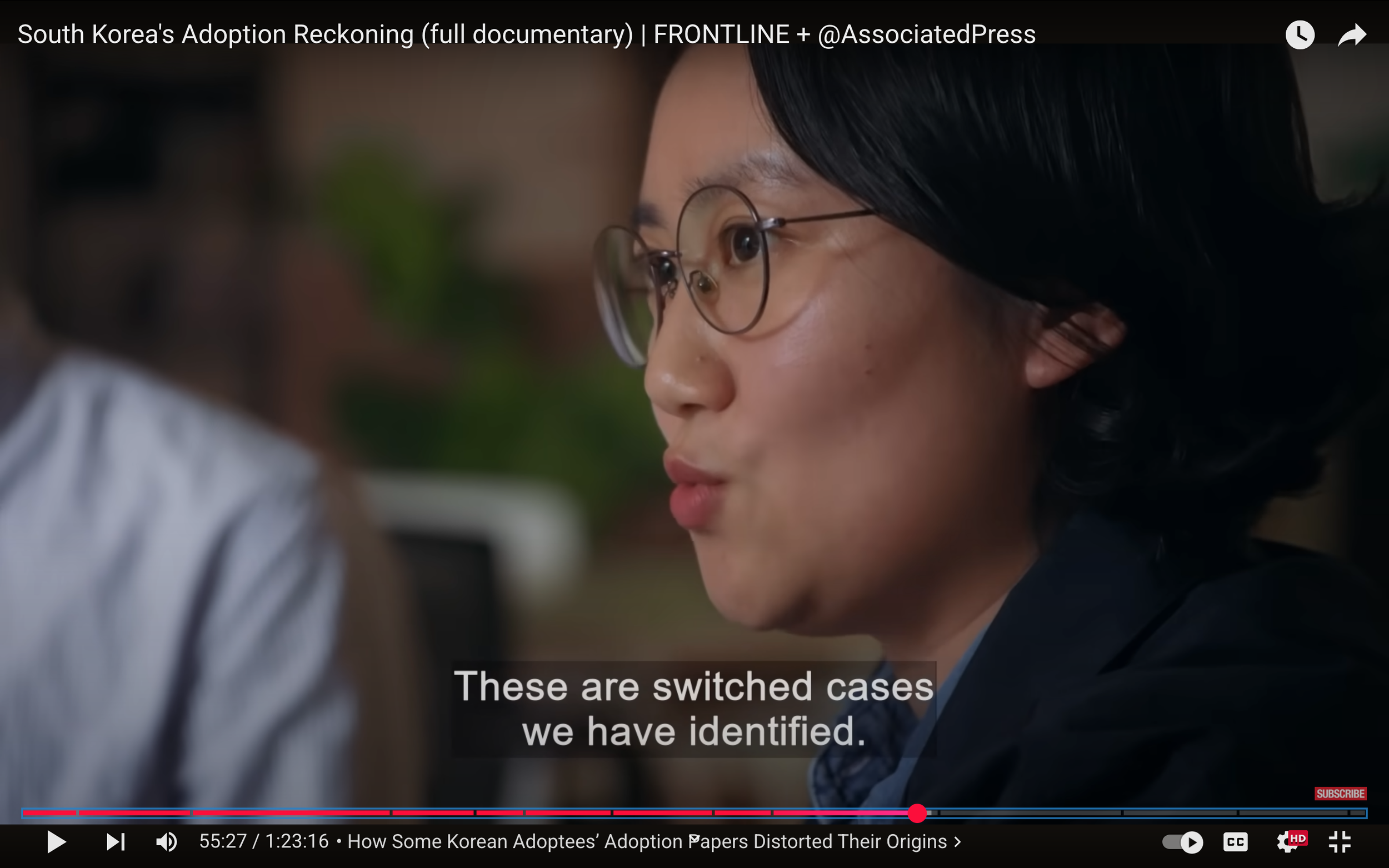
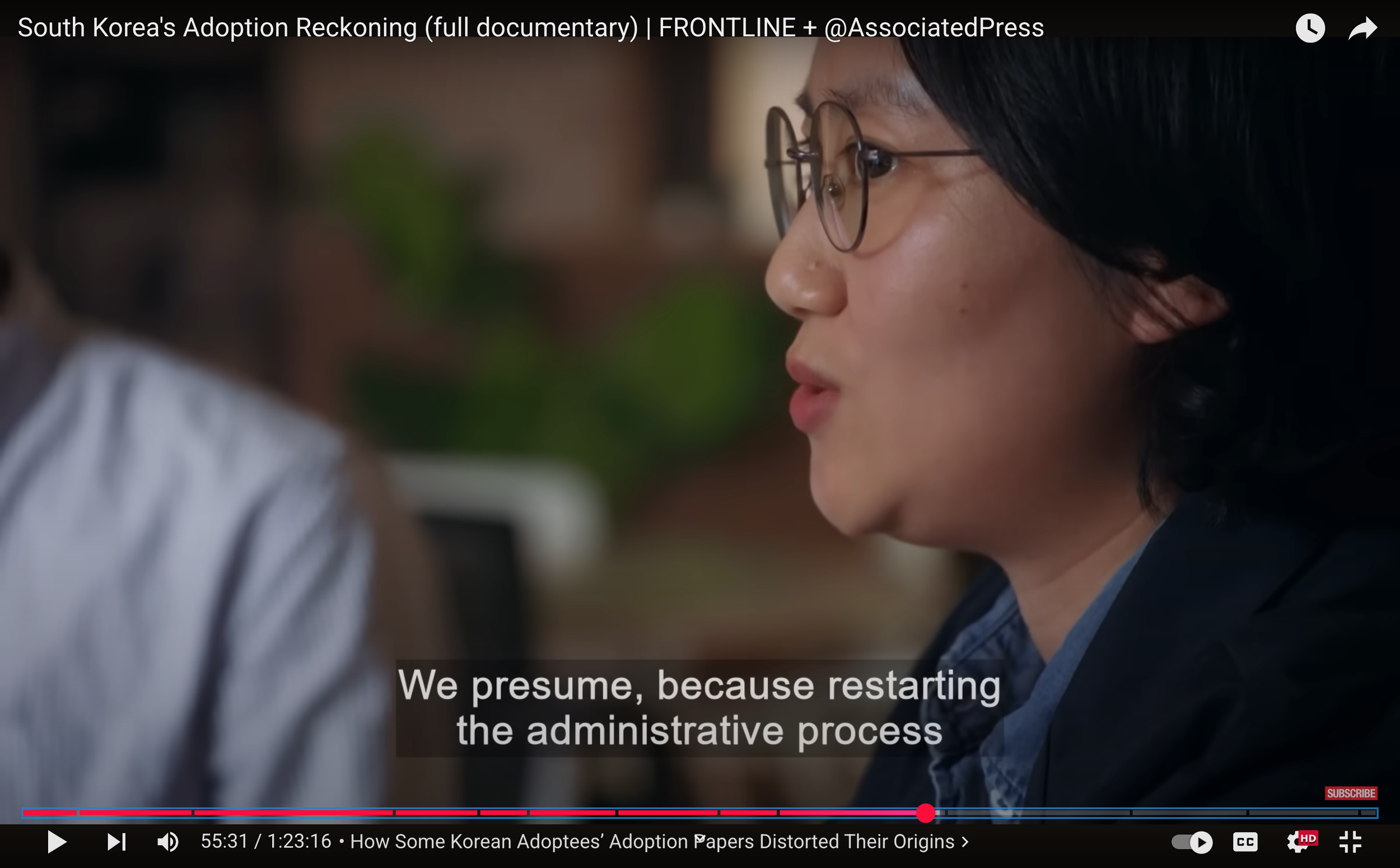
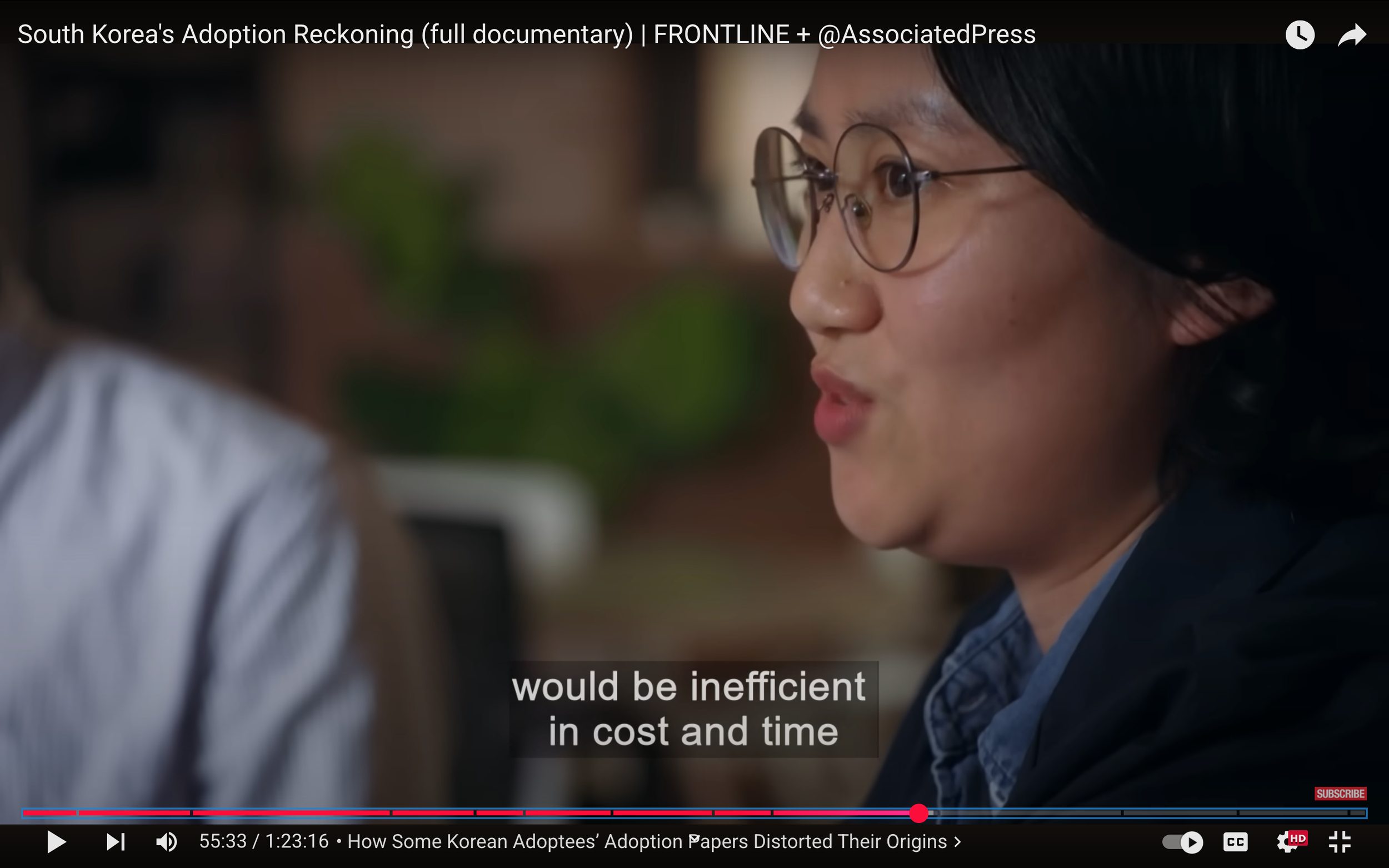
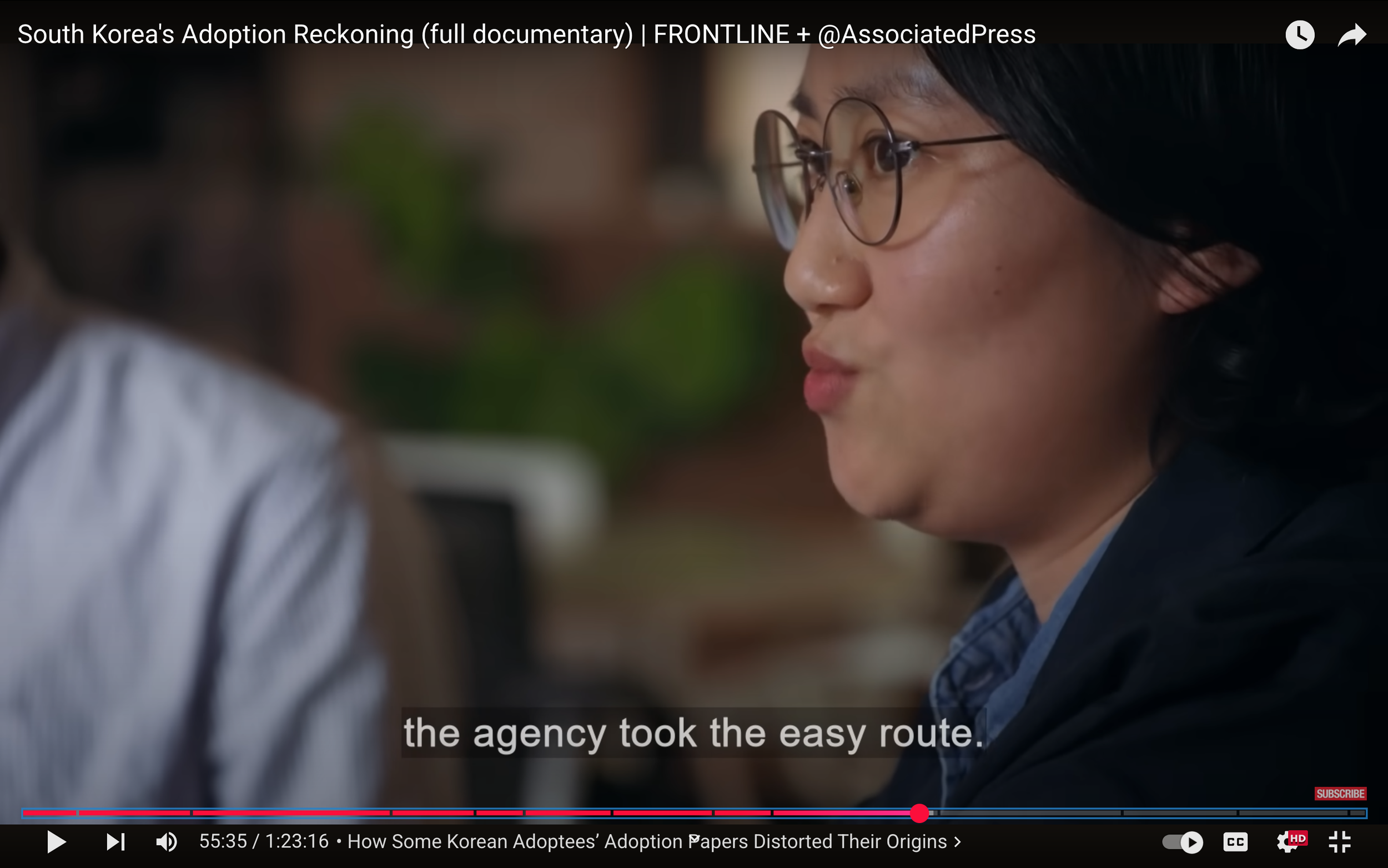
In the stills below from the 2024 FRONTLINE Documentary, TRC Investigator Park Hyejin is being interviewed by AP reporter Tong-hyung Kim about the practice of systemic switching. Notably, the investigator is essentially repeating—almost verbatim—the definition of systemic switching that I personally codified and submitted to the head of the TRC on December 18th, 2020 and which I STATE CLEARLY in the SBS documentary about my case, released December 24th, 2022. (see stills below). The FRONTLINE interview with the TRC 2 investigators took place years later in either 2023 or 2024. By that time, Tong-hyung Kim was already fully aware of the definition of switching I had formulated. I have CLEAR PROOF of this codification: I clearly state my definition of switching in the 2022 SBS documentary about my own switch case—stills from which are included below for context.
The FRONTLINE documentary makes no mention of the fact that I had submitted switch case story summaries to the head of the TRC on December 18th, 2020, and that this is how the TRC first came to know about switching—something of which Tong-hyung Kim was well aware at the time of this interview. Yet my contribution is never mentioned in the FRONTLINE documentary.
Park Hyejin says during her interview with AP reporter Tong-hyung Kim:
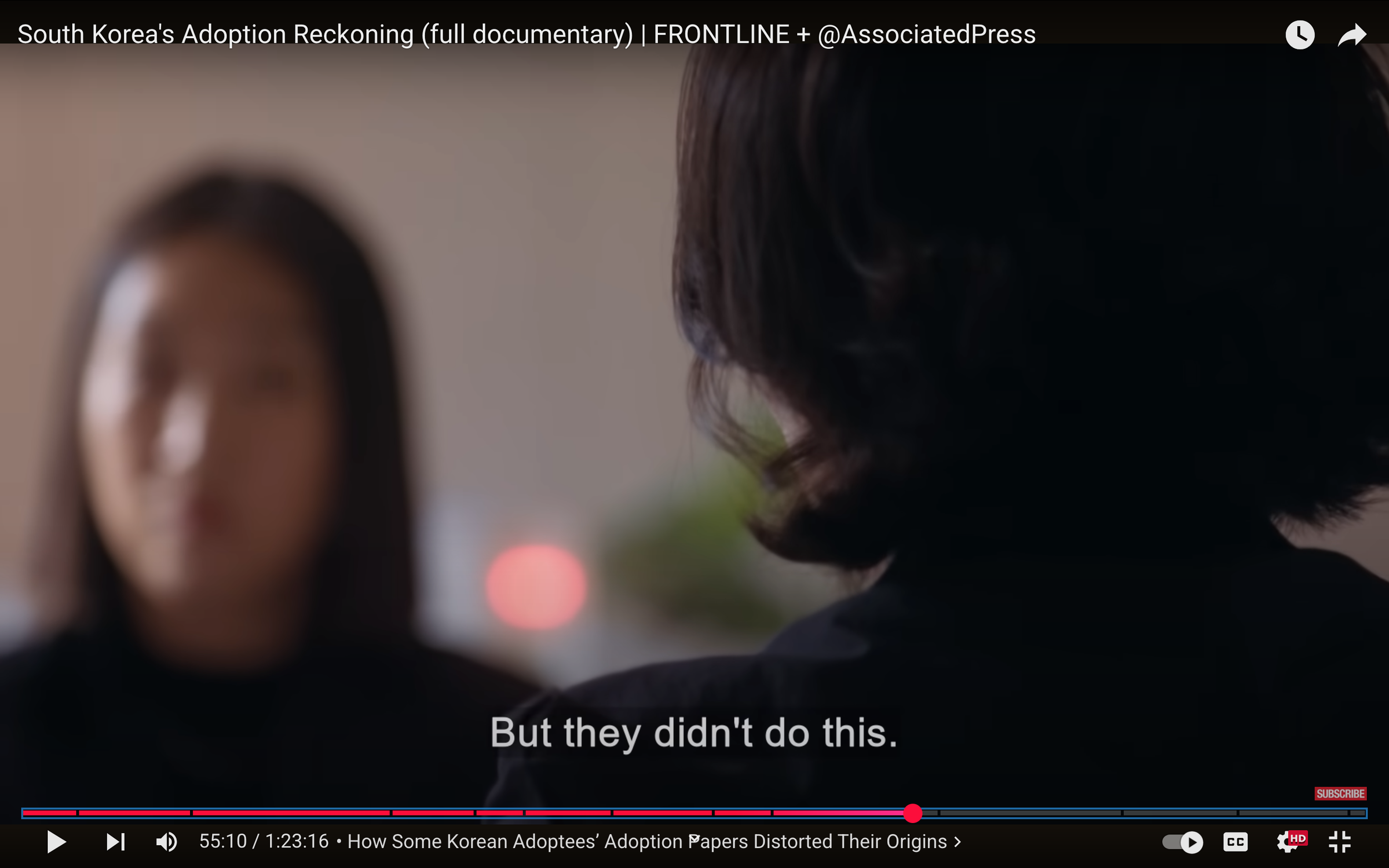
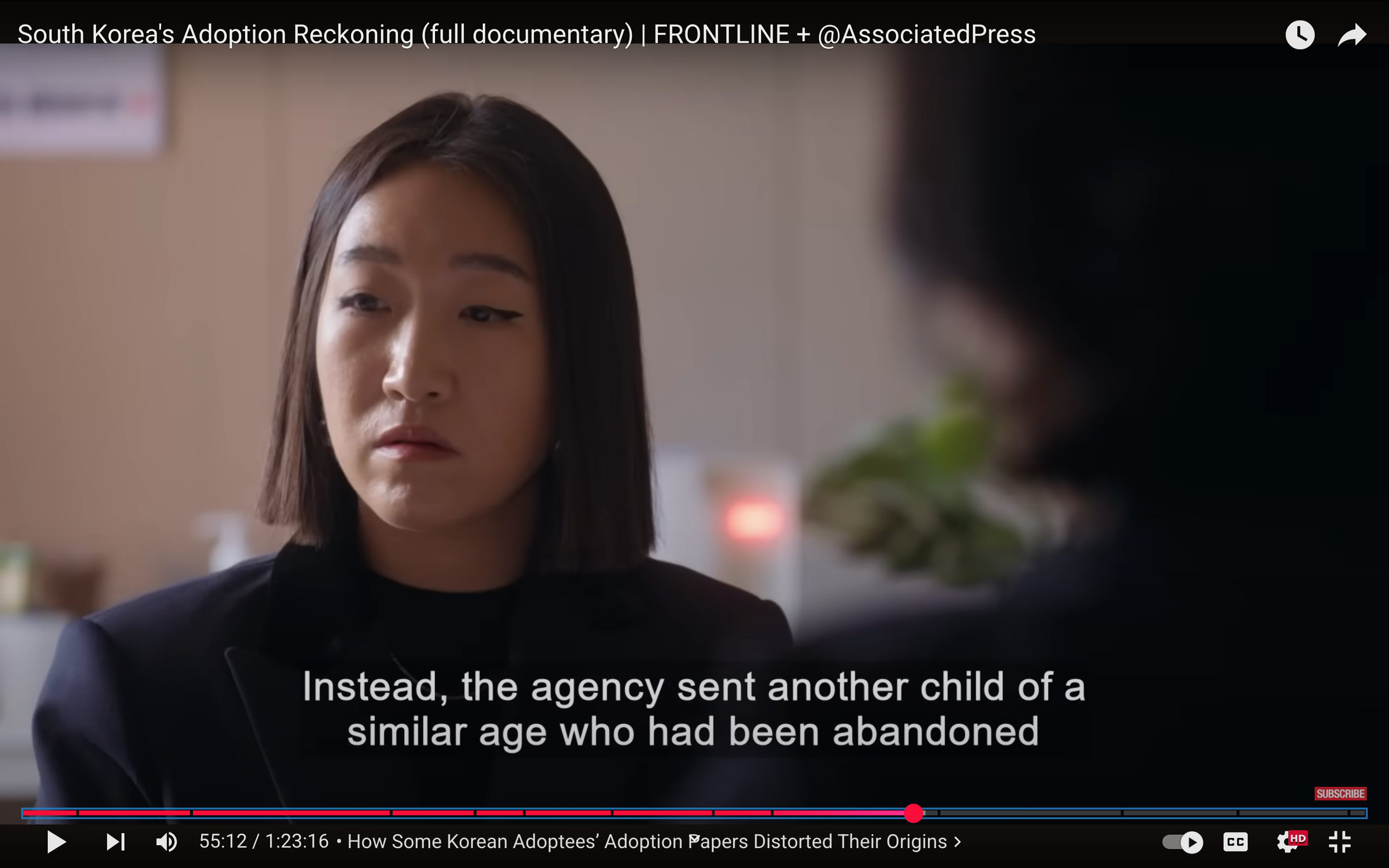
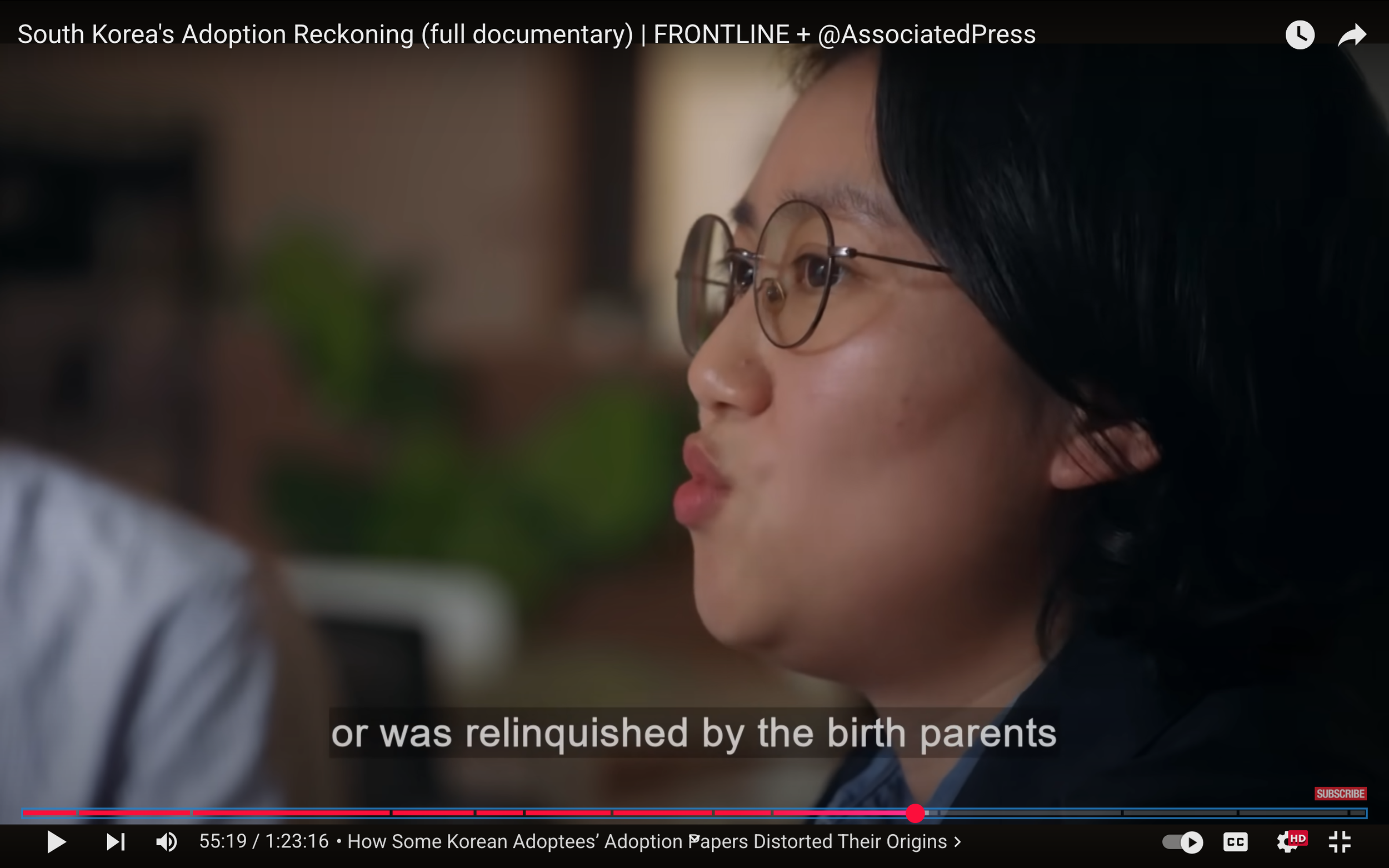
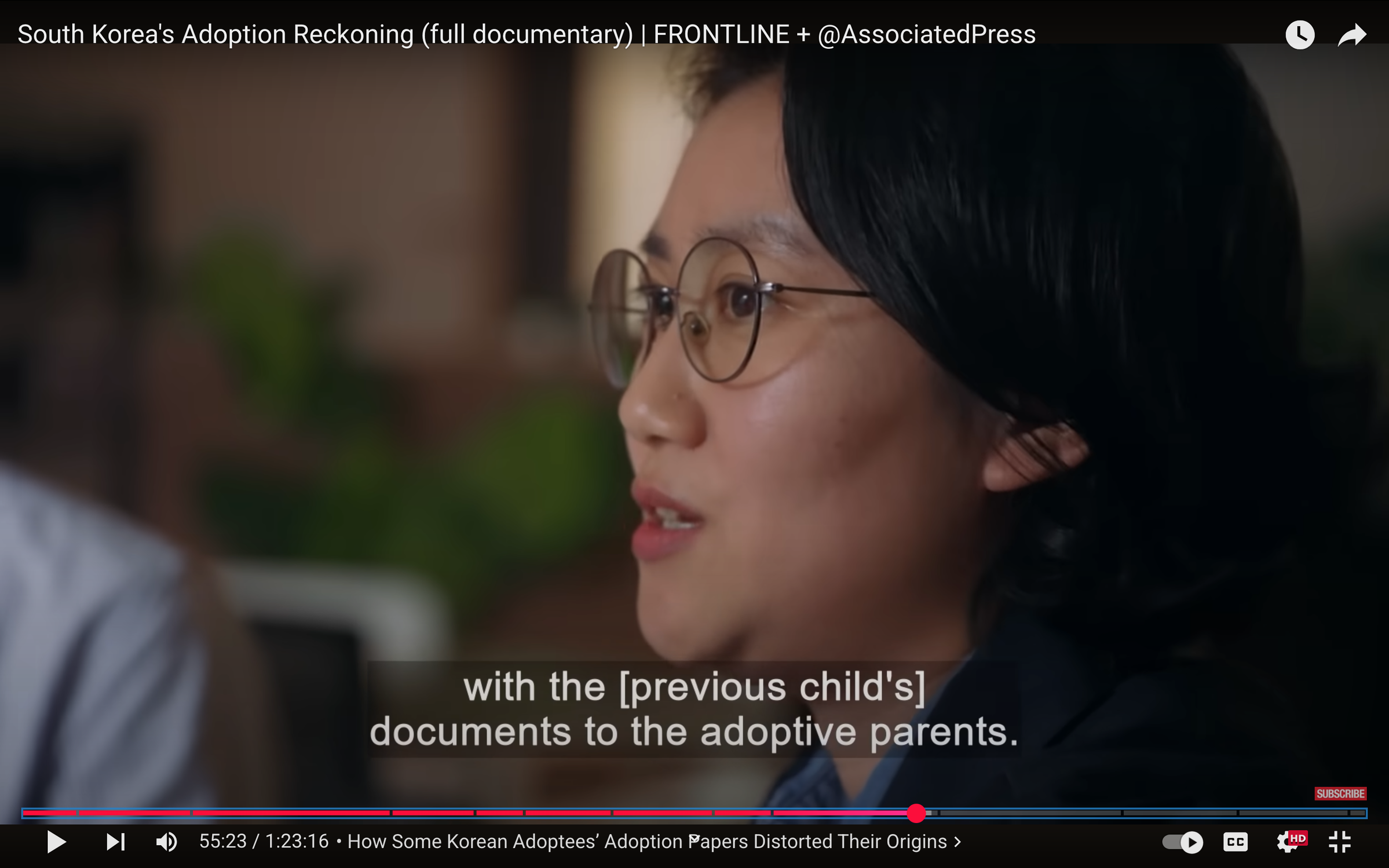
“(Switching is) when the child suddenly became unavailable for adoption, either due to death or because the birth parents took the child back. When this happens, the adoption agency should have informed the adoptive parents and started a new adoption process with a new child. But they didn’t do this. Instead, the agency sent another child of a similar age who had been abandoned or was relinquished by the birth parents with the previous child’s documents to the adoptive parents. These are switched cases we have identified. We presume, because restarting the administrative process would be inefficient in cost and time the agency took the easy route.” (sic)
The ONLY reason that the TRC knew about Switching even BEFORE the formal investigation into Overseas Adoption began on December 7th, 2022 is because I had submitted switch case story summaries to the head of the TRC through a contact on December 18th, 2020. Additionally, since my case was one of the first 34 cases accepted by the TRC in December 2022, I had emailed the TRC investigators a link to my SBS documentary from 2022. So the TRC Investigator PARK HYEJIN is repeating in this FRONTLINE documentary interview MY OWN definition of switching from the 2022 SBS documentary about my case. You can see stills from the SBS documentary below this section.
It’s also significant that many of the switched Adoptees I had identified since 2018 ultimately submitted their cases to the TRC 2 Investigation into Overseas Adoption once it began on December 7th, 2022. Without a doubt, this essential groundwork of collecting and codifying these over one dozen switched Adoptees contributed to the TRC 2 identifying Switching as a human rights violation in its March 26th, 2025 Interim Report.
Below: My email to a TRC Investigator on December 11th, 2022, alerting him that the SBS documentary of my case would be airing in Korea:
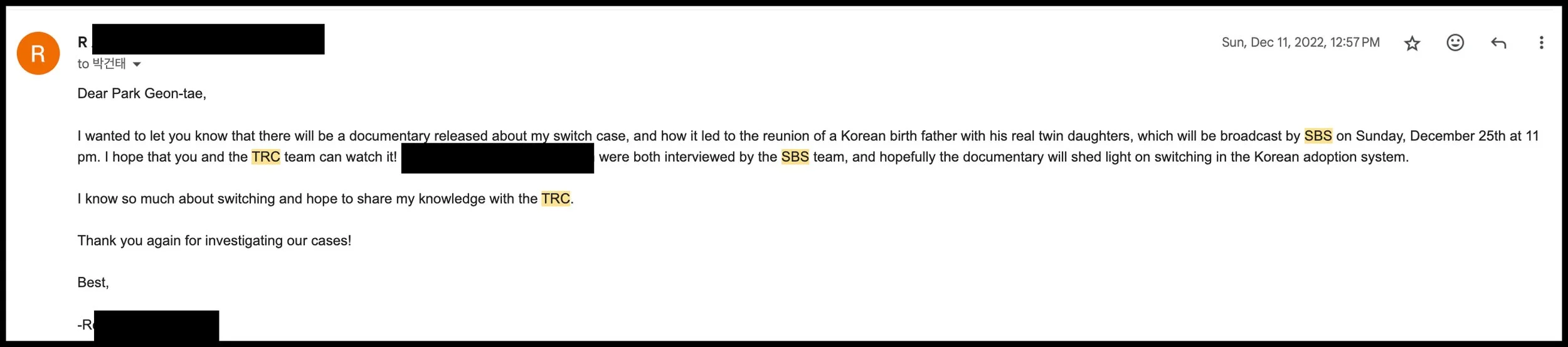
“Dear Park Geon-tae,
I wanted to let you know that there will be a documentary released about my switch case, and how it led to the reunion of a Korean birth father with his real twin daughters, which will be broadcast by SBS on Sunday, December 25th at 11 pm. I hope that you and the TRC team can watch it! (Redacted) were both interviewed by the SBS team, and hopefully the documentary will shed light on switching in the Korean adoption system.
I know so much about switching and hope to share my knowledge with the TRC.
Thank you again for investigating our cases!
Best,
-R”
Unfortunately I had to withdraw my TRC case, due to the behavior of DKRG leaders who sought to take credit for my work.
+
Below:
Stills from the FRONTLINE / AP documentary, in which one of the three TRC Investigators recites almost verbatim the definition of switching I had codified in 2018, based off of the many cases of switched Adoptees I was discovering.
On December 18th, 2020, I had submitted case study summaries of around one dozen switched Adoptees to the head of the TRC through a contact. This is how the TRC investigators became aware of systemic switching. I had also sent them a link to the 2022 SBS documentary about my case, in which I state the same definition of switching I had codified in 2018. You can see stills from the SBS documentary below this section.
TRC 2 Investigator Park Hyejin of the TRC states:
“(Switching happened) when the child suddenly became unavailable for adoption, either due to death or because the birth parents took the child back. When this happens, the adoption agency should have informed the adoptive parents and started a new adoption process with a new child. But they didn’t do this. Instead, the agency sent another child of a similar age who had been abandoned or was relinquished by the birth parents with the (previous child’s) documents to the adoptive parents. These are switched cases we have identified. We presume, because restarting the administrative process would be inefficient in cost and time, (that) the agency took the easy route.”
In the SBS documentary about my case, released on December 24th, 2022—nearly two years before the FRONTLINE/AP documentary aired on September 20th, 2024—I stated the definition of "switching" that I had codified in 2018:
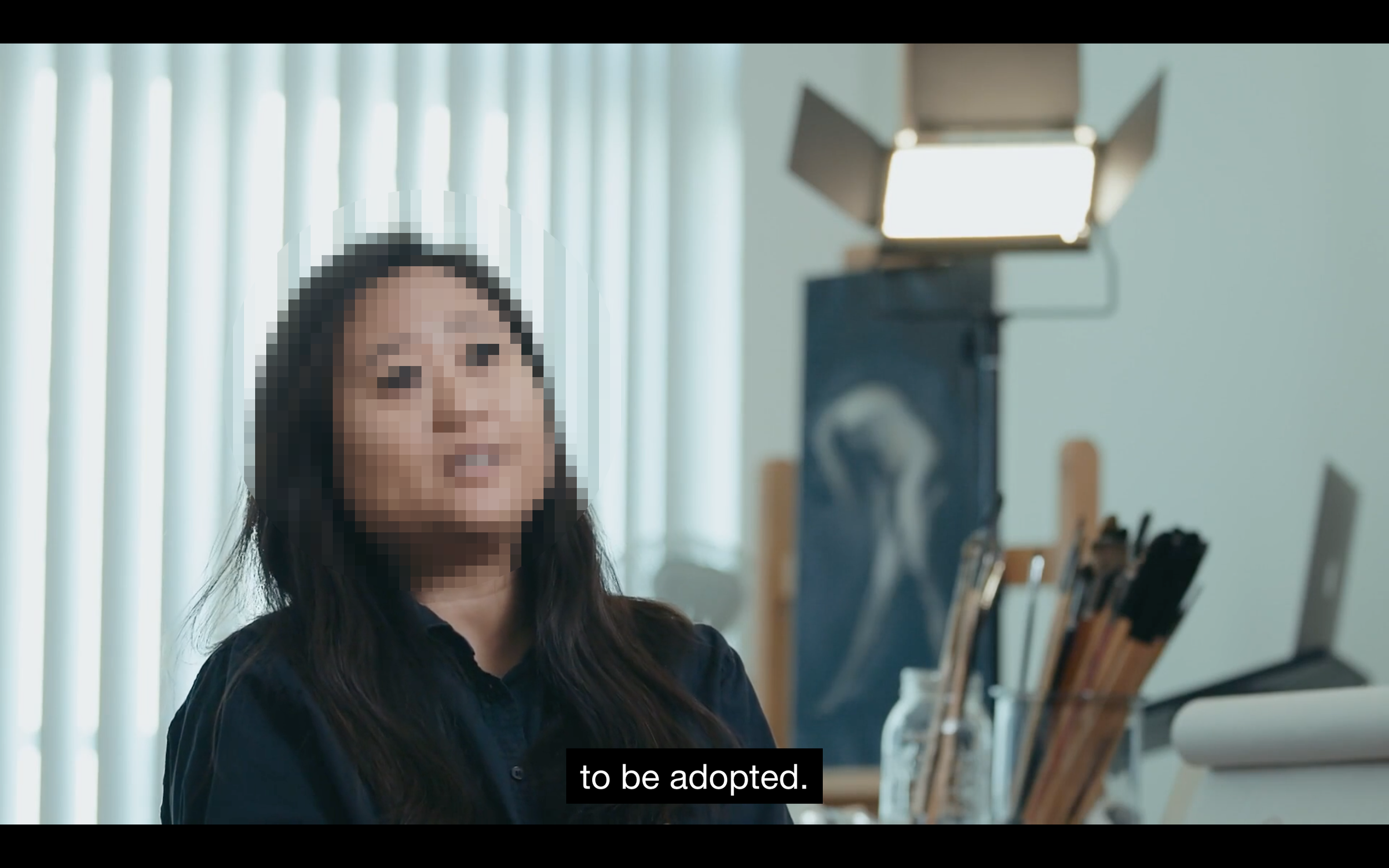
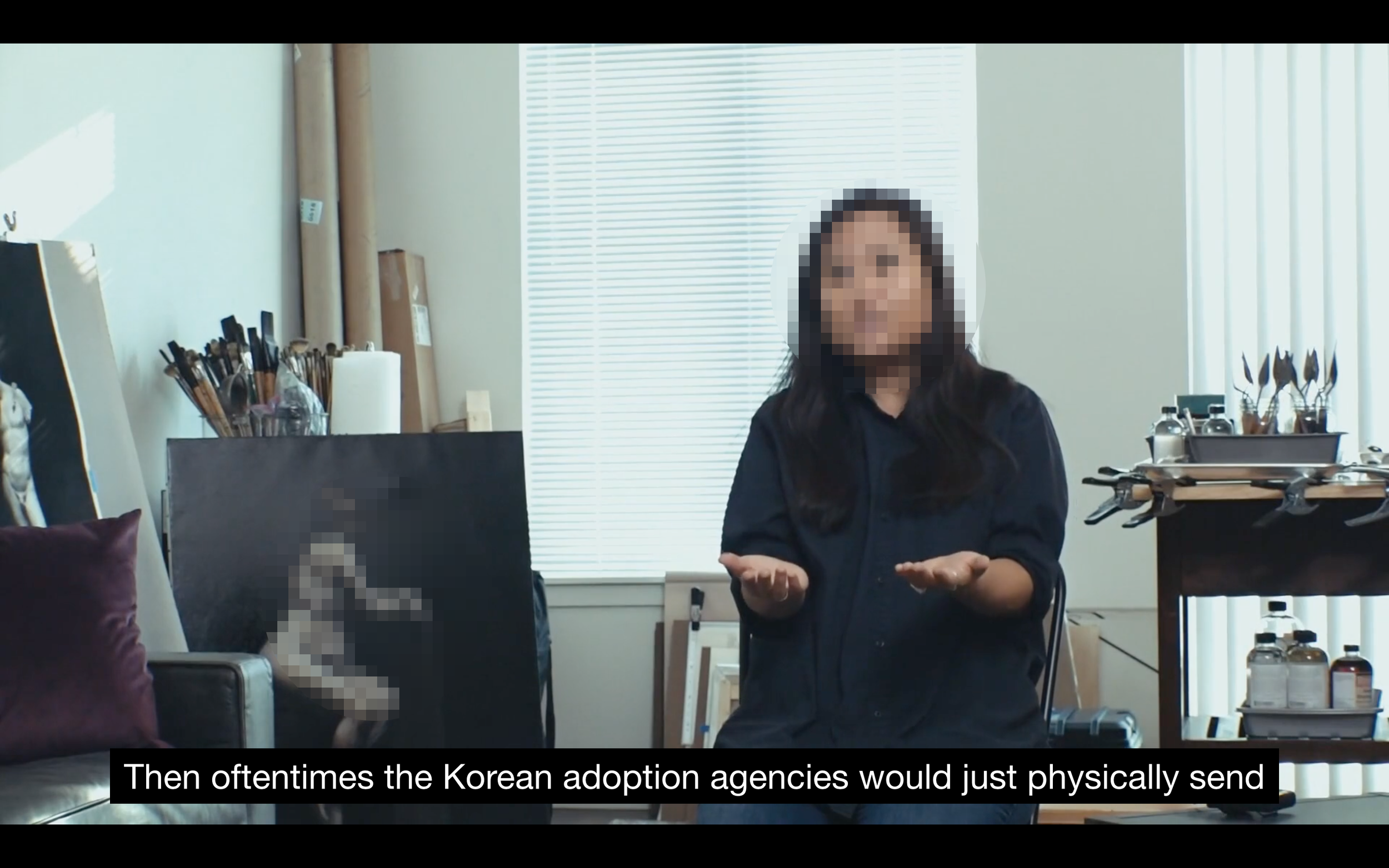
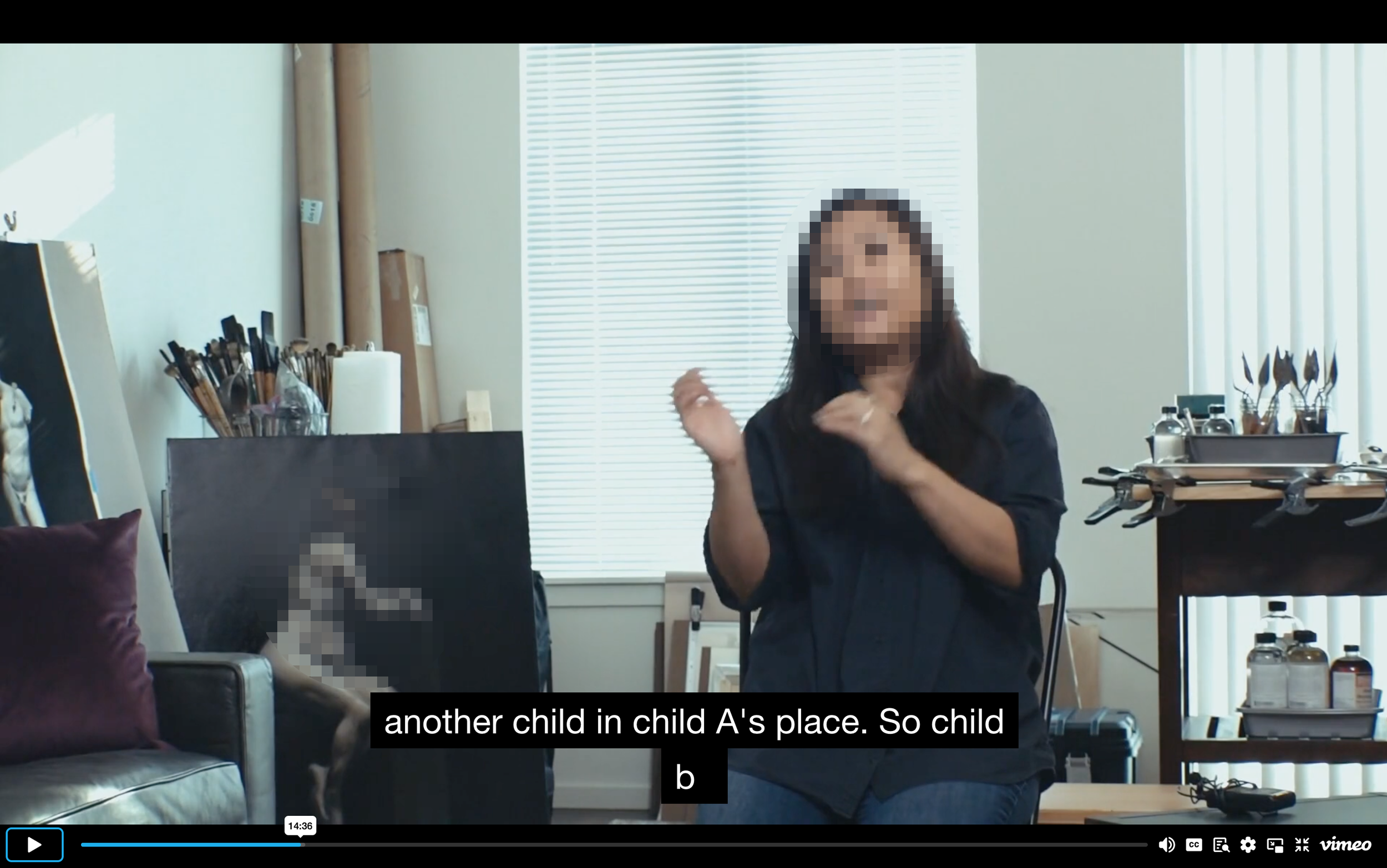
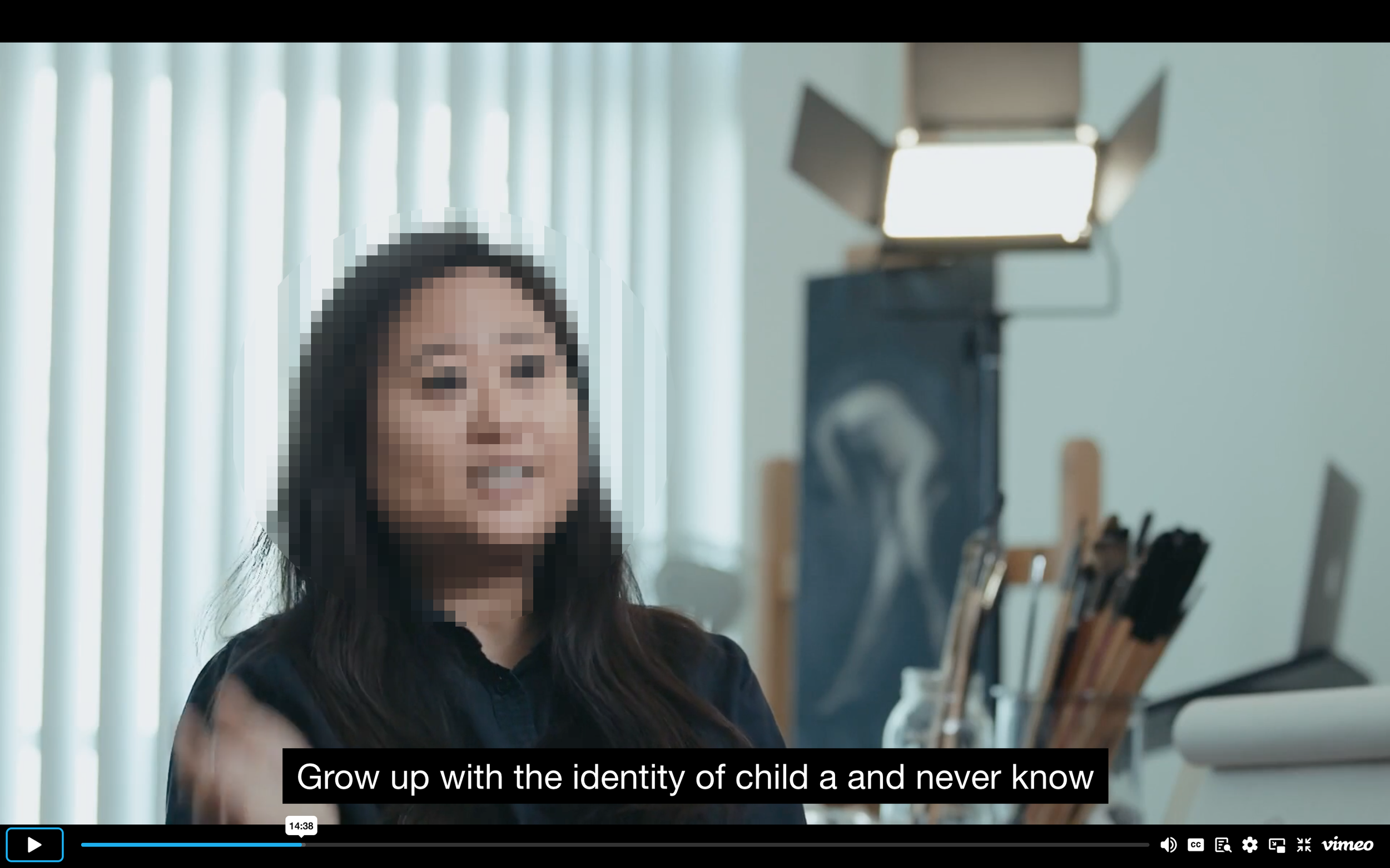
”Switching is basically when, let’s say “Child A” is matched to a prospective adoptive couple in the West. Let’s say she dies or becomes too sick to travel or her birth parents come back to the orphanage or adoption agency to pick her up before she’s supposed to be adopted. Then oftentimes the Korean adoption agencies would just physically send another child in “Child A’s” place. So “Child B” would grow up with the identity of “Child A” and never know the difference.”
*I should also note that switching could happen in cases where adoptions were cancelled — either by the adoption agency or by prospective adoptive parents. We frankly don’t know all the possible scenarios in which switching could take place.
My point, however, is that contrary to what Lora Moftah and Tong-hyung Kim claimed in their email to me after I called them out for failing to credit my work in the documentary, there is absolutely ZERO evidence that Tong-hyung was investigating switching prior to my first contacting him in January 2021 about writing a story on systemic switching — a topic I had been researching since 2018. By contrast, my evidence is clear and rock solid, as demonstrated by the 2022 SBS documentary.
Below:
Stills from the FRONTLINE / AP documentary, in which TRC Investigator Park Hyejin recites almost verbatim the definition of systemic switching I had codified in 2018, based off of the many cases of switched Adoptees I had identified since then. Her definition comes directly from me by way of the case study summaries I had submitted to the head of the TRC through a contact on December 18th, 2020.
The only way Tong-hyung Kim would even know to ask the TRC investigator about switching is because of my years of discussions with him about systemic switching since 2021. While individual switch cases had occasionally been identified before in media, systemic switching had only been first identified by me in the SBS documentary about my case, released on December 24th, 2022 — two years before the FRONTLINE / AP documentary came out.
+
BELOW: Stills From The SBS (Seoul Broadcasting System) Documentary About My Switch Case. Released: December 24th, 2022—Almost 2 Years BEFORE The FRONTLINE Documentary (Released: September 20th, 2024).
For the first time in such a prominent format, the issue of Systemic Switching was brought to the attention of the South Korean public (and the public anywhere in the world) through a one-hour SBS documentary that aired on December 24th, 2022, in which I shared my switch story. (Previously, individual cases of switching had been discussed in the media, but the topic of systemic switching had never previously been investigated).
I had sent the link for the SBS documentary directly to AP reporter Tong-hyung Kim, so he was well aware of its release. In fact this documentary was the basis of the article he would finally write about my case in October 2024. Moreover, the documentary gained significant visibility in Korea—it was virtually unavoidable. While filming the FRONTLINE documentary in Seoul in 2023, I was even recognized by a passerby on the street, and by a police officer at a police station.
In the SBS piece, I introduced and defined what I have termed Classic Switching—marking the first time this concept was publicly codified in South Korean media. To my knowledge, Systemic Switching had never been addressed in the context of the Korean Adoption program in U.S. media either. Although isolated cases of child switching have occasionally surfaced, the broader, systemic pattern had never been identified or publicly examined. I was the first to do so, through my 2022 appearance on SBS.
In the stills from the SBS documentary below, I say:
”Switching is basically when, let’s say “Child A” is matched to a prospective adoptive couple in the West. Let’s say she dies or becomes too sick to travel or her birth parents come back to the orphanage or adoption agency to pick her up before she’s supposed to be adopted. Then oftentimes the Korean Adoption Agencies would just physically send another child in “Child A’s” place. So “Child B” would grow up with the identity of “Child A” and never know the difference.”
Given that prior to this 2022 SBS documentary about my case, Systemic Switching within Korean Adoption had NEVER been discussed before in S. Korean or Western media, I find it difficult to believe that Tong-Hyung Kim and Lora Moftah can claim that “their” investigation into Systemic Switching did NOT originate with my case. No one else had previously discussed Systemic Switching in S. Korean or Western media. This was the entire reason I first reached out to Tong-hyung Kim in January 2021 — and it’s likely why both he and Lora Moftah ultimately failed to acknowledge my contributions: so they could claim credit for themselves. Regardless of their motivations, the result is the same — they received the credit, and I was almost completely sidelined in the documentary.
In all the years that I have known him (since January 2021), Tong-hyung Kim has NEVER ONCE talked about or produced ANY evidence that he was investigating systemic switching BEFORE I first approached him in January 2021. And since she is neither Korean nor an Adoptee, Lora Moftah probably had zero interest in Korean Adoption as a subject prior to when she landed the Director’s role for the FRONTLINE documentary in Summer 2023. So for them to pretend that “their” investigation into systemic switching did NOT begin with me is patently false and utterly ridiculous. It’s frankly deplorable.
BELOW: Stills From The SBS (Seoul Broadcasting System) Documentary About My Switch Case. Released: December 24th, 2022—Almost 2 Years BEFORE The FRONTLINE Documentary (Released: September 20th, 2024).
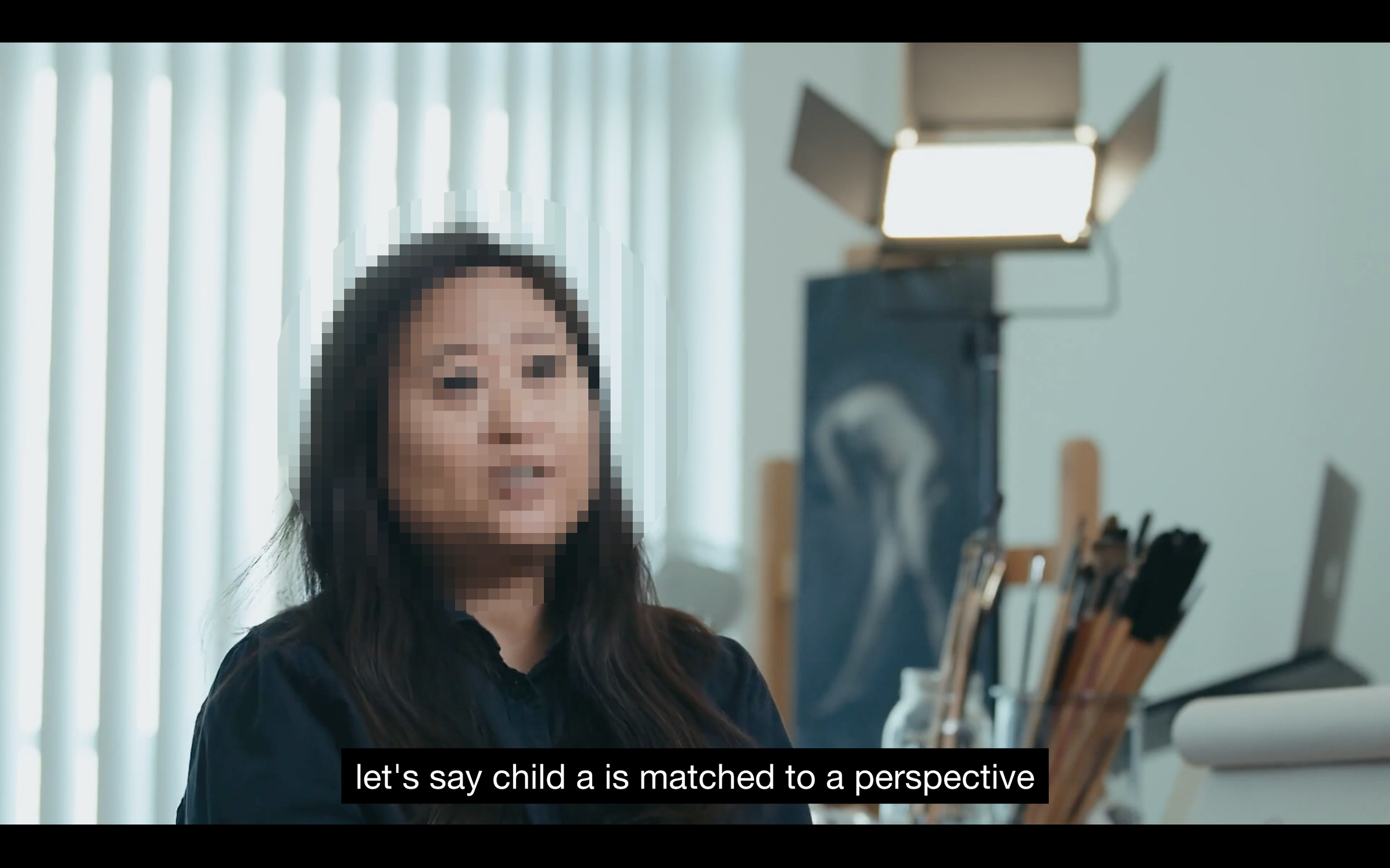
*perspective is an SBS misspelling in the English subtitles of “prospective”.
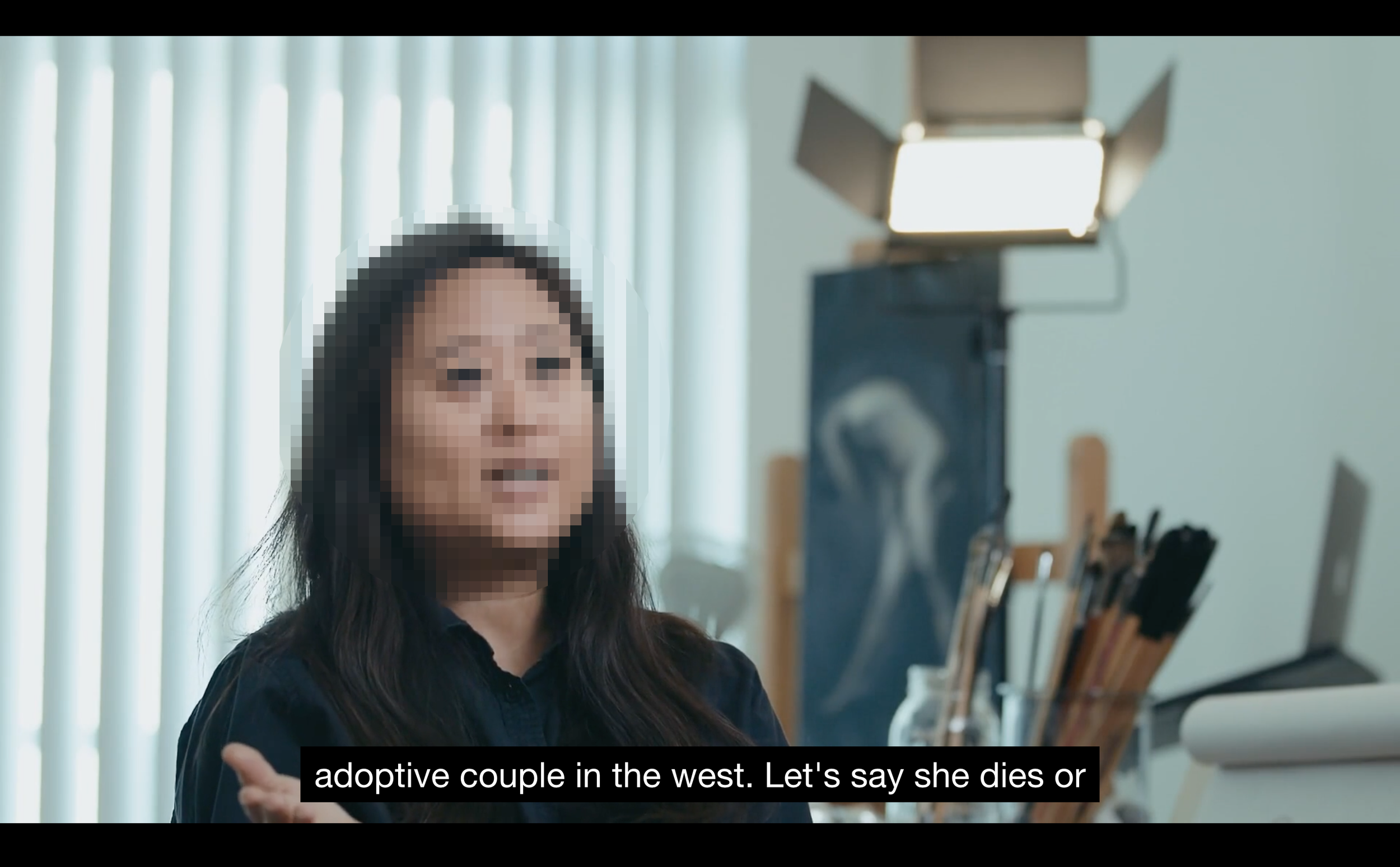
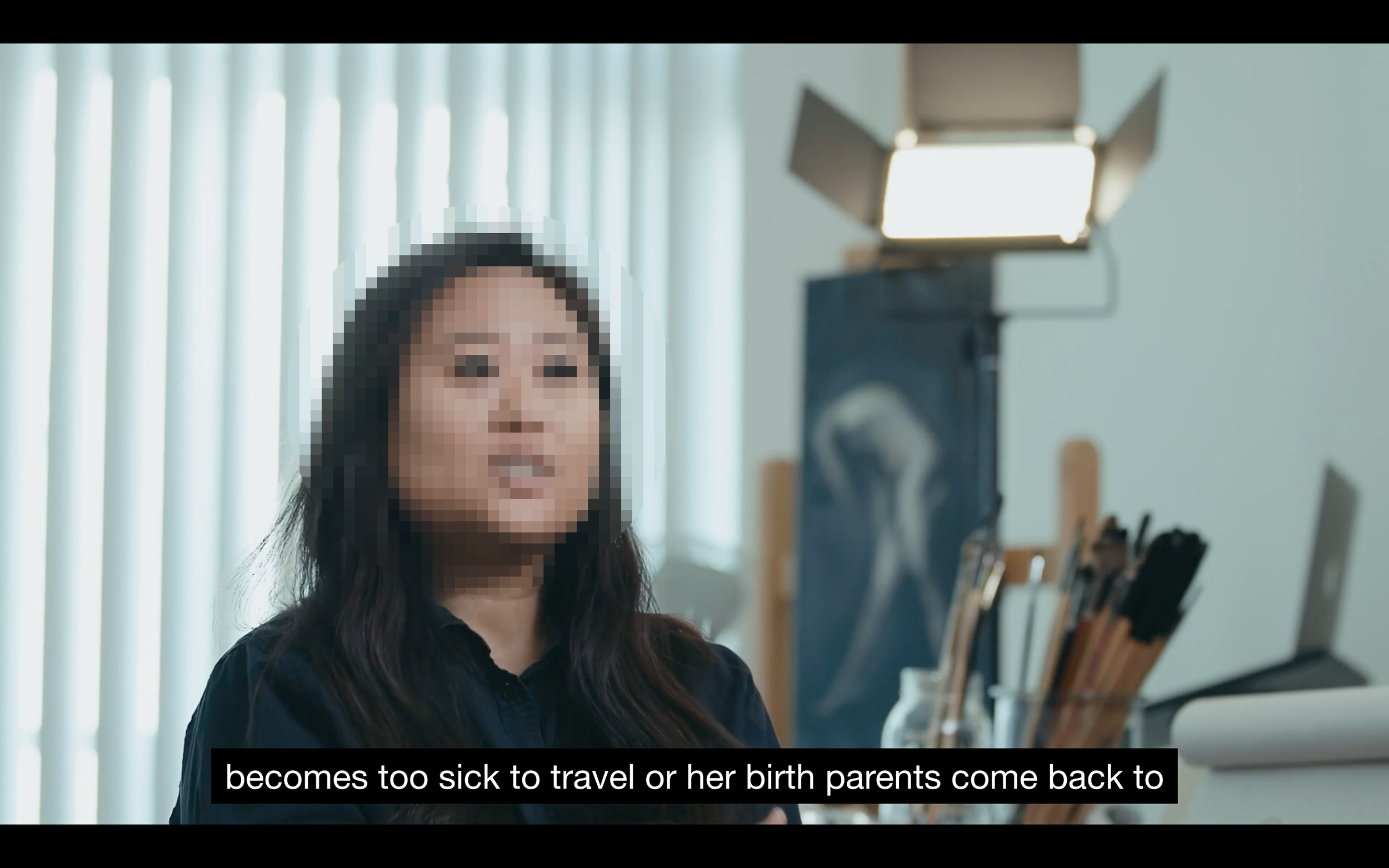
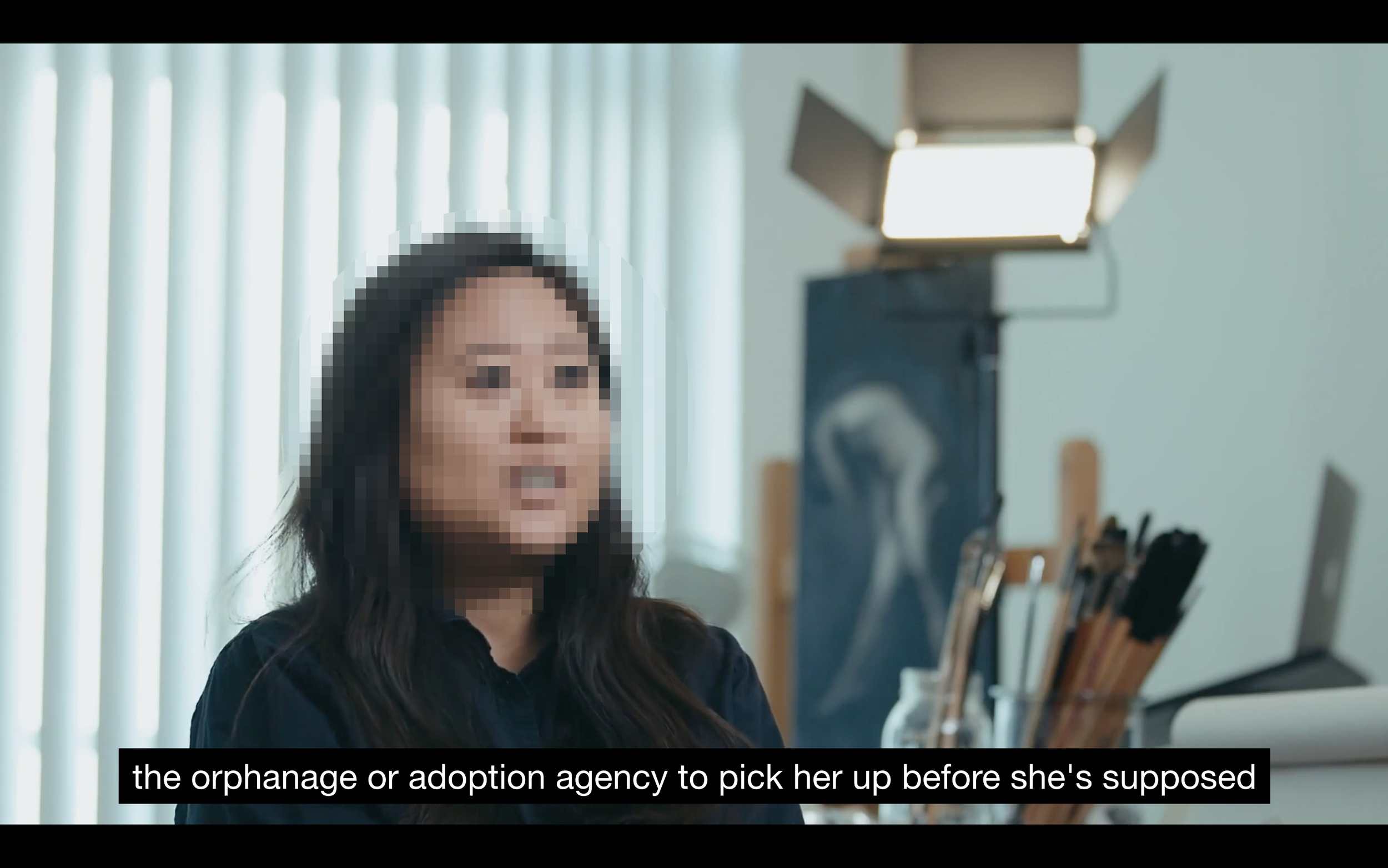
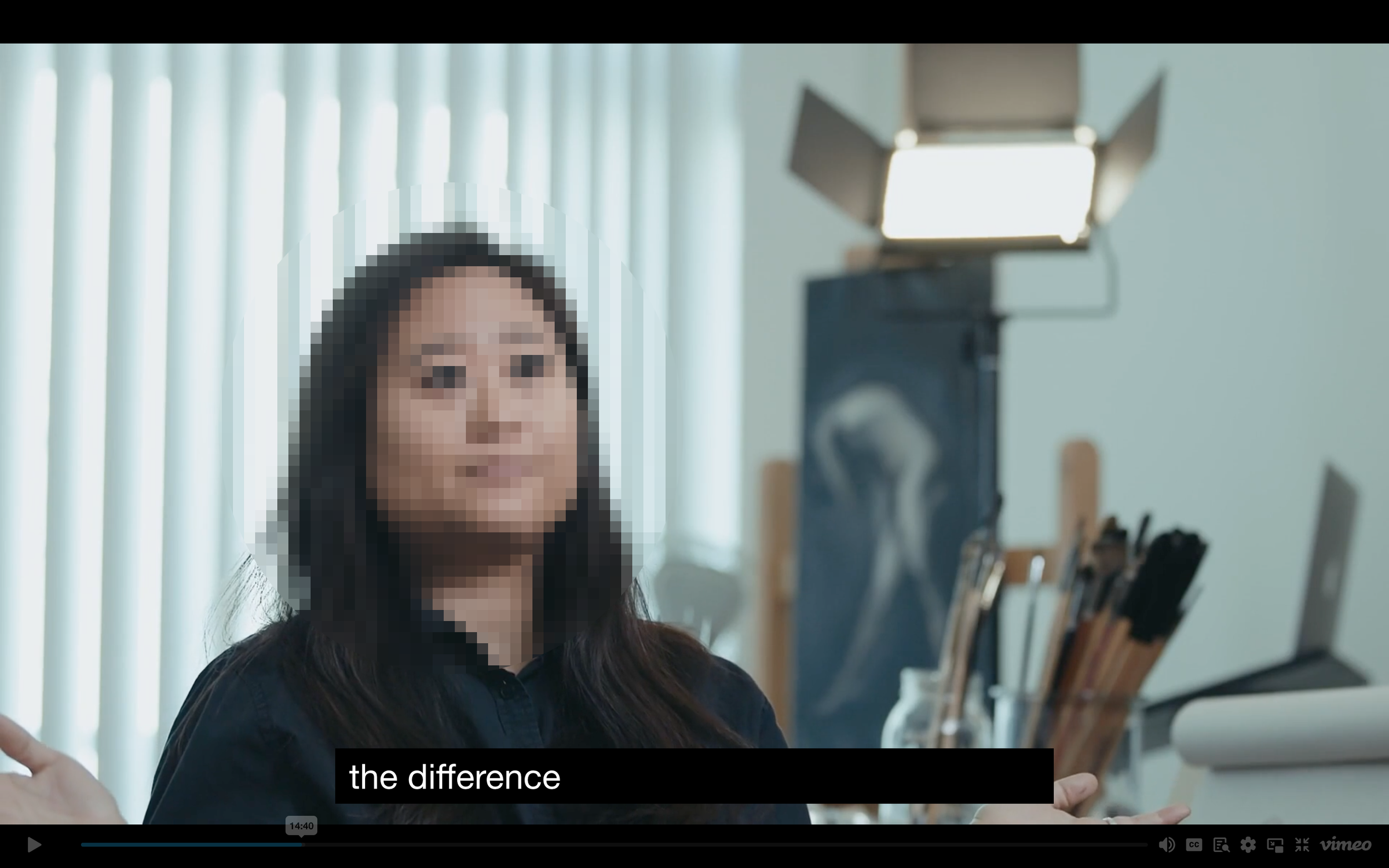
The definition of systemic switching that I codified in 2018 was also used by Tong-hyung Kim in his related AP articles—both about my case and those of other Korean Adoptees. This was with my full consent, as I had explained the definition to him directly during his interviews with me for the article on my case. However, the article about my case was released after the documentary.
+
Switched Adoptees Whom I Referred Directly To AP Reporter Tong-Hyung Kim Beginning In 2021. Including The “Switch” Cases Of Robyn Joy Park and Michaela Dietz (Previously Discussed) And My Own Switch Case And That of My Twin, I Directly Referred 12 Cases of Switched Adoptees To Tong-Hyung Kim.
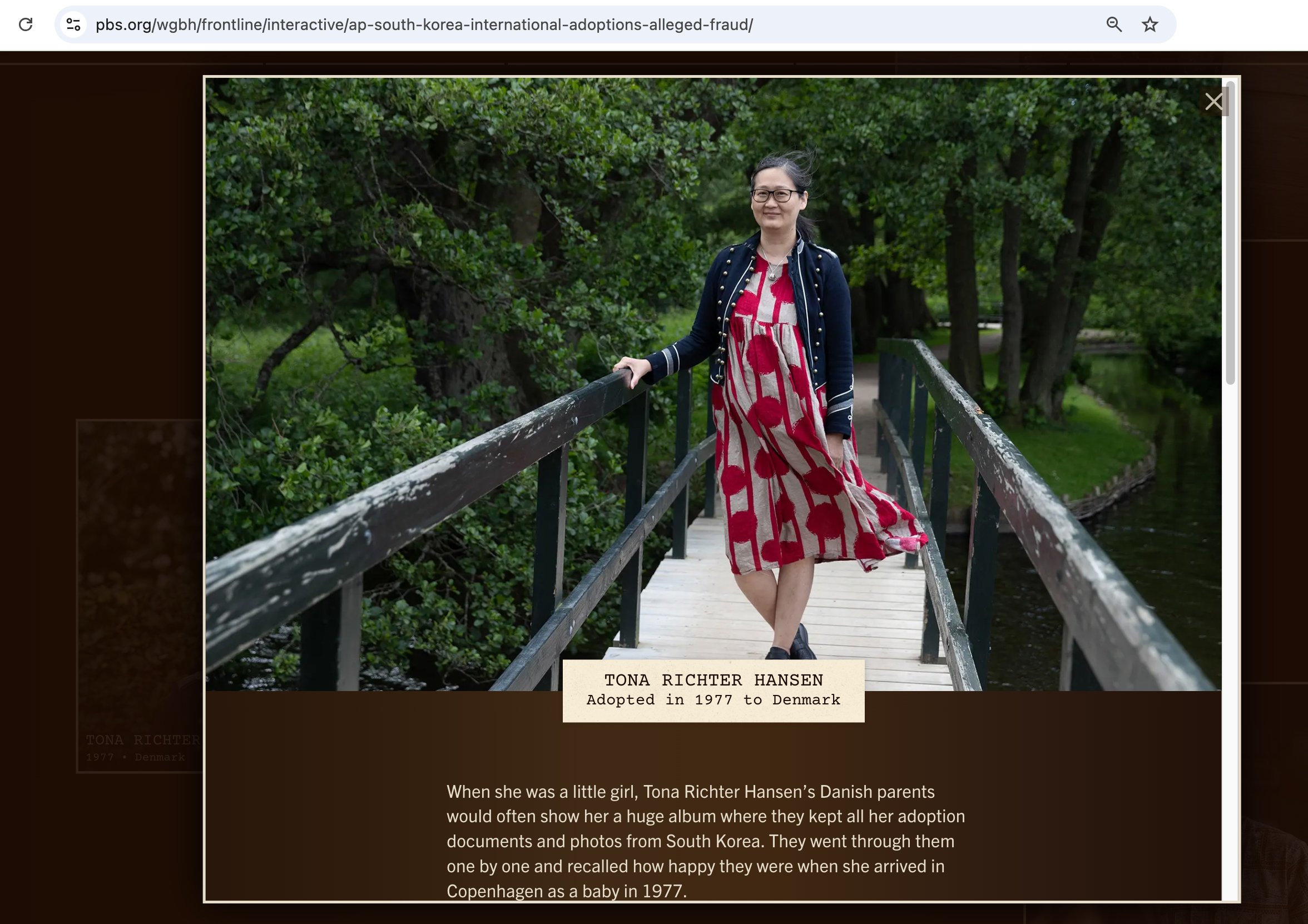
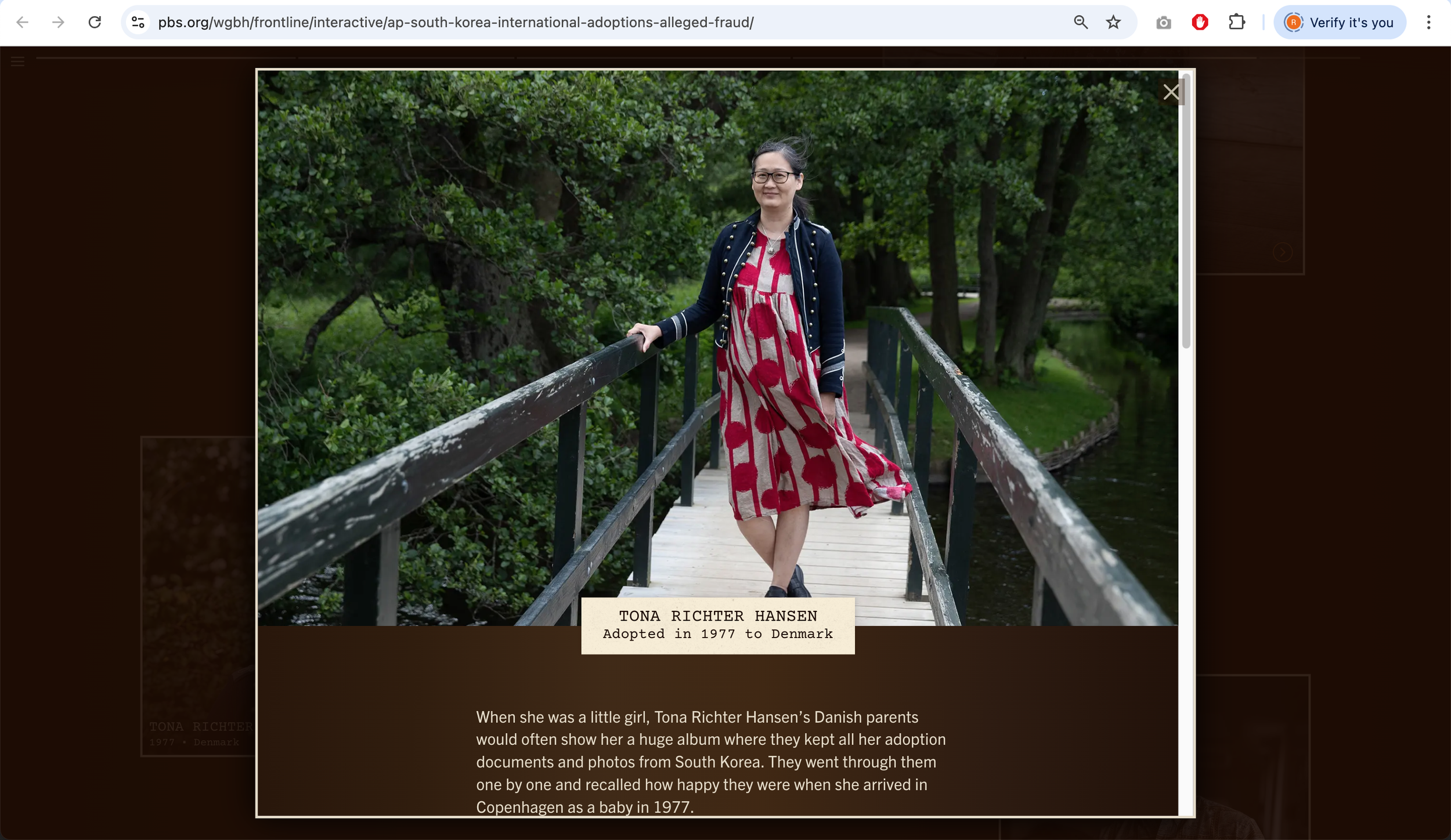
1. Tona Richter Hansen
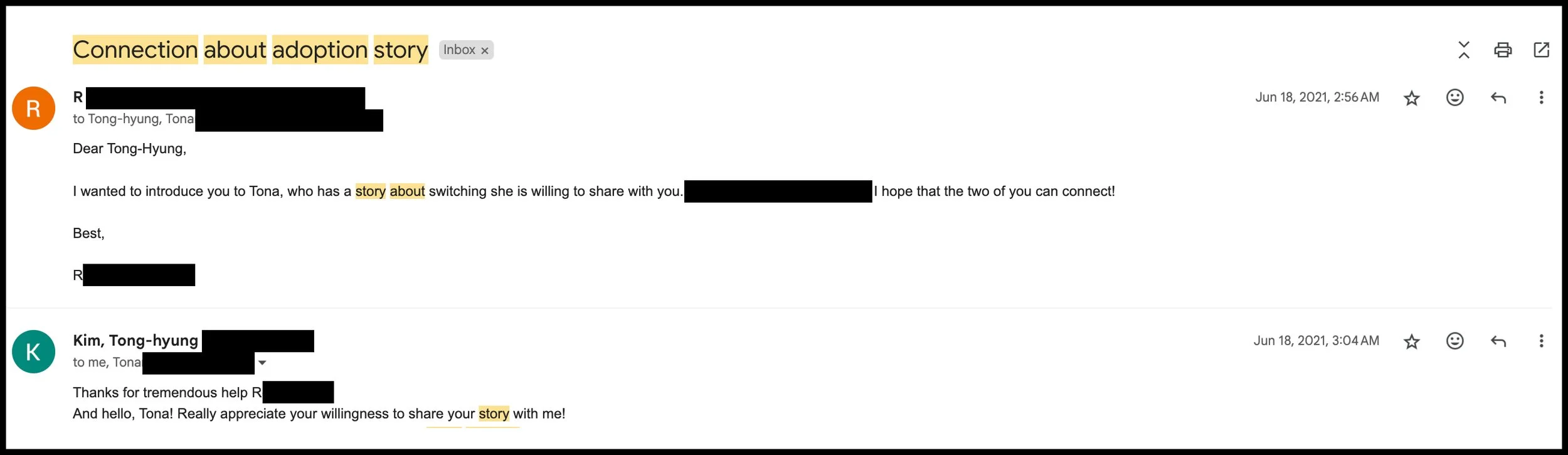
Tona Richter Hansen.
Tona’s story was featured in the FRONTLINE / AP Interactive:
https://www.pbs.org/wgbh/frontline/interactive/ap-south-korea-international-adoptions-alleged-fraud/
+
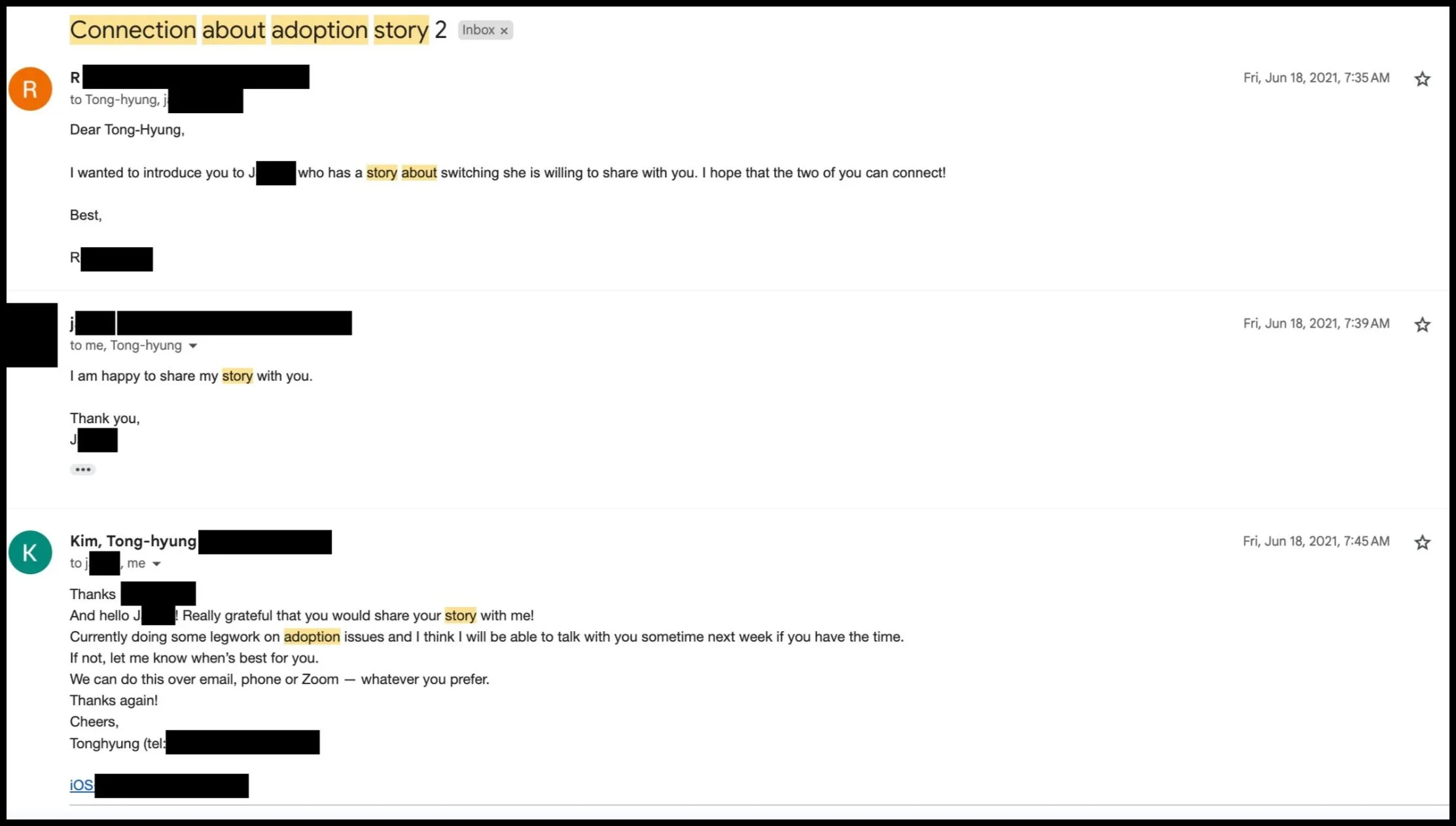
2. “J” - name protected for privacy since she was not featured in media.
+
3. “3” was skipped for some reason in my email titles. There is no Adoptee associated with subject heading “3”.
+
4. “Y” - Name protected for privacy since she was not featured in media.
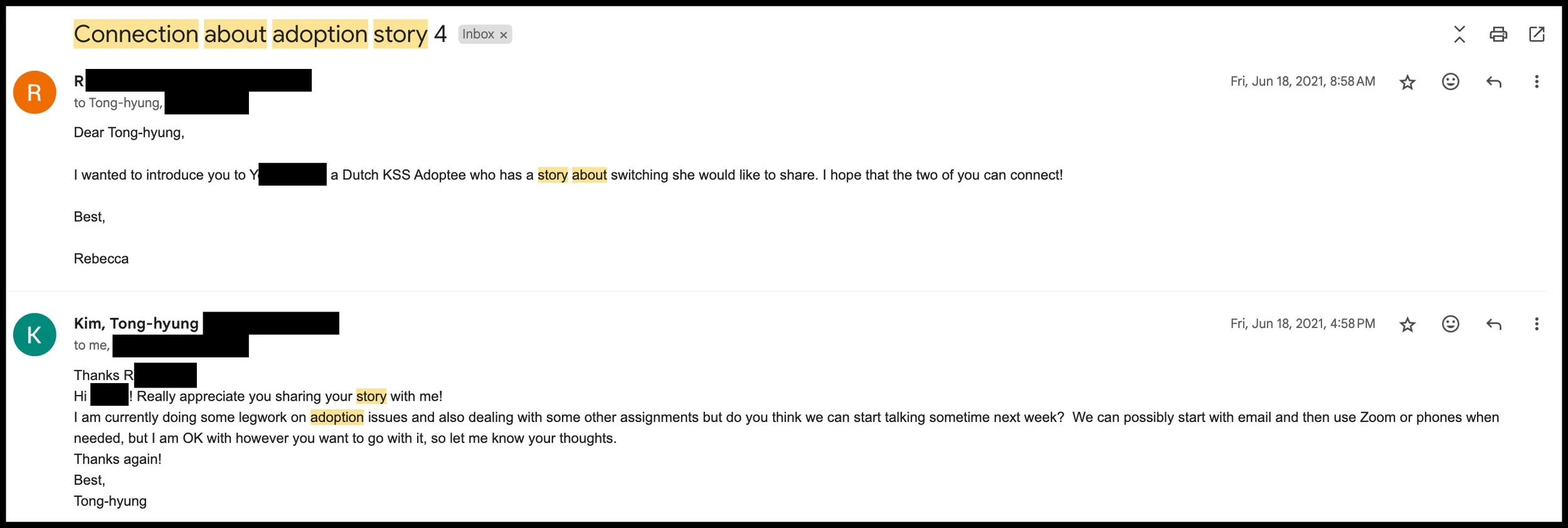
+
5. “K”- Name protected for privacy since she was not featured in media.
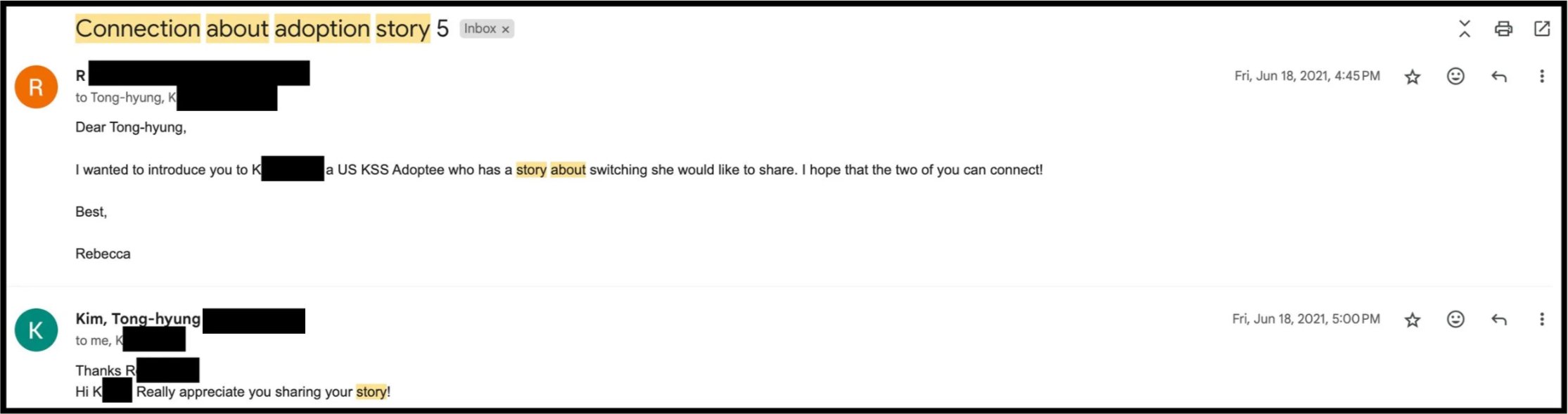
+
6. Mia Sang Jorno
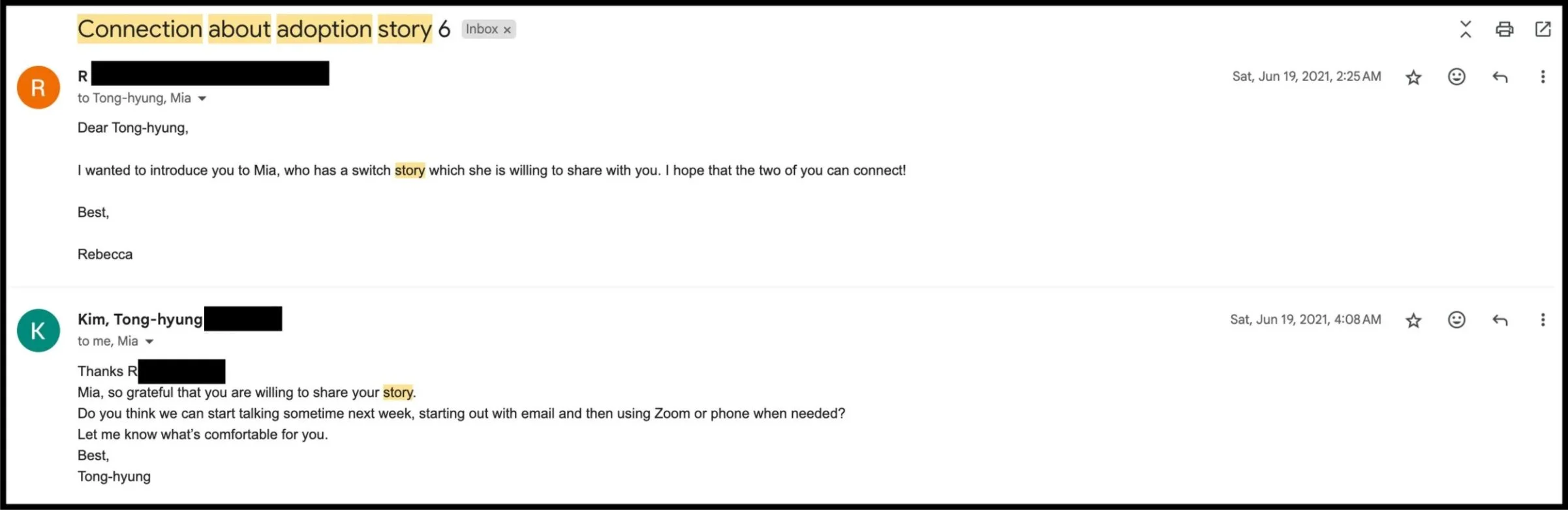
Mia Sang Jorno’s story was featured in:
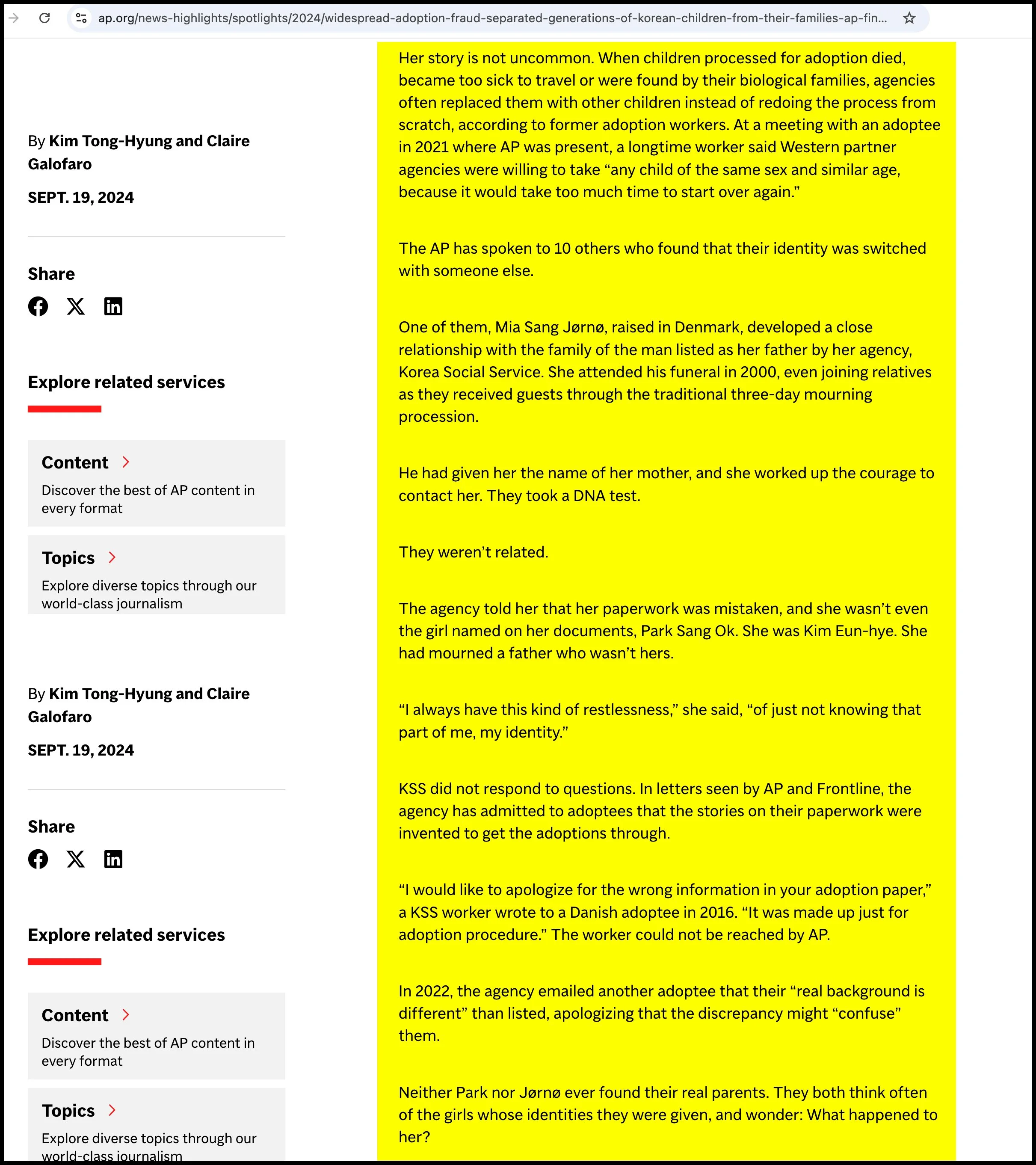
Adoption Fraud Separated Generations of South Korean Children From Their Families, AP Finds
Note: Actually it was me, not adoption workers who codified the definition of switching as happening when “any original child A either died, became too sick to travel, or were picked up by their birth families from the adoption agency or orphanage”. I have definitely relayed this definition to Tong-Hyung Kim, based off of my research amongst the Danish switched Adoptees like Mia, Tona, and Anja (whose stories were all featured by AP).
“Her story is not uncommon. When children processed for adoption died, became too sick to travel or were found by their biological families, agencies often replaced them with other children instead of redoing the process from scratch, according to former adoption workers. At a meeting with an adoptee in 2021 where AP was present” (Note - this was my meeting at KSS), “a longtime worker said Western partner agencies were willing to take “any child of the same sex and similar age, because it would take too much time to start over again."
The AP has spoken to 10 others who found that their identity was switched with someone else.” (Note - the majority of these were my referrals).
“One of them, Mia Sang Jørnø, raised in Denmark, developed a close relationship with the family of the man listed as her father by her agency, Korea Social Service. She attended his funeral in 2000, even joining relatives as they received guests through the traditional three-day mourning procession.
He had given her the name of her mother, and she worked up the courage to contact her. They took a DNA test.
They weren’t related.
The agency told her that her paperwork was mistaken, and she wasn’t even the girl named on her documents, Park Sang Ok. She was Kim Eun-hye. She had mourned a father who wasn’t hers.
“I always have this kind of restlessness, she said, “of just not knowing that part of me, my identity.”
KSS did not respond to questions. In letters seen by AP and FRONTLINE, the agency has admitted to adoptees that the stories on their paperwork were invented to get the adoptions through.
“I would like to apologize for the wrong information in your adoption paper,” a KSS worker wrote to a Danish adoptee in 2016. “It was made up just for adoption procedure.” The worker could not be reached by AP.
In 2022, the agency emailed another adoptee that their “real background is different” than listed, apologizing that the discrepancy might “confuse” them.
Neither Park nor Jørnø ever found their real parents. They both think often of the girls whose identities they were given, and wonder: What happened to her?
+
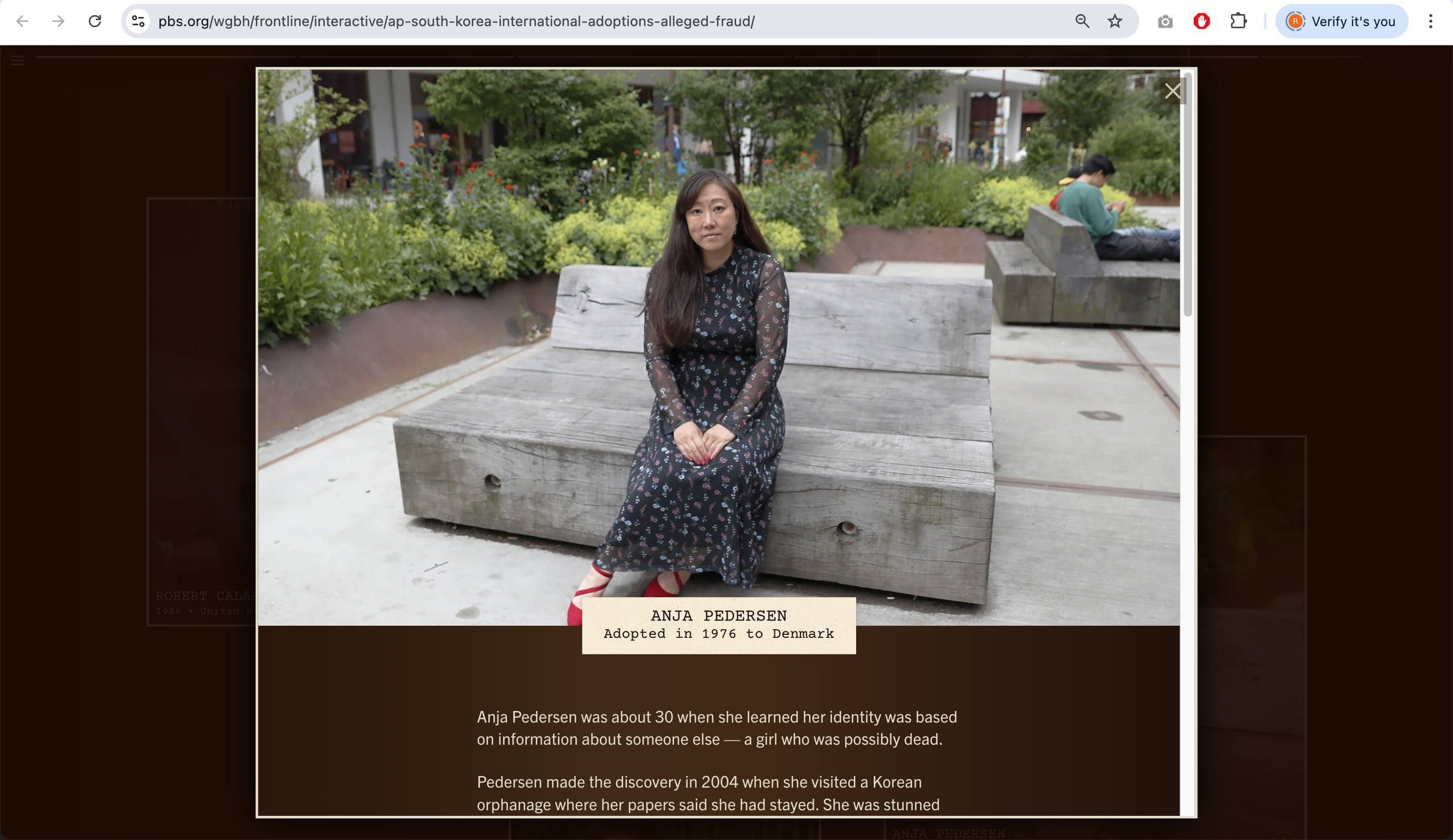
7. Anja Pedersen
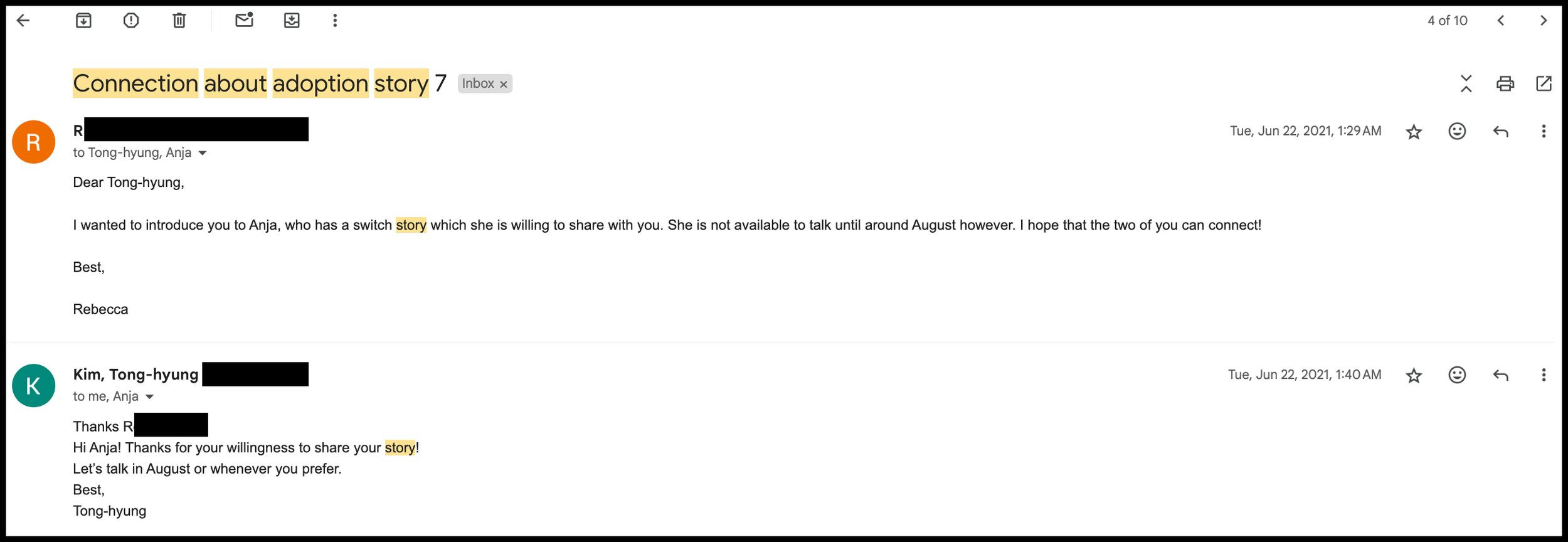
Anja Pedersen.
Anja’s story was featured in the FRONTLINE / AP Interactive:
https://www.pbs.org/wgbh/frontline/interactive/ap-south-korea-international-adoptions-alleged-fraud/
+
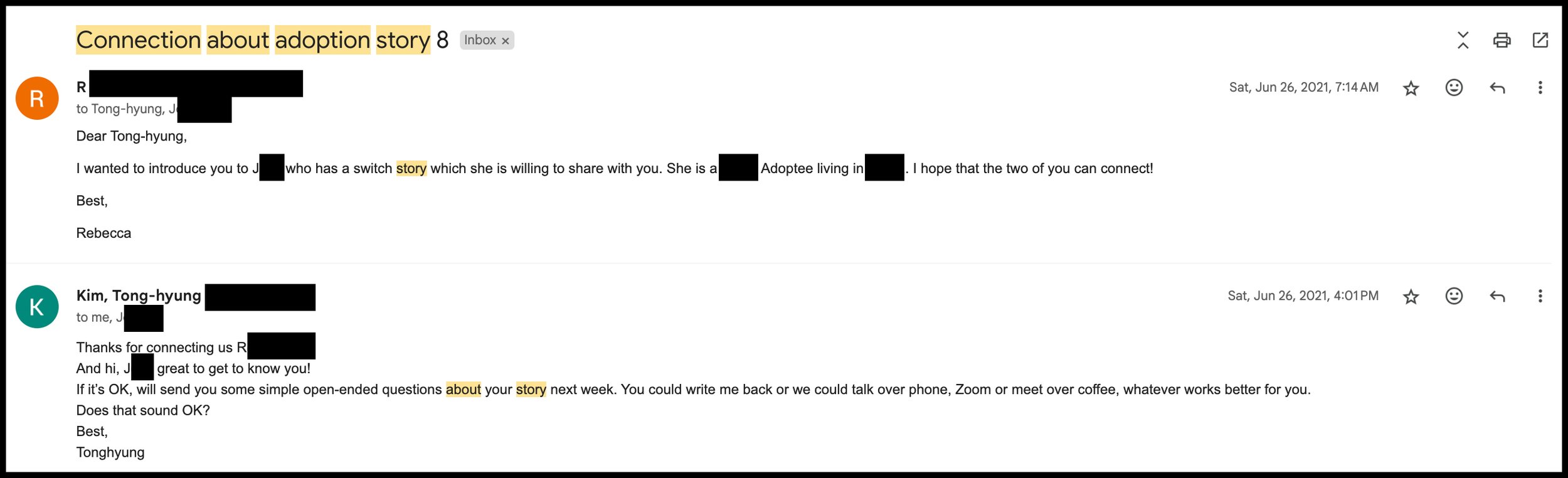
8. “J” 2 - Name protected for privacy since she was not featured in media.
+
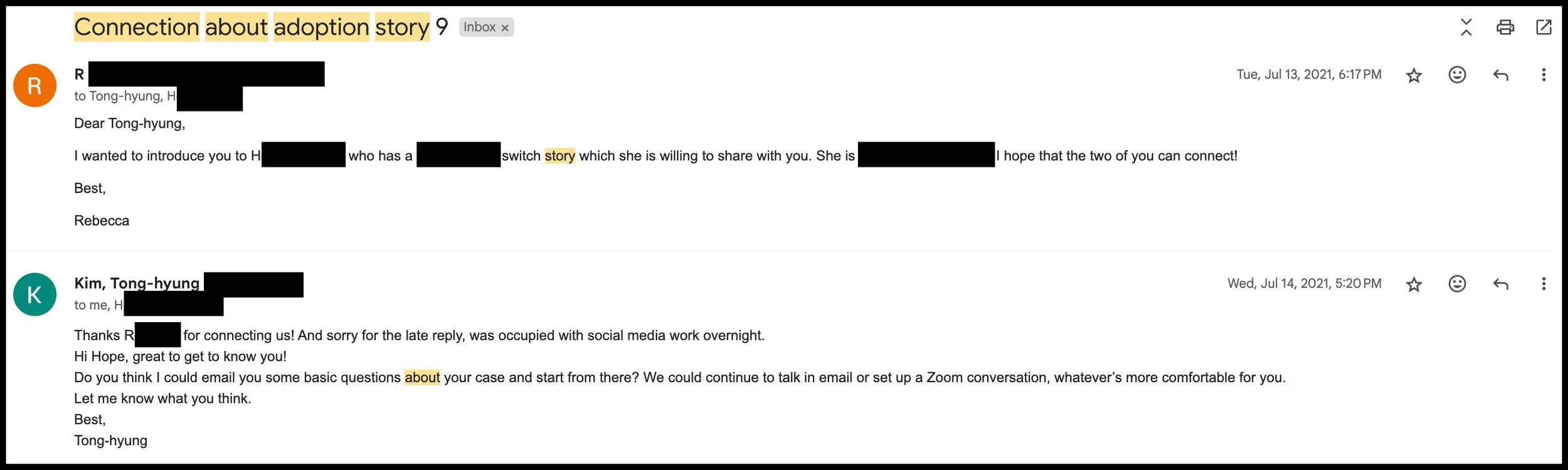
9. “H” - Name protected for privacy since she was not featured in media.
+
10. “A” - Name protected for privacy since she was not featured in media.
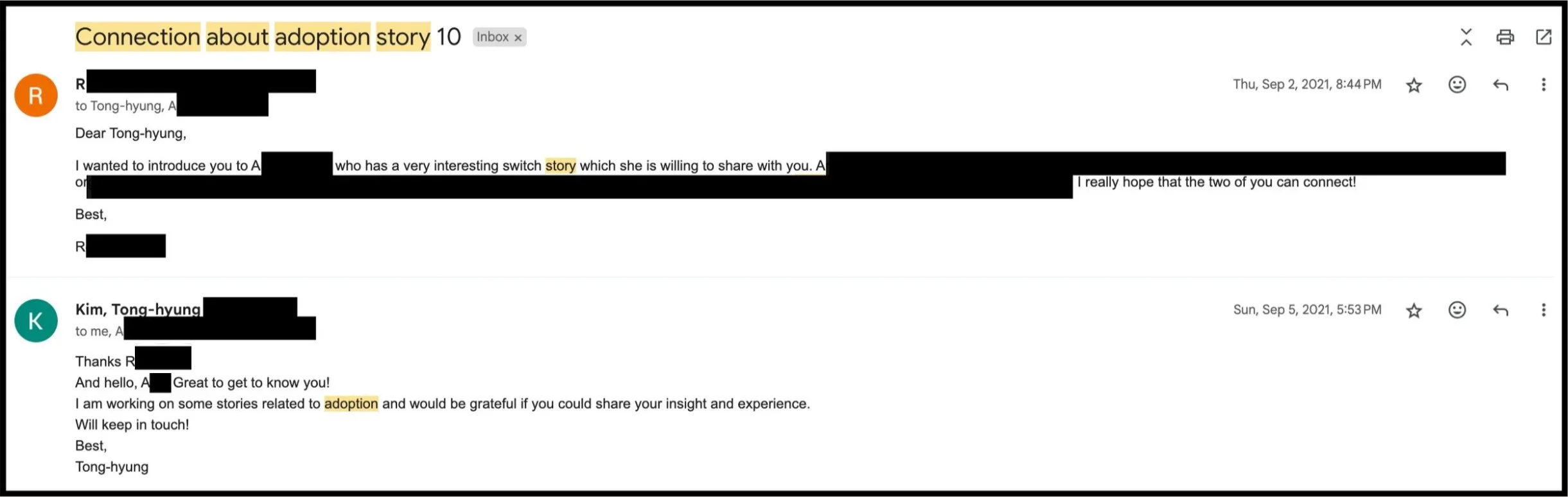
I know for a fact that Tong-hyung Kim talked to “A”, but it was unfortunately not until after the release of the FRONTLINE documentary and related articles.
+
11. and 12. - Of course, there is myself and my twin “Baby A”. We both have SEPARATE switch cases. We were not switched with each other.
These are the cases I was investigating when I invited Tong-hyung to visit my Korean Adoption Agency, KSS, in Summer 2021.
Tong-hyung Kim admits his years long interest in reporting on adoption corruption began during this 2021 visit with me to KSS.
My story was featured in:
A South Korean adoptee needed answers about the past. She got them — just not the ones she wanted
FRONTLINE / AP Interactive
However, I was given ZERO credit for ALL of my related work in the FRONTLINE documentary.
Referencing the literal ONE SECOND of time I appeared in the FRONTLINE documentary, Lora Moftah later laughed during a private Zoom and said something to the effect of, “We had to get you in there somehow!”
I appear in the FRONTLINE documentary for literally one second. Not even a single line of credit from FRONTLINE in the documentary — for the years of work I’ve done since 2018 to expose systemic switching, or for the numerous interview subject referrals I provided for the documentary and related AP articles/interactive. Without those referrals, there wouldn’t be much content for any of these pieces.
+
I Also Referred The Following Korean Adoptees Whose Cases Were Covered In The Associated Press (AP) Articles And / Or Interactive.
*Some Of These Adoptees Have Been Previously Mentioned As FRONTLINE / AP Used Many Of My Interview Referrals In Different Media Pieces.
+
My Direct Referrals To Tong-Hyung Kim and Lora Moftah For The FRONTLINE / AP:
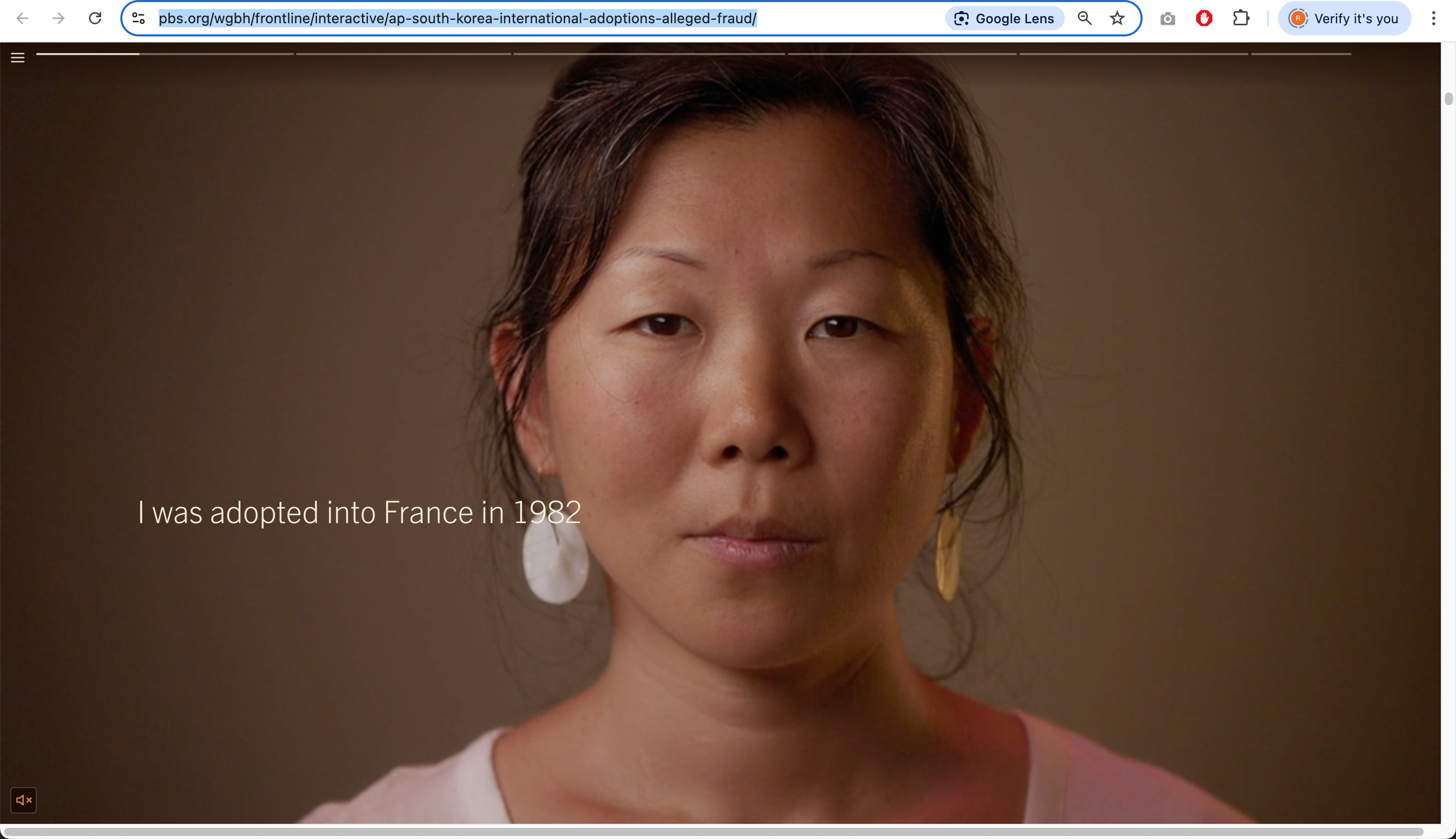
Who Am I Then? Interactive
Referral 1: Robyn Joy Park
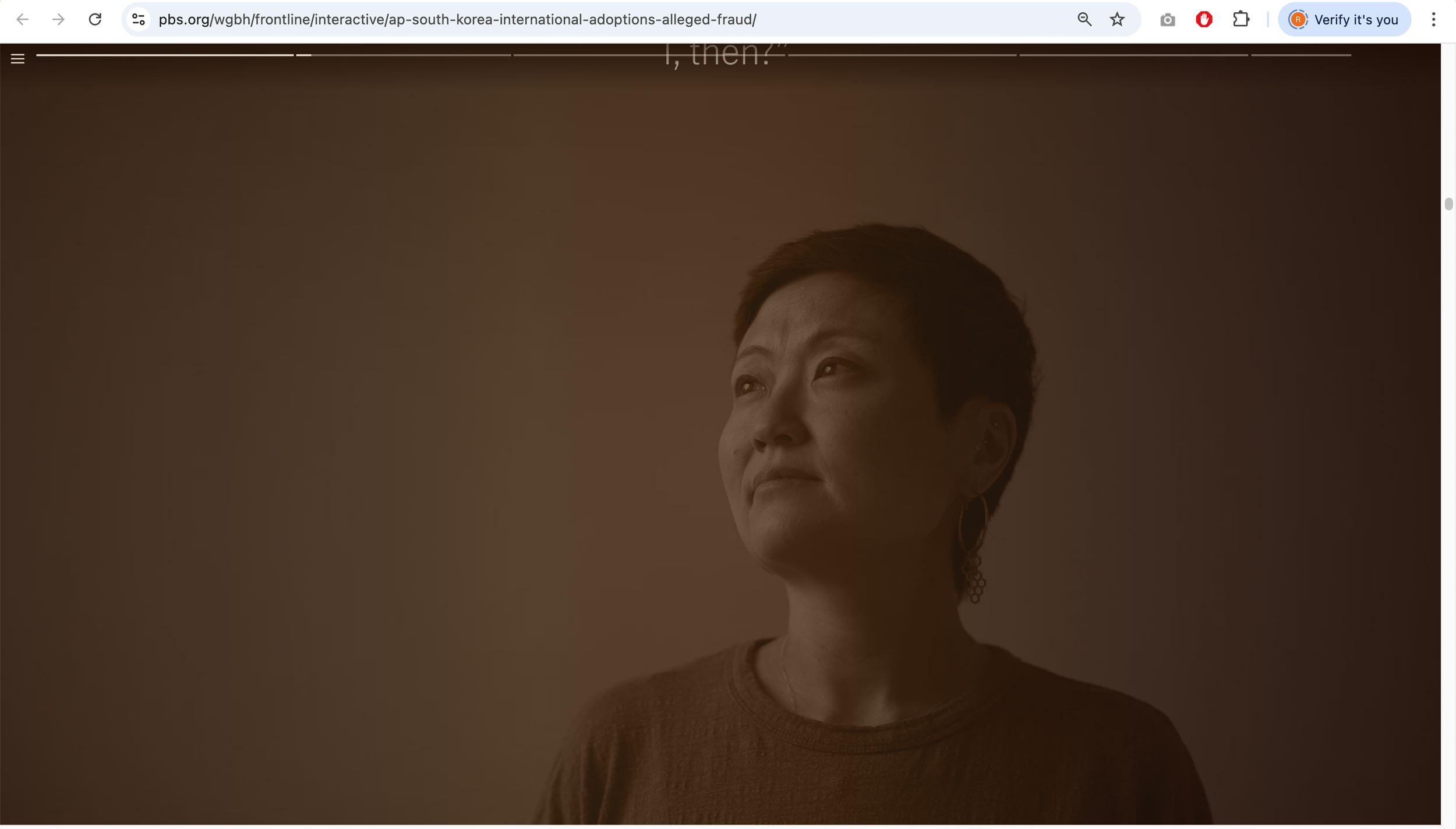
Referral 2: Dee and Becca
(These were not uncredited referrals, as these Adoptees were tied directly to my story).
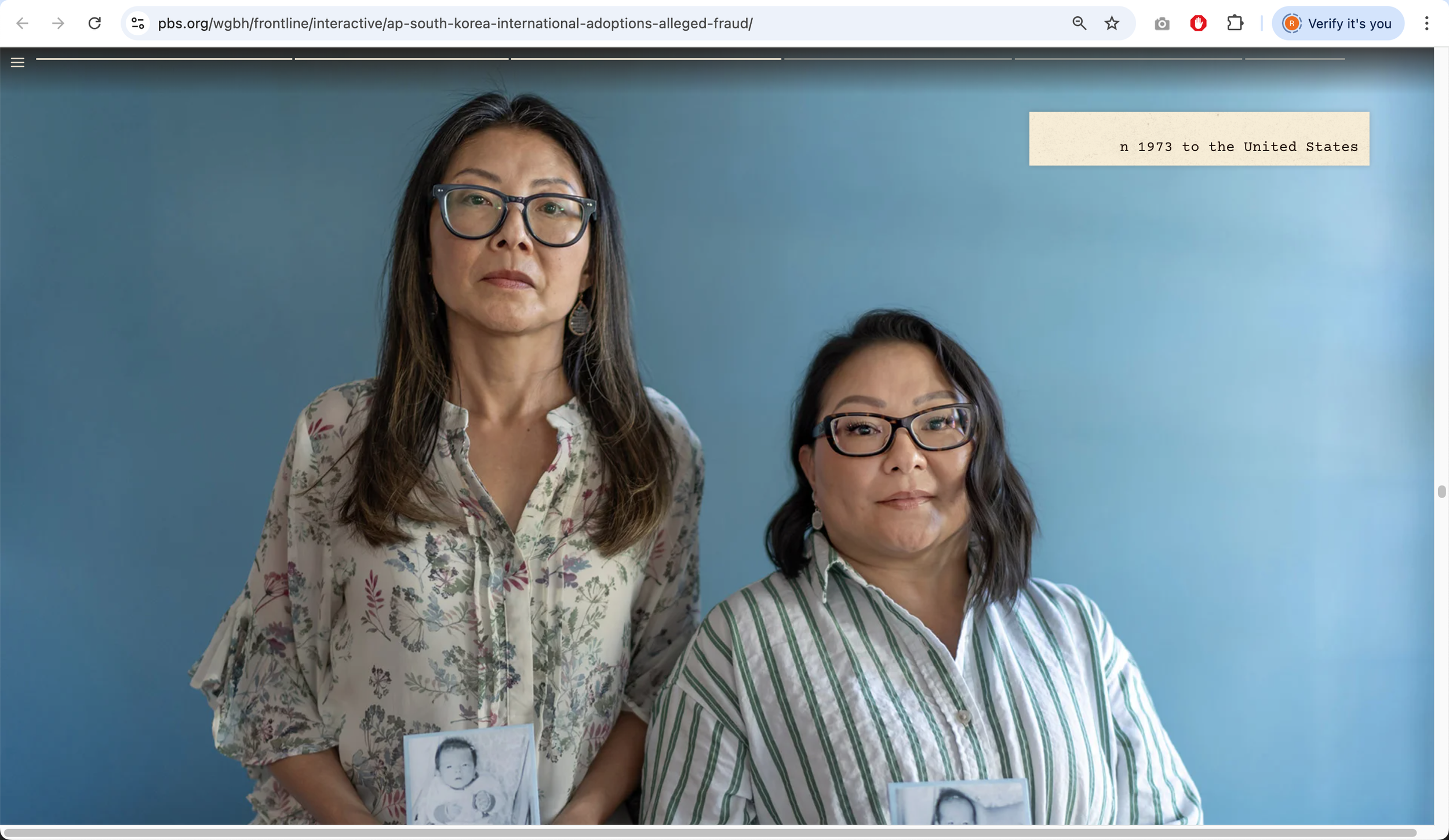
Referral 3: Michaela Dietz
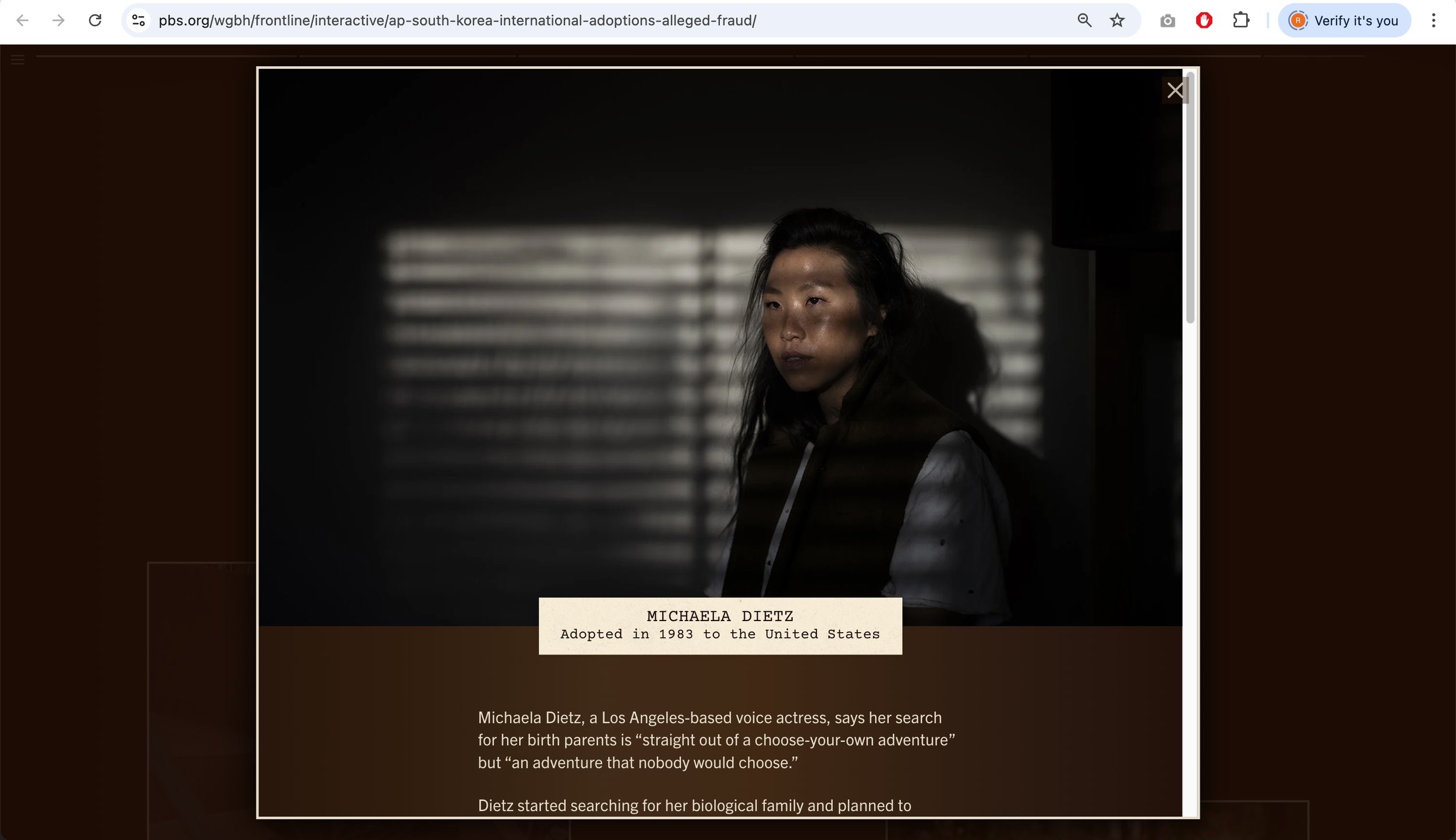
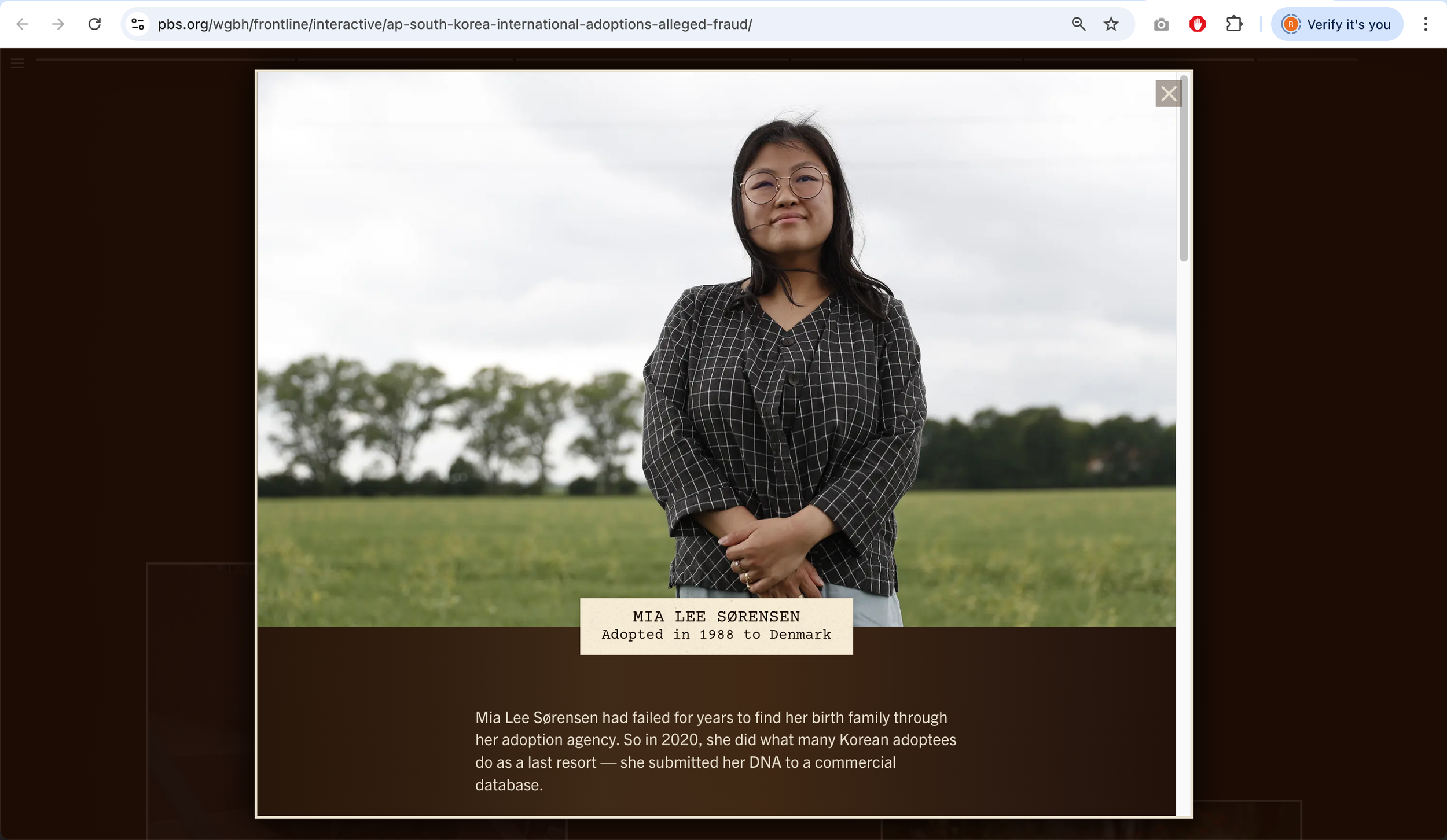
Referral 4: Mia Lee Sørensen
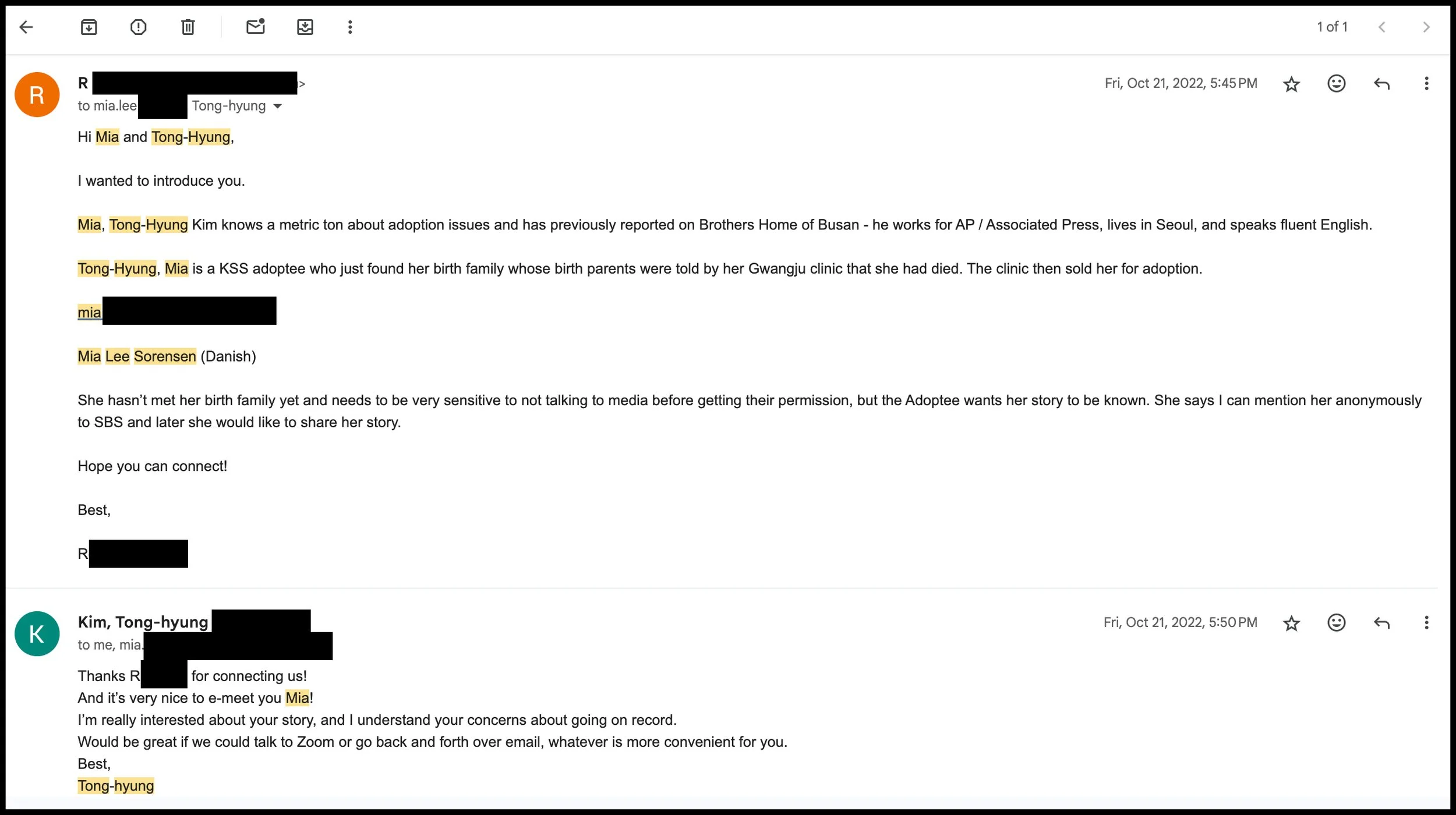
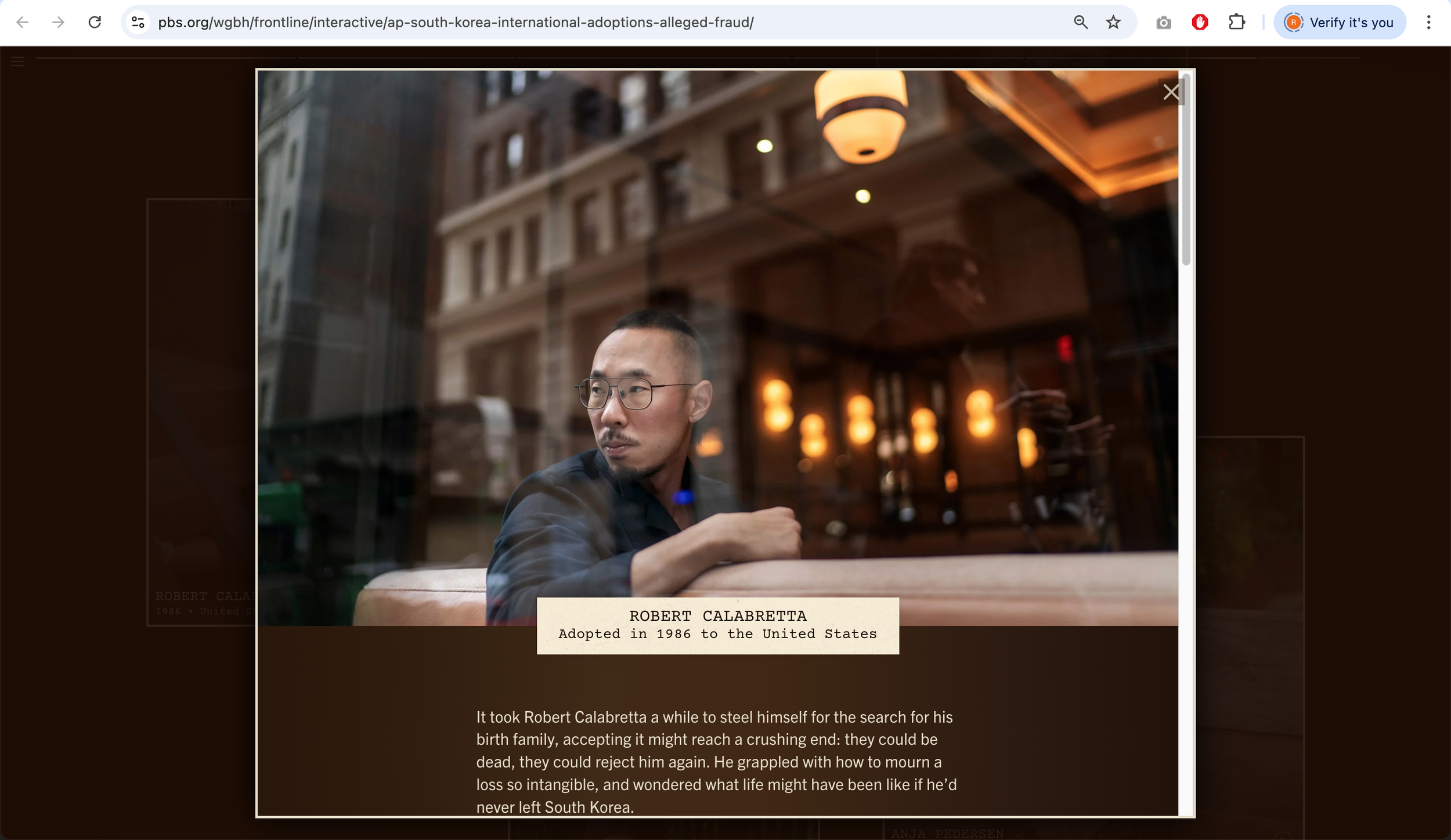
Referral 5: Robert Calabretta
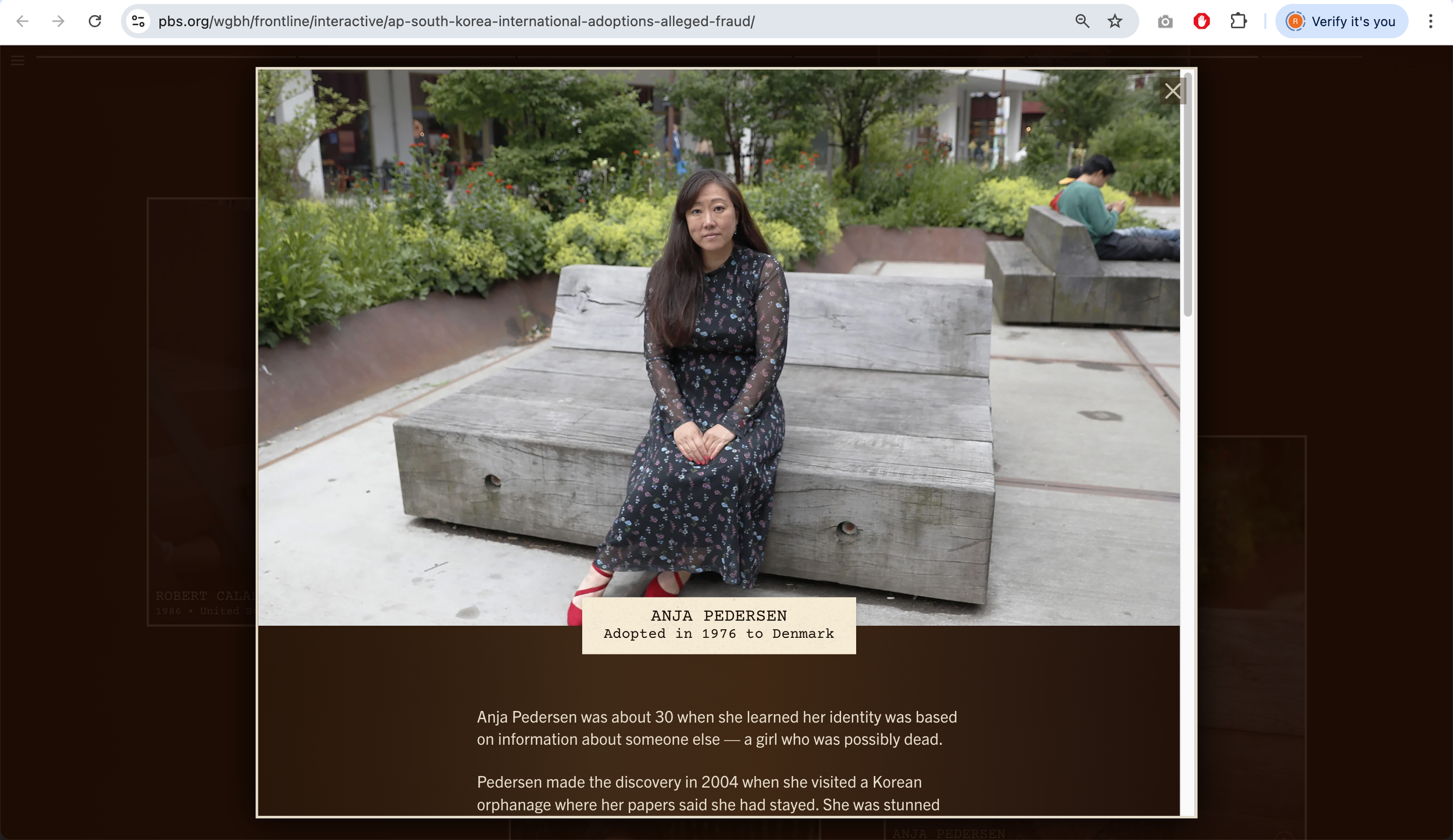
Referral 6: Anja Pedersen
Referral 7: Alice Stephens
Referral 8: Tona Richter Hansen
Indirect Referral 9: Maria Leister
Referral 10: Adoptee From IKAA Newcomer’s Event
Referral 11: Adoptee From IKAA Newcomer’s Event
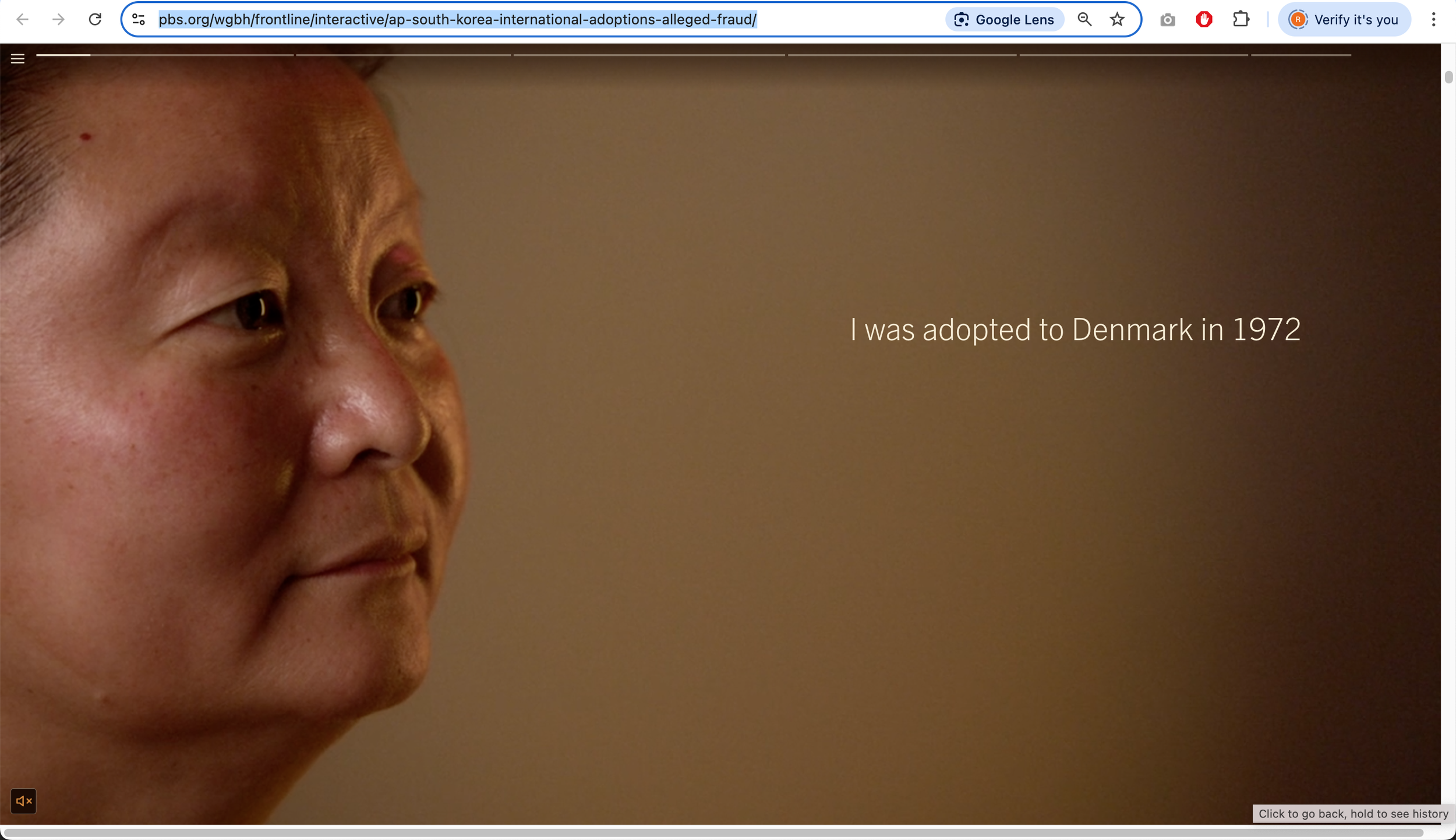
Referral 12: Adoptee From IKAA Newcomer’s Event
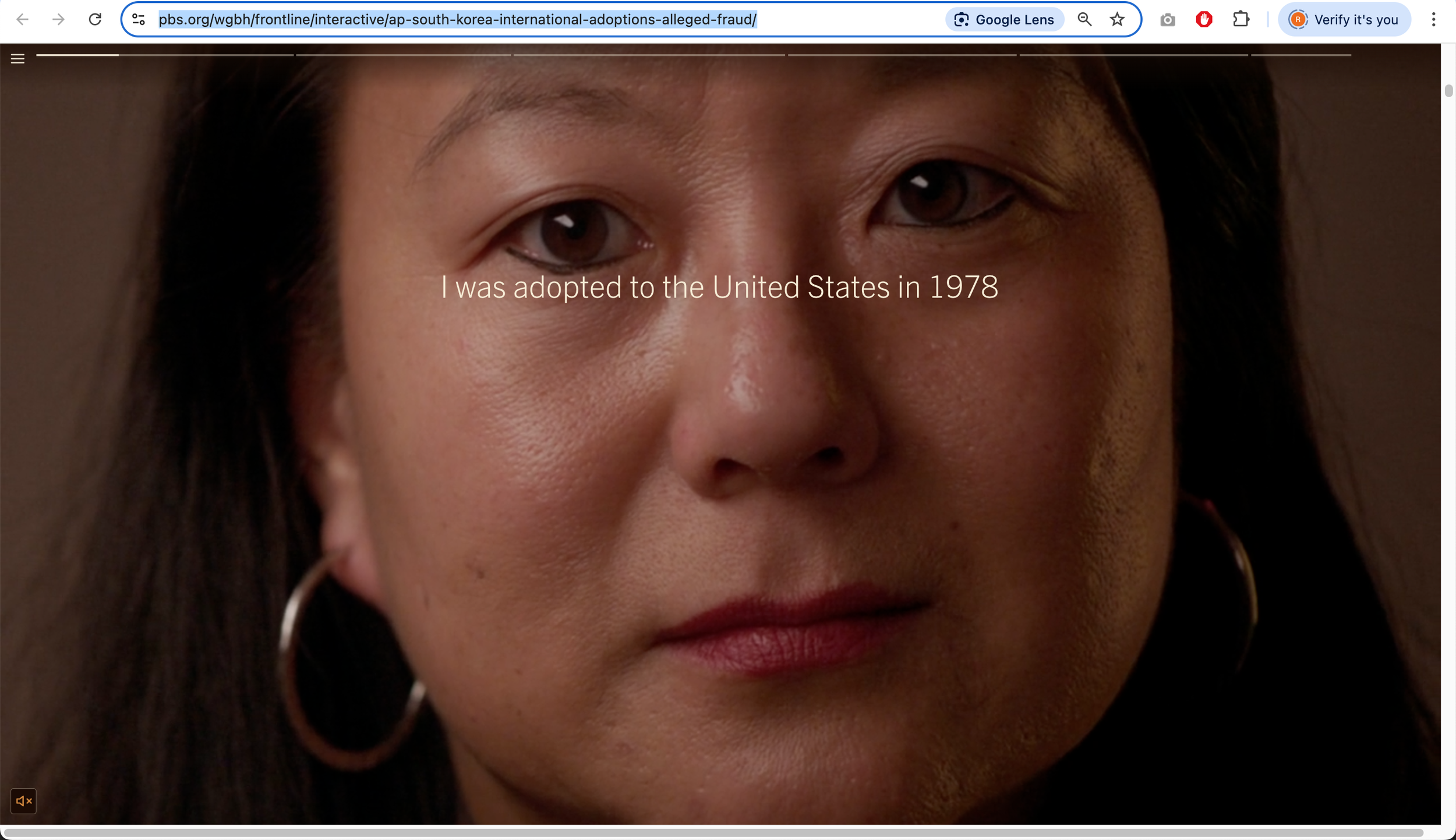
Referral 13: Adoptee From IKAA Newcomer’s Event
+
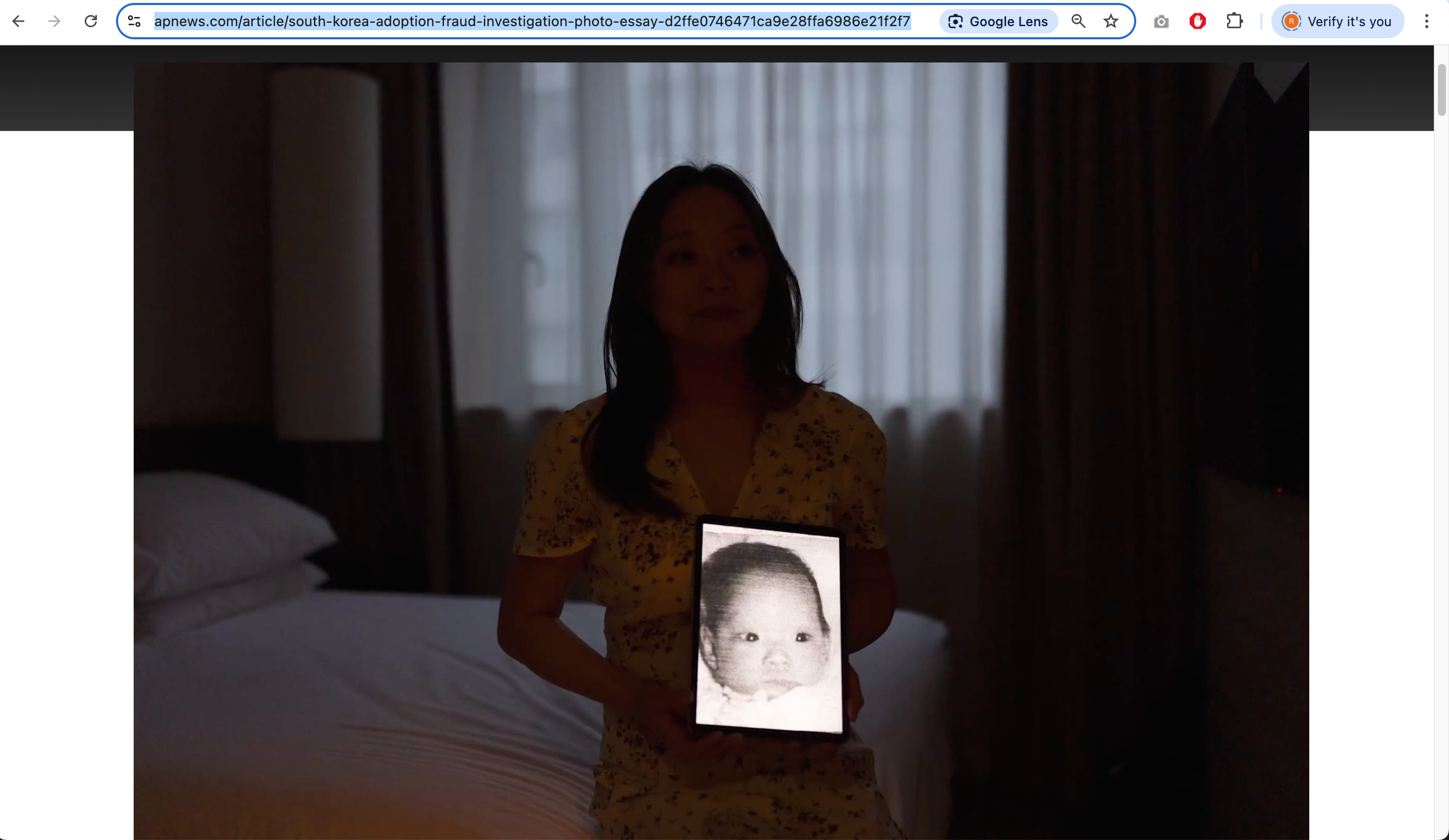
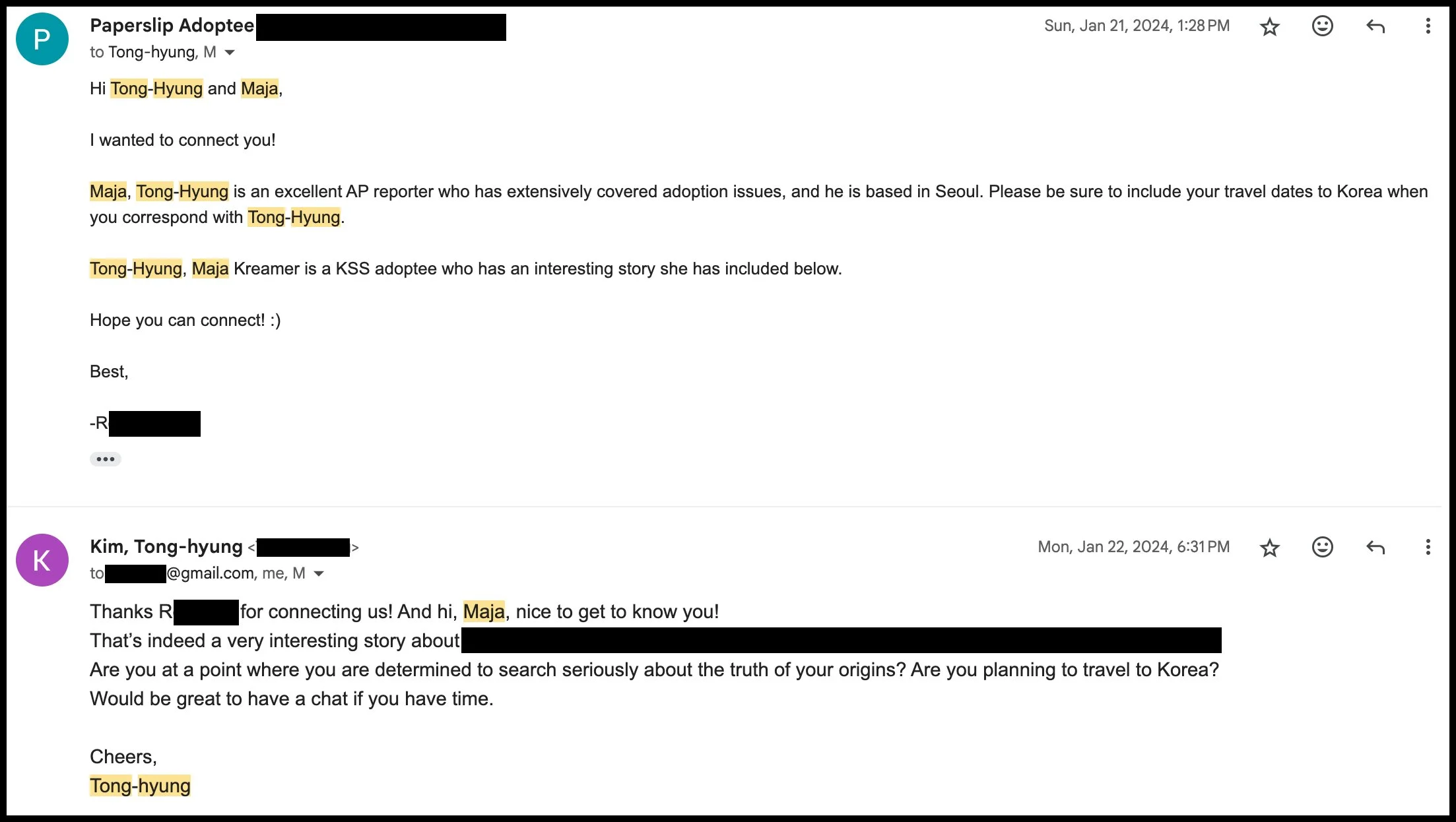
My Direct Referral To Tong-Hyung Kim For AP Article:
South Korea adoptees endure emotional, sometimes devastating searches for their birth families
Referral 1: Maja Andersen
My Direct Referral To Tong-Hyung Kim For AP Article:
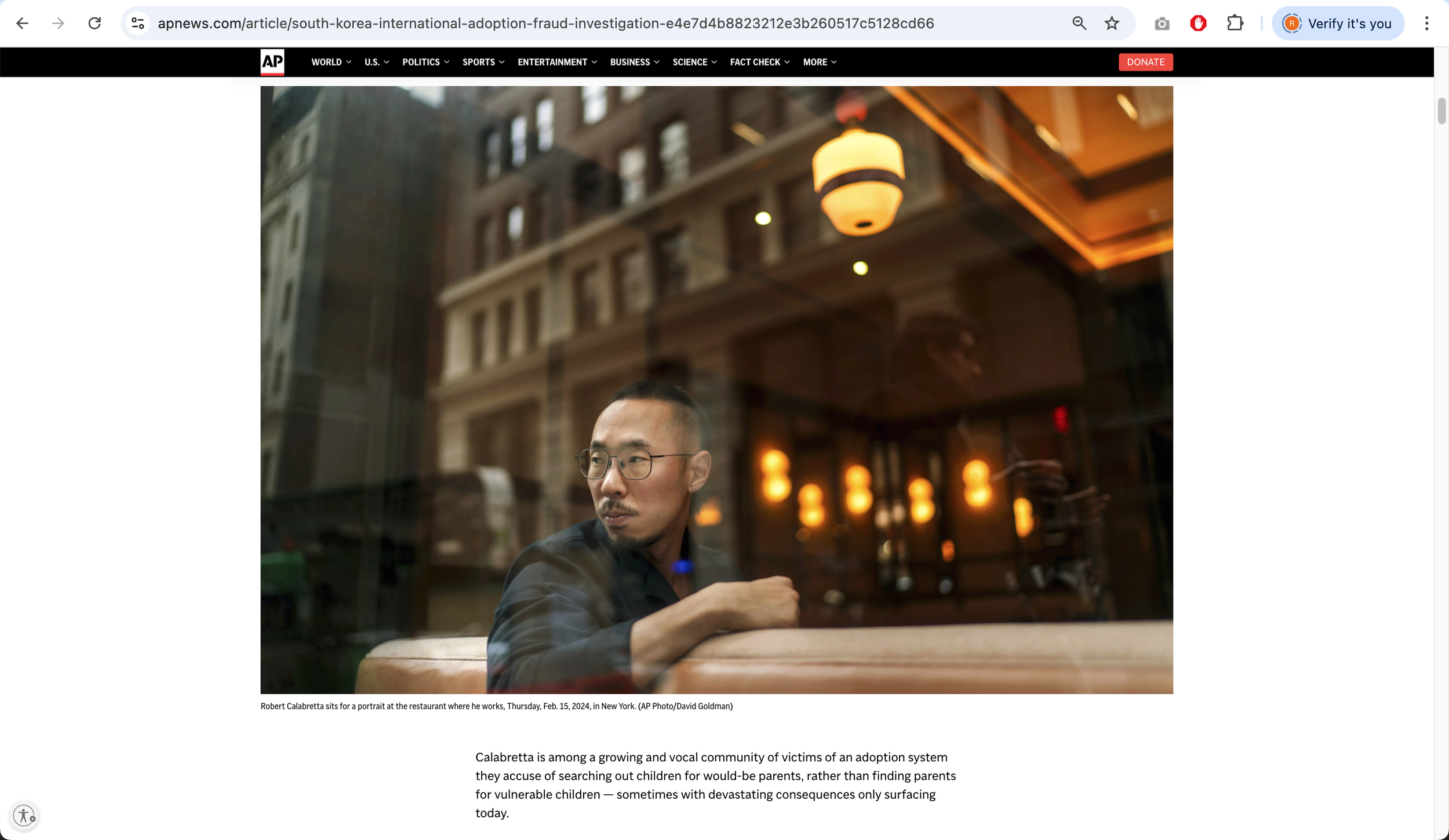
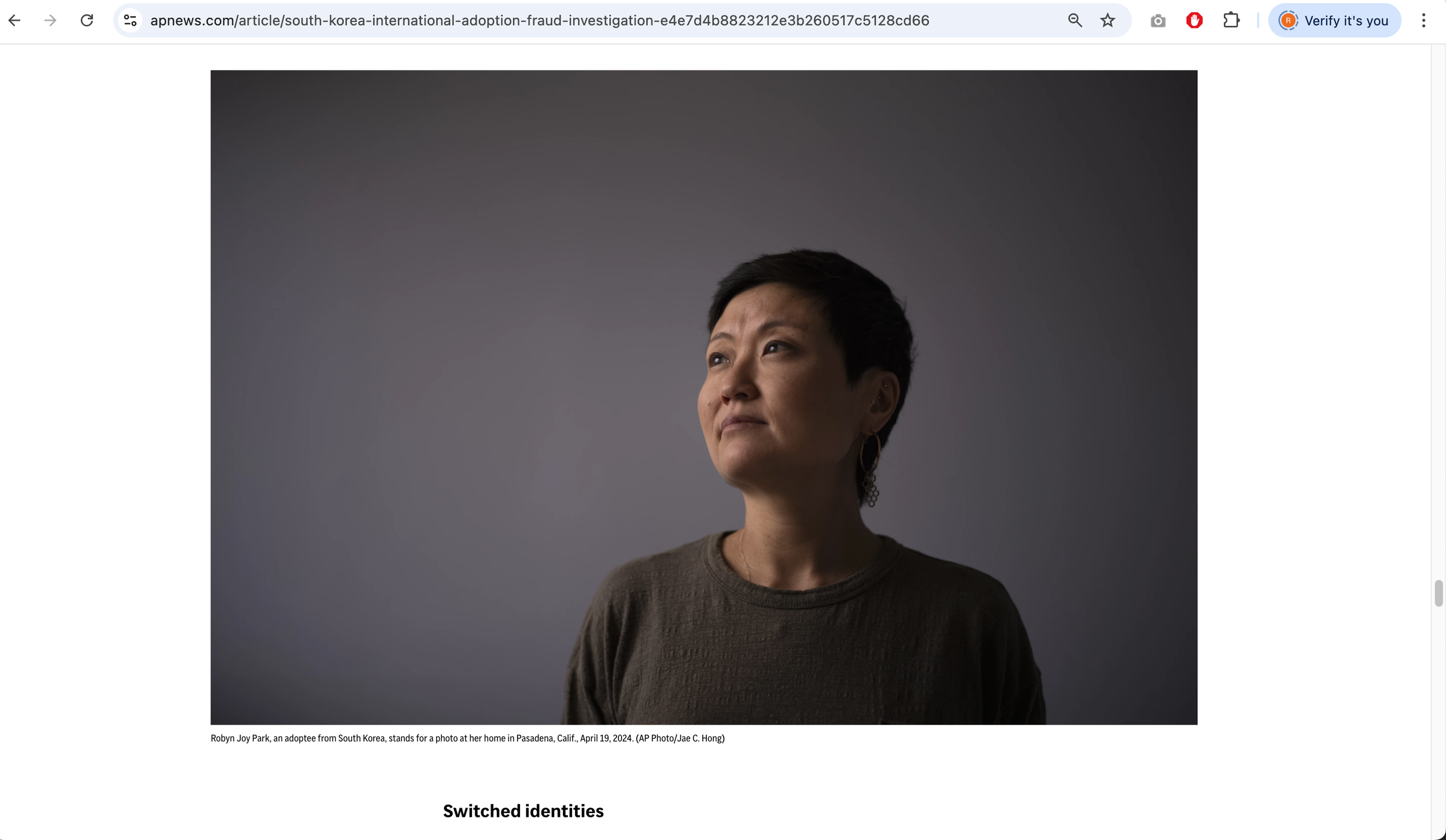
Widespread adoption fraud separated generations of Korean children from their families, AP finds
Referral 1: Robert Calabretta
Referral 2: Robyn Joy Park
+
Where It All Began—My Email To Tong-hyung Kim On January 24th, 2021, Asking Him To Write A Story About Systemic Switching.
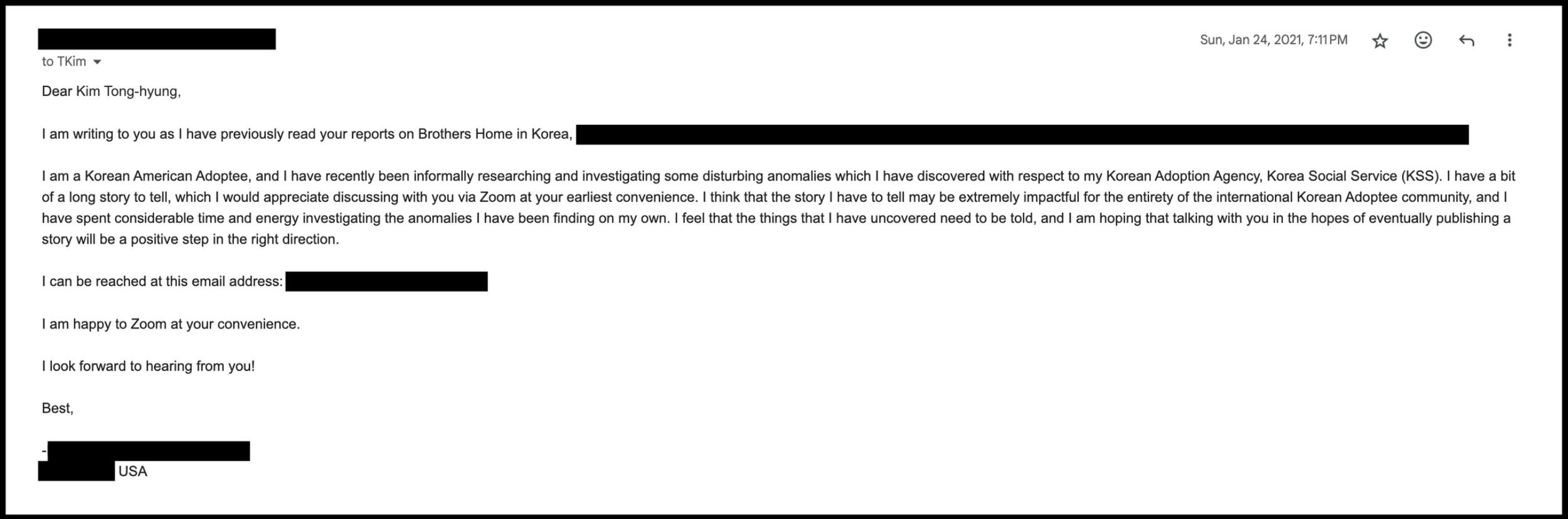
My email from January 24th, 2021 says:
“Dear Kim Tong-hyung,
I am writing to you as I have previously read your reports on Brothers Home in Korea.
I am a Korean American Adoptee, and I have recently been informally researching and investigating some disturbing anomalies which I have discovered with respect to my Korean Adoption Agency, Korea Social Service (KSS). I have a bit of a long story to tell, which I would appreciate discussing with you via Zoom at your earliest convenience. I think that the story I have to tell may be extremely impactful for the entirety of the international Korean Adoptee community, and i have spent considerable time and energy investigating the anomalies I have been finding on my own. I feel that the things that I have uncovered need to be told, and I am hoping that talking with you in the hopes of eventually publishing a story will be a positive step in the right direction.
I can be reached at this email address.
I am happy to Zoom at your convenience.
I look forward to hearing from you!”
Tong-Hyung would later accompany me to KSS in Summer 2021, where KSS’ longest serving social worker admitted on film in his presence that “Switching happened all the time”.
(Please note that I believe, based on anecdotal evidence, that a small minority of Adoptees are actually Switched, according to my definition of Switching).
+
THE FRONTLINE DOCUMENTARY OVERLOOKS THE GENESIS OF TONG-HYUNG KIM’S INVESTIGATION INTO SWITCHING AND ADOPTION CORRUPTION—MY SWITCH CASE:
On April 21st, 2025, AP Reporter Tong-hyung Kim and FRONTLINE Director Lora Moftah had the audacity to write this message as part of a larger email in response to my criticism of their not crediting me in the documentary:
”The issue of switching that you are raising was just one part of the FRONTLINE/AP investigation into fraud and abuse in the Korean adoption system over decades. And Tong-hyung was already six years into his reporting on Korean adoptions, and on switching itself, when he first met you in 2021.“
+
However, Tong-hyung Kim’s own published words below contradict this, and there is absolutely ZERO evidence that Tong-hyung Kim was investigating switching prior to January 2021 when I first reached out to him to do exactly that. He NEVER ONCE mentioned to me from 2021-2025 that he had been investigating switching prior to when I first contacted him in January 2021, and we had been in frequent communication, both online and in person. As I will later point out, ALL of the switched Adoptees interviewed in the FRONTLINE documentary and related AP articles were direct or indirect referrals from me to Tong-hyung Kim since 2021. THERE IS NOT ONE SWITCHED ADOPTEE FEATURED IN EITHER THE FRONTLINE DOCUMENTARY OR THE RELATED AP ARTICLES / INTERACTIVE WHO WAS NOT DIRECTLY OR INDIRECTLY REFERRED BY ME. I had been identifying switched Adoptees since 2018, and putting over one dozen switched Adoptees directly in touch with Tong-hyung Kim since January 2021.
By contrast, I have rock solid proof that I had been investigating systemic switching, in the form of the SBS documentary about my case, which was released on December 24th, 2022 — nearly two years prior to when the FRONTLINE / AP documentary was released.
Below is a messenger conversation between myself and AP reporter Tong-hyung Kim from October 25th, 2024, after the AP article below was published where Tong-hyung Kim admits that his visit with me to KSS in 2021 “birthed Kim’s years-long obsession with reporting on adoption fraud out of Korea.”
BEST OF AP — FIRST WINNER
A South Korean adoptee needed answers about the past. She got them — just not the ones she wanted
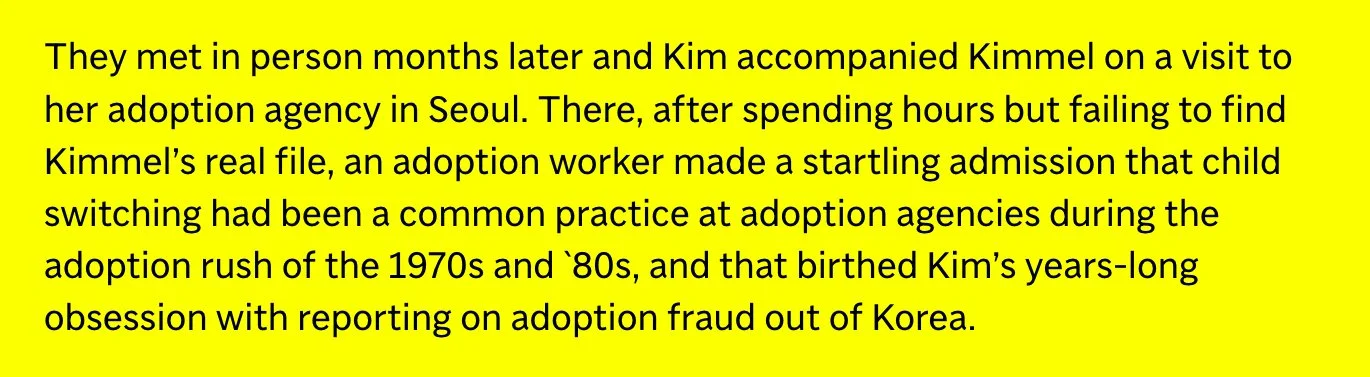
”They met in person months later and (Tong-hyung) Kim accompanied Kimmel (me) on a visit to her adoption agency in Seoul. There, after spending hours but failing to find Kimmel’s real file, an adoption worker made a startling admission that child switching had been a common practice at adoption agencies during the adoption rush of the 1970s and `80s, and that birthed Kim’s years-long obsession with reporting on adoption fraud out of Korea.”
After reading this article, I messaged Tong-hyung Kim on October 25th, 2024 to verify that what happened during his visit with me to KSS in 2021 was the genesis of his interest in switching and in overall adoption corruption, which he more or less confirmed. Note that he says, “I mentioned the conversation a lot as I continued to push the project with editors, proposing that we go bigger.”
Isn’t that essentially an admission that his opportunity to observe my investigation into my and my twin’s switch cases at KSS in 2021 played a major role in sparking the FRONTLINE documentary, AP articles, and Interactive? And yet, I received zero credit in the film.
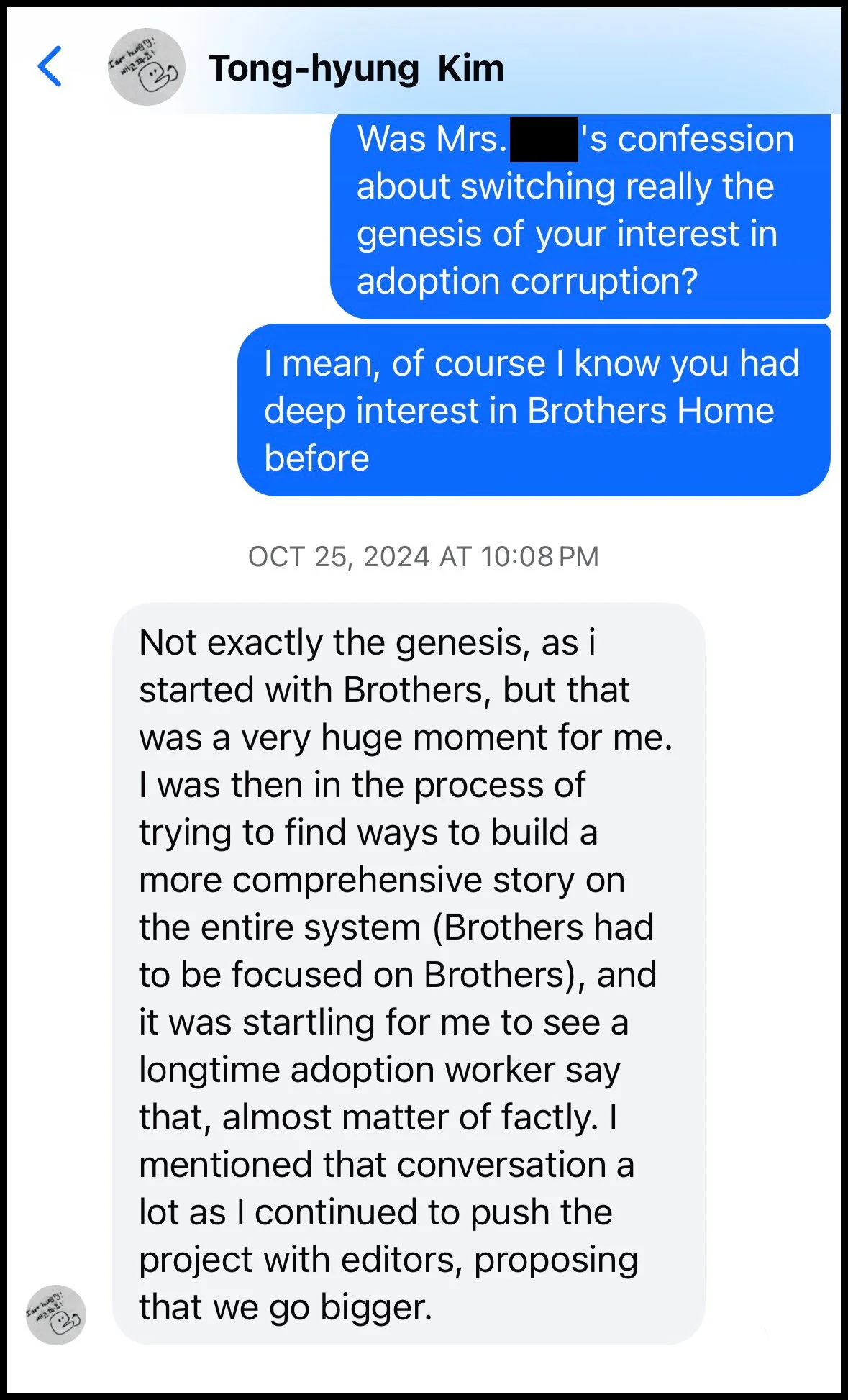
There is little way that Tong-hyung Kim could have gained access to the Director of KSS without my having invited him to my meeting at KSS in 2021. That was an extraordinary meeting, which was filmed by an independent filmmaker friend of mine, and not by any journalist.
Yet despite my investigation into my and my likely twin’s switch cases — of which my meeting at KSS in 2021 was a central part — being ground zero for Tong-hyung Kim’s later reporting on Korean Adoption, I was almost completely erased from the 2024 documentary and given zero credit.
+
Below: Screencapture of article — BEST OF AP — FIRST WINNER — A South Korean adoptee needed answers about the past. She got them — just not the ones she wanted
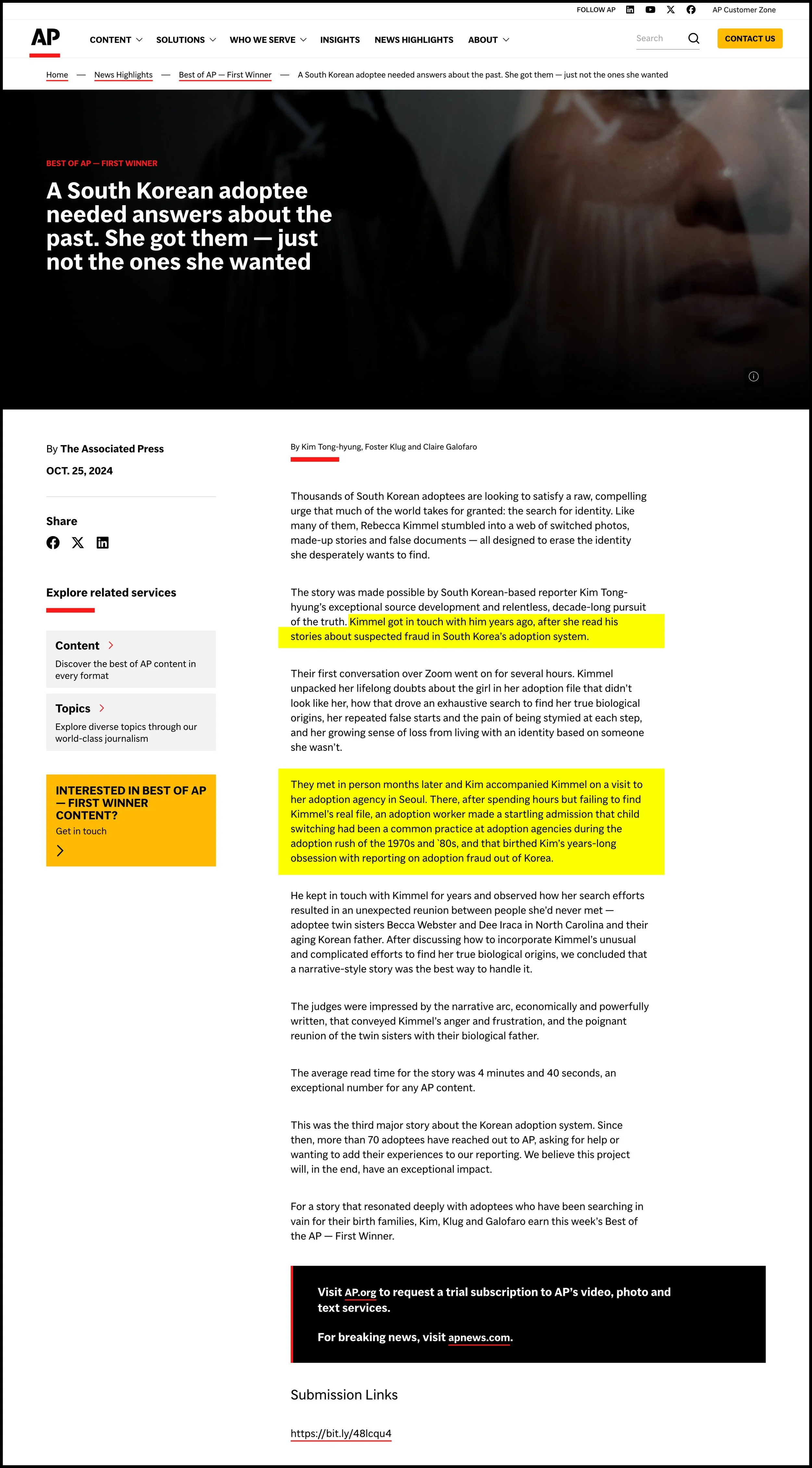
AP reporter Tong-hyung Kim didn’t just “happen” to be at KSS with me in 2021 — I had personally invited him, along with an independent filmmaker friend and some others, to join me there for a specific purpose: to investigate the systemic nature of switching, as exemplified by my switch case and the switch case of my twin — and to try to get answers in both of our cases. And of course, I wanted systemic switching to come to light in the press. Beginning that year, I referred approximately one dozen switched Adoptees to Tong-hyung, urging him to write a story focused on the broader systemic patterns behind these cases.
What began as a journalistic inquiry evolved—unexpectedly—into a series of AP articles and into the filming of the FRONTLINE / AP documentary, which first began filming at my studio in Seattle between June 30th - July 1st, 2023. Despite my foundational role in shaping a central theme of the project — Systemic Switching — and in connecting many of the documentary’s final interview subjects with the filmmakers, my contributions were never acknowledged in the final FRONTLINE production.
+
Conclusion.
When the director of the FRONTLINE documentary, Lora Moftah, exclaims while filming in Korea, “You’re the driver!”—acknowledging that you were guiding the very narrative they were documenting…
When, in a private Zoom after the film’s release, she admits, “Your handprints are all over the documentary,” despite your name never appearing in it…
When she shares that the entire FRONTLINE team was “amazed” by the depth and rigor of your investigation…
And when AP reporter Tong-hyung Kim, in a published piece about the award he received for covering your case, credits a pivotal moment —when you allowed him to witness your investigation firsthand — as the spark that ignited his years-long reporting on adoption fraud in Korea…don’t you think you might deserve even one line of credit in the final FRONTLINE documentary?
Yet that did NOT happen—I did not receive even ONE LINE OF CREDIT or even a note of “Special Thanks” in the FRONTLINE documentary.
I did not spend countless hours painstakingly sharing my story with Tong-hyung Kim under the impression that my information would go “on background” for a documentary. I was never being interviewed as a confidential source. At no point did I expect that the result of my work would be a film in which the journalist — with whom I spoke at length about my case and my investigation into systemic switching — would become the central figure, creating the impression that he had conducted the investigation into systemic switching himself. I certainly did not expect to be almost completely cut out of the documentary and receive no credit whatsoever.
As for whether I should have received credit in the documentary for my work, the fact that my case was mentioned in a related article and interactive is irrelevant. Tong-hyung Kim and Lora Moftah were credited across all three parts of the FRONTLINE / AP series — the documentary, the articles, and the interactive — while I was acknowledged only in the latter two. Yet my contributions to the documentary were substantial and should have been credited accordingly — had these journalists chosen to act ethically, which they did not.
The opening segments of the documentary, which focus on the history of Korean adoption—primarily through the lens of Holt, while largely ignoring the other major Korean Adoption Agencies— could have been lifted from any number of existing documentaries on the subject. As many Korean Adoptee viewers noted, much of what the film presented (with the notable exception of systemic switching) covered ground that Korean Adoptee researchers have been exploring and discussing for decades — knowledge that is already well-known within the Adoptee community. When I first watched the documentary, I couldn’t help but note, with some wry amusement, the disingenuous pretense that FRONTLINE and the AP were breaking new ground in investigating Korean adoption, despite the deep and longstanding body of scholarship that preceded them.
Without my contributions — specifically the referred interview subjects and the core theme of systemic switching — there would be little original substance left to the documentary.
It’s notable that in areas of the documentary where Tong-hyung Kim did not consult me — for example, with respect to his interview with NCRC (National Center for the Rights of the Child) official Sarah Yun - the reporting in the documentary is significantly weaker. Toward the end of the documentary, Tong-hyung Kim barely interrogates Sarah Yun, despite the fact that she worked for almost twenty years for Holt, and now works at NCRC. Tong-hyung Kim lets Sarah Yun off extremely lightly in his interview — despite the fact that she worked at NCRC during the same time period during which thousands of orphanage documents were effectively destroyed by this supposed “Child Rights” public institution.
I can’t help but think that if the FRONTLINE/AP documentary had acknowledged that I had already discussed systemic switching in the 2022 SBS documentary about my case, it would have undermined their claim to being "cutting edge" or on the “front line” — especially given that the SBS piece was released two years earlier. Perhaps that’s why Lora Moftah and Tong-hyung Kim chose to omit my role entirely: to present themselves — at least in the documentary — as the sole discoverers of the issue. Whatever their motivations, both appear firmly committed to erasing my involvement from the narrative in the documentary — something which, even two years later, continues to shock me.
After the documentary aired, Tong-hyung Kim was asked during a KAAN-hosted panel how he began investigating adoption fraud. His response? That he "just began to pull on a thread." What a joke — that so-called "thread" was, in fact, the result of my dozens of referrals of Adoptees to him from 2021-2024, along with my direct approach in January 2021 urging him to write a story about systemic switching.
It would have cost FRONTLINE and the Associated Press nothing — not a cent — to include a single line of “Special Thanks” in the credits of the documentary. But in the end, neither FRONTLINE’s Lora Moftah, nor AP’s Tong-hyung Kim, nor anyone in leadership at either organization found it within themselves to offer the most basic acknowledgment in the film. They were happy to use my time, my contacts, and my years long investigation into systemic switching — but not my name.
While Lora Moftah and Tong-hyung Kim have advanced their careers on the back of my work, they have never apologized for my lack of credit in the documentary, nor tried in the least to remedy the egregious omission.
If anything, Lora Moftah and Tong-hyung Kim have doubled down on their erasure of my contributions to the documentary.
In retrospect, it’s telling that when Tong-hyung Kim first approached me about being filmed for the FRONTLINE / AP documentary, he repeatedly emphasized how every time the two had partnered, they had won a major award. Looking back, I can’t help but wonder if that was the motivation behind omitting any mention of my name in the documentary credits — to create the impression that FRONTLINE / AP had led the entire investigation. In truth, what lay at the heart of the documentary was an Adoptee-driven effort — one largely driven by me.
In the end, the FRONTLINE / AP documentary won neither a Peabody nor an Emmy — awards that honor journalistic integrity. That absence speaks volumes.
The rest, as they say, is egregiously uncredited history.