
BBC Article: “South Korea woman and doctors guilty of murder of newborn baby.”
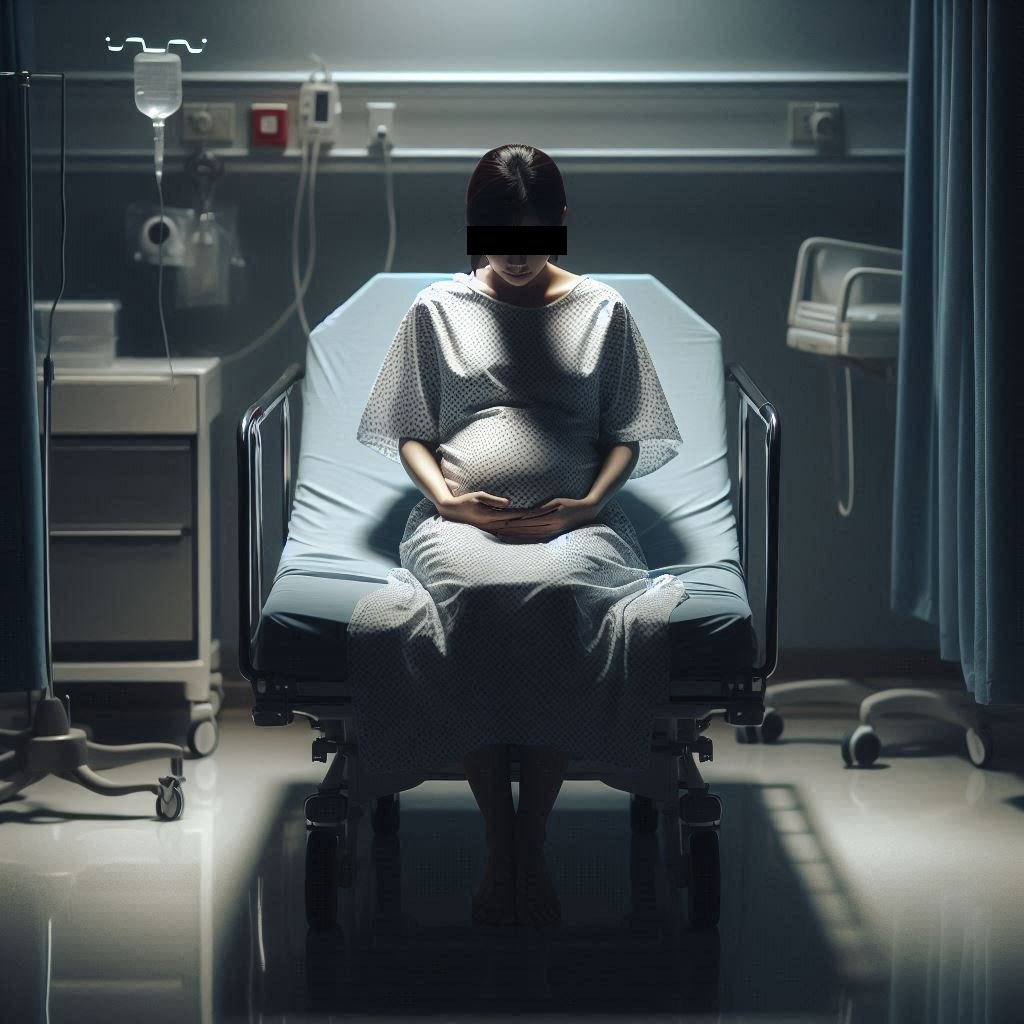
Above — AI generated image depicting pregnancy.
BBC Article: “South Korea woman and doctors guilty of murder of newborn baby.”
Jake Kwon, Seoul Correspondent, Koh Ewe and Leehyun Choi, Seoul producer
Update — March 10th, 2026 Korea Times Article (English):
Infanticide conviction exposes vacuum in Korea’s abortion law
Why do some people in South Korea — a country with one of the lowest birth rates in the world — still fail to value human life? While we are not fundamentally opposed to the safe practice of abortion, we are appalled by late-term abortions and by the lack of clear regulation surrounding abortion practices in South Korea.
TRIGGER WARNING:
This disturbing article is the latest example of S. Korea’s history of performing late term abortions. Please see related older articles related to this topic:
‘No update since 2019’: Korea’s inaction on abortion issue leaves women in limbo (July 7, 2024)
Groups call for action to address South Korea’s unmet commitment to abortion rights (May 20, 2024).
Abortion in South Korea (Wikipedia).
+
WARNING — EXTREMELY TRIGGERING CONTENT:
KBS Article and Video from 1994:
”Forced Delivery of Premature Infants
Published: January 16, 1994.”
Thanks to a Paperslip Contributor for the link.
Translation via ChatGPT.
Please refer to the original Korean article for the video link.
BOLDS and blue highlighting ours.
Paperslip Note:
We have known of this article and related video for a few years, but have not previously wished to publish it here on Paperslip. However, in light of the recent BBC article (linked at the top of this page), it only makes sense to share this older KBS article and video from 1994, which addresses the extremely disturbing topic of S. Korean doctors forcibly inducing delivery of premature babies. Many of the surviving babies whose deliveries were forcibly induced ended up in S. Korean adoption agencies.
+
“Here is the next news report.
In our society, it is true that abortion—an act no different from killing for various reasons—is still being condoned. However, in cases of unmarried mothers who have missed the legal timing for abortion, some obstetrics and gynecology clinics are committing acts even worse than murder by forcibly inducing delivery of premature babies at seven or eight months and then abandoning them. This reveals a shocking level of moral insensitivity in our society.
Reporter Bae Jong-ho exposes the scene of illegal forced inductions.
Reporter Bae Jong-ho:
This is a premature baby who was forcibly delivered at seven and a half months and then left alone on a hospital bed. The baby, who would have been born normally in just two and a half more months, was forcibly delivered at the request of an unmarried mother who had missed the abortion deadline. The baby cannot even cry like a healthy newborn.
“If you forcibly deliver a baby at seven and a half months, that’s not right, is it?”
“No, it isn’t.”
“Then why did you do it?”
“Both the mother and the father were high school students, and the adoptive parents pleaded earnestly about their difficult circumstances, so we had no choice but to do it.”
Many of the prematurely delivered babies soon lose their lives. Even those who survive and are transferred to adoption agencies must live their entire lives with disabilities due to severe brain damage and other critical injuries sustained during the forced delivery.
Cho Byung-guk (Hospital Director, Holt Children’s Welfare Society):
“If labor is induced at seven months of pregnancy, clinical symptoms appear that are similar to those of cerebral palsy.”
Reporter Bae Jong-ho:
This is a temporary shelter at an adoption agency that cares for premature babies abandoned by unmarried mothers. This premature baby, receiving milk through a tube inside an incubator, appears as if life could fade at any moment. Another baby, suffering from severe jaundice, is undergoing light therapy with its eyes covered. One child is suffering from hydrocephalus, a buildup of fluid in the brain. Another has twisted arms; another was born without a brain. Most of these children with various disabilities were forcibly delivered before reaching full term, which underscores the seriousness of the issue.
“Approximately how many of the babies were delivered through induced labor?”
Jung Hye-jin (Head Nurse, Eastern Social Welfare Society):
“Well, as far as I know, nearly all the babies who end up in incubators were delivered through induced labor…”
Reporter Bae Jong-ho:
This phenomenon is a common reality at nearly all adoption agencies.
So Hwa-young (Director of Social Work, Holt):
“The problem is that the number of these children has been gradually increasing this year. We are struggling greatly to come up with countermeasures for how to care for them going forward.”
Reporter Bae Jong-ho:
Under current law, such forced inductions are prohibited except in special cases, such as when the mother’s life is in danger. However, most obstetrics and gynecology clinics do not follow this law.
Obstetrician:
“In principle, as a doctor, it shouldn’t be done. But induced abortions are not covered by medical insurance, and terminating a pregnancy at seven or eight months costs around 700,000 to 800,000 won, so there is inevitably some financial temptation…”
Reporter Bae Jong-ho:
Last year alone, approximately 800 prematurely delivered babies were sent to adoption agencies after forced induction. Without special measures, this number is likely to increase further.
Shim Yang-geum (Director, Southern Gyeonggi Temporary Children’s Shelter):
“Induced labor is an act even more cruel than murder. These children must live with disabilities from the moment they are born. Even if a mother intends to give up the child, shouldn’t she at least carry the baby to full term—about ten months—and deliver normally?”’
Reporter Bae Jong-ho, KBS News.