
Illustrated Sequence of KSS’ Known Numbering Systems.
Above: Stock image.
Paperslip Content Is COPYRIGHTED: © 2018-2026. Instances of Plagiarism Will Be Legally Pursued.
*The duration of copyright is the author’s life + 70 years.
All content published on Paperslip.org is protected by official copyright law. Any unauthorized use, reproduction, or plagiarism of our original research and content — whether published or unpublished — will be pursued to the fullest extent permitted by law. By using our site, you agree to NOT plagiarize or reproduce “as your own” our copyrighted material. Any information shared from Paperslip.org must be done by linking directly to our site; plagiarizing, copying, modifying, or redistributing our original work “as your own” is strictly prohibited. Reproducing our original research and publishing it “as your own” is strictly prohibited.
+
Below is the:
Illustrated Sequence of KSS’ Known Numbering Systems.
While the full KSS adoption process likely involved many more steps than are outlined here, the steps below are intended to highlight key moments when KSS assigned specific types of identification numbers to children being processed for international adoption.
+
Important Building Block Concepts To Understand:
It is important to understand that KSS (Korea Social Service) was a Korean Adoption Agency, based in Seoul. KSS processed children for overseas adoption between 1964-2012 in cooperation with a specific list of Partner Western Adoption Agencies.
KSS could have gotten children from ANYWHERE in S. Korea. While ALL KSS children were processed out of Seoul, since that is where KSS was based, this definitely does not mean that ALL KSS Adoptees were BORN in Seoul.
There was a great deal of movement of children around Korea in the context of overseas adoption.
Please note that at least starting around 1976, only a Korean Adoption Agency such as KSS could have sent a child overseas for adoption. “Feeder Orphanages” could NOT (legally) do this.
KSS was a Korean Adoption Agency and Orphanage in one.
KSS could only house up to around 150 children at a time at KSS’ former campus in Seoul, however, and so most children were not housed directly at KSS for long periods of time. However, we believe that most children spent around 1-2 weeks at KSS in order to be processed for overseas adoption prior to their being sent abroad, assuming they came into KSS’ system through an external “feeder orphanage” or other source of children, such as a maternity clinic or hospital. Some children were also directly relinqished by birth parents or extended birth family members directly to KSS in Seoul.
+
Please note that I am currently aware of three KSS numbering systems (the Child Number, the K-Number, and the File Number), one Korean Government numbering system (the Travel Certificate numbering system), and one numbering system connected to one of KSS’ Western Partner Adoption Agencies, Welcome House (US).
My research into these KSS numbering systems — whether published or unpublished — is under official copyright.
KSS and its feeder orphanages likely have many more numbering systems for children of which I am currently unaware.
The major KSS’ feeder orphanage “Nam Kwang Orphanage in Busan” is known to have many of its own numbering systems, only one of which I have researched — KSS’ encoded K-Number.
I have known since 2021 that children were being assigned encoded KSS K-Numbers at Nam Kwang Orphanage in Busan. A Nam Kwang worker told me in person in 2021 that there were KSS workers who worked on site at Nam Kwang Orphanage in Busan. (This Nam Kwang worker also said that Holt had its own office on site at Nam Kwang). I do not know the duration of time during which KSS kept workers on site at Nam Kwang. However, KSS and Nam Kwang had a very tight relationship that lasted decades.
I have known since January 2021 that KSS was thus encoding children for adoption through its Partner Western Adoption Agencies at the FEEDER ORPHANAGE level.
Below I have assembled a guide for what is currently known about KSS’ Numbering Systems for children.
+
Step 1:
Child Relinquishment (Or Acquisition).
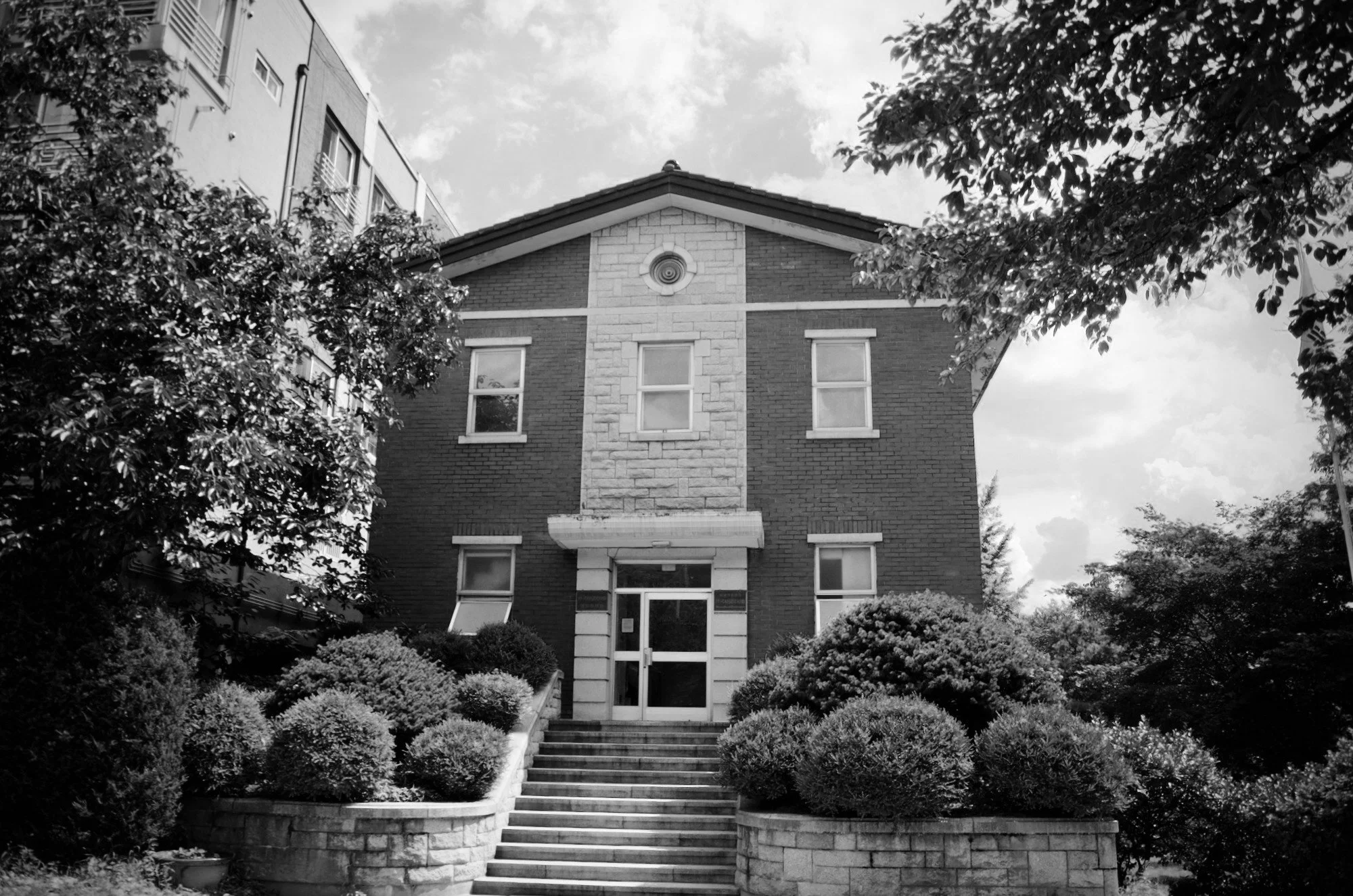
Above: The former K.S.S. Receiving Home in Seoul, which was the main building of its former campus. The KSS campus was torn down in 2016. For more information please see:
The KSS Receiving Home in Seoul -The Old KSS Campus.
In order to process a child for adoption, KSS first had to acquire the child.
KSS, like all of the other major Korean Adoption Agencies, had a network of feeder orphanages, maternity and birth clinics, hospitals, churches, single unwed mothers’ homes, and police stations from which to source children for adoption. Birth parent/s and birth relatives also could directly Relinquish a child or children to KSS in Seoul.
KSS — like all of the major Korean Adoption Agencies — was located in Seoul. However, children processed for international adoption through KSS could have come from ANYWHERE in S. Korea, between 1964-2012.
+
Step 2:
KSS sometimes assigned a child with a “Child Number” / “Receipt Number”, presumably at INTAKE to KSS in Seoul.
The “Child Number” has not previously been known to anyone outside of KSS, before I began to publish information about this formerly secret, internal KSS number in April 2026.
I have known about the “Child Number” since 2018, when I photographed my own file at KSS.
It appears as though once a child was either Relinquished or transferred to KSS in Seoul, KSS sometimes assigned the child with an unencoded, sequential “Child Number” / “Receipt Number”. In a 2019 email, the then KSS Director admitted that she did not know when KSS began to use this “Child Number” / “Receipt Number”.
Specifically, KSS’ then Director wrote in her email on February 11th, 2019:
“But it is not sure when the Receipt Number (Child Number) was started because the early cases don't have these numbers and these numbers are mixed for some years. So these days we don't use this number for our (Post Adoption Services) work.”
At least in the 1970s, this “Child Number” / “Receipt Number” was sometimes but sometimes not assigned and recorded at the upper left of the formerly secret KSS internal document called:
“국내소속서류작성의뢰서”
“Request Form for Preparation of Domestic Affiliation Documents”
or
“Domestic Affiliation Request Form”
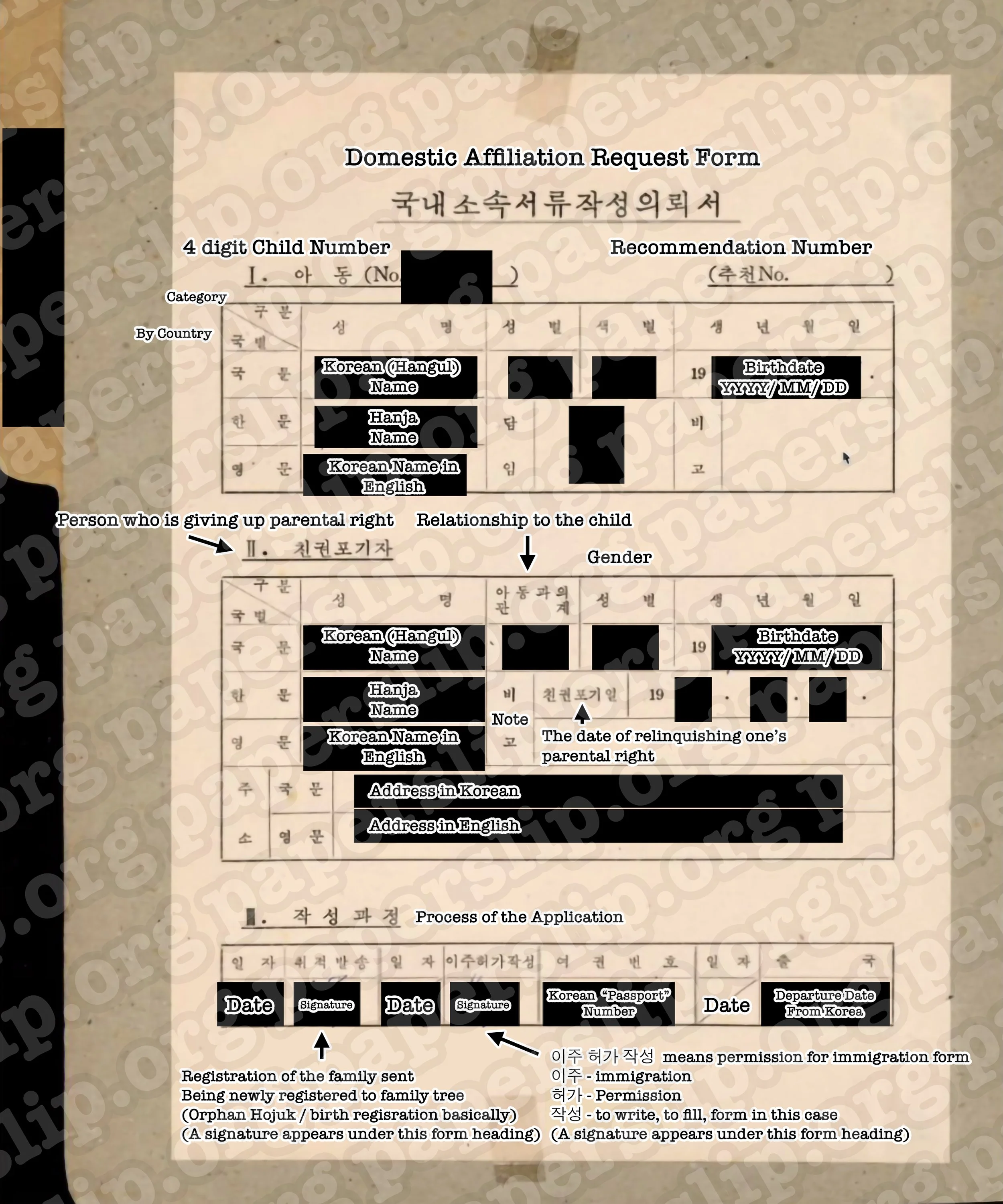
Image credit: Paperslip.org
The image above may NOT be reproduced or shared without permission. Thank you to the KSS Adoptee who shared this image with us. We have posted a redacted version with permission.
We have added translations which were done years ago by a live Korean translator. Since that time we have made some translation revisions (specifically to the title of the document) via ChatGPT.
You are welcome to share a link to this page on Paperslip.org directly. Thank you.
KSS Adoptees can (for) now obtain the “국내소속서류작성의뢰서” / “Request Form for Preparation of Domestic Affiliation Documents” through a Petition for Adoption Information Disclosure request through NCRC.
Please see:
Even KSS Adoptees among the 56 TRC 2 decision recipients did NOT receive the KSS form “국내소속서류작성의뢰서” (Request Form for Preparation of Domestic Affiliation Documents).
Please be advised that ALL former Korean Adoption Agency files will likely move from NCRC’s Temporary Storage Facility to the Seongam Branch of the National Archives sometime in 2026.
+
Step 3:
Around 1-2 months after a child’s INTAKE to KSS in Seoul, KSS assigned a child with a K-Number, which was uniquely encoded in the FIRST digit with a numeric code for one of KSS' Partner Western Adoption Agencies.

Image credit: Paperslip.org
The image above may NOT be reproduced or shared without permission.
In assigning a child with an encoded K-Number, KSS was thus MATCHING a child with one of its Partner Western Adoption Agencies.
KSS did NOT match children with prospective adoptive parents in the West.
KSS matched children to its Partner Western Adoption Agencies.
KSS always included the child’s K-Number on the ENGLISH Adoptive Child Study Summary, which was sent from KSS to its Western Partner Adoption Agencies, which then distributed this document to prospective adoptive parents, along with an associated photo of a prospective KSS child for consideration for adoption.
Secretly, KSS kept a KOREAN Adoptive Child Study Summary at KSS in Seoul. This document sometimes contained more information about a child’s origins and birth parents than was included on the often (though not always) falsified ENGLISH Adoptive Child Study Summary.
KSS’ Partner Western Adoption Agencies then matched children to prospective adoptive parents.
This was part of the process of matching within the system of Proxy Adoption, which was used for the majority of time during which KSS sent children for adoption to the West.
Proxy adoption was effectively a “mail order” system of adoption for Korean children to the West.
+
Step 4:
Once a set of Western prospective adoptive parents approved a KSS child for adoption through the Proxy Adoption process of “Matching” between KSS and its Partner Western Adoption Agencies, documents began to be prepared in both Korea and the child’s intended Western country of adoption.
KSS submitted documents to the Korean Government for the preparation of a Korean Travel Certificate for the child.
KSS then recorded this Korean Travel Certificate Number on the bottom right of this formerly secret, internal form called the:
“국내소속서류작성의뢰서”
“Request Form for Preparation of Domestic Affiliation Documents”
or
“Domestic Affiliation Request Form”
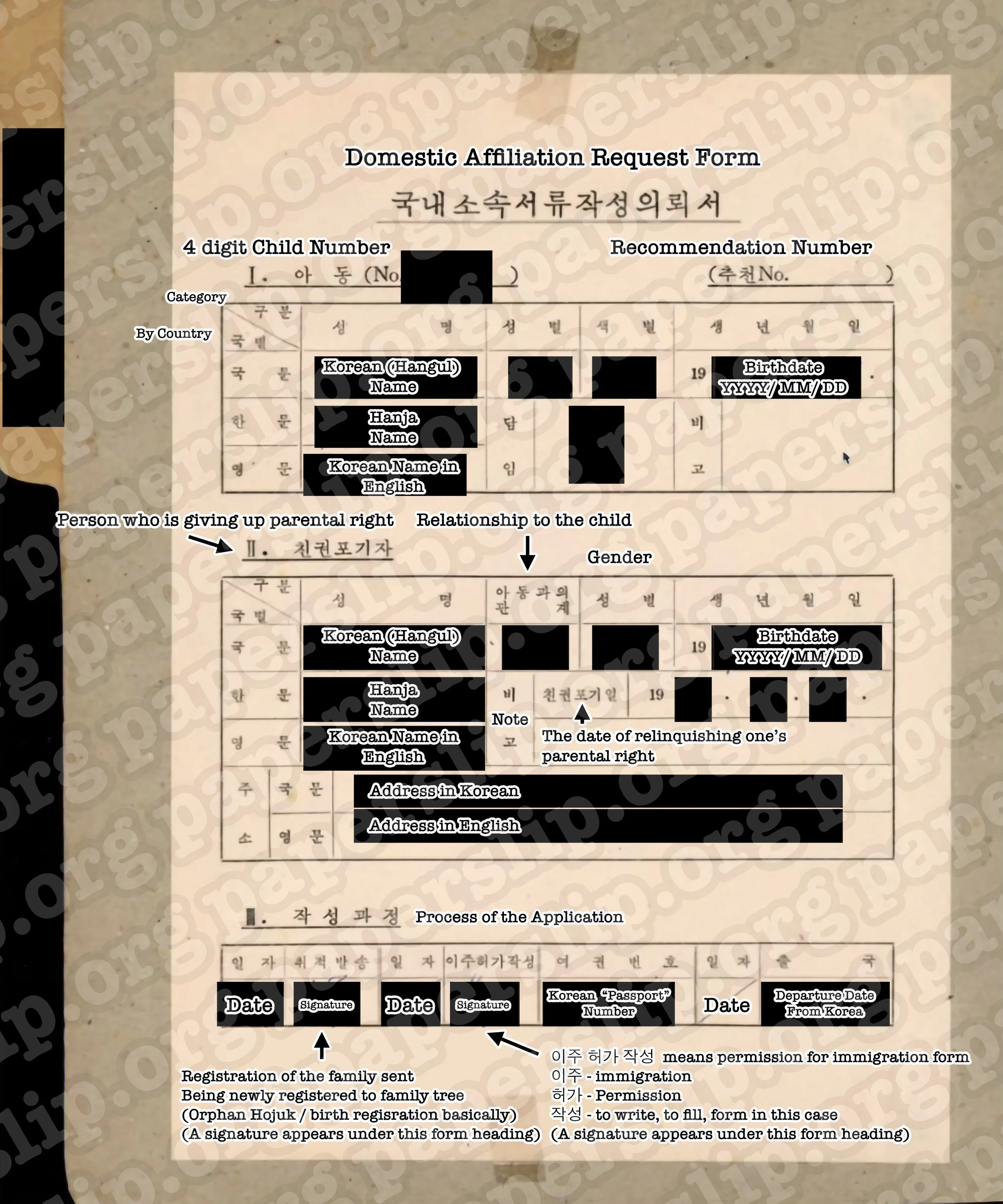
Image credit: Paperslip.org
The image above may NOT be reproduced or shared without permission. Thank you to the KSS Adoptee who shared this image with us. We have posted a redacted version with permission.
We have added translations which were done years ago by a live Korean translator. Since that time we have made some translation revisions (specifically to the title of the document) via ChatGPT.
You are welcome to share a link to this page on Paperslip.org directly. Thank you.
Step 5:
KSS escorted children to Gimpo Airport, where they departed Korea for their Western country of adoption, usually in batches of around one dozen or more children at a time — though the size of these groups almost certainly varied over time.
Incheon Airport was not built until 2001, so must of us flew out of Gimpo Airport.
Image credit: Stock photo.
KSS workers or other escorts accompanied the children on these flights.
During the Cold War, KSS children who were adopted to Europe flew the “Polar Route” — from Korea to Japan to Anchorage, Alaska, to Europe (often Schipol Airport in Amsterdam) and from there to either Denmark or Switzerland, depending on where they were matched for adoption.
This flight was often 2-3 days in duration.
It is known that some children died during these long flights.
+
Step 6:
KSS assigned a child’s folder with a “File Number” after she or he was sent for adoption to the West.
It is not known exactly when KSS made this “File Number” — presumably it was added to a child’s folder tab just before they departed for adoption to the West.
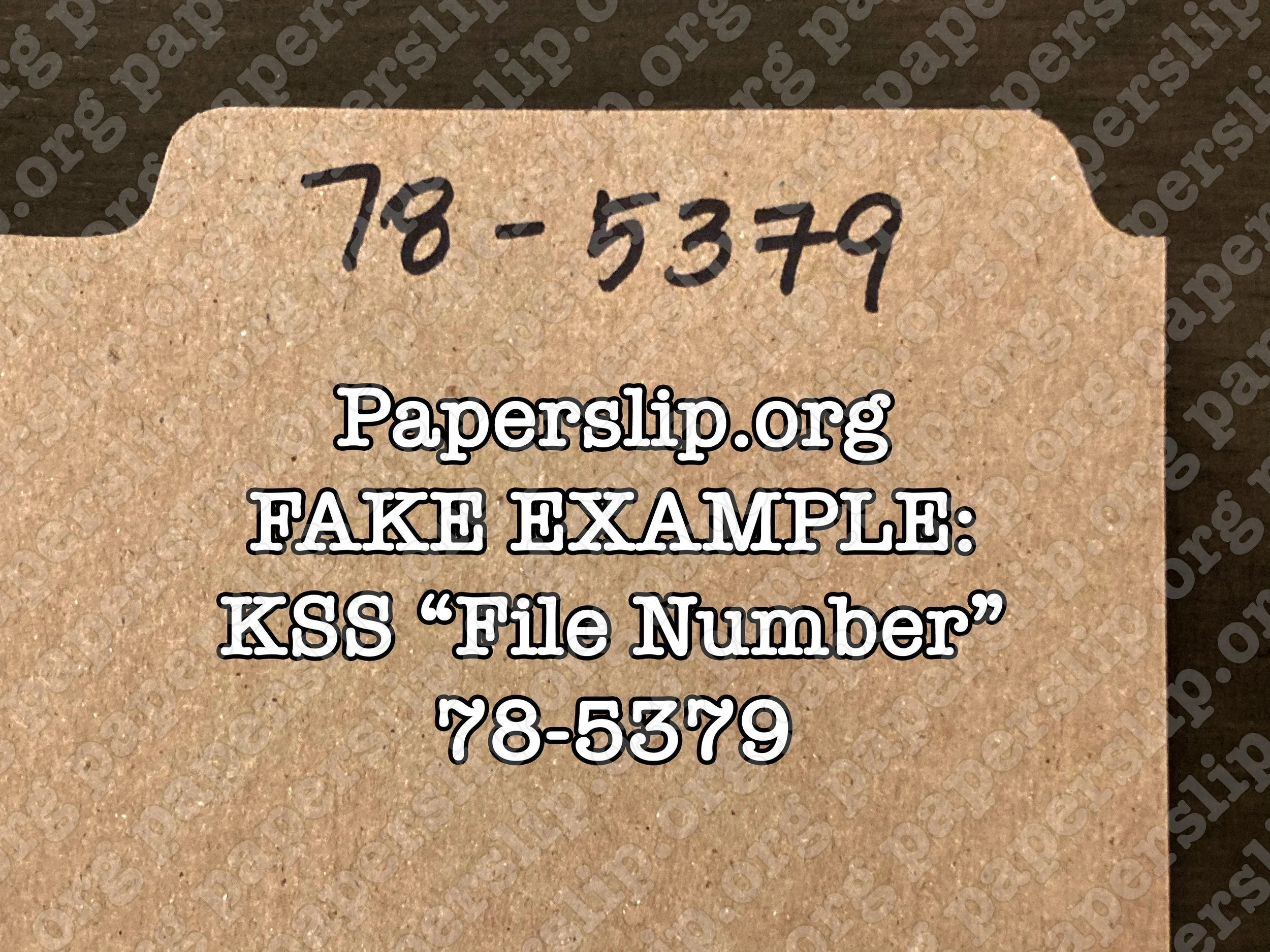
Image credit: Paperslip.org
This is a FAKE EXAMPLE of a KSS “File Number”. This number was handwritten on one side of the KSS child’s file folder by KSS, presumably after the child departed Korea to be adopted to the West.
The “File Number” was a YY-1234 number which denoted the last two digits of the year that the child DEPARTED Korea for adoption to the West. This was sometimes but not always the same year as the child was born — this just depended on an individual child’s case.
The last 4 digits were sequential. However, I do not know when this sequential number began — presumably it began around 1964 when KSS was founded, but this is not known for sure. Having seen many KSS file folders from 1975 and 1976, I can say that ALL of these file folders had “File Numbers”, handwritten on the tabs of one side of each KSS Adoptee’s file folders.
Please note that the KSS “File Number” was not exactly secret, but it was a KSS internal number which was NOT regularly shared with KSS’ Partner Western Adoption Agencies, Adoptees, or their adoptive parents, according to the then KSS Director in her 2019 email.
KSS’ then Director effectively wrote:
“The Receipt Number / Child Number and “File Number” are NOT known to our Partner Western Adoption Agencies or Adoptees.”
My own example of my KSS “K-Number”, K-1xxxx as written on my KSS file folder, is below.
The “File Number” is written on the opposite side of tab that the “K-Number” is written on.
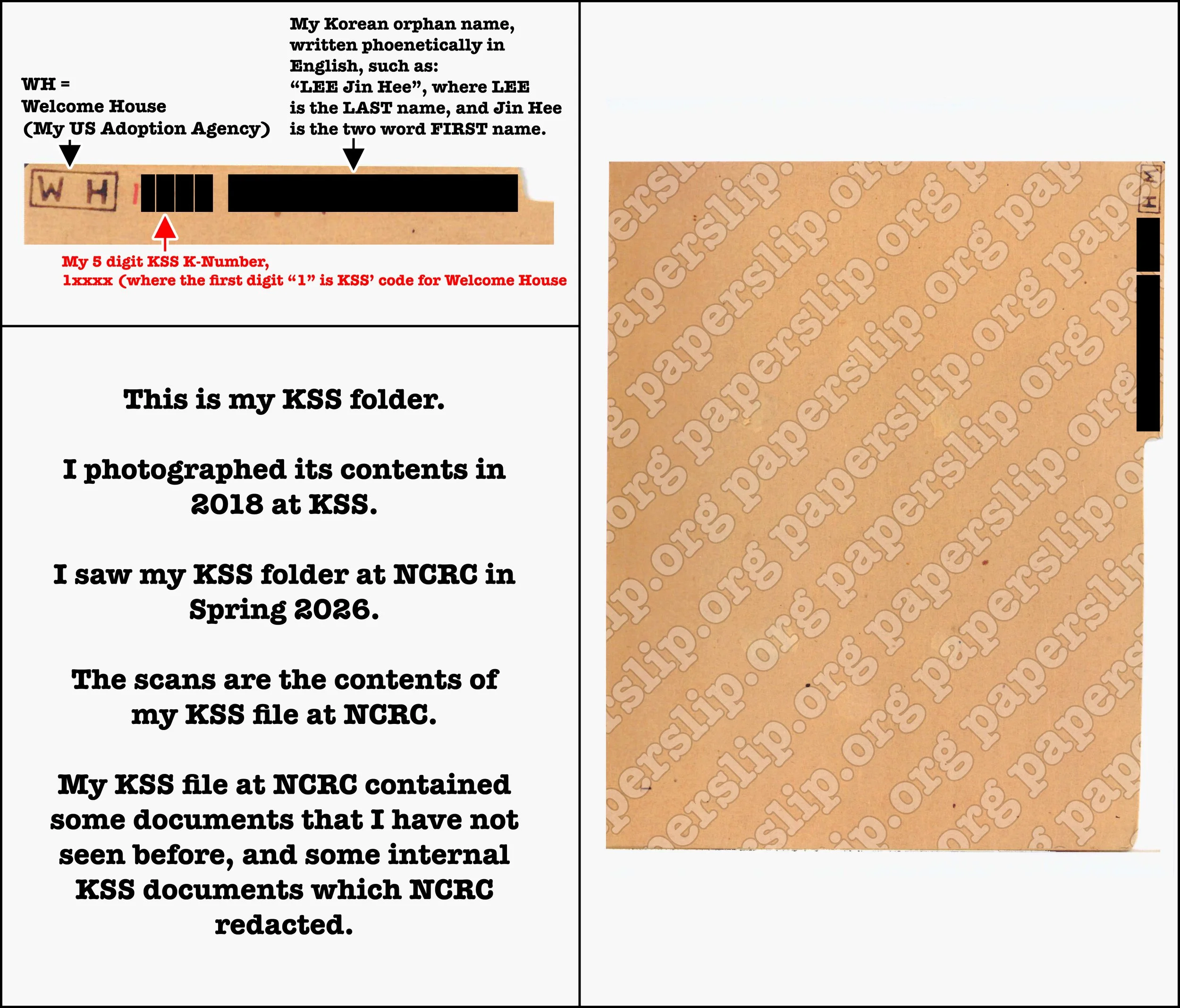
Image credit: Paperslip.org
This image belongs to the author and may NOT be reproduced without written permission.
Below:
KSS files sitting in the hallway at its former Post Adoption Services building in Seoul. The photo was taken at some point between 2016-2025.
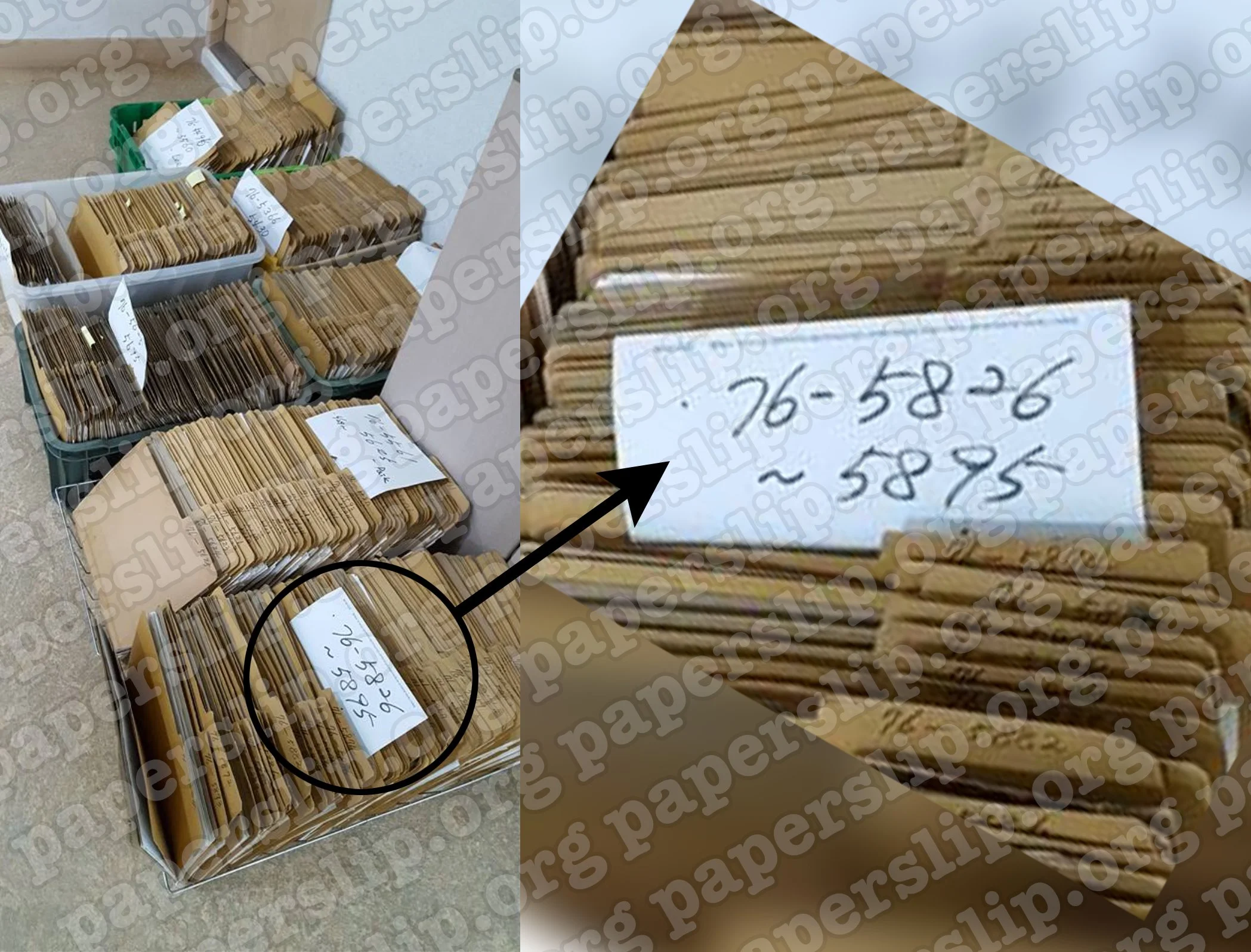
Image credit: Paperslip.org
This image belongs to the author and may NOT be reproduced without written permission.
Above: A photo of some KSS files in the hallway at its former Post Adoption Services building in Seoul. You can clearly see the KSS “File Numbers” written on the tabs of each of the folders. On the opposite side of the folder tab are the initials of the child’s Partner Western Adoption Agency though which they were adopted, their K-Number, and their Korean orphan name written phonetically in English, such as “LEE Jin Hee”.
KSS files were not normally stored in the hallway like this — apparently one year during a major Korean Adoptee conference, KSS put several files in the hallway like this.
Below:
KSS’ filing cabinets in the file room at KSS’ former Post Adoption Services building in Seoul. The photo was taken at some point between 2019-2025.
KSS files moved to the NCRC Temporary Storage Facility on July 19th, 2025 and are likely to be moved AGAIN to the Seongam Branch of the National Archives at some point in 2026.
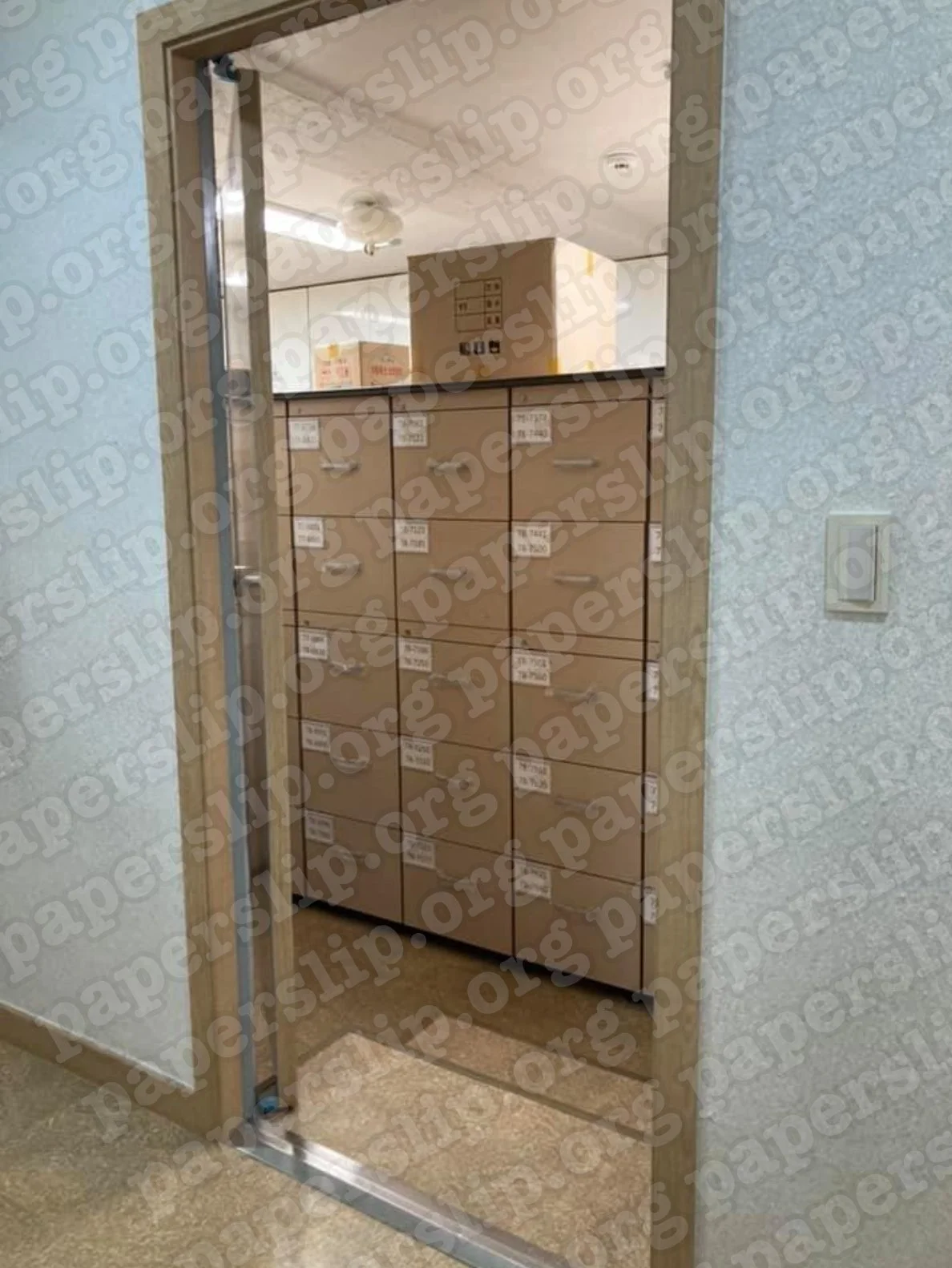
Image credit: Paperslip.org
This image belongs to the author and may NOT be reproduced without written permission.
Above: KSS’ former file room at its former Post Adoption Services building in Seoul. KSS files are no longer housed here.