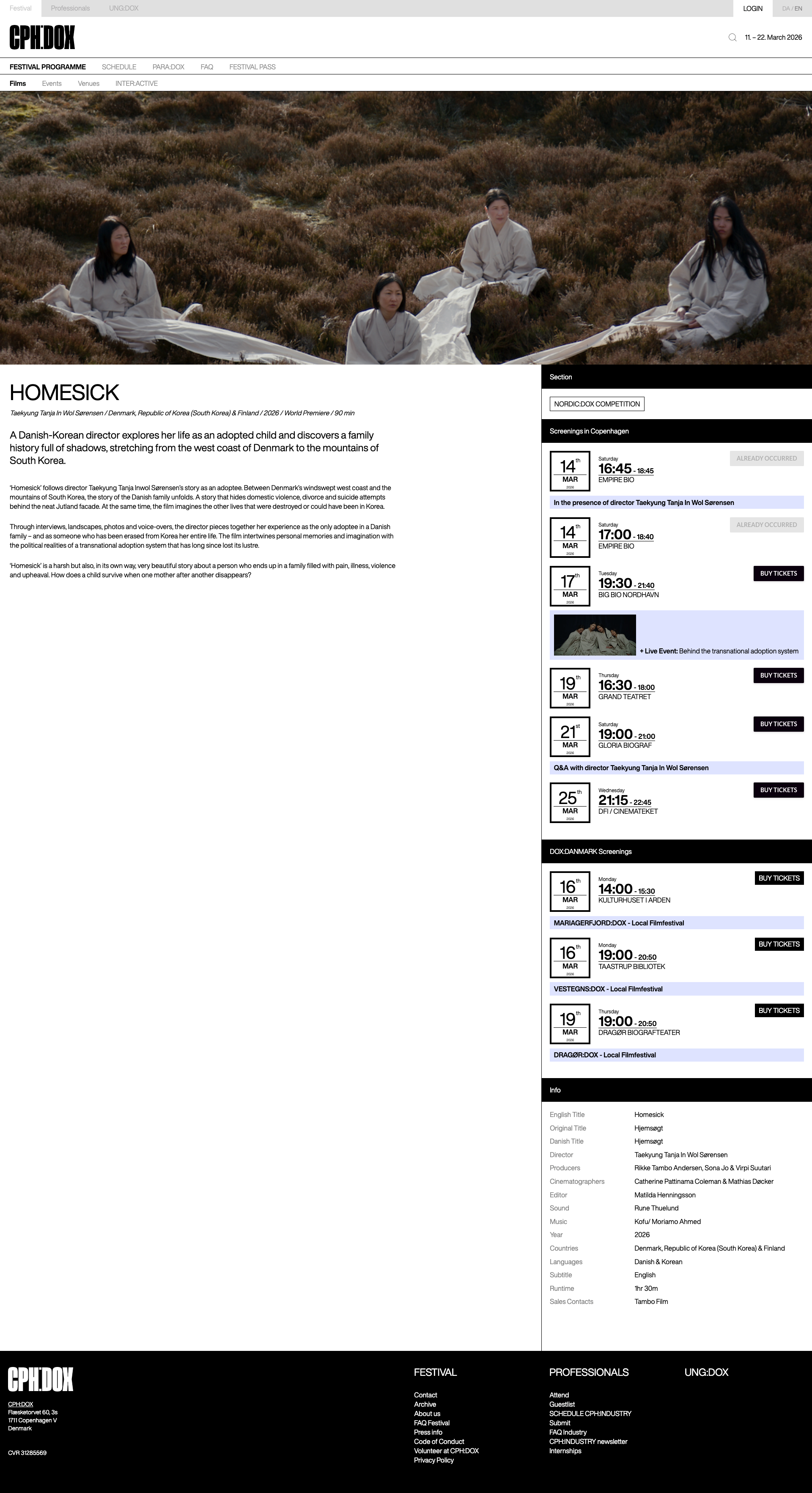
KSS Adoptee Taekyung Tanja In Wol Sørensen releases new documentary, “Hjemsøgt” / “Homesick”. We helped her obtain her Korean Adoptive Child Study Summary in 2022, and her birth certificate in 2025.
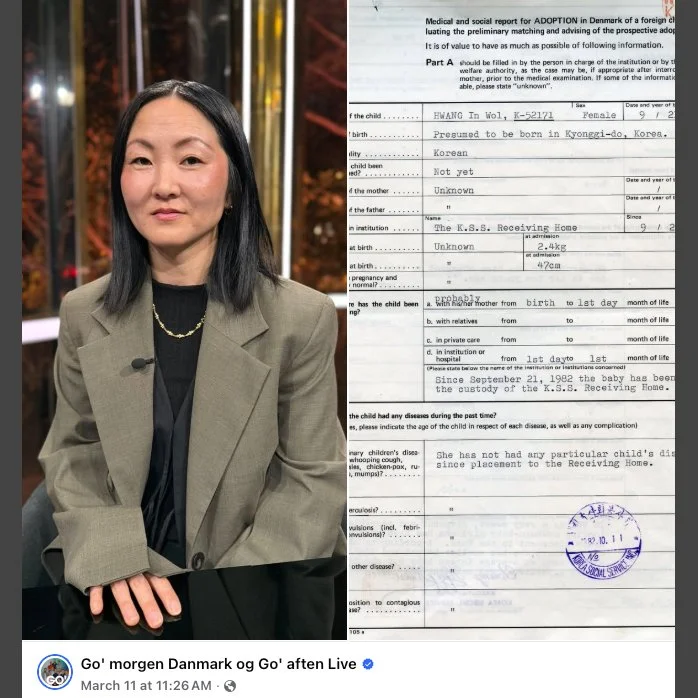
Above — photo of Danish KSS (Korea Social Service) Adoptee and Director Taekyung Tanja In Wol Sørensen (left) and her KSS English Adoptive Child Study Summary (right) from the post of “Go' morgen Danmark og Go' aften Live” (see their post further down this page).
Above — Danish KSS (Korea Social Service) Adoptee and Director Taekyung Tanja In Wol Sørensen is pictured at left.
On the right is her KSS English Adoptive Child Study Summary (in Denmark, the English Adoptive Child Study Summary is sometimes called: “Information for ADOPTION in Denmark of a foreign child”), which contains no information about her birth parents. However, KSS secretly maintained a separate Korean Adoptive Child Study Summary — a document that KSS never routinely informed Adoptees about nor explained how to obtain.
At Paperslip, we only discovered the existence of the Korean Adoptive Child Study Summary in 2018 — but it was not until July 2021 that we accidentally figured out the process for requesting and obtaining it from KSS. Thanks to our years of providing free information and assistance for KSS Adoptees, Tanja was able to request and receive her formerly secret Korean Adoptive Child Study Summary in 2022. It turned out to include birth parent information about which she had never previously been told. With our further assistance, Tanja was able to request and obtain her Korean birth certificate from KSS in 2025.
However, as in many such cases, strict birth parent “privacy laws” mean the birth parent information in the Korean Adoptive Child Study Summary remains partly redacted. While the Korean public institution which now maintains KSS files, NCRC, is able to see this birth parent information, the Adoptee — in this case, Tanja — cannot. This reflects a central, decades-long struggle for Korean Adoptees: the fight for our Right to Origin.
+
Please see the trailer for “Hjemsøgt” / “Homesick” here:
Source of trailer link. Please see full Danish article translation at the bottom of this page.
We helped Danish KSS Adoptee and Director Taekyung Tanja In Wol Sørensen to obtain the KSS footage which you see at the start of her film from another KSS Adoptee. We are glad to see that this footage made it into her film.
We have also heard that Paperslip’s co-founder (this writer) has been credited in the film. Thank you to Tanja for doing so.
+
Paperslip Note:
It is important to understand that KSS Adoptee and director Taekyung Tanja In Wol Sørensen was one of only 56 Korean Adoptees who received a judgment in their cases from TRC 2 (the Second Truth and Reconciliation Commission of the Republic of Korea). In total, 367 Korean adoptees submitted cases to TRC 2 (2022-2025).
TRC 2 placed the entire burden of proof on Korean Adoptees. Yet obtaining documentation from Korean Adoption Agencies has always been a monumentally difficult task. It was only through our years of volunteer work at Paperslip that many KSS Adoptees — and specifically a significant number of Danish KSS Adoptees — were able to provide documentary evidence to TRC 2 in the form of their often contradictory English Adoptive Child Study Summary and Korean Adoptive Child Study Summary documents. A central mission of Paperslip since its founding in 2020 has been to patiently educate KSS Adoptees not only about the differences between these documents, the names for which we coined in 2021 — but also about how to obtain them from KSS.
Tanja was one of hundreds of KSS Adoptees who, with our free guidance, were able to successfully request and obtain their formerly secret Korean Adoptive Child Study Summary and other documents prior to the transfer of all former Korean Adoption Agency files to the National Center for the Rights of the Child (NCRC) on July 19th, 2025. While it’s not impossible to obtain the Korean Adoptive Child Study Summary now from NCRC, the birth family search process through NCRC is significantly more bottlenecked than it was through KSS, due to the fact that the chronically and deliberately underfunded / understaffed NCRC is now responsible for ALL former Korean Adoption Agency files.
For years, Paperslip’s work and research supported TRC 2’s investigation into overseas adoption. TRC 2 relied heavily on evidence painstakingly gathered by Korean Adoptees themselves — particularly by KSS and Holt Adoptees, since KSS and Holt were the only Korean Adoption Agencies that sent Korean children to Denmark, which was the focus of TRC 2’s overseas adoption investigation.
Our relentless, free assistance to KSS Adoptees between 2021 and 2025 — who were adopted to the US, Netherlands, Denmark, and Switzerland between 1964-2012 — is a key reason why so many Danish KSS Adoptees were able to submit critical documentary evidence to TRC 2. Much of the material that ultimately supported TRC 2’s investigation was made possible through our extensive behind-the-scenes work.
Had Tanja not been able to locate her birth mother through the KSS search process with which we assisted her, and had she not understood the discrepancies between her English and Korean Adoptive Child Study Summary documents and been able to obtain her formerly secret Korean Adoptive Child Study Summary with our guidance, she would likely never have received a judgment in her TRC 2 case.
It is also important to understand the tremendous emotional cost which Korean Adoptees must bear in order to undertake a birth family search. “Simply” requesting documents from a Korean Adoption Agency like KSS — whose social workers often treated KSS Adoptees in belittling and demeaning ways, and who seemed to delight in gaslighting us for decades — is the emotional equivalent of climbing Mt. Everest.
We understand what it cost Tanja to open the Pandora’s box of a birth family search. Many of us know firsthand the searing emotional fire of search — and the agonizing uncertainty of what may (or may not) be found along the way. For that reason, we deeply commend Tanja for her courage, not only in undertaking this journey, but also in sharing with the world in a profound and personal way what it demanded of her and what it ultimately cost.
+
Tanja’s story was promoted on the Danish Facebook page of the TV show called Go' morgen Danmark og Go' aften Live.
Watch the full segment from Go' aften Live on TV 2 Play here (you’ll probably need to be in Denmark / Europe to be able to view this).
More info and showtimes in Denmark here:
https://cphdox.dk/film/homesick/
We corresponded with Danish KSS Adoptee and Director Taekyung Tanja In Wol Sørensen a bit between 2022-2025, and helped Tanja get her (formerly secret) Korean Adoptive Child Study Summary from KSS in 2022 and her birth certificate in 2025, prior to the transfer of all KSS files (along with ALL former Korean Adoption Agency files) to NCRC. Her Korean Adoptive Child Study Summary apparently had birth parent information which was absent from her English Adoptive Child Study Summary (which, according to our original research, for Danish KSS Adoptees is sometimes called, “Information for ADOPTION in Denmark of a foreign child”).
Tanja was one of hundreds of KSS Adoptees we helped for free to obtain the formerly secret Korean Adoptive Child Study from KSS, between 2021-2025. This document was unique to KSS, though certainly other Korean Adoption Agencies likely had differently named documents serving the same purpose — to secretly record the (sometimes) more truthful information about a child’s origin. KSS orphanized thousands of children it sent for adoption to the West in this way — by routinely erasing their origins.
The fact that so many KSS Adoptees were able to obtain their Korean Adoptive Child Study Summary with our free assistance between 2021-2025 is why this document dominates the paper evidence of the March 26th, 2025 Interim Report of TRC 2 (The Second Truth and Reconciliation Commission, Republic of Korea). We have been in contact with hundreds of Danish KSS Adoptees since 2018, due to our years of free work with the international KSS Adoptee community, both through Paperslip, and through the private Facebook group for KSS Adoptees only, “KSS Cribmates”.
KSS adopted to the US, Netherlands, Denmark, and Switzerland, between 1964-2012. KSS closed Post Adoption Services in 2025, and (for now) all KSS files are (currently) at NCRC’s Temporary Storage Facility in Goyang, Gyeonggi-do. All KSS files are likely to move AGAIN to the Seongam Branch of the National Archives, sometime in the first half of 2026, though the timeline is unclear.
This scenario — of a KSS Adoptee’s Korean Adoptive Child Study Summary often containing more information than was included in the English Adoptive Child Study Summary which was provided to adoptive parents during the early stages of the adoption process between KSS and its Partner Western Adoption Agencies — was unfortunately not uncommon for KSS Adoptees, though KSS unfortunately did not have birth parent information for every KSS Adoptee in its system. Indeed, this mass form of Orphanization — where a child’s original identity was routinely erased — is the very reason why we call this website “Paperslip”. KSS frequently wrote in a child’s English Adoptive Child Study Summary that the child was “abandoned” and “found with a paper-slip” or “memo” in her or his “clothings” (sic). Or it said that the child was found at a “police station”. Yet in the very same child’s formerly secret Korean Adoptive Child Study Summary — which KSS kept hidden for decades — birth parent information, or other tidbits of information about a child’s past were often (though not always) recorded. KSS kept this information for decades, but did not routinely inform Adoptees or their adoptive parents that they had done so — and never would have, had we not accidentally figured the process out in 2021. Tanja first reached out to us by email in 2022.
We only accidentally figured out how to request and obtain KSS' formerly secret Korean Adoptive Child Study Summary — a term which we ourselves coined — in July 2021. We then spent 4 years helping as many KSS Adoptees as we could to request and obtain this document, for free, prior to the July 19, 2025 transfer of all KSS files to NCRC.
Unfortunately, now that KSS has PERMANENTLY CLOSED Post Adoption Services in the wake of the file transfer to NCRC on July 19th, 2025, KSS Adoptees must now make a Petition for Adoption Information Disclosure request through NCRC in order to try to obtain their formerly secret Korean Adoptive Child Study Summary. As NCRC must now serve the request of ALL Korean Adoptees around the world with a very small staff, these requests by KSS Adoptees in attempting to obtain their Korean Adoptive Child Study Summary documents are unfortunately predictably experiencing challenges.
You can read Paperlip's original research about the KSS Korean Adoptive Child Study Summary here:
Korean Adoptive Child Study Summary
You can read Paperlip's original research about the KSS English Adoptive Child Study Summary here:
English Adoptive Child Study Summary
In Denmark, the English Adoptive Child Study Summary is sometimes called: “Information for ADOPTION in Denmark of a foreign child”.
Due to the systemic erasure of so many thousands of KSS Adoptees’ origins through their often (*though not always) falsified paperwork, the ability to find and connect with any blood relatives largely boils down to DNA testing. We strongly encourage those Korean Adoptees who have interest in finding any blood relatives to take ALL possible DNA tests.
+
The post by the Danish TV show Go' morgen Danmark og Go' aften Live says:
“I have always wondered why I ended up here.”
Documentarian Taekyung Tanja In Wol Sørensen grew up in Varde but was adopted from South Korea.
In her new documentary “Homesick,” she imagines what her life might have been like if she had grown up in South Korea.
Taekyung had always believed that she was a foundling, but that was not the reality.
“I discovered that the adoption agency (KSS) in South Korea has had my mother’s contact information the entire time,” Taekyung says.
She explains that the South Korean state has acknowledged violating human rights by falsifying adoption documents."
+
Article from Danish film magazine Filmmagasinet Ekko:
“She Was Adopted on a Lie.”
Translation via ChatGPT.
Posted to Paperslip on March 14th, 2026.
First posted in Denmark on March 11th, 2026.
BOLDS and blue highlighting ours.
“Articles | CPH:DOX 2026 | She Was Adopted on a Lie – RSS Feed / Articles
CPH:DOX 2026
11 March 2026 | 11:35
She Was Adopted on a Lie
Photo | Tambo Film
When Taekyung Tanja Inwol Sørensen was two months old, she was adopted by a married couple in Varde, Denmark. But her adoptive parents divorced when she was only two.
“Is transnational adoption even a good idea?” asks Taekyung Tanja Inwol Sørensen, who in Haunted tells the tragic story of her own adoption.
By Kevin Lundgreen Frederiksen
When she was just two months old, in 1982, Taekyung Tanja Inwol Sørensen was adopted and brought to the Danish peninsula of Jutland. Her first childhood memory is of her mother throwing a frying pan at her father’s head.
As a child she was told that she had been found abandoned in South Korea. But many years later she discovered that the story was not true.
She had not been found on the streets of Seoul, and her origins were not unknown. Instead, she had been born in a maternity ward in the port city of Incheon, where her biological mother was a single factory worker. Korean authorities had falsified the documents to make her more adoptable. Taekyung’s past had been deliberately erased.
Now she tells her own family story in the moving documentary Haunted, which premieres on March 14 at CPH:DOX. The director focuses on adoption institutions in Korea and Denmark, as well as the so-called nuclear family.
The documentary follows Taekyung’s personal story as an adoptee in Denmark. Between the Danish west coast and the mountains of South Korea, a story unfolds. On the surface it appears to be a Jutland family chronicle, but in reality it is about systemic and structural frameworks that end up having lifelong consequences for ordinary people.
“I really want to question what we consider sacred in society: the nuclear family. What are we willing to sacrifice in order for it to exist?” she asks in an interview with the film magazine Ekko.
Behind the Facade
Taekyung was adopted by a married couple in Varde who ran a gas station.
Outwardly the family resembled a classic Danish nuclear family, but behind the facade there was a father with growing alcohol problems and a divorce waiting just around the corner.
At the age of three she moved to the island of Funen with her mother and her mother’s new husband. When her mother died three years later, she moved back to Varde to live with her father and his new family.
But the tragedies did not stop there. Her father was violently abusive, and for a period her stepmother moved away with her own children, leaving Taekyung alone with him. More than ten years ago he fell into a lake and drowned.
In the documentary, Taekyung is both director and main character. She interviews uncles, aunts, and friends of the family.
“It has been important for me that viewers get to look at the Danish family through my eyes. That there’s no doubt that it’s me looking at them—and that I’m inviting the audience to look with me,” she says.
“It has also been important to be honest about the relationship between me and the people appearing in the film. The only reason they sit there and answer the questions so openly is because they’re answering me. That’s the premise of the whole story: I’m trying to focus on things that no one really wants to talk about.”
The Construction of Family
The film focuses on family secrets and how family members often unconsciously protect them.
“Secrets can only exist because people don’t open up about them. So you have to start somewhere. When I conducted the first interviews, I realized it wasn’t because people didn’t want to talk about it. Rather, no one had ever asked the questions,” says Taekyung Tanja Inwol Sørensen.
“I realized it only took one person willing to prick the balloon. Once that happened, it actually wasn’t so dangerous.”
In her own family, the issues revolved around domestic violence, her father’s alcoholism, and his attempts to commit suicide. That raises another question: who has the greater right to a family? The single mother in South Korea—or the childless couple in Varde who were on the brink of divorce?
“For me, family has never been something sacred. From a fairly young age I’ve been very aware that family is a construction. And it takes a lot of effort to maintain the idea of a family,” she says.
“So the difficult part for me hasn’t been telling the story. The difficult part has been taking responsibility and facing all the people who trusted me to tell it.”
Mother Is Afraid
During the process, Taekyung gained access to her real birth certificate, and through the South Korean adoption agency she made contact with her biological mother.
“The letter came through the adoption agency, so I didn’t even know if it was completely genuine. I wasn’t allowed to get her name, address, or a photo of her. But I sensed that she was very afraid.”
“That put me in a difficult situation. Of course I wanted to meet her and get a lot of information from her. I also wanted to know more about my father.”
“But my feeling was that she was so traumatized by it that she didn’t want to talk about it. It was something she had locked away in a small box in her mind.”
Since the director’s Korean mother had meanwhile married and had two children who did not know about Taekyung, she decided to end the correspondence.
“What I realized during the exchange of letters was that just as my entire existence had been a secret in my Danish family, I had also been a huge secret in Korea. And there really wasn’t anything to do but respect that. When she stopped contact, I started making the film.”
— How do you think your life would have been in Korea?
“If my mother had kept me, I think life would have been very difficult. Because of shame and taboo. Maybe her own family would not have helped her.”
“I don’t have a rosy fantasy about what my life would have been like if I hadn’t been adopted. The film doesn’t suggest that either, because that would impose an intention on the people involved. The answer isn’t there. It’s about the system that didn’t give her any other option.”
Violation of Human Rights
In March 2025, South Korea’s Truth and Reconciliation Commission released an extensive report concluding that the state had violated human rights in 56 adoption cases—including Taekyung Tanja Inwol Sørensen’s own case. These are the first of thousands of cases now under review.
“For a long time I’ve known that documents were falsified. But I feel it’s a big responsibility to be one of the first whose case is officially recognized,” says the director.
South Korea’s government has also decided that all international adoptions of children will stop from 2029.
“It’s quite wild that it’s only happening now, but there’s still a growing internal adoption market. Korean society’s inability to accept single mothers hasn’t been resolved. Still, it’s good that they’re examining themselves, and I hope more countries follow.”
In Denmark the adoption system has been paused. People can no longer sign up to adopt children from abroad. The government has appointed a working group to propose a new approach.
“Denmark still hasn’t acknowledged that the country itself is part of the problem. You fulfill some people’s need to start a family, but it happens at the expense of others. There’s really nothing that can justify transnational adoption as a good idea. There are scandal after scandal from every country.”
A Tribute to the Mothers
Working on the film has had a therapeutic significance for Taekyung Tanja Inwol Sørensen. At first the director felt a need to place blame, but along the way her perspective changed.
“It started with me looking for a scapegoat or a bad guy. And it ended with me making a tribute to my mothers so they can be honored and understood. Because they’re the ones who carried the heavy burden,” she says.
Instead, she wants us to turn our attention toward the deeper structures and systems that shape society.
“The problem is that single mothers are not accepted in Korea. If we don’t acknowledge that it’s a human right to have a child as a single mother, it will continue to happen at the expense of other people.”
Taekyung Tanja Inwol Sørensen believes the concept of family should be expanded. That is also the message she hopes audiences take with them after the credits roll on Haunted.
“Don’t think that it’s your right to have a nuclear family consisting of father, mother, and children. Drop that rigid idea of the nuclear family. Instead, think about how family can be created on different terms. Open the family up!”
Trailer: Haunted”
*Please see trailer at the top of this post, and at the top of this page.
+
Tanja’s speech at the “Significance and Tasks of the TRC’s Human Rights Violation Decision on Intercountry Adoption” on August 26th, 2025 alluded to Paperslip’s assistance in obtaining her Korean Adoptive Child Study Summary.
Danish KSS Adoptee and Director Taekyung Tanja Inwol Sørensen spoke at the “Significance and Tasks of the TRC’s Human Rights Violation Decision on Intercountry Adoption” conference in Korea on August 26th, 2025. Her speech appears briefly in the trailer to her film. In her speech at the conference, which you can read in full below. Tanja alluded to our assistance, though did not mention Paperslip directly. The video from the event may no longer be available, but the PDF from the event can be found at the link above. We have quoted Tanja’s full speech from the PDF below.
We wrote then:
“It was nice that a Danish KSS Adoptee panelist (Taekyung Tanja Inwol Sørensen) mentioned Paperslip’s work in the Lawyer's event yesterday, even if she did not mention Paperslip by name. We had helped her get documents from KSS a couple of years ago, including her Korean Adoptive Child Study Summary, and she mentioned how it wasn't KSS who helped her obtain documents, but only the expertise of other Adoptees. You can see her remarks at about the 1:00:00 mark.”
+
The Significance and Tasks Following the Truth and Reconciliation Commission’s Decision on Human Rights Violations in Overseas Adoption:
Remarks by Taekyung Tanja In Wol Sørensen.
NOTE:
Tanja was one of 56 Korean Adoptees who received judgments in their TRC 2 cases. The TRC 2 investigation into Overseas Adoption was from 2022-2025, though the overall TRC 2 was from 2020-2025.
We at Paperslip were the first Korean Adoptees in history to submit case descriptions of any Korean Adoptees to any TRC investigation in Korea. We informally submitted case study summaries of switched Korean Adoptees to the head of TRC 2 on December 18th, 2020.
The official TRC 2 investigation into Overseas Adoption would not begin until two years later — on December 7th, 2022.
Along with Tanja, (who is not switched), three Danish switched KSS Adoptees with whom we had been in contact since 2018 received TRC 2 judgments in 2025.
Blue highlighting ours.
“The Significance and Tasks Following the Truth and Reconciliation Commission’s Decision on Human Rights Violations in Overseas Adoption
Remarks by Taekyung Tanja In Wol Sørensen”
(Found on pages 85-86 of the PDF from the event)
‘“Good afternoon everyone. My name is Taekyung Tanja In Wol Sorensen I have been invited today as one of the 56 adoptees, whose cases have been recognised by the Truth and Reconciliation Commission to have well documented human rights violations, thus recognising us as victims of state violence.
I would like to share with you what they look like in my case. And some thoughts on what should happen now.
When you tell a life story you often start at the beginning. But what if there is no beginning? I grew up believing my life started when I landed in Denmark. That is what I was told by my adoptive parents and that is what they were told by the Danish adoption agency. Even the adoption documents corroborate this story: unknown father, unknown mother, unknown birthplace, everything unknown, in sum, there is no story. What you can deduct from all the unknowns is that I was found and placed in the KSS children’s home before being sent to Denmark to start my story. But why has no one questioned this? Found how, by who and where?
It was a convenient story for a childless couple. To receive a child with no attachments and no story, the closest to having your own child. And the documents show the stamps and approval of all the correspondent authorities in both Denmark and Korea. So why question it.
As an adult, with the help of the knowledge of other adoptees, I filed a family search through KSS, and it turns out they had my mother’s contact on file this whole time. She exists, she is alive! But that’s all I got, no name, no picture, no address. But I could write her through KSS, and for a short time we exchanged a couple of letters, before she cut all contact. After she had me she married and had two kids, and she is scared that her life will be torn apart, that her family will turn away from her if they find out about me. She is scared and traumatised, even after all these years society will not accept her. We are both victims of this system.
I filed another family search through KSS, if they have my mother’s contact information, they must have more information about me. And again it was only thanks to the help and knowledge of other adoptees that I learnt how to apply the exact way, so they had to give me my birth document. In the application, all the way down, you cross out section D named ‘other’ and you write the name of the document you need with the exact title. KSS did not give information gladly. Even though it was your own information. And there in the Korean birth document it said birthdate, birthplace, birthweight. Not much but a little bit more than what I had. In the official document I was found in Seoul, and in the secret document I was born in a midwife clinic in Incheon.
To grow up with no beginning affects your sense of self in many ways. But to find out your beginning was erased on purpose to uphold a system, shakes your identity in a profound way.
I do not have grave and violent circumstances for my beginning, like too many other adoptees have, instead my case represents the large majority of all adoptees, and it represents the system’s logic, it is from this standpoint I speak. As one out of hundreds of thousands, whose beginnings have been erased and falsified to be sent abroad! In 1982 when I was born, at the height of the adoption frenzy, hundreds of Korean babies were being flown into Denmark alone, to be strewn across the country into white Danish families, on my flight we were at least a dozen small babies. All with the same story of no story. All found orphans on paper. Was Korea flooded with orphan babies on the streets for over 40 years?
I will never have a relationship with my mother, it is too late. But even the adoptees who find their families and resume a relationship with them, it will never mend the time and hurt caused.
Us adoptees have known for years that our documents were falsified, that our orphan hojuk signed by the authorities were false, that our stories of no stories were fabricated. Because we’ve been looking for our backgrounds, we’ve been questioning the official story, and we’ve met the walls of secrecy and bureaucracy in Korea and the countries we were adopted to. Transnational adoptees have been calling out the Korean intercountry adoption system for decades and have been met with silence. So I, and many of us, welcome the TRCs conclusion. It is the first time in history, in Korea and in any country, to officially acknowledge the human rights violations in the cases of transnational adoptees. But it will be merely symbolic if no legal and political change follows.
I still don’t know my mother’s name or what she looks like. I don’t know anything about my father. And I can’t go asking for them because I don’t speak the language and I don’t know the system. The adoption agencies had our folders and would not share them, and now they are in an abandoned warehouse, under the jurisdiction of an underfunded and incapable NCRC. Even now we are still not able to access our documents or gain all information about our beginnings.
Having been sent away under false pretence, having lived a life with false information, having lost access to family, language, culture, history, and being inserted into another family, language, culture and history has life-long consequences. And as adults, adoptees have been coming back for decades to search for pieces of our very empty puzzles and for recognition and justice for what has been done to us. But it should not be up to us to go look and search and demand, each on our own, like strangers in our own country, it should be in the government’s interest to offer compensation, acknowledgment, assistance and restoration, as outlined by the TRC.
Now is the time for a reckoning with the past, for the ones you sent away are back, and we demand to be recognised, to be compensated and to have our lost identities restored. The TRC’s conclusion to find human rights abuses in 56 out of hundreds of thousands of cases should only mark the tip of a legal and political iceberg in Korea, for the benefit of all adoptees.”
+
Note:
In her remarks above, Danish KSS Adoptee Taekyung Tanja In Wol Sørensen refers to the now OUTDATED birth family search process through KSS, which we helped hundreds of KSS Adoptees navigate between 2021-2025. You can view this OUTDATED process here:
(OUTDATED) Step by Step Korea Social Service (KSS) Birth Family Search.
Currently, KSS and ALL Korean Adoptees who have interest in pursuing an official birth family search must submit a Petition for Adoption Information Disclosure through NCRC. Please see the page below for more information:
ALL Adoptees Start Here! General Birth Family Search Steps Through NCRC — Overview
However, we expect that this process will likely soon change, as ALL former Korean Adoption Agency files will likely move AGAIN — this time from NCRC’s Temporary Storage Facility in Goyang, Gyeonggi-do to the Seongam Branch of the National Archives. This may happen in the first half of 2026, though the timeline is unclear. Please see:
NCRC is going to destroy some of our former Korean Adoption Agency files, one way or another…
We will post updates to the PAPERSLIP BLOG as more information becomes available:
PAPERSLIP BLOG: INFO HUB FOR TRC 3 AND IMPORTANT NEWS UPDATES