
KSS Adoptees: Please be aware of complications regarding the KSS document called the “KOREAN Adoptive Child Study Summary” when making Petition for Adoption Information Disclosure requests to NCRC.
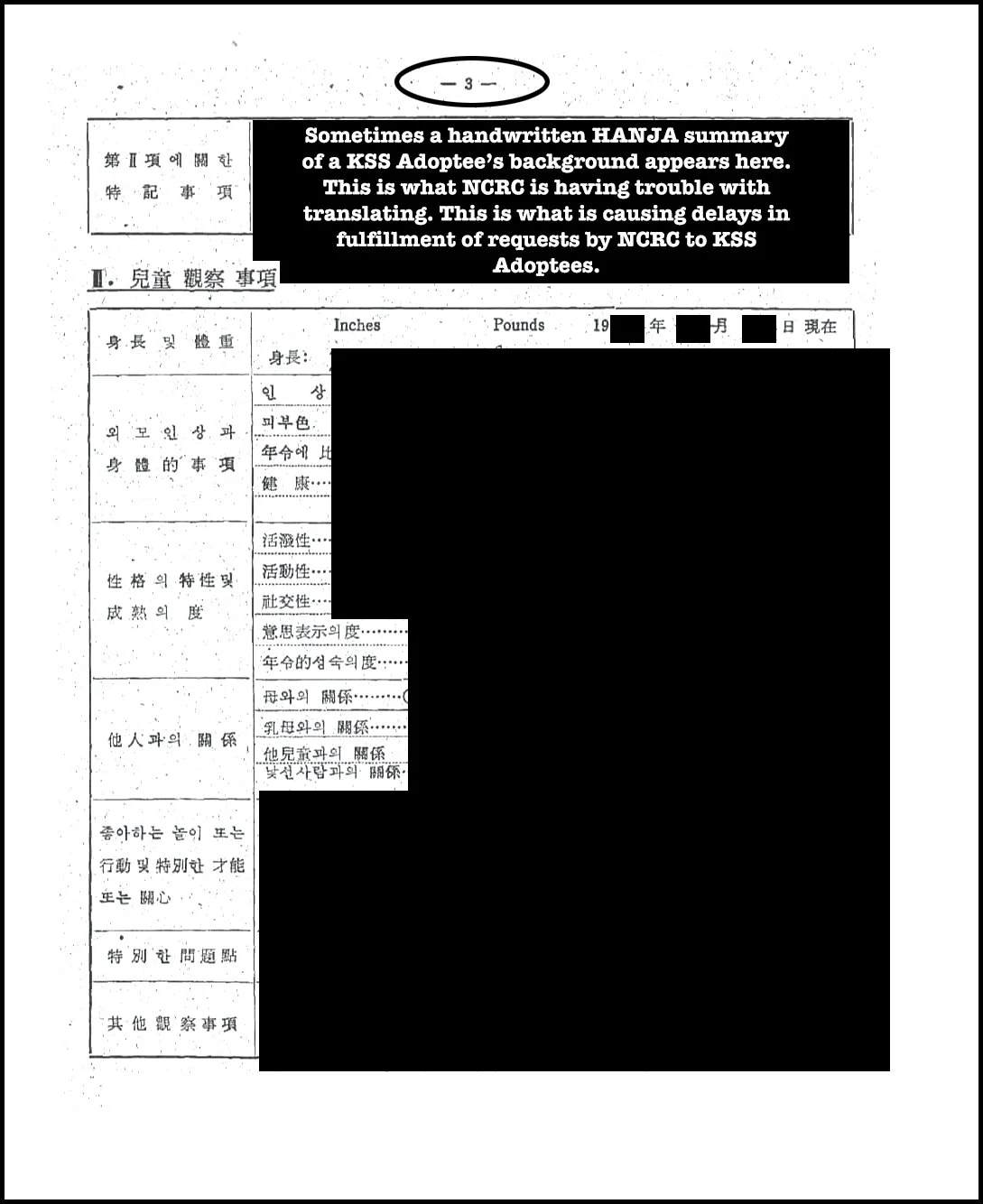
At the top of page 3 of a (typically 3 page) KSS (Korea Social Service) Adoptee’s KOREAN Adoptive Child Study Summary, there is sometimes a handwritten paragraph of text in HANJA. Hanja is an older version of Korean which is a mix of Chinese and Korean — which most modern Koreans cannot read / speak / translate. This paragraph of information on page 3 is important because it often provides a more truthful tidbit of information about a KSS Adoptee’s past than the more often falsified ENGLISH Adoptive Child Study Summary. Because NCRC does not have a regular Hanja translator on staff — and because there are regular staff changes every 2-3 years in general within government — this Hanja text translation is causing delays in fulfillment of Petition for Adoption Information Disclosure requests by KSS Adoptees. NCRC likely does not want to disclose more than they are allowed by law, but typically this paragraph does NOT contain birth parent names, meaning that withholding disclosure based on NCRC’s inability to translate this Hanja text is typically unnecessary.
*Please note that the document above is an example of a late 1960s / 1970s / early 1980s style of the Korean Adoptive Child Study Summary. Our original research showed that the STYLE of the Korean Adoptive Child Study Summary changed over time. In later versions of this document, Hanja was phased out, and only Hangul was used. Hangul is what is now considered to be “regular” Korean.
IMPORTANT TAKE-AWAY / SUMMARY:
NCRC may delay fulfilling requests from KSS Adoptees when NCRC possesses a formerly secret Korean Adoptive Child Study Summary (a document unique to KSS Adoptees), IF it includes a handwritten background narrative in Hanja, which NCRC staff may be unable to read. Due to strict birth parent privacy law, NCRC will want to redact any sensitive information about birth parents contained in the handwritten Hanja summary, causing a delay in sending a KSS Adoptee their KSS documents containing Hanja — since so few modern Koreans read / speak this older form of Korean, which is a blend of Korean and Chinese. NCRC already faces a substantial backlog of requests from Adoptees worldwide and has limited staff. The added burden of translating handwritten Hanja notes in the Korean Adoptive Child Study Summary documents of KSS Adoptees appears to be causing further delays — or, in some cases, preventing any disclosure of documents at all.
If you experience issues with this, do not give up — please contact GOAL in Korea to help you. Please note that GOAL requires a $100 per year membership fee.
We support GOAL and believe that they do great things, but it severely pains us to think that each KSS Adoptee who may have Hanja text in their Korean Adoptive Child Study Summary might have to pay GOAL in order to obtain from NCRC this important KSS document, which often (though not always) contains more information than is found in the English Adoptive Child Study Summary. KSS was FAR from perfect, but at least from 2021-2025, they were providing KSS Adoptees with the formerly secret Korean Adoptive Child Study Summary for free — so long as the KSS Adoptee knew the magical trail (which we blazed, since KSS never told anyone about it) to request and obtain their Korean Adoptive Child Study Summary.
However, when a KSS Adoptee was unaware of the document or did not know how to request it precisely, KSS almost always failed to inform the Adoptee or unjustifiably denied the request, in one case that we know of requiring the Adoptee to wait another year before reapplying. To prevent unreasonable KSS bureaucratic delays such as this, we offered free reviews of birth family search forms for KSS Adoptees from 2021 to 2025, with the aim of preventing unnecessary delays and the loss of years of time for KSS Adoptees. However, now that ALL KSS files have been transferred to NCRC, it is no longer possible for us to assist KSS Adoptees in the exact same manner, as the NCRC petition process differs from that of KSS. We have, however, provided a guide on how to submit requests to NCRC. It is this new NCRC process which we unfortunately always knew would be extremely problematic.
We have recently learned that a KSS Adoptee who submitted a Petition for Adoption Information Disclosure to NCRC several months ago was informed that NCRC must first obtain a Hanja translator before they could provide the Adoptee with their formerly secret Korean Adoptive Child Study Summary. This is a document which was part of nearly every KSS Adoptee’s file. NCRC has twice reassured us that KSS Adoptees would continue to be able to obtain this document following the July 19th, 2025 transfer of KSS files to NCRC — however, the fact that older versions of this document may have portions which are handwritten in Hanja is complicating the fulfillment of birth family search and document requests by NCRC.
This could affect many KSS Adoptees who make Petition for Adoption Information Disclosure requests to NCRC. This additional delay for KSS Adoptees on top of the already significantly backlogged NCRC process is happening conveniently in the run up to the TRC 3 investigation into Overseas Adoption.
NCRC, as a Korean public institution, has every incentive to withhold information from Adoptees as they seek to obtain their documents, not only for themselves, but as evidence for their TRC 3 cases. So please continue to push for your information from NCRC, if necessary with the help of GOAL, while expecting that NCRC will likely put as many obstacles in place as possible. Please note that even if you do not have significant evidence of wrongdoing in your case, you can still apply to TRC 3, which you can do INDEPENDENTLY and not through any representative group. However, we have significant doubts that TRC 3 will be able to even investigate all of the 311 cases left suspended from TRC 2 — which will have priority for investigation in TRC 3. So please do NOT count on TRC 3, in its limited roughly 3 year term, as an investigative tool for very many Korean Adoptees. We will be surprised if TRC 3 makes it through 75 cases left over from TRC 2.
KSS Adoptees should be aware that, when KSS provided the Korean Adoptive Child Study Summary in response to specific requests made between 2021 and 2025 — during the period when Paperslip was providing ongoing guidance about this process, prior to the transfer of all KSS files to NCRC — KSS typically issued a partially redacted copy of this document via email. Specifically, the birth parent’s two-word first name and birth date were whited out on the photocopies provided to Adoptees. KSS had at least one social worker knowledgeable in Hanja, whereas NCRC likely does not. In addition, as a Korean public institution, NCRC rotates staff every few years, which may result in inconsistent institutional knowledge regarding Hanja literacy. This lack of continuity could lead to additional delays in the NCRC process for the foreseeable future.
+
Please note that the information below is part of our COPYRIGHTED original research about the formerly secret KSS specific document, which we found in 2018 at KSS and coined as the “KOREAN Adoptive Child Study Summary” in 2021. You may NOT adapt this information as “your own” to be shared as part of other websites, videos or any other platforms. This is not only to protect our copyrighted information, but also to ensure that our original research is not FRAGMENTED into MISINFORMATION. You are welcome to share this and other Paperslip links directly. Thank you for respecting our years of original work and research about KSS.
+
*PLEASE NOTE: KSS (Korea Social Service) was the SMALLEST of the 4 major Korean Adoption Agencies. KSS ONLY sent children for adoption to the US, Netherlands, Denmark, and Switzerland between 1964-2012, through a SPECIFIC list of Western Partner Adoption Agencies.
KSS did NOT adopt to Sweden, Canada, Australia, or to any other European countries other than the ones we mentioned above.
Please note that KSS is NOT the same as KWS (Korea Welfare Society) / formerly SWS (Social Welfare Society) / formerly CPS (Child Placement Services). KSS did NOT adopt to Sweden — that was KWS / SWS.
KSS is also NOT the same as Holt or Eastern Social Welfare Society (ESWS) - formerly Eastern Child Welfare Society (ECWS).
KSS is also NOT the same as the Korean Public Institution KAS (Korea Adoption Services) which is now called NCRC (National Center for the Rights of the Child).
+
To understand what’s going on, you need to know a lot about the history of KSS and it’s documents.
You need to know that the older versions of the formerly secret KSS document colloquially (in common language) called the “Korean Adoptive Child Study Summary” used a combination of Hanja and Hangul characters — in both printed and handwritten text on the document.
We are not sure the exact year that KSS created and first began to use the Korean Adoptive Child Study Summary, but it was likely in the 1960s (KSS was founded in 1964 and sent children overseas for adoption until 2012). KSS destroyed its former campus in 2016 to sell the land for apartments (you can still visit the area). We are currently only aware of ONE KSS Adoptee from the 1960s for whom KSS did NOT have a Korean Adoptive Child Study Summary. Everyone else whom we assisted between 2021-2025 in requesting and obtaining this formerly secret document from KSS was able to successfully obtain it (assuming they followed our instructions correctly), prior to the transfer of ALL KSS files to NCRC on July 19th, 2025. This included KSS Adoptees who were adopted from the 1960s through the 2000s.
KSS’ one remaining Post Adoption Services office, which housed ALL KSS Adoptees’ files from 2012-2025, is now permanently CLOSED to visitors — however, you can still visit the area and walk around. We know for an absolute fact that KSS was regularly using the Korean Adoptive Child Study Summary by the 1970s, and continued to use different, evolving versions of this form until 2012. Versions of the Korean Adoptive Child Study Summary from around the mid-late 1980s until 2012 typically use Hangul, rather than Hanja, making such later versions easier to translate.
The majority of documents that KSS maintained for each child it processed for adoption were stored in individual file folders for each KSS Adoptee. These were housed in banks of metal filing cabinets, which we are among a presumably very small number of KSS Adoptees to have ever seen the contents of in person. These documents are now all housed at NCRC’s temporary storage facility in Goyang, Gyeonggi-do, though may very likely be moved AGAIN to the Seongam Branch of the National Archives in the first half of 2026.
To view ALL known versions of the KSS Korean Adoptive Child Study Summary, please see:
Korean Adoptive Child Study Summary Examples and Translation Keys
The Korean Adoptive Child Study Summary is a KSS specific document whose style changed over the years. We know this from personal investigation beginning in 2018, and from our original research with KSS Adoptees, which we have conducted on the KSS Cribmates forum and through Paperslip since 2020. However, in the 1970s version of the document, the title and the various category headings of the document are in HANJA — an older form of Korean which are a blend of Chinese and Hangul (Korean) characters. Often (though not always) KSS would include a HANDWRITTEN paragraph of background information about a child in Hanja, usually on the second page of the typically 3 page Korean Adoptive Child Study Summary, which was NOT provided to the Adoptee nor their adoptive parents at the time of adoption.
Handwritten Hanja can be especially difficult to translate, not only because most modern Koreans no longer use Hanja, but also because handwritten Hanja text from older documents can often be tricky to even decipher. ChatGPT does a decent though far from perfect job of translating Hanja. ChatGPT does an amazing job of translating regular Hangul, though any information relevant for birth family search (such as names, dates, place names) should definitely be VERIFIED with a REAL Korean translator. Unfortunately at the time, we only know of ONE Hanja translator, who does not regularly provide Hanja translation for Adoptees. Many modern Korean people do NOT read or speak Hanja, making translation of the older versions of the Korean Adoptive Child Study Summary a constant challenge.
Depending on a KSS Adoptee’s case, information from the Korean Adoptive Child Study Summary was rarely if ever included as part of the more falsified version of the document, which we now know as the ENGLISH Adoptive Child Study Summary which was provided to KSS’ Western Partner Adoption Agencies, prospective adoptive parents, and KSS Adoptees.
We discovered the Korean Adoptive Child Study Summary in 2018 at KSS, but did not figure out until July 2021 that KSS colloquially (in common language) referred to this form as the “Korean Adoptive Child Study Summary”. While over the years, some KSS Adoptees were able to obtain this document from KSS if they visited KSS’ Seoul based Post Adoption Services office in person, it wasn’t until July 2021 that we figured out how to formally and regularly request and obtain this document for EVERYONE whom we could inform about the process. KSS would often NOT provide this document for KSS Adoptees — sometimes even if they visited in person — if the KSS Adoptee did not know about the document nor how to request the document by name. In other words, KSS Adoptees’ experiences in obtaining information from KSS about their backgrounds widely vary from person to person over the years. While some KSS Adoptees may have obtained the Korean Adoptive Child Study Summary from KSS wily-nilly over the years, NO ONE knew that KSS called this document the Korean Adoptive Child Study Summary, nor how to regularly request and obtain this document through email until we accidentally figured it out in July 2021.
The Hanja title of this document, which is 入養兒童調書 does NOT directly translate to “Korean Adoptive Child Study Summary”. This is what we figured out in 2021 that KSS colloquially (in common language) called this document in English. From 2021-2025, KSS would ONLY provide this document for KSS Adoptees IF they specifically knew to request this EXACT NAME of the document — Korean Adoptive Child Study Summary — on KSS’ birth family search request forms. KSS would not simply provide this document if you requested it by email, without requesting it specifically using their forms. We helped hundreds of KSS Adoptees navigate this process for free between 2021-2025, prior to the file transfer to NCRC. We also referred everyone who received this document to a translator.
The 1970s and early 1980s version of the “Korean Adoptive Child Study Summary” was often written in a mixture of Hanja and Hangul. Apart from the header and various categories on the document being in Hanja, this form also sometimes (though not always) contains a paragraph of handwritten information in Hanja on page 3, which is usually a short summary about an Adoptee’s background — which only highly educated modern Koreans (usually older) can now read. There are often (though not always) little bits of information contained in the Korean Adoptive Child Study Summary NOT included in the English Adoptive Child Study Summary. It is unfortunately not unusual for the English Adoptive Child Study Summary to say that a child was “abandoned” with “unknown parents” and found with a “paper-slip” or “memo” in their “clothings” (sic) or at a “police station” — while secretly, the Korean Adoptive Child Study Summary contained birth parent information, which KSS never regularly shared with Adoptees or their adoptive parents.
Now, if any of this birth parent information exists in an individual KSS Adoptee’s Korean Adoptive Child Study Summary, NCRC will partly redact it in the copy provided to an Adoptee who makes a Petition for Adoption Information Disclosure request. However, this is the information off of which NCRC can conduct a birth family search. The average wait time currently for this process appears to be about 5 months.
Your average Korean person is no longer able to read or speak Hanja. This is likely to be an issue for any KSS Adoptees who were adopted between 1964 through the mid 1980s who make a Petition for Adoption Information Disclosure request to NCRC, since the “Korean Adoptive Child Study Summary” documents from this time period were often partly in Hanja. KSS from around the mid 1980s forward to 2012 used a purely Hangul form, which is possible for any modern Korean person to translate. ChatGPT can also do a very good job of translating Hangul text, and can even translate some Hanja.
IMPORTANT NOTE:
NCRC may delay the fulfillment of requests of KSS Adoptees who have a Korean Adoptive Child Study Summary containing a handwritten Hanja description of their background story, because presumably NCRC workers to not read / speak Hanja. They will therefore want to redact any sensitive information about birth parents contained in the handwritten Hanja summary, causing a delay in sending you your KSS documents. If you experience issues with this, do not give up — please contact GOAL in Korea to help you. Please note that GOAL requires a $100 per year membership fee.
We want to make KSS Adoptees aware that we have long had translated templates for ALL KNOWN VERSIONS (between 1964-2012, the years of KSS’ adoption operation) of the Korean Adoptive Child Study Summary here:
Korean Adoptive Child Study Summary Examples and Translation Keys
This is the often less falsified document which KSS secretly kept in its file room in the individual files KSS kept for each Adoptee. (All of these files are now at NCRC, but may be moved yet again to the Seongam Branch of the National Archives in the first half of 2026). KSS would sometimes provide this document for Adoptees if they came to Korea in person, but this was never a guarantee. We did not figure out until July 2021 how to regularly request and obtain this document through email. Through Paperslip and KSS Cribmates, probably several hundred KSS Adoptees have been able to obtain this document from 2021-2025 with our FREE assistance. However, both KSS (which is no longer in operation) and NCRC will partly redact any birth parent information on this file. It is on the basis of any birth parent information in this file, however, that NCRC can conduct a birth family search.
English Adoptive Child Study Summary Examples
This is the document which was regularly provided to KSS’ Western Partner Adoption Agencies and to prospective adoptive parents. If you are a KSS Adoptee, try to see if your adoptive parents still have this document. Depending on your case, it may contain birth parent information. However, for thousands of KSS Adoptees, this document was often a falsified document and a central component of widespread Orphanization which said you were “abandoned” with “unknown parents” and found with a “paper-slip” or “memo” or at a police station or orphanage. This was essentially copy / paste language used to disguise a child’s true origins (if known by KSS) and in order to render the child adoptable to the West. It is unfortunately impossible to know what is true or false from this document unless you find a birth parent who is a DNA match to you — and they are able / willing to tell you the true story.
Please note that our translation templates for the Korean Adoptive Child Study Summary will unfortunately NOT help in translating any short story summary that is in Hanja, typically found on page 3 on the Korean Adoptive Child Study Summary, which is sometimes included in the 1964-mid 1980s version of the document. However, the translation templates CAN assist you in understanding what the basic categories on the form are. We have previously alerted GOAL to these templates, but we do not know if they use them.
We have been sharing the links above regarding the Korean and English Adoptive Child Study Summaries with KSS Adoptees for years — ever since we accidentally figured out the process for how to obtain the Korean Adoptive Child Study Summary from KSS, before KSS’ files were ALL transferred to NCRC on July 19th, 2025. We were assured twice in person by NCRC workers that KSS Adoptees would continue to be able to obtain this important document following the file transfer to NCRC. While we are glad that NCRC appears to be honoring this request, it deeply concerns us that NCRC is dragging its feet when it comes to providing KSS Adoptees with the Korean Adoptive Child Study Summary, even when an Adoptee specifically requests the untranslated original version. KSS Adoptees please note: you always want to see the ORIGINAL document, NOT an NCRC provided translation. Again, if obtaining documents from NCRC becomes an issue, please contact GOAL for assistance.
To learn more about how we figured out how to request and obtain the formerly secret Korean Adoptive Child Study Summary, please see:
How Two US KSS Adoptees Figured Out How To Obtain KSS’ Korean Adoptive Child Study Summary In 2021
*Please note that the Korean Adoptive Child Study Summary is a document SPECIFIC to KSS, and would NOT be amongst the files for Korean Adoptees from other Korean Adoption Agencies, such as Holt, Eastern Social Welfare Society (ESWS) - formerly Eastern Child Welfare Society (ECWS), or Child Placement Services (CPS) / Social Welfare Society (SWS) / now Korea Welfare Society (KWS).
Implying that NON-KSS Adoptees might have a Korean Adoptive Child Study Summary amongst their paperwork is dangerous MISINFORMATION which can gaslight Adoptees into forever looking for a document which they and their Korean Adoption Agencies will NOT have, since this is a document ONLY used by KSS.
Furthermore, Adoptees FOREVER CONFUSE KSS (Korea Social Service) with KWS (Korea Welfare Society). Please note that KSS did NOT adopt to ANY other country regularly except for the US, Netherlands, Denmark and Switzerland between 1964-2012, through a SPECIFIC LIST of Western Partner Adoption Agencies. KSS did NOT adopt to Sweden — that was KWS / SWS!
If you are a KSS Adoptee and you encounter issues with obtaining your documents or other information from NCRC, we strongly recommend that you contact GOAL in Korea for help. If NCRC says it is trying to find a Hanja translator for your document, please let them know that you can get your document translated with the help of GOAL — that is, assuming you have already contacted GOAL and that they can assist you. Please note that GOAL requires about a $100 per year membership fee.
As long as you are able to obtain your Korean Adoptive Child Study Summary from NCRC, you can use ChatGPT to attempt to translate it — however, for any important info, such as names, birthdates, place names, etc., PLEASE be sure to consult a REAL translator as well. You never want to go down a years long rabbit hole based on badly translated information!
To learn how to use ChatGPT for translation of Korean and even some Hanja text, please see:
ChatGPT for Korean Text Translation
Google Lens + ChatGPT Translation Tutorial
Google Translate and Papago are FAR INFERIOR to ChatGPT. While we have not tried DeepL, that is another AI platform you can use for translation. ChatGPT no longer even requires a login to use, and it’s incredibly simple to use for text translation. ChagGPT is a gamechanger for Korean and Hanja translation overall! We cannot more highly recommend it for Korean translation, and it can even translate some Hanja!
Again, please be sure to VERIFY any AI translation with a REAL translator, if it’s important information for birth family search. However, please be advised that most Korean translators do NOT read / speak Hanja — so this can be tricky.
If you are a KSS Adoptee, please be sure to join KSS Cribmates to connect with the global KSS Adoptee community. Please be sure to answer the membership questions, or your request will be declined. We also do not admit empty profiles to the group.
Good luck out there! If you are a KSS Adoptee, you can reach out to us at: paperslipadoptee@gmail.com