
KSS Numbering Systems.
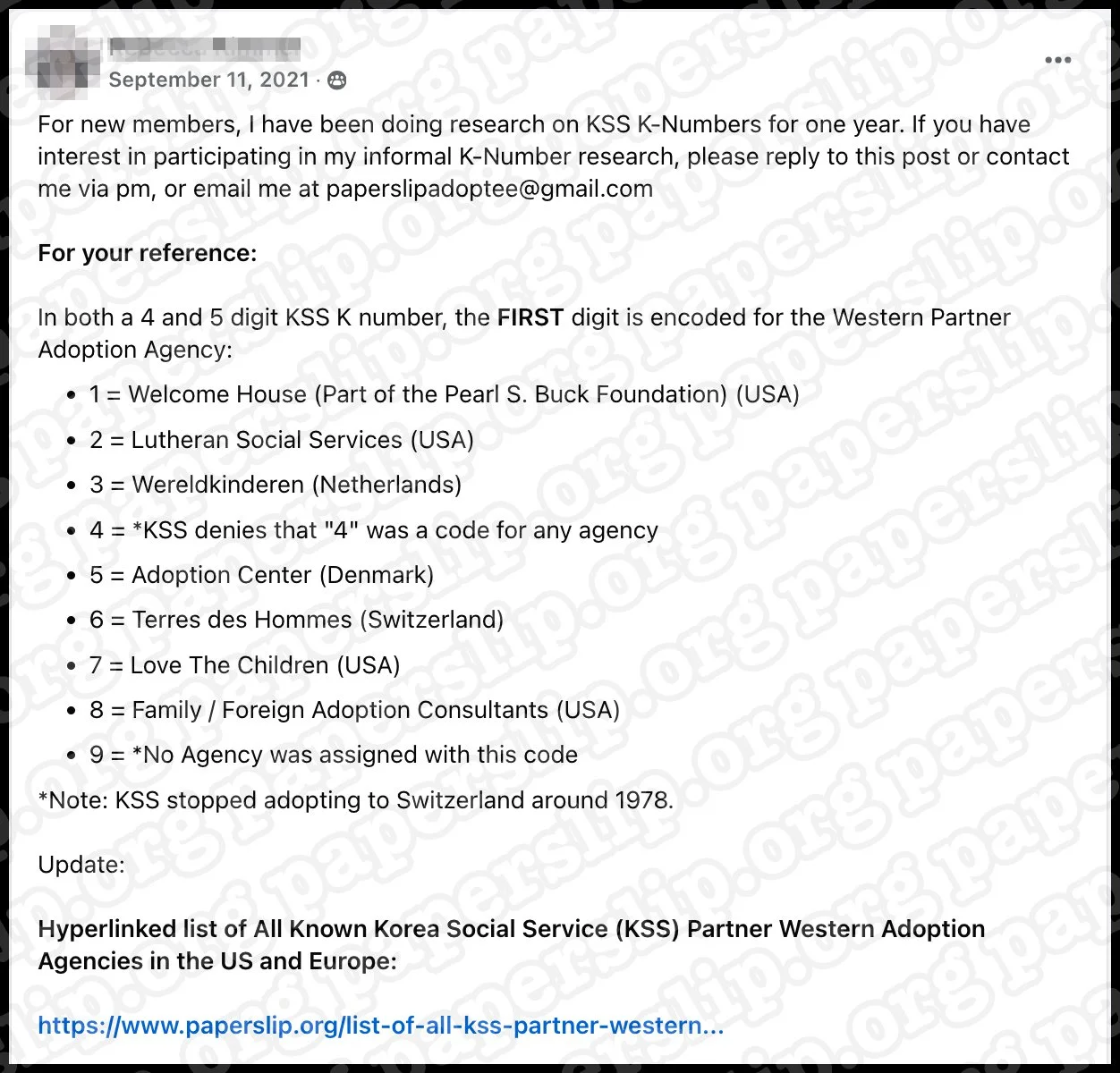
Above is a screenshot from the KSS Adoptee forum where I began my KSS K-Number research in 2020. This particular post is dated September 11th, 2021. As shown, by that time I had already solved all KSS K-Number first digit codes.
Image credit: Paperslip.org. This image may not be shared without permission.
On January 1st, 2023, other so-called “Korean Rights” groups attempted to claim false credit for this work. In order to maintain that claim, they excluded me from TRC 2 for three years (December 7th, 2022–2025). This exclusion denied me the opportunity to pursue justice for myself and my deceased twin sister, whose case I was investigating through this research.
My case was among the first 34 accepted by TRC 2. However, due to repeated abuses by these groups — actions I know were motivated by their desire to control recognition and media attention — I withdrew my case in March 2023.
On March 27th, 2026, I resubmitted my case to TRC 3 INDEPENDENTLY, without the involvement of any of these groups. I hope that THIS time I will be able to pursue justice for myself and my twin sister, “Baby A,” free from interference by those who claim to advocate for “Korean Adoptee Rights”.
+
This page will be updated over time.
+
Paperslip Content Is COPYRIGHTED: © 2018-2026. Instances of Plagiarism Will Be Legally Pursued.
*The duration of copyright is the author’s life + 70 years.
All content published on Paperslip.org is protected by official copyright law. Any unauthorized use, reproduction, or plagiarism of our original research and content — whether published or unpublished — will be pursued to the fullest extent permitted by law. By using our site, you agree to NOT plagiarize or reproduce “as your own” our copyrighted material. Any information shared from Paperslip.org must be done by linking directly to our site; plagiarizing, copying, modifying, or redistributing our original work “as your own” is strictly prohibited. Reproducing our original research and publishing it “as your own” is strictly prohibited.
+
Please Note:
The numbering systems on this page are UNIQUE TO KSS (Korea Social Service).
If you are NOT a KSS Adoptee, this page will NOT apply to you!
Please note that KSS is NOT the same as HOLT, Eastern Social Welfare Society (ESWS) - formerly Eastern Child Welfare Society (ECWS), or Social Welfare Society (SWS)/ now Korea Welfare Society (KWS).
KSS did NOT adopt to Sweden! Please see:
KSS (Korea Social Service) is NOT the same as KWS (Korea Welfare Society). KSS did NOT adopt to Sweden.
+
Part 1.
KSS K-Numbers.
What’s So Important About A KSS K-Number?
Above is a screenshot from the KSS Adoptee forum where I began my KSS K-Number research in 2020. This particular post is dated September 11th, 2021. As shown, by that time I had already solved all KSS K-Number first digit codes.
Image credit: Paperslip.org. This image may not be shared without permission.
+
The main takeaway for me personally from my years long KSS K-Number research, starting in 2020 is that KSS had used its secretly encoded K-Number system to SEPARATE me for adoption from my likely twin sister “Baby A”, practically from the moment of our intake in 1975.
I have a different first digit than my likely twin “Baby A”. Because KSS secretly encoded its K-Numbers for each of its Partner Western Adoption Agencies, by giving my likely twin and I DIFFERENT first digit K-Number codes almost immediately upon intake, KSS had thus pre-determined to SEPARATE us between DIFFERENT Partner Western Adoption Agencies.
But then, unexpectedly, my likely twin “Baby A” died at KSS, before she could be adopted.
I am “lucky” that I found what remained of my likely twin “Baby A“ — her file — by accident in 2019 while searching KSS’s file room for my own REAL file, which I still have NOT found.
45 KSS Adoptees (and two Holt twins) have had reunions based on the intensive research that I have done into KSS history and practice since 2020.
Paperslip has helped countless KSS Adoptees around the world. It has also become a major resource for Korean Adoptees in general globally.
This is the legacy of my deceased twin sister “Baby A”.
NO ONE — no matter how unscrupulous, jealous, or outright evil — can steal that from her.
+
Due to having to investigate my own case (since 2018) and the separate case of my deceased twin sister (since 2019 / 2020) — cases which involve multiple children — I have gone down a serious rabbit hole when it comes to looking into KSS’ numbering systems over the years.
This is how I came to decode KSS’ secretly encoded K-Numbers, starting in 2020. I first visited KSS in 2018, and photographed what I believed at the time to be my own real file. However, after this first trip to Korea as an adult — my first trip back to Korea since 1987 when I was ten years old — I realized that the file I had photographed was NOT my real file.
In 2019 at KSS, while looking for my own REAL file in KSS’ filing cabinets with their permission, I found what I thought was MY real file — because it contained a photograph of a baby, whom I now call “Baby A”, whom I thought was the REAL me for over one year. However, I would not realize until 2020 through a series of investigative steps that what I had found instead was the file of my likely deceased twin sister.
The first day I realized this — September 11th, 2020 — I was trapped in the US during Covid and was unable to travel back to Korea to visit KSS to attempt to get more answers about my likely deceased twin sister’s case. You cannot imagine the level of desperation I felt during this time to attempt to get answers in my and my twin’s separate adoption cases. I am not usually a big crier, but I found myself just intermittently crying in these early days of realization about my previously unknown likely twin’s death over 45 years earlier. Discovering an incredibly dark secret this big in your mid-forties is not a fate I would wish upon anyone.
Suffice it to say I could not concentrate on much else besides trying to figure out what had happened during my early days at KSS as a baby, and Covid gave me the excuse to just hunker down and try to get to the bottom of my and my twin’s separate cases. I went from knowing basically nothing about Korean Adoption to digging up the entire history of KSS in a year. My learning curve during this time period was VERTICAL.
All of this research had to go somewhere — thus, Paperslip was born in 2020, though at first it was just a password protected site shared only with other KSS Adoptees. I did not make the site public until January 2021. I have been adding information to Paperslip almost daily ever since I co-founded the site with a fellow US KSS Adoptee, who has helped me significantly with research over the years.
It’s now 2026, and I first “came out of the fog” in late 2017. That adds up to nearly a decade of informal research into KSS history and practice, along with sustained involvement in the KSS Adoptee community since 2018.
At just the moment in 2020 that I first realized I might have had a twin who passed away at KSS, another female KSS Adoptee — who for years has preferred not to be publicly identified — suggested to me that the first digit “3” in a KSS K-Number might stand for the Netherlands (one of the Western countries with which KSS had partnered), and that the first digit “5” in a KSS K-Number might stand for Denmark (another of the Western countries with which KSS had partnered).
She also said she thought that if a KSS Adoptee had a 4 digit K-Number, then they might NOT have had orphan siblings at KSS, but if they had a 5 digit K-Number, they might HAVE HAD an orphan sibling at KSS. This hypothesis was based on her own case: she had a 4 digit KSS K-number and had no known orphan siblings. However, another KSS Adoptee she knew had a 5 digit KSS K-number and did have an orphan sibling — both of whom were adopted together into the same adoptive family. I did not initially know this, but those siblings were, in fact, twins.
At first, I dismissed her hypothesis about the encoded KSS K-Numbers. I wasn’t yet aware how short the list of Western countries with which KSS partnered actually was, and it seemed unlikely that a country as small as the Netherlands would rank third. However later, after compiling around 500 KSS K-Numbers and reconstructing the complete — and surprisingly short — list of KSS’ Partner Western Adoption Agencies from 1964 to 2012 (the time period of KSS’ active adoption business), I realized she had been entirely CORRECT about KSS K-Numbers being encoded in the first digit for KSS’ Partner Western Adoption Agencies.
By 2021, I had successfully decoded ALL of KSS’ first-digit K-Number codes, which stood for each of KSS’ Partner Western Adoption Agencies. No one had ever done this kind of research before.
Unfortunately, others who had nothing to do with my years long research would later try to take credit for it. Outrageously, these people were part of so-called “Korean Rights” groups who were representing Korean Adoptees for TRC 2. It would take me over one year to get the person who had been given false credit for my work to finally publicly confess that he had played NO role in my original research.
It was with my KSS Adoptee friend’s second hypothesis — suggesting that a 5 digit KSS K-Number might indicate that an Adoptee had an orphan sibling at KSS — that I found myself particularly obsessed. This was because both my likely deceased twin sister and I had 5 -digit KSS K-Numbers. I realized that in the absence of being able to prove that “Baby A” was my twin in any other way, if I could prove that our both having 5 digit K-Numbers was evidence that we each had a sibling at KSS, this would be a major piece of circumstantial evidence that we had, in fact, been twins.
In 2020, while I was stuck in the US with no way to return to Korea until 2021, I began a deep dive into my KSS K-Number research. Of course, I wanted my KSS Adoptee friend’s second hypothesis to be correct. Spoiler alert: it was NOT.
When I first realized that “Baby A” — whom I had believed for a year, since discovering her file at KSS in 2019, to be ME — was not actually me, and might instead be my twin sister, I was overwhelmed with grief. I began to understand that I may have had a twin who likely died at KSS sometime between late 1975 and early 1976 — yet I have never been able to find definitive proof. Even with photographs of her entire KSS file, there is nothing that explicitly states that “Baby A” is my twin. However, because of the secretive nature of KSS, the fact that there is no explicit statement of my and “Baby A’s” relationship certainly does NOT preclude the possibility of our being twins.
KSS has been described by another Korean social worker whom I have personally met in Busan, Korea as being “like Fort Knox” — in other words, NO ONE knew how KSS operated. Their methods of operation remained, even amongst other Korean Adoption Agencies, highly secretive.
For over a year, I believed that the photo of “Baby A’” which I had found at KSS in 2019 was of me. Now, after years of investigating her case, I have accumulated substantial circumstantial evidence suggesting she was my twin, but I still have no definitive proof. This is an endlessly frustrating consequence of my not being able to obtain direct answers from my Korean Adoption Agency, KSS. Trust me, I have tried — I have probably visited KSS 5-6 times since 2018 in repeated attempts to get answers in my and my twin’s separate adoption cases. My investigation into my and my twin’s separate adoption cases is a major factor in TRC 2 acknowledging Switching as a human rights violation in its March 26th, 2025 Interim Report, as well as in the reporting by FRONTLINE / AP in its documentary, articles, and interactive. FRONTLINE / AP utterly failed to credit me in the documentary, but my story is featured in their articles and interactive.
The possibility that the number of digits in my and “Baby A’s” KSS K-Numbers might provide some clue that we were siblings was an irresistible possibility for me. This is why, in 2020, I began to collect as many KSS K-Numbers from fellow KSS Adoptees as I possibly could.
This is how I came to realize by 2021 that my KSS Adoptee friend’s first hypothesis about KSS encoding in the first digit of a KSS K-Number was entirely CORRECT. KSS’s Director CONFIRMED these first digit KSS K-Number codes to me in the presence of an AP reporter and a documentary filmmaker who was openly filming our meeting in 2021, when I was finally able to return to Korea to again visit KSS.
It was also by 2021 that I came to realize my KSS Adoptee friend’s second hypothesis — that a KSS Adoptee’s 4 or 5 digit K-Number might indicate the presence of orphaned siblings at KSS — was NOT supported by the evidence. This second hypothesis unfortunately turned out to be FALSE. I found KSS Adoptees with 4-digit K-Numbers who were aware they had orphan siblings at KSS, which demonstrated that a 5-digit KSS K-Number does not, in itself, imply the existence of siblings within the system.
Additionally, starting in Relinquishment Year 1979 — the year a child was relinquished to KSS or a feeder orphanage, which was not necessarily the same as their year of birth — KSS transitioned from an alternating 4- and 5-digit K-Number system to an ALL 5-digit format for the majority of its Partner Western Adoption Agencies.
You can read what I have made publicly known about KSS K-Numbers here.
You can view a list of all KSS Partner Western Adoption Agencies here.
+
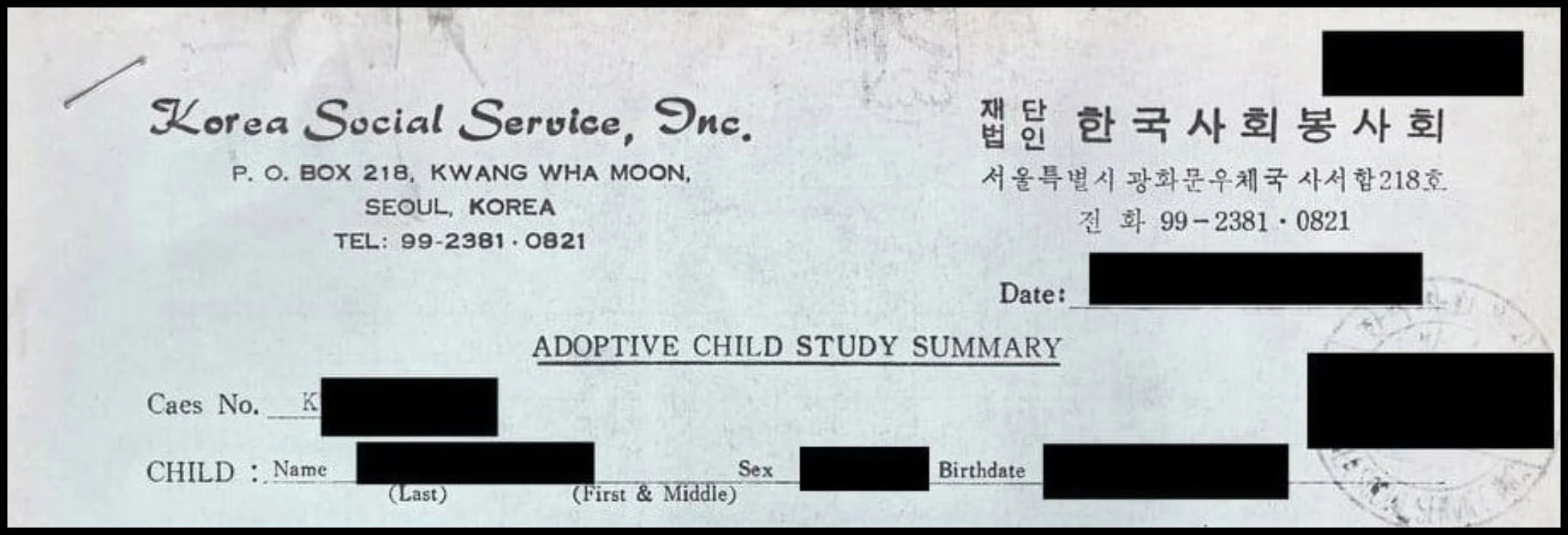
Locate your own KSS K-Number / “Caes No.” (sic) at the top of your ENGLISH Adoptive Child Study Summary.
Your K-Number may also appear on other adoption documents.
+
Please Note:
I do NOT believe that ANY other type of KSS number apart from the KSS K-Number is encoded in ANY way.
I also do NOT believe that ANY other Korean Adoption Agency had an encoded K-Number system such as KSS did.
KSS was UNIQUE amongst the 4 major Korean Adoption Agencies in having an ENCODED K-Number system.
+
Part 2.
Child Numbers.
What is a KSS Child Number?
+
Paperslip is the first and only site to discuss KSS Child Numbers.
+
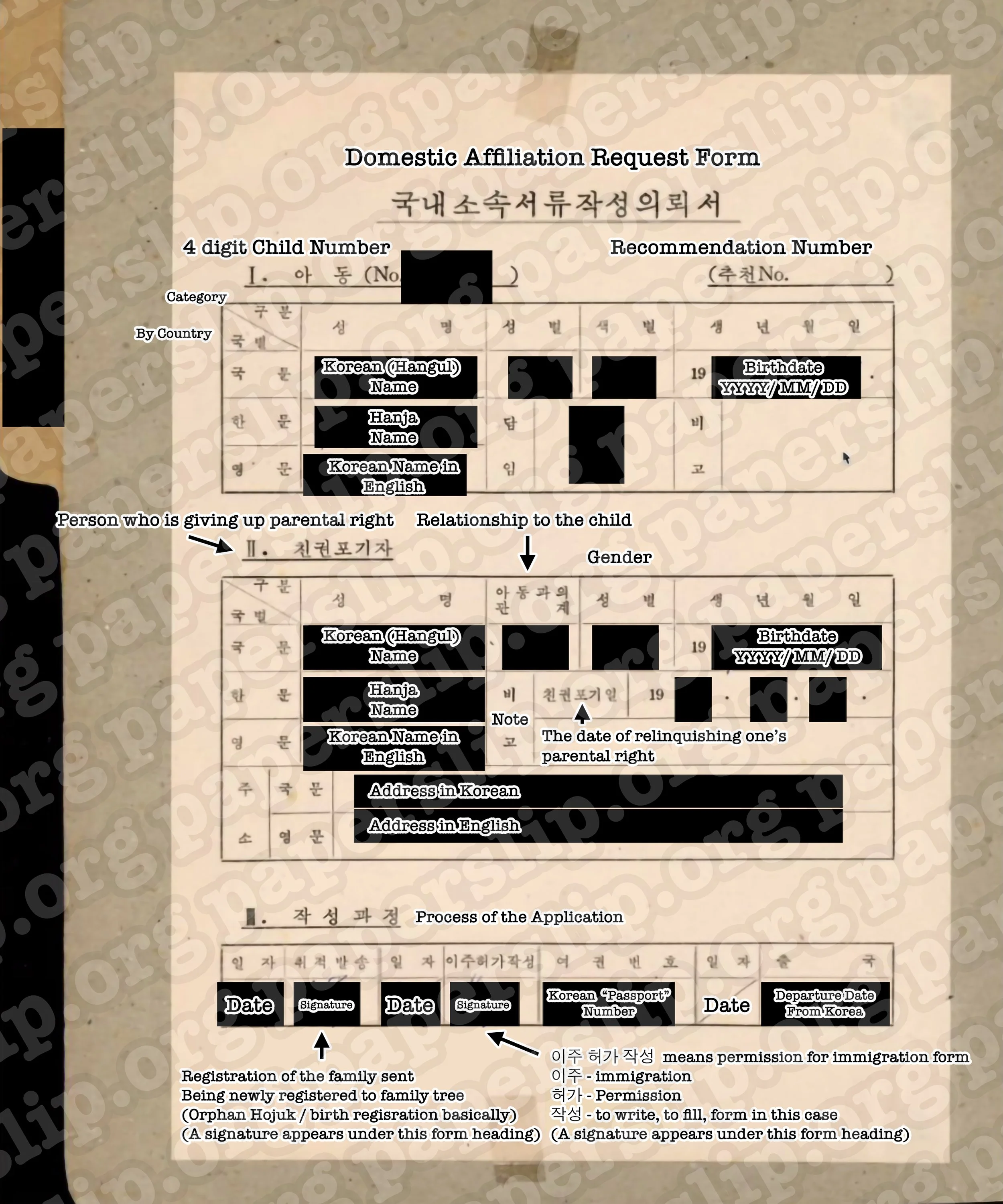
Image credit: Paperslip.org. You may NOT share this image without our permission.
Thank you to the KSS Adoptee who allowed us to use a redacted version of their 국내소속서류작성의뢰서 / “Request Form for Preparation of Domestic Affiliation Documents” form as an example.
We have added translations which were done years ago by a live Korean translator. Since that time we have made some translation revisions (specifically to the title of the document) via ChatGPT.
+
So that no one gets “confused” about who discovered this formerly secret KSS internal form, here’s a Google search for the form’s title as of April 22nd, 2026, clearly showing that Paperslip is the only site appearing in the results:
“국내소속서류작성의뢰서”

+
Child Numbers are NOT recorded anywhere else (to my knowledge) except on KSS’ formerly secret internal form (see another KSS Adoptee’s example above), which I photographed in my own file in 2018.
The 국내소속서류작성의뢰서 / “Request Form for Preparation of Domestic Affiliation Documents” form is a one page document which KSS used internally to track the progress of a child through its system — from intake to export date. It’s essentially a one page summary of a child’s entire processing through KSS’ system.
This form was NEVER to my knowledge previously shared with KSS Adoptees, unless under extraordinary circumstances like my own.
I am only aware of ONE other KSS Adoptee who had ever seen the form on which the “Child Number” appears, prior to the transfer of all former Korean Adoption Agency files to NCRC on July 19th, 2025.
This document (along with most others from a KSS Adoptee’s file) can now be obtained from NCRC through a Petition for Adoption Information Disclosure request.
I first saw and photographed my entire KSS file at KSS in 2018. This is how I came to photograph KSS’ formerly secret, internal page which tracked the progress of a child through its entire system on a single sheet of paper. I know from seeing MANY KSS Adoptees’ files from the mid 1970s that ALL KSS files have this page taped to the inside front cover of the individual KSS Adoptee’s file folder.
I know that the 국내소속서류작성의뢰서 / “Request Form for Preparation of Domestic Affiliation Documents” form is one which KSS has taped inside the front cover of the file folder of almost ALL KSS Adoptees, at least from the mid 1970s. I think that it is likely that this form (or a similar one) was used for ALL KSS Adoptees, between 1964-2012. However, I cannot say for sure, having only seen a preponderance of files from the mid 1970s at KSS prior to the transfer of all KSS files to NCRC on July 19th, 2025.
The “Child Number” at the upper left of this form was not one which KSS shared with its Western Partner Adoption Agencies, adoptive parents, or Adoptees. I know this from interviewing the Director of KSS on film in 2021, and from previous meetings at KSS from 2018-2024.
The KSS “Child Number” has NEVER before been publicly discussed. I am the first and only KSS Adoptee (or any non-KSS employee) who has ever brought this KSS internal number to public light.
I was the first non-KSS employee to note and understand this KSS number, which is just one of many different kinds of KSS numbering systems it used for children. Even younger KSS social workers with whom I have dealt have not really understood this number in depth, since it was out of use by the time they began to work for KSS.
The “Child Number” is NOT the same as the KSS K-Number.
The Child Number appears to have been assigned to a child upon intake to KSS. A KSS K-Number was only assigned once a child was matched by KSS to one of its Partner Western Adoption Agencies. It is the KSS K-Number (or “case” number) which appears on the English Adoptive Child Study Summaries of KSS Adoptees. The “Child Number” was an internal KSS number which they kept confidential.
Once the child was sent from Korea to the West for adoption, a final “File Number” (what I colloquially call an “Exit Folder” number) was added to the outside tab of the KSS child’s file folder at KSS, on the backside of the tab. The front of the tab contained the initials of the child’s Partner Western Adoption Agency (such as WH for Welcome House; LSS for Lutheran Social Services; W for Wereldkinderen or NFIA for Netherlands Foundation for Intercountry Adoption; AC for Adoption Center; LTC for Love The Children; FAC for Family Adoption Consultants), as well as the child’s English spelled Korean orphan name (such as Jin Hee LEE — where the capitalized LEE is the last name), and the KSS K-Number, which was encoded in the first digit for the Partner Western Adoption Agency, per my original research into KSS K-Numbers.
The “File Number” denoted the 2 digit YY of a child’s export followed by a typically 4 digit number — for example, 77-1234 — where 77 = 1977, the year the child departed Korea (which was not always the year the child was born) and the sequential number 1234.
The absolute meaning of the “Child Number” was never explained to me in full, but I believe it’s logically related to the sequential intake of a child by KSS. In my own case, the “Child Number” is a 4 digit number. KSS’ Director more or less confirmed this though has never given a hard definition of this number’s meaning. Logically, the “Child Number” is at the upper left, at the start of a child’s “journey” through KSS’ system, and the “Departure” date from Korea is at the lower right. You can draw your own logical conclusions about the “Child Number’s” likely meaning based on its placement.
KSS’ Director informed me in 2021 in person at KSS that NOT every KSS child had a Child Number — even during the time period, such as the 1970s, when the Child Number was definitely in use by KSS.
This has been borne out by my own observation of many 1970s KSS files at KSS in 2019. It was also apparently NOT a number used throughout its entire history from 1964-2012. It appears to have been phased out at some point after the 1970s, though the precise starting and ending point is unknown. Younger KSS social workers who only began working around 10 years prior to KSS’ closure in 2025 appear to not have much familiarity with the KSS “Child Number” from its earlier years.
The “Passport Number” at the bottom is the Travel Certificate number, the numbering style of which varied over time, according to our original and COPYRIGHTED research.
You can now obtain the 국내소속서류작성의뢰서 /
“Request Form for Preparation of Domestic Affiliation Documents” document from NCRC — at least, prior to the coming SECOND transfer of ALL former Korean Adoption Agency documents from NCRC to the Seongam Branch of the National Archives, which may happen at a currently unannounced time in 2026. You should hopefully be able to obtain it from the Seongam Branch of the National Archives once former KSS files move there from NCRC. We just don’t know the exact timeline of this SECOND move yet.
I am sharing this document now, so that KSS Adoptees will know what this is if when they obtain a copy of it from NCRC through a Petition for Adoption Information Disclosure request.
This KSS document is taped into the inside front cover of all KSS’ Adoptees’ file folders. Only one other KSS Adoptee that I know of has ever seen this document before.
I again viewed this document inside my KSS folder at NCRC’s Temporary Storage Facility in Gyeonggi-do, following the July 19th, 2025 file transfer from KSS to NCRC, in March 2026. This means that KSS preserved this document in advance of the file transfer to NCRC.
Please note that I have not previously publicly shared about this document. However, I have known about it since 2018, and have shared about it privately amongst KSS Adoptees since 2020.
NO ONE has publicly shared about the 국내소속서류작성의뢰서 /
“Request Form for Preparation of Domestic Affiliation Documents” document previously. You will NOT find a reference to a KSS document titled “국내소속서류작성의뢰서” which pre-dates this first PUBLIC publication here on Paperslip.
Please note that sadly, just because a KSS folder exists for a child, does not necessarily mean that that child lived to be adopted.
+
I asked ChatGPT:
What is a “국내소속서류작성의뢰서” form?
ChatGPT said:
“A 국내소속서류작성의뢰서 (Korean) can be broken down like this:
국내 (guknae) = domestic / within the country
소속 (sosok) = affiliation / belonging (e.g., company, institution)
서류작성 (seoryu jakseong) = document preparation
의뢰서 (uiruiseo) = request form
So, the full meaning is essentially:
“Request Form for Preparing Domestic Affiliation Documents”
What is it used for?
This type of form is typically used in Korea when:
Someone needs official documents showing their affiliation with a Korean organization (like a company, university, or institution)
Paperslip Note: Or a Korean Adoption Agency
They are asking an admin office, HR department, or third party to prepare or issue those documents on their behalf
Paperslip Note: Or the Korean Government, for the issuance of a Korean Travel Certificate
Common situations
You might encounter this form when:
Applying for visas or immigration paperwork
Paperslip Note: ChatGPT listed other options which did not apply, which I removed.
What’s usually included
The form often asks for:
Personal details (name, ID, contact info)
Organization details (company/school name)
Paperslip Note: Or Korean Adoption Agency name
Type of document requested
Purpose of the request
Signature or authorization”
+
Having thought about the국내소속서류작성의뢰서 / “Request Form for Preparation of Domestic Affiliation Documents” form for years, I believe it is highly likely that a copy of this form was submitted to the Korean Government as part of the process for issuing the Korean Travel Certificate. Most likely a copy of this document was submitted to the Ministry of Health and Welfare (MOHW).
Or a copy of this document was submitted to whatever Korean Government Ministry issued Travel Certificates.
Notably, among the documents retained in KSS Adoptees’ file folders, the Korean Travel Certificate number does not appear elsewhere — this form is the ONLY place where it is recorded.
KSS does NOT appear to have retained a copy of the actual Korean Travel Certificates in KSS Adoptees’ files — the only record of this document is the handwritten Travel Certificate Number recorded at the bottom of the form.
+
Please see related:
KSS-specific documents are now available from NCRC, such as the “Request Form for Preparation of Domestic Affiliation Documents,” along with other KSS documents.
+
Part 3.
KSS “File Number”.
I colloquially call this the “Exit Folder” Number.
What is a “File Number” / “Exit Folder” Number?
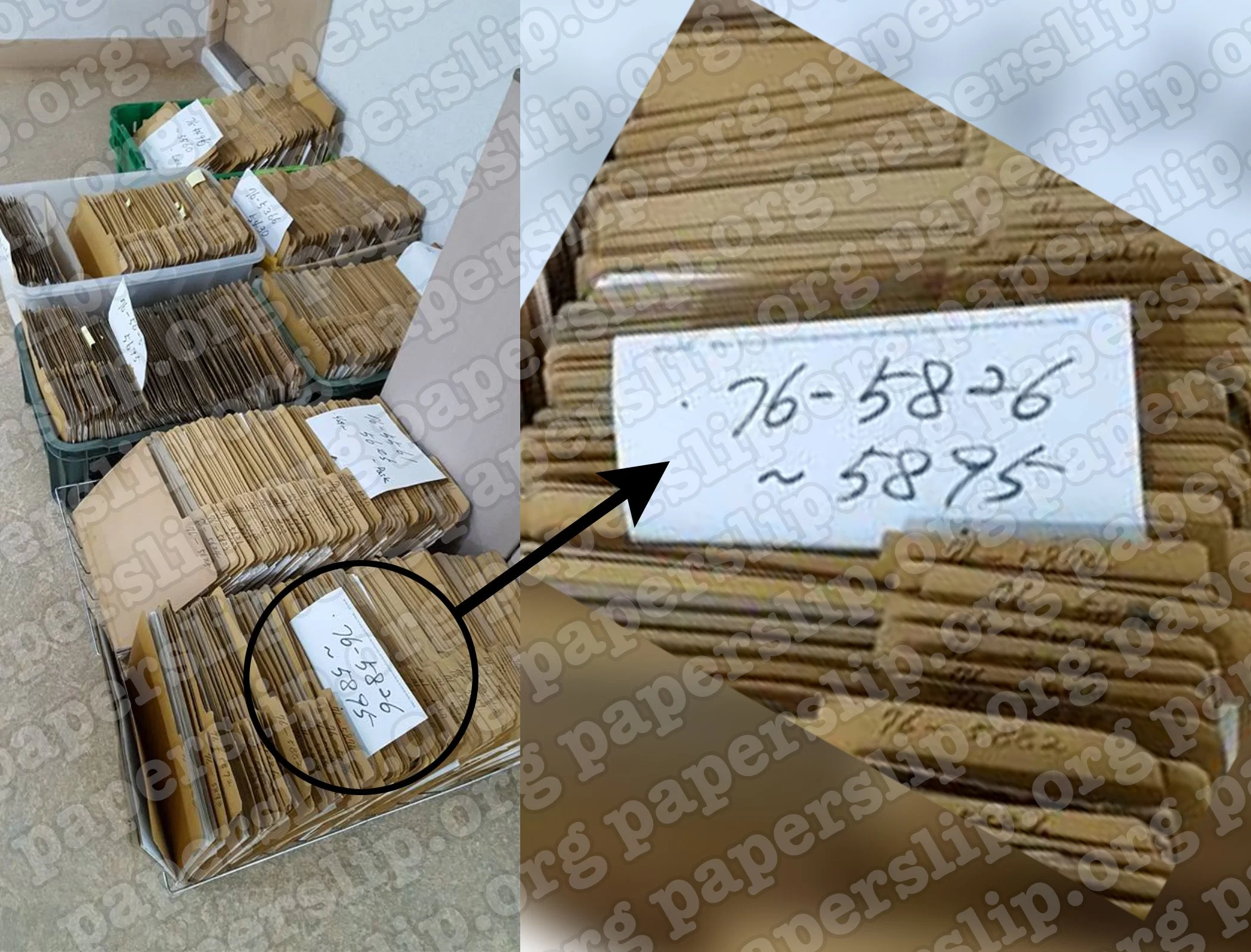
Image credit: Paperslip.org. You may NOT reproduce this image without written permission.
Please see: The KSS File Room at KSS’ Post Adoption Services Building, 2016-2025.
A photograph taken at KSS’ Post Adoption Services building (prior to its closure on July 19th, 2025). KSS files were in the halllway due to there being a big adoption conference, with many Adoptees in Korea at the time. KSS files were not normally stored this way, they were stored in filing cabinets in KSS’ file room at their former Post Adoption Services building (at least from 2016-2025, prior to the transfer of all former Korean Adoption Agency files — including those of KSS — to NCRC’s Temporary Storage Facility on July 19th, 2025. These files are likely to move AGAIN to the Seongam Branch of the National Archives at some point in 2026).
You can clearly see the KSS “FILE NUMBER” on each of the files in the hallway.
+
Below:
Our FAKE Adoptee, KSS / Welcome House (US) Adoptee “KIM Yu Jun”, with K-Number 1758 (where the first digit “1” stands for “Welcome House) and the “File Number” /“Exit Folder” Number 78-5379.
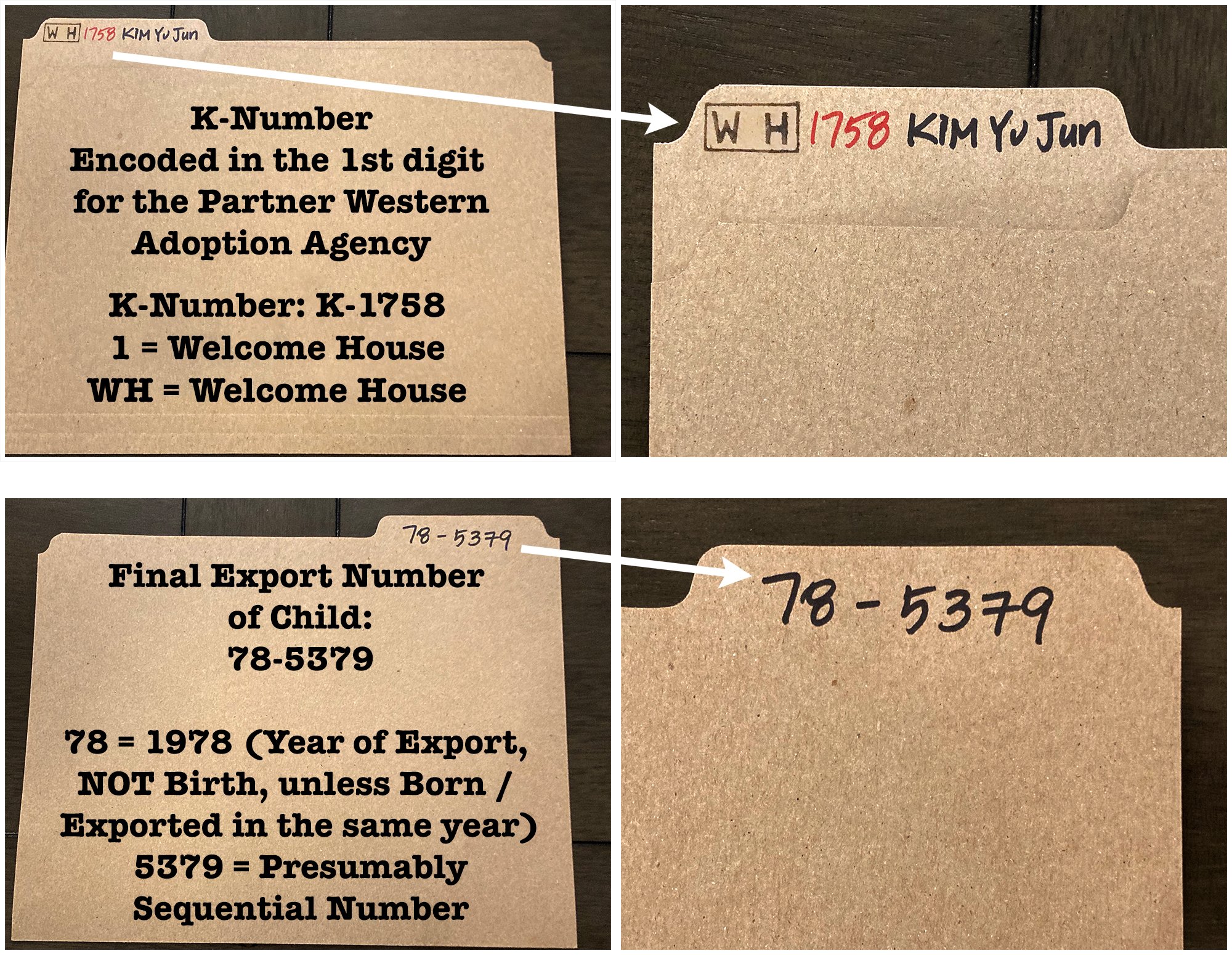
Image credit: Paperslip.org. You may NOT share this image without our permission.
We created this graphic in 2020 as part of our previously private page about KSS Adoption Procedure. Since KSS Adoptees are now able to obtain this information from NCRC (and hopefully later from the Seongam Branch of the National Archives after ALL former Korean Adoption Agency files move there sometime in 2026), we are now sharing this information publicly.
In 2021, KSS’ Director told me in person during a visit to KSS — in the presence of multiple witnesses, including an Associated Press reporter — that KSS referred to what I colloquially call an “Exit Folder” number the “File Number”.
Once a child in KSS’ system was flown / sent from Korea to the West for adoption, a final “File Number” / “Exit Folder” number was added to the outside tab of the KSS child’s file folder at KSS, on the backside of the tab.
This number denoted the 2 digit YY of a child’s export followed by a typically 4 digit number — in our FAKE example above, 78-5379, 78 = 1978, the year the child departed Korea (which was not always the same year the child was born) and the presumably sequential number 5379. This presumably sequential 4 digit number is NOT believed to be encoded in any way.
Please note that the K-Number and “File Number” / “Exit Folder” Numbers do not bear a sequential relationship with one another. This is because in the 1970s, KSS REPEATED / RESET its K-Numbers.
The “File Number” / “Exit Folder” Number is a 2 digit YY-1234 number, where the YEAR is the year that the child departed Korea for the West for adoption. This YEAR is NOT ALWAYS the same year that a child was born (though this COULD be the case — it just depended on whether or not the child left Korea in the same year she or he was born).
The 1234 number which follows the 2 digit YY is presumed to be a purely sequential number. We do not know if KSS started this 1234 number at the beginning of each “File Number” / “Exit Folder” year, or if KSS started this number at its founding in 1964.
The front of the tab contained the initials of the child’s Partner Western Adoption Agency (such as WH for Welcome House; LSS for Lutheran Social Services; W for Wereldkinderen or NFIA for Netherlands Foundation for Intercountry Adoption; AC for Adoption Center; LTC for Love The Children; FAC for Family Adoption Consultants), as well as the child’s English spelled Korean orphan name (such as Jin Hee LEE — where the capitalized LEE is the last name), and the KSS K-Number, which was encoded in the first digit for the Partner Western Adoption Agency, per my original research into KSS K-Numbers.
+
Part 4.
Travel Certificate Numbers.
We have done YEARS of research on Korean Travel Certificate Numbers. Our research is no longer public.
Yet our research is still officially COPYRIGHTED.
+
Part 5.
Sequence of Assignment of Known KSS and Korean Government Numbers:
Child Number
(Internal and previously secret / unencoded / likely purely sequential / KSS internal number presumed to be associated with the intake of a child to its system. The Child Number was used in at least the mid 1970s but appears to have been phased out in subsequent years. Even in the 1970s and prior, not every child had a Child Number at KSS).KSS K-Number
(Encoded in the first digit for KSS’ Partner Western Adoption Agency. KSS K-Numbers REPEATED in the 1970s, so not all KSS Adoptees have unique K-Numbers. The encoded KSS K-Number came into use around Relinquishment Year 1968, though KSS was founded in 1964. Prior to the use of the encoded KSS K-Number, KSS assigned children unencoded sequential 123 numbers).Travel Certificate / “Passport” Number
(Korean Government Number)File Number / “Exit Folder Number”
(Internal / KSS Number)