
Statement by the Korean Association of Archivists: (We) “Strongly Urge the Establishment of a ‘Records Management Division’ in the 3rd Truth and Reconciliation Commission (TRC 3).”
Original Korean Statement by the Korean Association of Archivists published on February 19th, 2026.
ChatGPT English translation posted to Paperslip on March 8th, 2026.
Thank you to a Paperslip Contributor for the link.
Some BOLDS and blue highlighting ours.
+
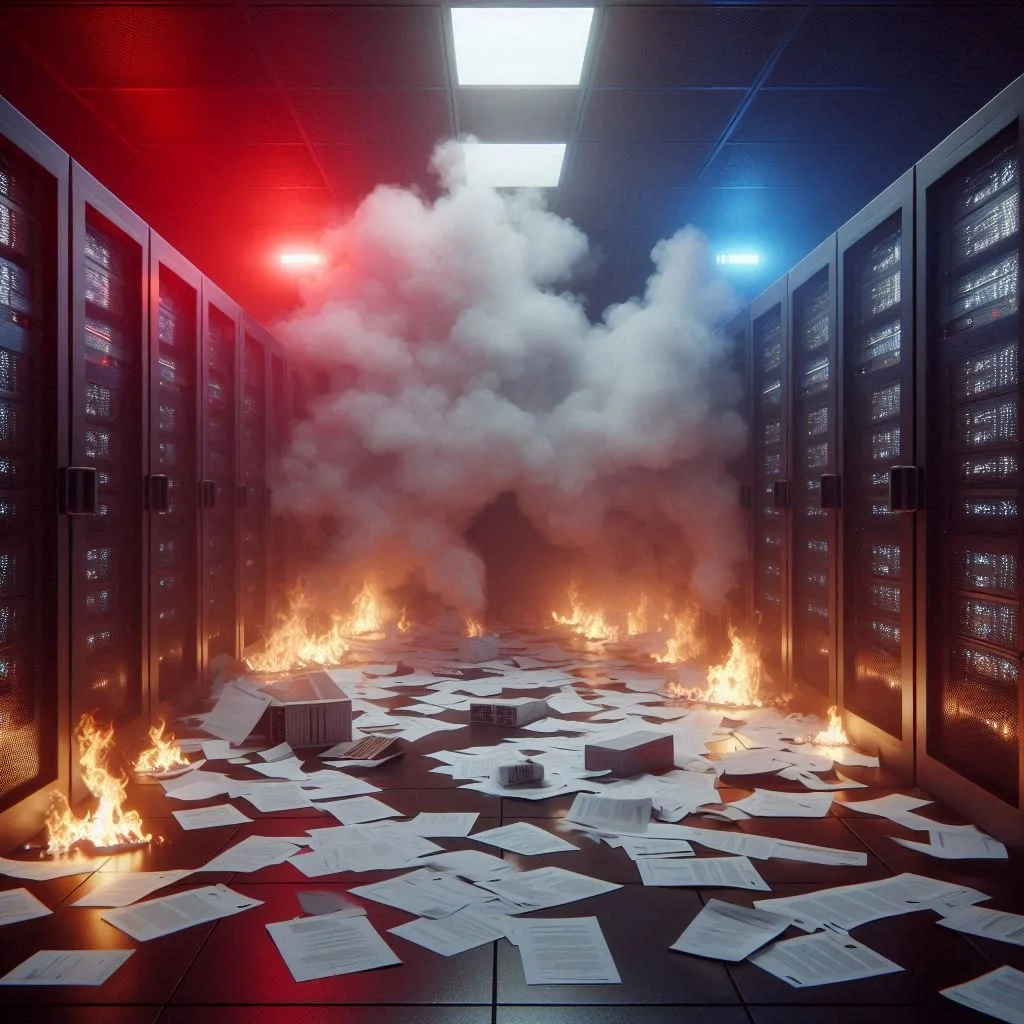
Above - our AI generated image depicting the loss of the G-drive at the National Information Resources Service on September 26th, 2025. The G-drive did contain TWO TRC 2 SYSTEMS. These TRC 2 Systems were reportedly RECOVERED. However, we do not know what data may have been affected by the fire or recovered.
Please see:
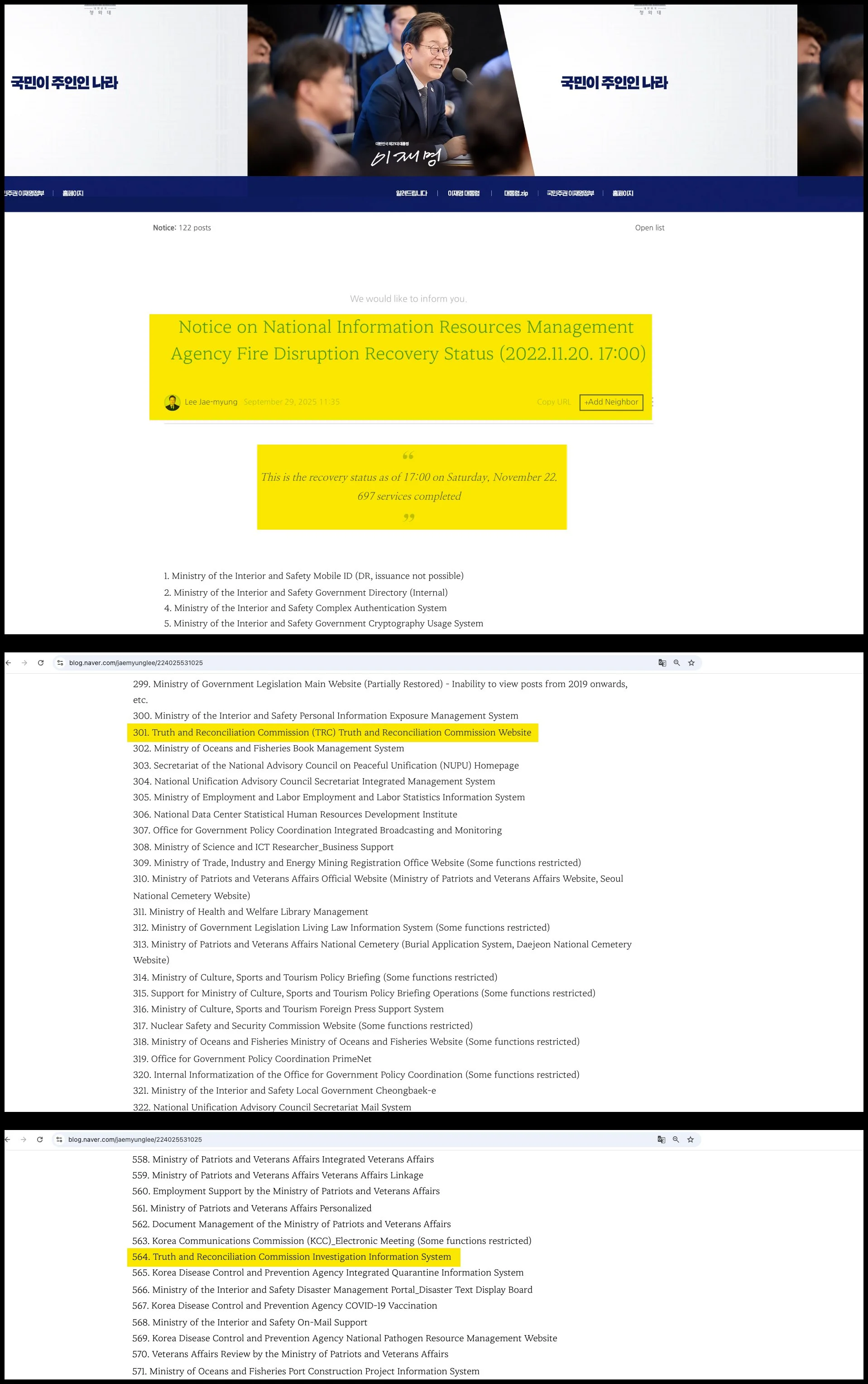
President Lee Jae Myung’s blog highlights the restoration of two TRC 2 systems that were impacted by the National Information Resources Management (NIRS) fire on September 26th, 2025.
*Please note that the National Information Resources Service (NIRS) is not located in the same building as the office building where TRC offices are located. However, two TRC 2 SYSTEMS were affected by the fire at NIRS, and later recovered.
TRC has recently posted a Notice on its ENGLISH website ONLY:
+
UPDATE — March 17th, 2026:
We have worked diligently over the past week to provide validation for what we first shared on March 8th, 2026.
At this point, everything we have shared on this topic — since first learning that TRC 2 was impacted by the National Information Resources Service (NIRS) fire in Daejeon on September 26th, 2025 — has been validated by multiple credible sources, including the South Korean President’s official blog.
We have therefore updated our March 8th, 2026 post below to include evidence showing that the NIRS fire did indeed impact two TRC 2 SYSTEMS, which were reportedly recovered. However, we have not been able to locate any detailed information regarding what DATA was affected or subsequently restored. At this time, available information only identifies the systems that were impacted and recovered, without specifying the data involved.
A key thing which we do not yet understand is the interrelationship between a SYSTEM and DATA. If we learn more about what TRC 2 DATA was affected, we will share it.
Please see:
Even if the two TRC 2 SYSTEMS which were affected by the NIRS fire on September 26th, 2025 were both recovered, does that mean that the associated DATA was recovered? We don’t know.
We want to emphasize that it is INDEFENSIBLE to maintain the position that TRC 2 was NOT impacted by the NIRS fire in any way.
Please see below for further details.
+
We have been able to VERIFY that indeed TWO TRC 2 SYSTEMS were impacted by the National Information Resources Service (NIRS) on September 26th, 2025. The two impacted TRC 2 systems are:
301. Truth and Reconciliation Commission (TRC) Truth and Reconciliation Commission Website
564. Truth and Reconciliation Commission Investigation Information System
These TWO TRC 2 SYSTEMS were reportedly RECOVERED by November 22nd, 2025. However, we do not know what specific DATA was affected by the NIRS fire, and whether or not any DATA was lost or recovered. We only know that the two TRC 2 SYSTEMS were impacted by the fire and then recovered.
Please see:
How might the loss of at least some TRC 2 investigation data — potentially permanently destroyed in the NIRS fire — affect the timeline for rulings in the 311 TRC 2 cases?
President Lee Jae Myung’s blog highlights the restoration of two TRC 2 systems that were impacted by the National Information Resources Management (NIRS) fire on September 26th, 2025.
+
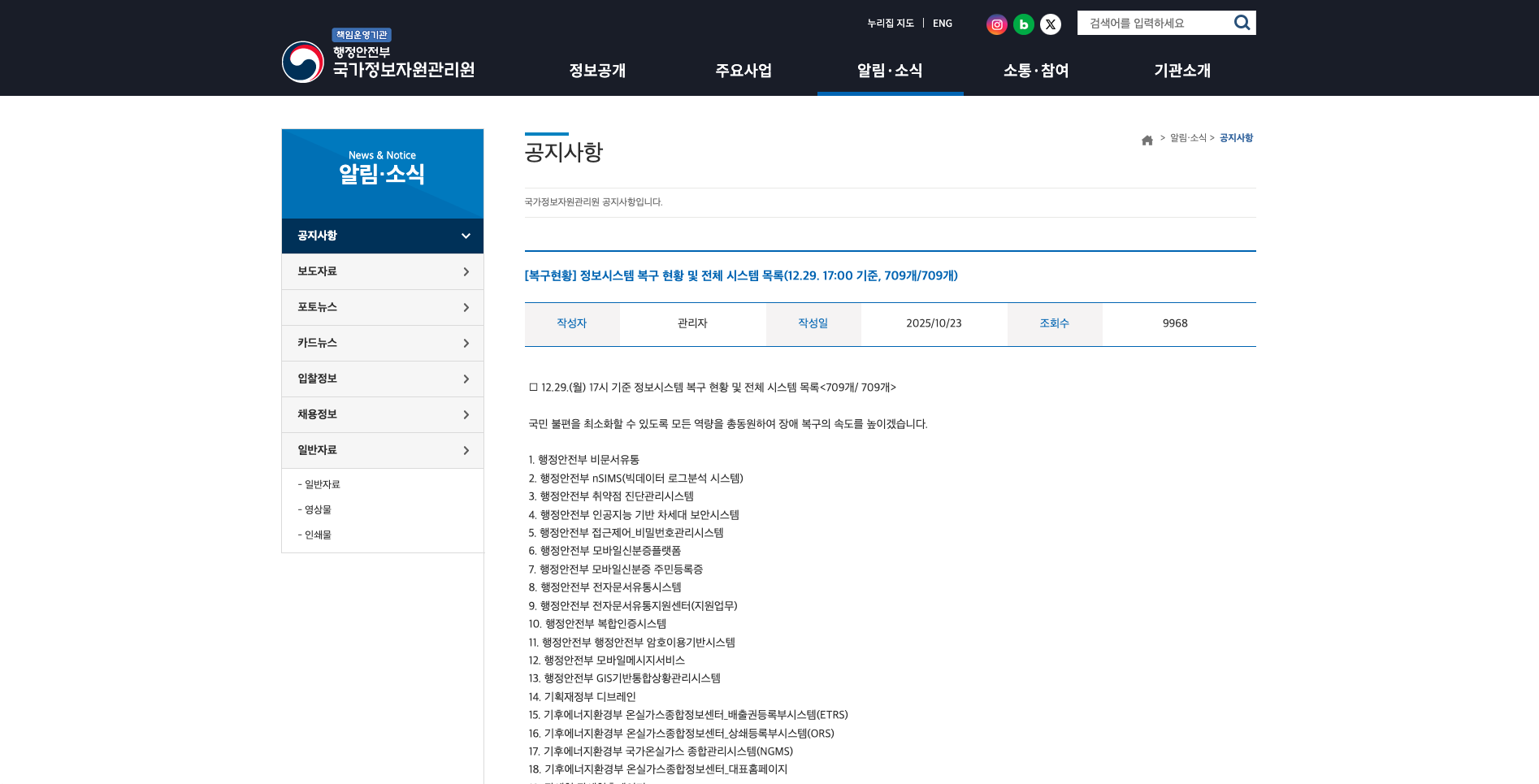
Additional PROOF that these TWO TRC 2 SYSTEMS were impacted by the by the National Information Resources Service (NIRS) on September 26th, 2025 is below:
Notice from the National Information Resources Service (NIRS): Status of Information System Recovery + Complete System List —includes Two TRC 2 SYSTEMS which were affected by the fire but RECOVERED.
+
Please note that the TRC posted a Notice to its ENGLISH website only, on or around March 16th, 2026.
Let’s use “Media Literacy” to parse what this statement DOES say, and significantly, what it DOES NOT say:
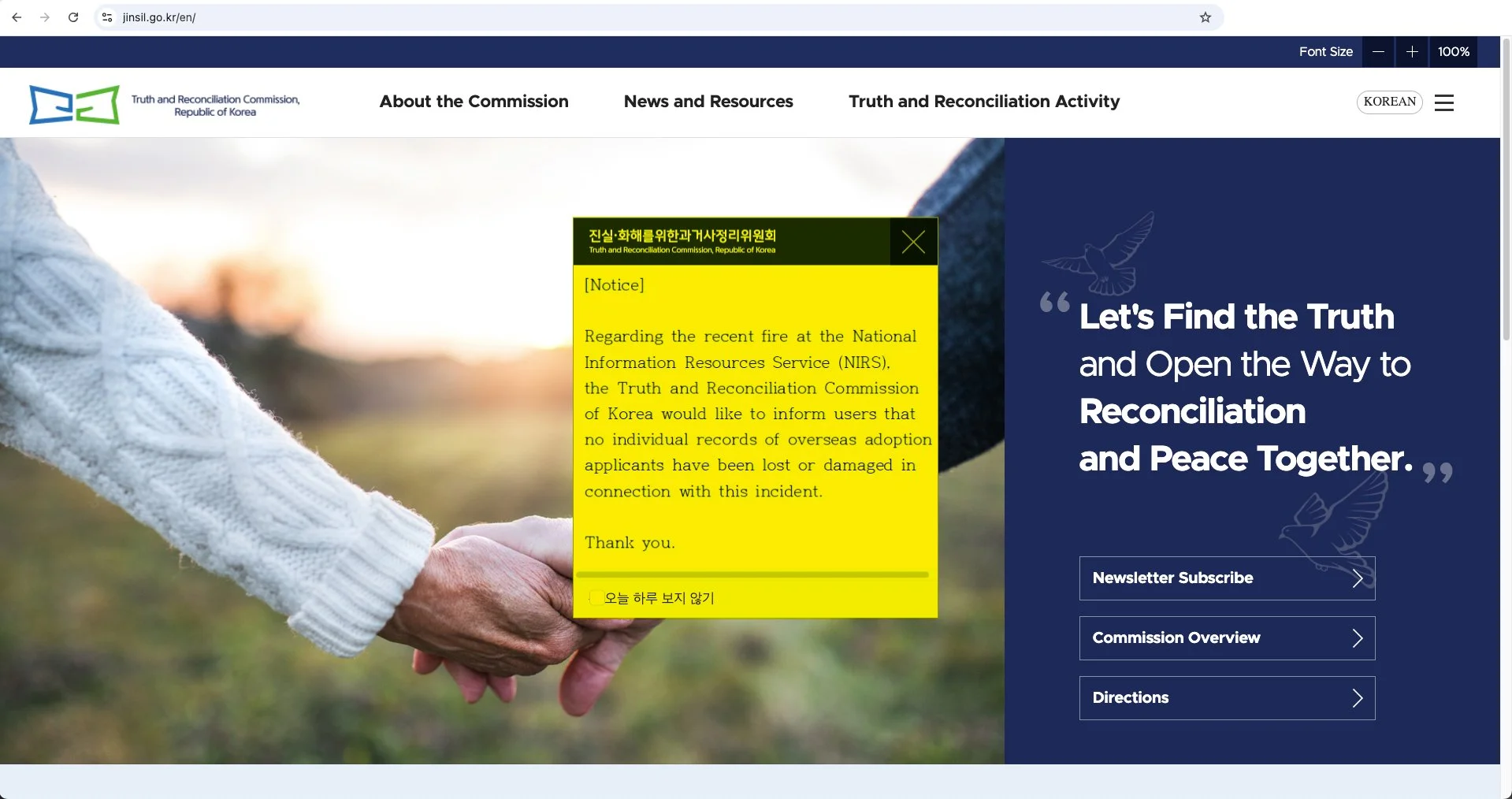
TRC’s ENGLISH only Notice states:
“Regarding the recent fire at the National Information Resources Service (NIRS), the Truth and Reconciliation Commission of Korea informs users that no individual records of overseas adoption applicants were lost or damaged in connection with this incident.”
While we are relieved to hear that “no individual records of overseas adoption applicants were lost or damaged” in the NIRS fire, what this Notice OMITS is that TWO major TRC 2 SYSTEMS were damaged in the NIRS fire and later recovered:
301. Truth and Reconciliation Commission (TRC) Truth and Reconciliation Commission Website
564. Truth and Reconciliation Commission Investigation Information System
So yes, “Media Literacy” IS required to parse this Notice by TRC — in order to see what it really says, and what it does NOT.
TRC has stated on its ENGLISH website only that “no individual records of overseas adoption applicants were lost or damaged” in the NIRS fire.
However, we think it is important to note that TRC has NOT stated that NO INVESTIGATION DATA was lost or damaged in the NIRS fire.
*SIGNIFICANTLY, this means that we currently DO NOT KNOW if any TRC 2 INVESTIGATION DATA was lost, damaged by, or recovered from the NIRS fire.
We were right to question why the TRC Notice was posted only on the ENGLISH TRC website and not on the KOREAN TRC website. We think that there are multiple possible reasons for why this might be.
One possibility is that English-speaking Overseas Adoptees are far less likely than native Korean speakers to be aware that the NIRS fire did, in fact, impact TRC 2 — and that native Korean victims’ groups are already aware of the impact of the NIRS fire on TRC 2.
Another possibility, however, is that native Korean victims’ groups are NOT aware, and that TRC is only responding on their ENGLISH site since we — English speaking Adoptees — are the ones who raised the issue.
While TRC’s ENGLISH website Notice does address a central concern of Overseas Adoptees about “individual records of overseas adoption applicants”, not being affected by the NIRS fire, the Notice unfortunately OMITS key information about TWO KEY TRC 2 SYSTEMS which were impacted by the NIRS fire, and reportedly recovered. TRC’s Notice also DOES NOT mention anything about whether or not INVESTIGATION DATA was damaged, lost, or recovered.
We think it is important to note that “individual records of overseas adoption applicants” may be different from INVESTIGATION DATA. We honestly do not know for sure. Wouldn’t it be worthwhile to find out?
Please see:
TRC Notice: “Regarding the recent fire at NIRS, the (TRC) informs users that no individual records of overseas adoption applicants were lost or damaged…” Yet the TRC Notice OMITS critical information.
+
Paperslip Note:
Please be sure to read this article and the related links CAREFULLY. Please note what IS said in the article, and what is NOT said, so that you understand, before jumping to conclusions.
It is important to note that this article does NOT state that ALL TRC 2 data was destroyed. At this point, there's no article which has been published in Korean or otherwise which clarifies specifically what TRC 2 data was affected. We do NOT personally believe that everything was destroyed. However, we do not know precisely what data was, and what data was NOT, affected. We have anecdotally heard that information from TRC 2 was passed directly to TRC 3, but we do not have any OFFICIAL confirmation of that so far. If there is more information which becomes available OFFICIALLY, we will share it.
No matter what precise TRC 2 data was affected by the fire at the National Information Resources Service (NIRS) in September 2025, the Statement by the Korean Association of Archivists below points out larger data management issues which were inherent in TRC 2, and which have NOT been addressed for TRC 3. Adoptees should take note of this if they plan to submit their cases to TRC 3.
+
We had not previously realized that “TRC 2’s investigation record data” was lost in the National Information Resources Service (NIRS) fire in September 2025.
*Please note that the National Information Resources Service (NIRS) is not located in the same building as the office building where TRC offices are located.
From the translated “Statement by the Korean Association of Archivists”, originally published in Korea on February 19th, 2026 below:
”Unfortunately, when a fire at the National Information Resources Service in September 2025 destroyed the G-drive, the TRC’s investigation record data stored there was also lost.Investigators attempted recovery efforts, but it appears that complete restoration was not achieved. Since proper records management processes before and after storage had not been established and professional staff had not been assigned to the work, the commission could not prepare for such a contingency.”
The statement above does not make clear precisely what TRC 2 data was destroyed in the fire at the National Information Resources Service (NIRS). However, the Korean Association of Archivists is making this statement as part of a broader message regarding their concerns regarding TRC related data management, which is important to understand by reading the full translation of their Statement below.
+
The screenshot below is an excerpt of the Statement by the Korean Association of Archivists, which was posted on February 19th, 2026. This Statement was referenced in The Hankyoreh Article: “Records Experts: ‘A Records Management Division Must Be Established in the 3rd Truth and Reconciliation Commission’”.
Please Note:
The Statement does NOT say that ALL TRC 2 data was lost in the September 2025 fire at the National Information Resources Service (NIRS); however, it IS clear that there WAS significant TRC 2 data that was lost to the fire.
In order to share an ENGLISH screenshot of the Korean Association of Archivists website, we had to use automatic web translation through our browser. Text which is automatically translated through a browser is (at least as of now) inferior to text translated separately via ChatGPT. In the inferior automatic web translation of the text in the screenshot below, the "2nd Investigation Commission" refers to TRC 2.
Please refer to the better ChatGPT translation of the full Statement by the Korean Association of Archivists below this screencapture, which shows the same quote we translated via ChatGPT above:
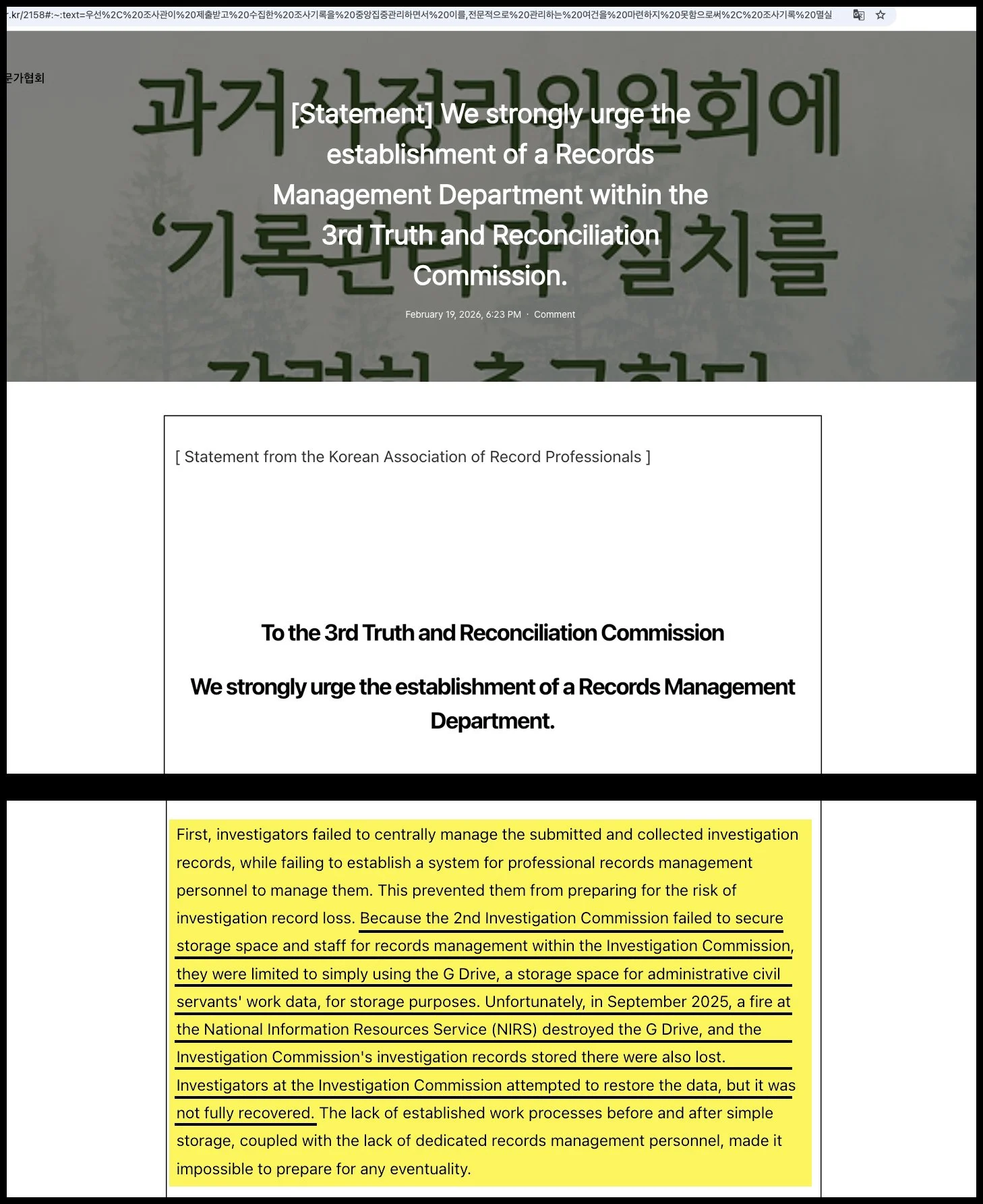
The text (translated automatically through our browser) in the screenshot above says:
“First, investigators failed to centrally manage the submitted and collected investigation records, while failing to establish a system for professional records management personnel to manage them. This prevented them from preparing for the risk of investigation record loss. Because the 2nd Investigation Commission (TRC 2) failed to secure storage space and staff for records management within the Investigation Commission, they were limited to simply using the G Drive, a storage space for administrative civil servants' work data, for storage purposes. Unfortunately, in September 2025, a fire at the National Information Resources Service (NIRS) destroyed the G Drive, and the Investigation Commission's (TRC 2’s) investigation records stored there were also lost. Investigators at the Investigation Commission (TRC 2) attempted to restore the data, but it was not fully recovered. The lack of established work processes before and after simple storage, coupled with the lack of dedicated records management personnel, made it impossible to prepare for any eventuality.
출처: https://www.archivists.or.kr/2158 [사단법인 한국기록전문가협회:티스토리]”
*Note: What is translated as “ 2nd Investigation Commission” refers to TRC 2. We have added “(TRC 2)” for clarity.
+
Please note that the quote above speaks to the larger concerns we have about TRC 3 related data privacy and security.
*Please note that it is clear from the FULL translated statement below that TRC 3 will run documents through AI.
Adoptees should bear this in mind when considering WHETHER or NOT they should submit their case to TRC 3. We strongly encourage Adoptees who DO decide to submit their cases to TRC 3 to REDACT any sensitive information in their documents — such as A (Alien number), or any other information you consider to be sensitive and do NOT want to be run through AI. You should ASSUME that any documents you submit to TRC 3 WILL be run through AI and will likely be shared with third parties.
+
Please see related:
The Hankyoreh Article: “Records Experts: ‘A Records Management Division Must Be Established in the 3rd Truth and Reconciliation Commission’”.
G-Drive Data Lost in S. Korean Data Center Fire…All Central Government Work Files Gone
Korea JoongAng Daily Article: “5 charged over data center fire with discovery of illegal subcontracting”
Originally published October 22nd, 2025.
Are my documents secure during the TRC 3 process?
+
“[Statement by the Association of Korean Archivists] Strongly Urge the Establishment of a “Records Management Division” in the 3rd Truth and Reconciliation Commission”
Paperslip Note: Unfortunately, oftentimes Korean links do not work in the US. This is the link to the original Korean Statement:
https://www.archivists.or.kr/2158
“February 19, 2026 – Commentary
Statement by the Korean Association of Archivists
We strongly urge the establishment of a Records Management Division in the 3rd Truth and Reconciliation Commission.
The launch of the 3rd Truth and Reconciliation Commission (hereafter “TRC”) is now only one week away. It is fortunate that the third term will continue without interruption from the second term. However, we cannot help but express serious concern about the current direction of the organizational structure being prepared.
As archival professionals working in public records management sites and the academic field of archival studies across the country, we are deeply concerned that the preparation team for the third commission is organizing its structure without sufficiently recognizing the core importance of records management in a temporary investigative body dealing with historical issues—continuing the approach taken during the second commission.
The 1st TRC, launched in December 2005, established a Records and Information Division according to its organizational rules, and under the “Regulations on Records and Materials Management,” it also set up a Records Information Center to systematically manage and utilize records of the commission’s activities and investigation materials. This reflected a level of awareness comparable to other historical truth commissions at the time.
For example, the Truth Commission on Pro-Japanese and Anti-National Activities, launched in May of the same year, created a Materials Management Division responsible for preservation, management, digitization, access, and provision of records. Likewise, the Investigative Commission on the Property of Pro-Japanese Collaborators, launched in 2006, established a Records Management Division to carry out the collection, analysis, maintenance, organization, digitization, access, and provision of records. In truth commissions dealing with historical issues, a dedicated records management unit was not optional but essential.
However, the 2nd TRC, launched in 2020, effectively excluded records management functions from its organizational structure and merely assigned one seconded civil servant (a records researcher). Considering the organization’s size and the nature of its work, this measure was grossly insufficient.
The final state of records management in the second commission has not yet been fully revealed. However, based on the commission’s comprehensive report and statements from several investigators, it is difficult not to judge it as inadequate. Investigators acknowledge that the single records researcher worked with great dedication, but the state of records management can only be described as doing one’s best with minimal resources. Regardless of effort, the scale of the work was simply too large for one person to manage properly.
First, the commission failed to establish conditions for centralized management of investigation records collected and submitted by investigators, with professional records management personnel overseeing them. As a result, it could not adequately prepare for the risk of record loss. Because the commission lacked sufficient storage space and records management staff, the second TRC (TRC 2) ultimately relied on the G-drive used by administrative officials merely as a storage space.
Unfortunately, when a fire at the National Information Resources Service in September 2025 destroyed the G-drive, the TRC’s investigation record data stored there was also lost. Investigators attempted recovery efforts, but it appears that complete restoration was not achieved. Since proper records management processes before and after storage had not been established and professional staff had not been assigned to the work, the commission could not prepare for such a contingency.
Second, investigation records must be organized and filed according to a unified system and method in order to be permanently usable. However, due to insufficient training and support, they were not managed in a unified manner. Investigators in temporary investigative bodies come from diverse professional backgrounds and are assembled quickly due to urgent needs. Therefore, training and support are essential to maintain consistency in records management. Although guidelines were prepared and distributed, the severe shortage of records management personnel meant that in practice the records were organized and filed inconsistently.
Third, according to the Public Records Management Act, all records from the second commission were required to undergo reclassification for disclosure before the commission’s closure. However, it has been confirmed that such reclassification had not even begun before liquidation procedures started. Therefore, it is likely that the final reclassification process was never completed. The legally mandated review of records—meant to correct classification errors and maximize public or partial disclosure—was not even initiated.
The 3rd TRC must not repeat the mistake of neglecting records management, which led to such deficiencies in the second commission. According to the supplementary provisions of the revised Truth and Reconciliation Act, the third commission must also properly preserve and provide access to the second commission’s records, which must be inherited rather than transferred elsewhere. However, the draft revision of the enforcement decree announced on January 23—particularly the provisions concerning staffing—showed no sign of improvement.
Therefore, the 3rd TRC must establish a Records Management Division and carry out the following functions:
1. Support for Investigations
Records management staff must provide practical support so that investigators with diverse backgrounds and capabilities can conduct investigations accurately and efficiently. This is not merely an auxiliary role but a core support function affecting the quality of investigations.
Records professionals would provide training and practical assistance, organize and index received and collected records, and carry out tasks directly necessary for investigators. Experts who worked in temporary investigative bodies related to events such as the Sewol Ferry disaster and the humidifier disinfectant incident have also consistently recommended assigning at least one records management specialist per investigative bureau.
2. Management of the Third Commission’s Records
This includes the fundamental functions typically performed by an institutional archives in government agencies. However, records management for the TRC is far more complex than in ordinary administrative agencies.
It must:
Manage investigation records with case-file characteristics alongside records produced in the standard government work management system.
Incorporate a large amount of non-electronic records into an electronic management system.
Provide detailed guidance, training, and monitoring so that investigators—many of whom are not familiar with administrative procedures—can produce and manage records in compliance with regulations.
This requires proactive management from the moment records are created, rather than simply managing them after transfer.
3. Processing Remaining Work on Second Commission Records
If the second commission’s records are left in their current state and later transferred to the National Archives, their disclosure and use may be severely restricted due to their minimal level of organization.
Therefore, the successor body must:
Complete unfinished tasks such as disclosure reclassification and record organization
Review and revise related regulations
Set priorities and carry out systematic improvements
This will allow timely responses to internal and external requests for access to second-term records during the third commission’s operation.
4. Preparation for Establishing an Archival Repository for the Future Foundation
Social expectations for the third commission are likely to culminate in the creation of a Past History Research Foundation under Article 55 of the Truth and Reconciliation Act. One of the most important tasks related to this will be preparing the establishment of an archival repository.
This requires policy research and legal revisions to determine the scope and nature of the historical records and materials that will form the foundation of such an archive. It is not merely a matter of building a facility but of designing an institutional system for preserving and utilizing historical records.
To perform these functions stably during the legal investigation period of three years (extendable by two additional years), a substantial workforce is necessary. The workload clearly exceeds the standard criteria for establishing a government division under administrative guidelines.
Therefore, establishing an independent Records Management Division is fully justified.
Expected Effects
The establishment of this division will improve the accuracy and efficiency of investigations. Experiences from temporary investigative bodies dealing with the Sewol disaster and the humidifier disinfectant case have already demonstrated the value of deploying archival professionals.
If records are proactively digitized, processed with OCR (optical character recognition), and systematically indexed, investigators will be able to quickly search and utilize necessary information. Moreover, well-organized electronic records will enable integration with government-wide AI analysis environments.
The benefits will continue even after the commission ends. Since the records of the Jeju 4·3 Truth Commission were first transferred to the National Archives in 2008, historical investigation records have been continuously used for victim rights relief and academic research in modern Korean history.
However, the National Archives has often explained the limits of its authority and role because it is not the records-producing agency.
Therefore, the 3rd TRC must invest resources so that records are transferred only after necessary processes—such as organization and disclosure reclassification—have been completed. This is the only way to ensure the proper preservation and use of the second and third commission’s records.
The starting point for this is the establishment of a Records Management Division.
We, archival professionals, believe that the importance of records management—greatly weakened in the second commission—must be restored in the third commission, beginning with the establishment of this division. This is the minimum condition for restoring a normal organizational structure.
The third commission’s investigation scope will also expand to include human rights violations in social welfare institutions, adoption agencies, and collective residential facilities, making records types and production contexts even more diverse and complex. Correspondingly, a professional and systematic records management function is essential.
Furthermore, if advanced technologies such as AI are to be actively used in investigations, records must at least be managed in a machine-readable form. Establishing a Records Management Division is therefore not merely an administrative measure but a strategic response to the future.
A decisive step must be taken to establish the division at the same time as the launch of the 3rd Truth and Reconciliation Commission.
This is not optional—it is essential.
February 19, 2026
Korean Association of Archivists”
+
To understand more about the “G-drive” referred to in the Statement above, please see the article below, originally published on October 1st, 2025:
The Hankyoreh Article:
“‘G-Drive’ Government Cloud Loses 8 Years of Data…‘Recovery Impossible Without Backup’ Cloud Used by 190,000 Public Officials ‘Investigation Needed to See if Any Data Remains.’”
Original Korean Article by The Hankyoreh published on October 1st, 2025.
ChatGPT English translation posted to Paperslip on March 8th, 2026.
Thank you to a Paperslip Contributor for the link.
Some BOLDS and blue highlighting ours.
+
“Nationwide General
‘G-Drive’ Government Cloud Loses 8 Years of Data…“Recovery Impossible Without Backup”
Cloud Used by 190,000 Public Officials
“Investigation Needed to See if Any Data Remains”
By Park Hyunjung, Cheon Kyungseok, Kwon Hyeokcheol
Updated: 2025-10-02 14:26 | Published: 2025-10-01 20:40
The government has begun efforts to restore administrative services paralyzed by a fire at the National Information Resources Service (NIRS) on the 26th. On the 1st, a notice about partial suspension of administrative information systems was posted at a community center in Seoul. (Yonhap News)
A fire at the Daejeon headquarters of the National Information Resources Service caused all 8 years of data in the cloud service ‘G-Drive’, used by roughly 190,000 public officials, to be lost. Built by the government in 2017, G-Drive allows officials to store work and policy documents on the cloud instead of on office PCs. Among the 647 public and administrative systems currently suspended, only 399 systems (61.7%) either have disaster recovery (DR) systems that activate when the main system fails or perform daily data backups, making their recovery relatively easier.
According to the Ministry of the Interior and Safety (MOIS) and NIRS officials, in the case of G-Drive—one of the 96 systems in the 5th-floor 7-1 server room destroyed by the fire—not only was the system itself burned, but all backup data stored separately in the same server room was also lost. Lim Jeonggyu, Director of the MOIS Public Service Bureau, said at a Central Disaster and Safety Countermeasures Headquarters briefing held at the Sejong Government Complex on the afternoon of the 1st, “Since G-Drive had no backup, it is judged that data recovery is impossible. It is necessary to investigate whether any data remains.” MOIS stated that as of August this year, 191,000 officials from 74 central ministries and affiliated agencies were registered on G-Drive. However, there are no other systems like G-Drive with backup data stored at the Daejeon headquarters.
According to MOIS, out of the 647 systems, only 47 have disaster recovery systems using servers or storage, and 352 perform daily backups. The remaining 248 systems have neither DR systems nor daily backups; their data is backed up monthly. An MOIS official explained, “Of the total 674 systems, the 352 top-priority 1st and 2nd-grade systems are backed up online to the Gwangju Center once daily, and the rest have their data sent monthly to the Gongju Center for storage.”
In the case of the Ministry of Patriots and Veterans Affairs, the fire disrupted the National Cemetery Burial Application System and the internal Integrated Patriots System, and September’s backup data has yet to be located. A ministry official said, “We understand that September’s data was backed up at the NIRS Daejeon headquarters, but the physical data has not yet been confirmed. Whether data has been lost will only be known after verification.”
News that all G-Drive data is lost has left officials who stored work documents on the service visibly shaken. The Ministry of Personnel Innovation, in particular, was the only central ministry where all officials followed MOIS’s recommendation to store materials solely on G-Drive rather than on office PCs. A ministry official said, “Personnel-related information is managed in a separate system at the Gwangju Center, but other policy documents were stored on G-Drive.”
According to materials released when MOIS established the service in 2017, “G-Drive allows officials to systematically store, manage, and share policy and work documents.”
Currently, 576 personnel from professional firms are deployed at NIRS to continue system recovery. As of 8 PM on the 1st, the Central Disaster and Safety Countermeasures Headquarters reported that 103 of the 647 systems (15.9%) have been restored.
Park Hyunjung (saram@hani.co.kr), Cheon Kyungseok (1000press@hani.co.kr), Kwon Hyeokcheol (nura@hani.co.kr)”