Archived Screenshot/s Of The “History of Adoption in Korea” Page From The Old KAS (Korea Adoption Services) Website. (NCRC is erasing our history).

UPDATE —
Hurray! We were able to find the COMPLETE former “History of Adoption in Korea” page!
(Please note this page may take a while to load due to the size of the screenshots).
This took some sleuthing as we first had to recover the old KAS URL of the “History of Adoption in Korea” from our notes.
Note — the link below will no longer work, since NCRC recently updated the KAS site, and the previous links all just redirect to the new KAS website’s home page:
https://www.kadoption.or.kr/en/info/info_history.jsp
Download a PDF of the screencapture below here.

+
Below, we have reconstructed the editable text of the screenshot above from the old KAS website. This is so that text can be found through online search.
(The screenshot is from around August 2025).
Our editable text reconstruction has been achieved through the use of Google Lens — we have not added text of our own, except to indicate a “Paperslip Note”. Since errors are still possible in OCR transcription, please refer to the original screenshot above as the primary “document”, since the screenshot is directly from the original KAS website.
The page which was screenshot above is no longer available on the new KAS website — which is why we have preserved it here.
+
History of Adoption in Korea
Chapter 1. The Korean War and the Beginning of intercountry adoption
The Establishment of Institutions
January 1954 Founded 'Child Placement Service'
1955 Organized 'Catholic Relief Service', 'The Seventh-Day Adventist Church Education Association'
October 1956 Founded 'Holt Adoption Program'
1957 Founded 'International Social Services'
Annual No. of Adoptee
1954 Over 10 (President Rhee Syngman's order to deal with emigration procedures in a short period)
1955 59
1956 617
1957 486 (abolition of the refugee protection law in the U.S.)
Distribution of Adoptees
1958-1960 2,388 mixed-race children out of 2,700 intercountry adoptees
1955~1961 4,155 out of 4,185 mixed-race children were adopted to the U.S.
→ Most intercountry adoptions in the 1950s were mixed-race children adopted to the U.S.
The Outbreak of the Korean War, The Establishment of Child Placement Service.
As a national tragedy, the Korean War, which broke out on June 25th, 1950 and ended with a truce in July 1953, produced tens of thousands of war orphans including mixed-race children.
No Legal Standards for Intercountry Adoption
Then, most children were sent to the U.S., with only a small minority sent to the UK or some Scandinavian countries. But it was merely a pursuit of measures for mixed-race children, and there were no regulations on foreigners' adoption of Korean children, causing difficulties in intercountry adoption of war orphans. Intercountry adoption in the 1950s was influenced not by domestic laws but by the enactment and revision of laws related to adoption in the U.S., such as the Displaced Persons Act and other laws related to orphans and immigration. In its early days, intercountry adoption started based on the article of 'fostering', which stipulated that 'children in welfare facilities can be placed in volunteering foster homes in accordance with certain procedures', in the 4th chapter of the regulation announced by the order of the Ministry of Health and Social Affairs in 1952.
Therefore, the government proposed the Act on Special Cases Concerning Orphan Adoption on July 23rd, 1955, and laid the bill as many as 6 times from 1957 to 1961. However, the session of the National Assembly was not maintained, thereby leaving it as a pending issue.
The Beginning of Intercountry Adoption
The adoption procedures of 12 adoptees who left Korea with Holt in 1955 were carried out through Child Placement Service (Holt Adoption Program began its own intercountry adoption procedures since June 1956, but Child Placement Service took charge before then).
Harry Holt's departure with the children was recorded and aired on many TV and radio channels in the U.S.
Chapter 2. Child Protection Efforts in the Era of Military Dictatorship
Trend of Domestic and Intercountry Adoption
Domestic adoption was relatively booming while intercountry adoption was stagnant → The government enacted and revised relevant laws while introducing a variety of polices, as a way to promote domestic adoption
4,206 children out of 11,841 adoptees were domestic adoptees in the previous 10 years, totalling 36.63%
The number of domestic adoption ended up exceeding that of intercountry adoption by the mid-1960s
Major Events
February 1961 Prepared legal grounds for intercountry adoption and enacted Act on Special Cases Concerning Orphan
Adoption
1961 Built accommodations for 300 orphans in Nokbeon-dong, Seoul (Holt Children's Services)
1962 Conducted a campaign, Foster One Orphan per Family
1964 Established Korea Social Service
February 1965 Launched a campaign, Share your love, as a way to mobilize financial support from the public
April 1965 Holt Adoption Program started a foster home project
1967 International Social Services handed over its duties to Child Placement Service
Development of Foster Care Projects
Park Chung-hee, Chairman of the Supreme Council for National Reconstruction who seized power in a military coup d'etat in 1961, emphasized that Korean children must be brought up at home rather than in an orphanage, and developed a domestic adoption project and a long-term foster care project.
Child Placement Service changed its Korean name in August 1961 (but kept its English name), launching a campaign, Foster One Orphan per Family, as an independent effort of Korea's child welfare projects, which in fact, had depended heavily on international aids.
The effort, however, failed to produce satisfactory results because of its inherent vulnerabilities, such as an over emotional project development, and lack of a professional service system and lack of foster parents' awareness.
Due to these reasons, the long-term foster care project of Child Placement Service ended as a failure after a number of trials and errors. However, it created the momentum to revive the significance of foster care, later serving as a catalyst that would vitalize a temporary foster care project before adoption.
Furthermore, the government enacted and revised adoption-related laws and policies that gave priority to domestic adoption, which in turn discouraged intercountry adoption. As a result, by the mid-1960s, the number of domestic adoption ended up exceeding intercountry adoptions.
The Establishment of Korea Social Service
Baek Geun-chil, the second president of Child Placement Service, established Korea Social Service in 1964 and carried out consulting service, adoption service, and sponsorship projects for mixed-race children, war orphans, children from low-income families, children from broken families, and phsically- or mentally-challenged children in Korea.
Korea Social Service developed a variety of services for child welfare by systematizing child welfare projects to provide healthy homes for children who did not have homes or could not be fostered by their parents.
The Enactment of Act on Special Cases Concerning Orphan Adoption
The Act on Special Cases Concerning Orphan Adoption was enacted in 1961 to protect adopted orphans and children with special needs. The Act provided legal standards for intercountry adoption of children with special needs and the purpose (Article 1) was 'to seek enhancement of welfare for orphans by providing simple measures for foreigners to adopt Korean orphans.'
Then, there were many adverse effects coming from private adoptions, due to lack of organizations or policies responsible for intercountry adoption. In 1966, the government made it a rule to enable only authorized organizations to carry out intercountry adoptions.
The government also introduced a number of laws related to child welfare, such as Law Concerning the Duties of Guardians for Orphans and Child Welfare Law.
* International Social Services (ISS)
The International Social Services is an international organization with its headquarters located in Geneva, Switzerland, and it was authorized by the Korean government in 1957 to carry out activities related to intercountry adoption.
There are three branches worldwide, and the Korean branch withdrew from Korea in 1967 due to operational problems, handing over all relevant duties to Child Placement Service.
The ISS mostly took care of intercountry adoption, settlement of refugees, international marriages, family counseling, adoption problems, mediation and solutions.
Chapter 3. A Leap into Professional Adoption Projects and Child Services
Trend of Domestic and Intercountry Adoption
Intercountry adoption began to increase again from 1968, taking up 75.92% of adoption in the 1970s Problems arose due to unfeasible domestic adoption policies
Intercountry adoption became diversified into Europe as well as the U.S.
Major Events
1970 Temporarily suspend adoption to Northern European countries
1972 Korea a Christian Crusade (Eastern Social Welfare Society) began adoption services
1976 Established Eastern Child Welfare Society, abolished Act on Special Cases Concerning Orphan Adoption, and enacted
Act on Special Cases Concerning Adoption
Planned to suspend intercountry adoption from 1985
Developed a 5-year plan of adoption projects
Implemented an intercountry adoption quota system
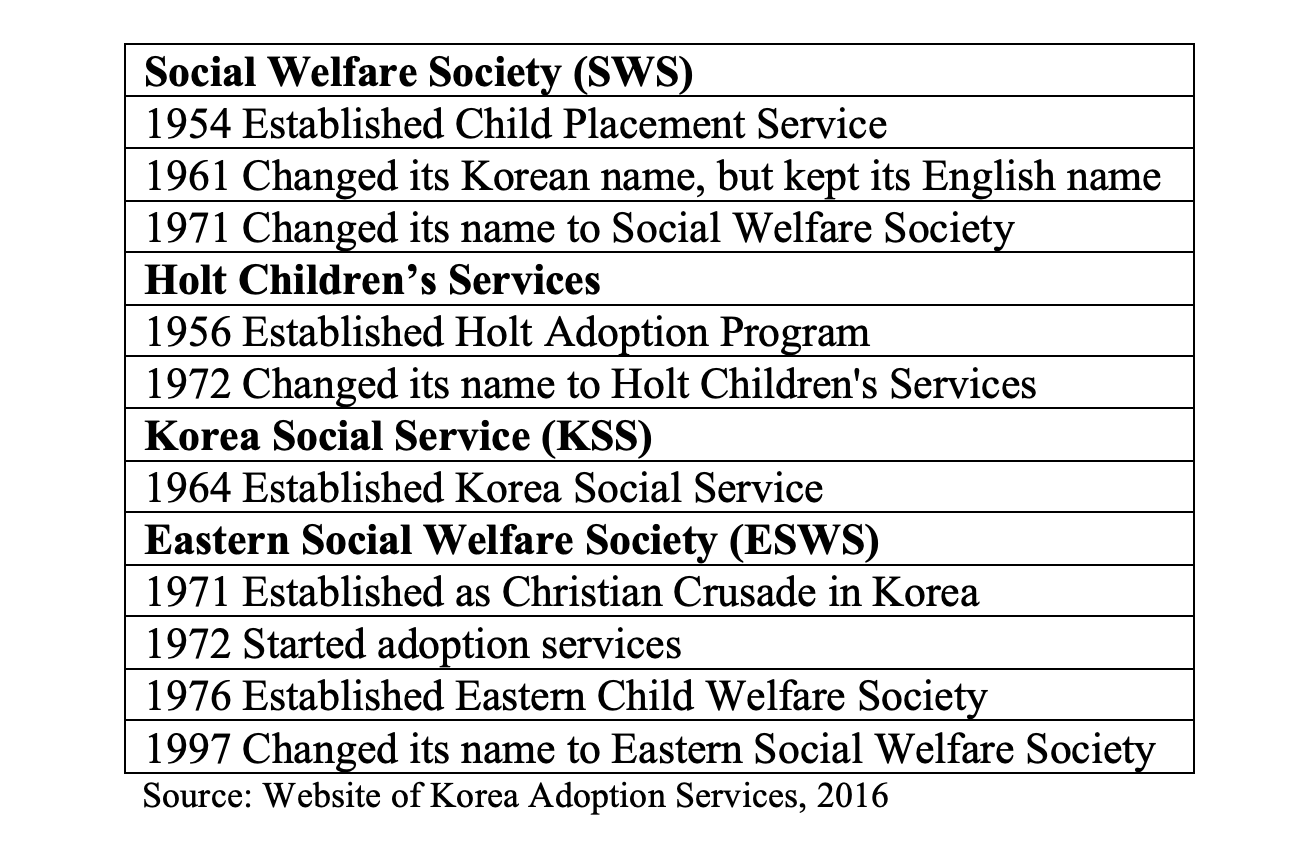
Current Status of Adoption Agencies
<According to Year of Establishment>
Social Welfare Society
1954 Established Child Placement Service
1961 Changed its Korean name, but kept its English name
1971 Changed its name into Social Welfare Society
Paperslip Note: SWS (Social Welfare Society) eventually became KWS (Korea Welfare Society), but we do not know in which year this took place.
According to the film “In The Matter of Cha Jung Hee” by Deann Borshay Liem, her ISS (International Social Service) file was found at KWS. When ISS closed, SWS likely took over their files. So if you have an early ISS case, your file may either be at KSS (Korea Social Service, which also partnered with ISS in the 1960s) or at KWS. However, please note that ALL former Korean Adoption Agency files moved to NCRC’s Temporary Storage Facility in Goyang, Gyeonggi-do on July 19th, 2026. At some point in 2026, ALL former Korean Adoption Agency files may move AGAIN to the Seongam Branch of the National Archives.
Holt Children's Services
1956 Established Holt Adoption Program
1972 Changed its name into Holt Children's Services
Korea Social Service
1964 Established Korea Social Service
Eastern Social Welfare Society
1971 Established a Christian Crusade in Korea
1972 Started adoption services
1976 Established Eastern Child Welfare Society
1997 Changed its name into Eastern Social Welfare Society
The Establishment of Eastern Social Welfare Society
Kim Deuk-hwang, the first president of Eastern Social Welfare Society, established a Christian Crusade in Korea in July 1971, and began adoption services with authorization of the government in 1972. He established Eastern Child Welfare Society in 1976, forming the current structure of Social Welfare Society, Holt Children's Services, Korea Social Service, and Eastern Child Welfare Society to start vigorous adoption services.
An increase in intercounty adoption
In the 1970s to 1980s when people were confident that the economy had grown to a certain level and that they had overcame almost all the wounds from war, the number of intercounty adoptions rather rapidly increased.
7,275 children were adopted overseas in the 1960s, which soared by 6.6 times to 48,247 in the 1970s and by 8.9 times to 65,321 in the 1980s. As the success of the economic development plan that had started from
1962 achieved economic growth, aid from foreign private organizations gradually decreased.
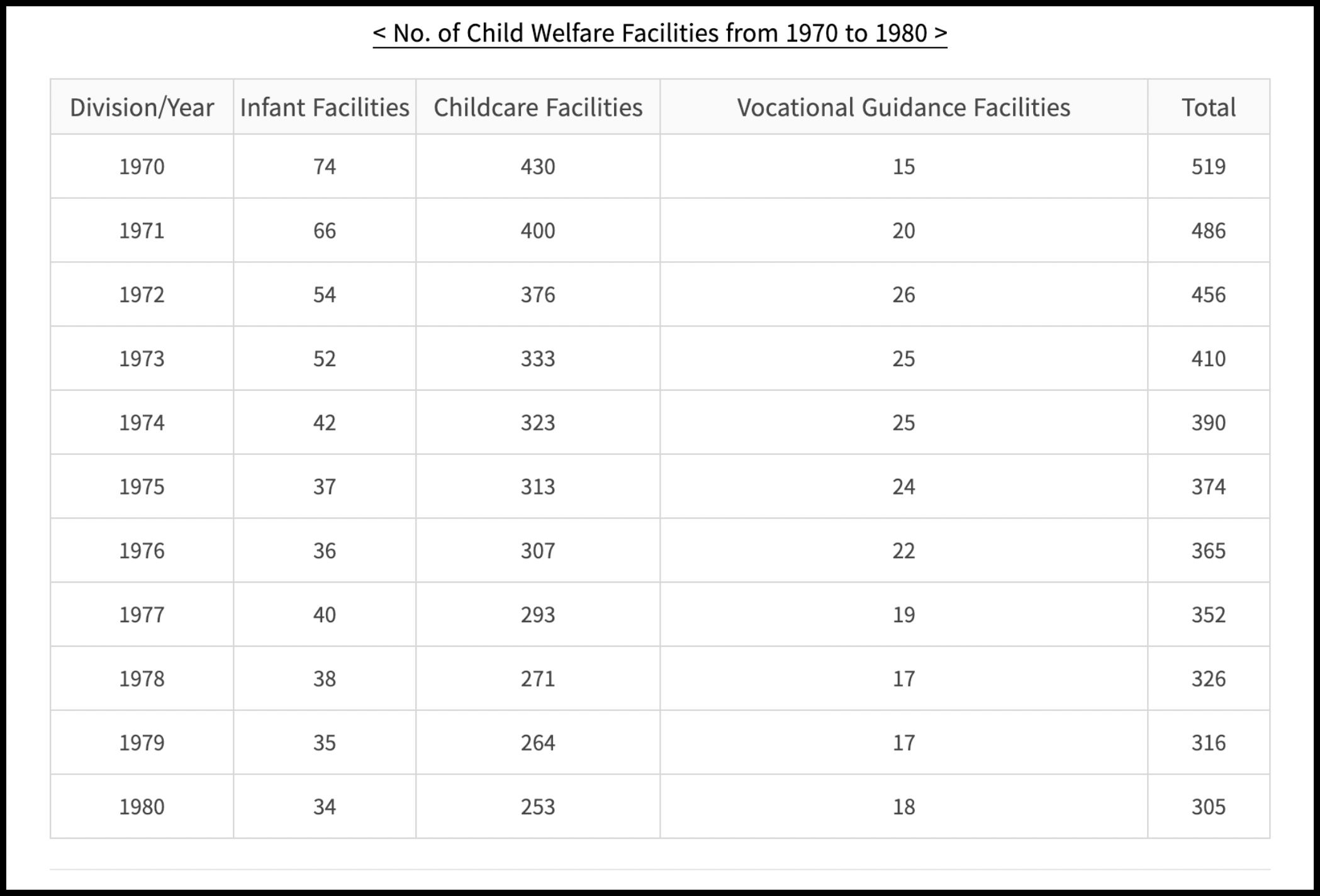
As a result, it was insufficient to cover the child welfare budget, which had depended on overseas aids, with domestic support. The government presented an outline for child welfare reform in 1972 and reformed child welfare facilities accordingly. Therefore, the number of child welfare facilities, such as childcare centers, dropped in the mid-1970s, leading to a greater number of children with special needs in intercountry adoption.
The Enactment of Act on Special Cases Concerning Adoption
As intercountry adoption rapidly increased in the late 1960s, overseas Koreans and diplomats pointed out the problems with the intercountry adoption policy. Domestic opposition also arose regarding intercounty adoption, along with the international criticism from the U.S. and Europe, calling it 'orphan exports.' North Korea used this politically to reinforce false propaganda against South Korea, which led to the temporary suspension of adoption to Northern European countries. This served as a momentum for Korea's adoption policy to put more emphasis on domestic adoption than intercountry adoption. The government enacted the Act on Special Cases Concerning Adoption in 1976 to correct the flaws of The Act on Special Cases Concerning Orphan Adoption and simplify the procedures for domestic and intercounty adoption of children accommodated in protective facilities, attempting to encourage domestic adoption rather than intercountry adoption. The government also imposed a duty on each intercounty adoption agency to fulfill a quota of domestic adoptions, and introduced a new system of allocating intercountry adoptions according to the number of domestic adoptions, as a way to encourage domestic adoption. The move was aimed at a complet banning on intercountry adoption by 1985, by increasing domestic adoption 10% annually while reducing intercountry adoption 10%, but to little avail.
In 1985, the government established the 5-year plan of adoption and foster care for children with special needs, aiming to stop intercountry adoption. According to the plan, the government founded adoption and counseling agencies, which would carry out the duties of identifying, enlightening, counseling and encouraging prospective adoptive parents. However, ambiguous regulations on duties and standards of establishment, which adoption agencies must fulfill, and performance-oriented adoption projects, hiring amateurs, resulted in lack of professionalism, which in turn probably reinforced the public's negative perception on adoption.
Chapter 3. A Leap into Professional Adoption Projects and Child Services
Trend of Domestic and Intercountry Adoption
The number of adopted children fluctuated according to the government's adoption policy, but overall the number reached 91,000 in the 1980s with the annual average of 9,182 adopted domestically and abroad
The number of domestic adoptions was approximately 26,000 (28.86%) and the annual average was 2,650 (81~90)
The number of international adoptions was approximately 65,000 (71.14%) and the annual average was 6,532 (`81~`90)
Major Events
1981 Fully opened intercountry adoption to increase emigration and activate people-to-people diplomacy 1989 Established a domestic adoption agency, Holy Family Child Adoption Center
Planned to completely stop intercounty adoption by 1996 through the phased reduction project
Opening of Intercountry Adoption, as a way to Increase Emmigration and Activate People-to-People Diplomacy
In the 1980s, the government decided to fully open intercountry adoption to increase emmigration and activate people-to-people diplomacy, withdrawing the quota system and the intercountry adoption suspension plan that had been carried out to stimulate domestic adoption. With the opening of intercounty adoption, the number of children adopted to overseas homes rapidly increased, which led to competition among adoption agencies to secure the sufficient number of prospective adoptive children. However, not long after the announcement of full opening, the government gave an administrative instruction to refrain from carrying out intercountry adoption around the 1986 Seoul Asian Games and the 1988 Seoul Olympic Games, considering international attention to this issue.
These measures by the government did not fully regulate international adoption, but were rather implemented occasionally when they might give a negative perception overseas.
Hosting the Olympic Games and the Change of the Adoption Policy
With the 1988 Seoul Olympic Games, many countries around the world started to show interest in Korea. In the meantime, the foreign press focused on the increasing number of children adopted overseas and the continued overseas adoption despite Korea's eye-opening economic growth and the hosting of the Olympic Games. They pointed out that Korea was "the world's top orphan exporter," criticizing that Korean children given up by single mothers made up 60% of foreign children sent to the U.S. in the form of adoption, the number of which exceeded 6,000 a year. Influenced by the foreign press, the media in Korea started to raise the issue of intercountry adoption, which increased social attention. Accordingly, the government decided to encourage domestic adoption by establishing the Adoption Project Improvement Guideline in June 1989. According to the guideline, the government intended to reduce intercountry adoption every year and eventually ban it with the exception of mixed-race children or disabled children by 1996. But this plan was withdrawn in 1995 due to lack of domestic adoption.
The Establishment of Domestic Adoption Agency, Holy Family Child Adoption Center
Holy Family Child Adoption Center is an agency exclusively for domestic adoption established on May 11th, 1989, after the 24th Olympic Games in Seoul in 1988, as a project of the International Eucharistic Congress with the belief that Korean children must be raised by Korean. While the four previous adoption agencies were launched with the purpose of overseas adoption, this agency has great significance in that it was launched as an exclusive domestic adoption agency.
Chapter 5. The Establishment and Activities of Organizations for Adoptees and Adoptive Parents
Trend of Domestic and Intercountry Adoption
The declining birth rate and social stability reduced the number of children with special needs, and the influence of the national policy to lower overseas adoption led to over 50% reduction of adoptees
The share of domestic adoption continued to grow to 34.6% of all adoptions by the early 1990s, and the adoption of disabled children was around 1% of domestic adoption
The share of disabled children in intercountry adoption increased again in the 1980s, taking up around 40% of children adopted overseas by the 1990s
Major Events
1994 Canceled the policy of complete ban on overseas adoption
Implemented Foster Care system
1996 Domestic adoption rose while intercountry adoption naturally fell
End of intercounty adoption except disabled children and mixed-race children
1997 Planned to lower intercountry adoption annually, making it harder to get intercountry adoption permission and establishing The Overseas Koreans Foundation
1998 Postponed the attempt to make it harder to get intercounty adoption permission, helping applicants to get intercounty
adoption permission more easily, enacting enforcement ordinance and regulations on Act on Special Cases Concerning Adoption Promotion and Procedures, seeking ways to boost adoption of disabled children (after the IMF's bail-out of the
Korean economy), and establishing Global Overseas Adoptees' Link
1999 Established International Korean Adoptee Service (InKAS)
Established Global Adoption Information and Post Services
Established Mission to Promote Adoption in Korea
The Enactment of Act on Special Cases Concerning Adoption Promotion and Procedures
In May 1995, the revised Act on Special Cases Concerning Adoption Promotion and Procedures was enacted by correcting the flaws in the Act on Special Cases Concerning Adoption. For instance, the revised law was aimed at eliminating obstacles to domestic adoption and making post-adoption services for intercountry adoption compulsory. The government also provided adoptive families with housing loans, medical expenses, educational costs, and living expenses. However, with the tradition of valuing blood ties and the reality of keeping adoption secret, the financial support for adoptive families did not act to vitalize domestic adoption. Consequently, with a new plan to accept intercountry adoption as an alternative for domestic adoption, the policy to stop intercounty adoption was withdrawn in August 1995.
IMF and Adoption
As Korea suffered a financial crisis in 1998 and was put under the supervision of IMF, children with special needs increased by 40% within a year, reaching 9,000 children. Most of them were from not only out-of-wedlock birth by single mothers but also broken homes and dysfunctional families. In the aftermath of the financial crisis, the number of children with special needs soared, resulting in a temporary suspension of the intercountry adoption quota system.
The Establishment of Organizations for Adoptees and Adoptive Families
Intercountry adoption that had started since the Korean War sent approximately 150,000 children for adoption (as of 2000, based on the statistics of the Ministry of Health and Welfare) to 14 countries, including the U.S., Europe, Canada and Australia.
Koreans adopted overseas autonomously formed organizations for Korean adoptees in places they grew up with the intention to find their identities as Korean adoptees. There are already more than 20 organizations around the world. Moreover, as Korea began to distinguish itself in the international stage since the 24th Seoul Olympic Games in 1988, the number of visits by Koreans adopted overseas to Korea increased. They come to their homeland to find their identities, roots and families and to learn about Korean culture and language. This led to the emergence of organizations for post-adoption services of intercountry adoption since the late 1990s, such as Global Overseas Adoptees' Link (G.O.A.'L) and International Korean Adoptee
Service (InKAS).
Moreover, with the national awareness of Korea's long history of intercountry adoption as well as the changing public opinion on domestic adoption, Mission to Promote Adoption in Korea was established by domestic adoptive families to promote and enhance domestic adoption and change the public perception on adoption. In July 1999, Adoption Information Center was established to provide integrated and professional post-adoption services for domestic and overseas adoptees.
Chapter 6. The Enactment of National Adoption Day and Improvement of Domestic Adoption Culture
Trend of Domestic and Intercountry Adoption
Promoted adoption of disabled children by increasing support of child-rearing expenses and medical bills for families adopting disabled children
The Minster of Health and Welfare announced at the National Assembly's inspection of state administration as well as in interviews with the press that intercountry adoption will be completely banned in 2010 Introduced a plan to promote domestic adoption first: Intercounty adoption is allowed only if children fail to be adopted within five months after permission of domestic adoption
Major Events
2002 Established non-profit private organization KoRoot
2005 Enacted National Adoption Day
Partially revised the enforcement ordinance of Act on Special Cases Concerning Adoption Promotion and Procedures
2006 Presented comprehensive countermeasures to promote domestic adoption
Established Nest Korea
2009 Ended service of Adoption Information Center
Established Korea Adoption Information Services
Domestic Adoption Vitalization Effort 1 - Comprehensive Countermeasures to Promote Domestic Adoption
Background
The measures to promote domestic adoption (Mar. 30, 2006) had been established before, but the latest measures of Comprehensive Countermeasures to Promote Domestic Adoption included additional plans, such as adoption holiday system, relief of qualifications for adoptive parents, and a plan to promote domestic adoption first
Basic Direction
Providing family-centered child protection services by promoting domestic adoption
Enhancing institutional and financial support for adoptive families
Reinforcing national promotion activities to improve the public perception
Establishing systems to provide efficient post-adoption services
Main Contents
Institutional Support
Implemented Adoption Holiday System, such as maternity leave, for psychological adjustment of adoptees and adoptive parents from 2007, starting with public workers (agreed by the Ministry of Security and Public Administration)
Adoption agencies implemented a plan to promote domestic adoption first for five months after the child was decided to be adopted (2007)
Established and managed Integrated Management System of Children for Adoption, providing comprehensive information on adoptees for families hoping to adopt
Relieved qualifications for adoption: Single and unmarried people were permitted to adopt, the age gap between adoptive parents and children was narrowed from 50 to 60 years, and the regulation limiting the number of children of adoptive parents (currently no more than five) was scheduled to be eliminated
Promoted a plan to include adoptive families of disabled children in the beneficiaries of special provision of national housing in order to stabilize housing for the families (the Ministry of Construction and Transportation)
Improvement of Adoption Culture
Promoted a plan to improve adoption culture by eliminating prejudice, encouraging open adoption, and promoting adoption
Attracted participation of religious circles and private organizations to promote domestic adoption
Financial Support
Adoption Charge Support (KRW 2 million) was intended to lessen financial burden of adoptive families and improve public awareness on adoption
Nurturing Benefit of Adoptees (KRW 100,000 per child a month) was intended to raise adoptees in a healthy and sound environment
Reinforced support of child-rearing expenses and medical bills for families adopting disabled children
Reinforced support of adoption agencies' counseling activities
Promoted a plan to support child-care expenses (the Ministry of Gender Equality) and nursery expenses (the Ministry of Education) for adopted children
Reinforcement of Post-Adoption Services
Established a comprehensive support system to find adoptees' roots
Established Homes for Adoptees, which provides all kinds of information, such as information about Korean culture and jobs, as well as long-term or short-term accommodations, for intercountry adoptees while they stay in Korea
Expanded services for intercountry adoptees, such as Korean language education, Korean culture experiences, and employment counseling services
Domestic Adoption Vitalization Effort 2 - The Enactment of National Adoption Day in 2005
To establish a healthy adoption culture and promote domestic adoption, the Ministry of Health and Welfare designated May 11th as the National Adoption Day, indicating that one family (1) adopts one child (1) in the Family Month of May to become a new healthy family (1+1). The week starting from the National Adoption Day was designated as Adoption Week. The government and local organizations have been carrying out appropriate events, starting in 2006. The government, adoption agencies and organizations are carrying out projects of adoption policy establishment, adoption survey and research, post-adoption management, adoption and family support, and education and promotion of adoption to encourage adoption of children with special needs and enable smooth adjustment of family life after adoption. They are also supporting the emotions of adoptive families by providing adoptive family gatherings, camps and contests, while also promoting adoption through broadcast, newspaper, internet and pamphlets.
Domestic Adoption Vitalization Effort 2 - The Enactment of National Adoption Day in 2005
To establish a healthy adoption culture and promote domestic adoption, the Ministry of Health and Welfare designated May 11th as the National Adoption Day, indicating that one family (1) adopts one child (1) in the Family Month of May to become a new healthy family (1+1). The week starting from the National Adoption Day was designated as Adoption Week. The government and local organizations have been carrying out appropriate events, starting in 2006. The government, adoption agencies and organizations are carrying out projects of adoption policy establishment, adoption survey and research, post-adoption management, adoption and family support, and education and promotion of adoption to encourage adoption of children with special needs and enable smooth adjustment of family life after adoption. They are also supporting the emotions of adoptive families by providing adoptive family gatherings, camps and contests, while also promoting adoption through broadcast, newspaper, internet and pamphlets.
Chapter 7. 2011~2013 / Revised Act on Special Cases Concerning Adoption and Signed the Hague Adoption Convention
Trend of Domestic and Intercountry Adoption
Expanded support of child-rearing expenses and medical bills for disabled children
Reinforced support for disabled children through an increase in adoption charge
Enforced the revised Special Adoption Act, focusing on the protection of rights and interests of adoptees
Signed the Hague Adoption Convention to implement the standard for international children's rights
Major Events
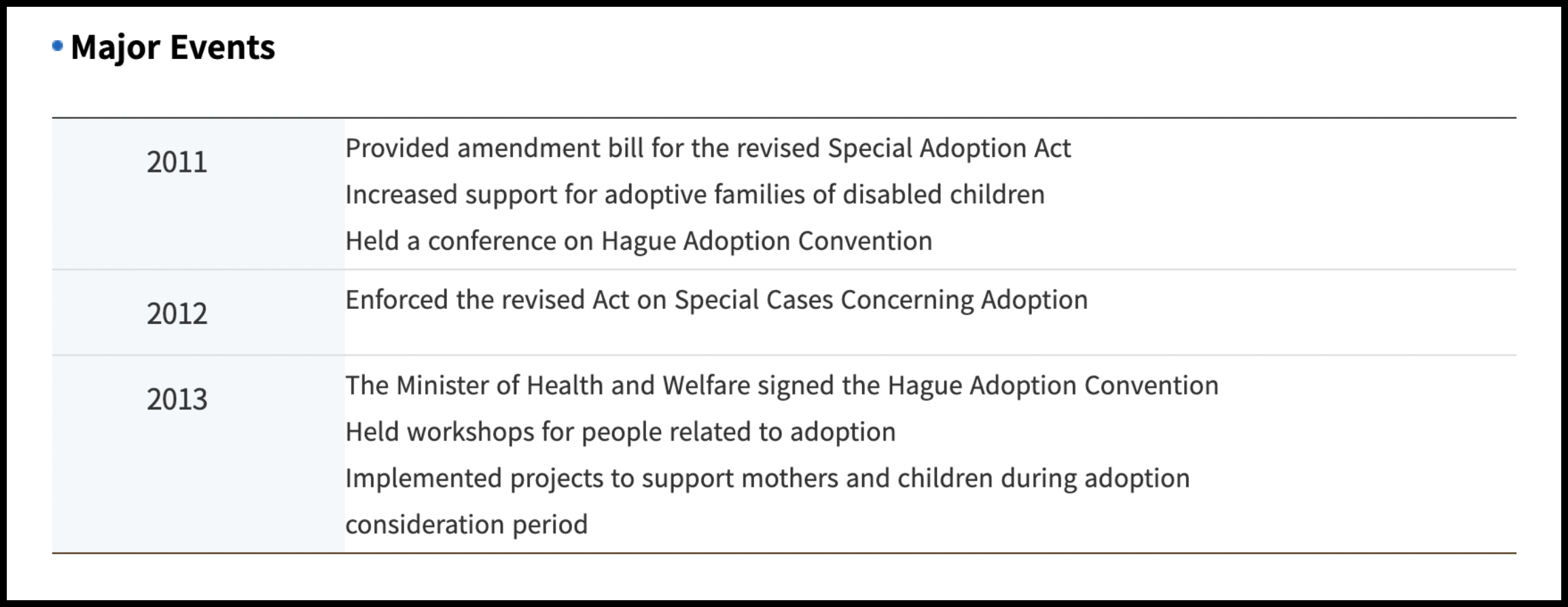
2011
Provided amendment bill for the revised Special Adoption Act Increased support for adoptive families of disabled children Held a conference on Hague Adoption Convention
2012
Enforced the revised Act on Special Cases Concerning Adoption
2013
The Minister of Health and Welfare signed the Hague Adoption Convention Implemented projects to support mothers and children during adoption consideration period
Held workshops for people related to adoption
*Paperslip Note: We have included both the graphic of the text and the editable text above the graphic, so that the text is searchable online.
Main Contents of the Revised Special Adoption Act (revised in Aug. 2011, enacted in Aug. 2012)
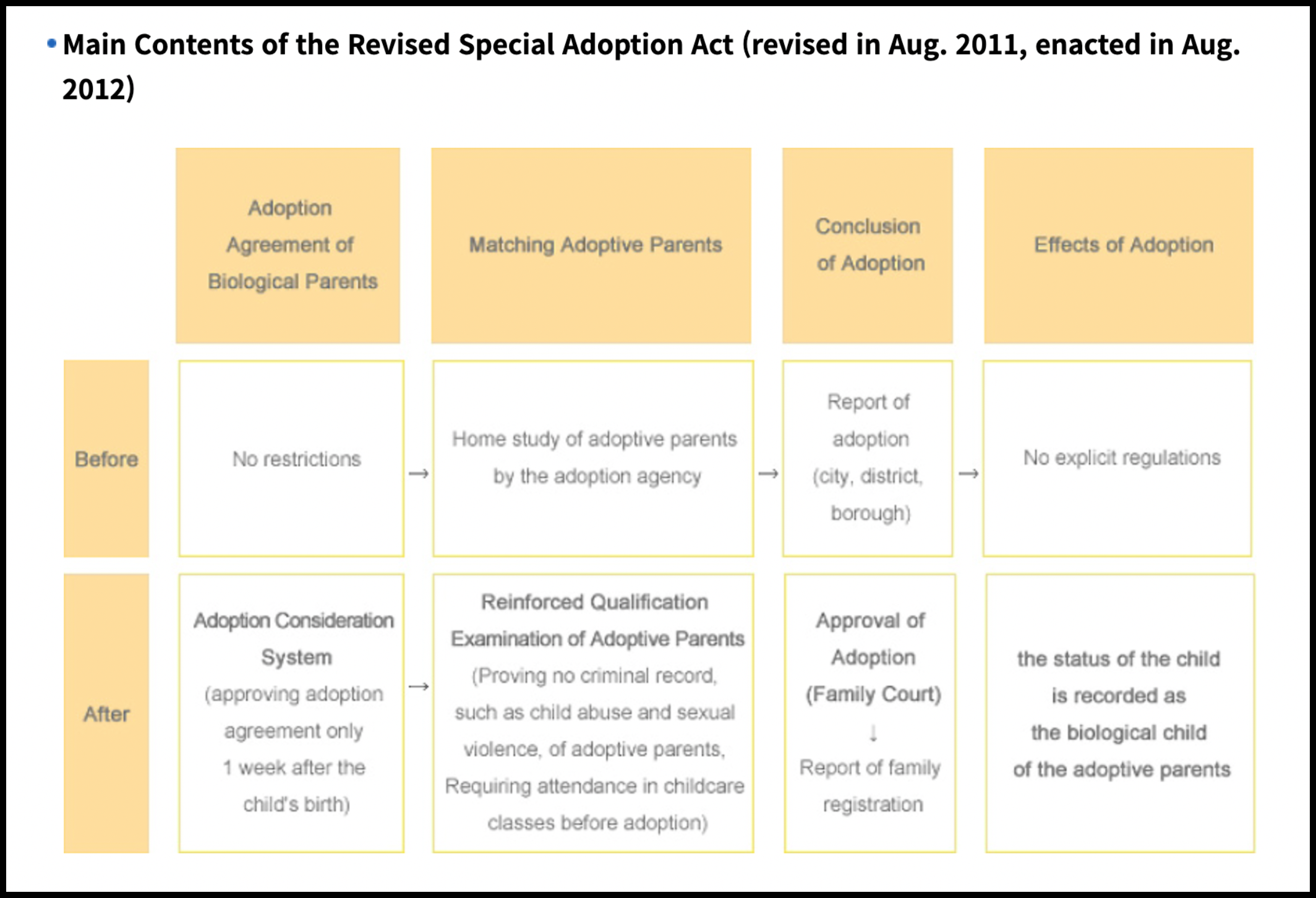
Implementation of Family Court Approval System: Reinforcing national responsibility and making adoption procedures strict by having the court determine the final completion of adoption
Implementation of Adoption Consideration System of Biological Parents: Providing a week of consideration period for biological parents after the child's birth to preferentially consider the natural family protection for the benefits of the child
Reinforcement of Qualification of Adoptive Parents: Those with criminal records, such as child abuse, family violence, sexual violence or drug addiction(e.g. alcohol), are prohibited from being adoptive parents, and those who will be adoptive parents must attend classes offered by adoption agencies before adoption
Giving the status of Parental Adopted Child: The adoptee approved by the court is given a legal position equal to a biological child by the civil law, reinforcing the legal status of adoptees
System to Promote Domestic Adoption First: Promotion of domestic adoption in order to encourage domestic adoption
Support of Family Search: Guaranteeing the claim of adoption information disclosure for adoptees
(Procedure) Apply to authorized adoption agency or Korea Adoption Services → Receive agreement of biological parents on disclosure of adoption information → Disclose adoption information
Establishment of Korea Adoption Services: Key organization for promotion of domestic adoption and rendering of post-adoption services
Signed the Hague Adoption Convention
On May 24th, 2013, the Minister of Health and Welfare signed the Hague Adoption Convention in the Netherlands. The signing ceremony took place in the Netherlands Prime Minister's office (Binnenhof).
It was determined that Korea had secured legal and institutional grounds to join the convention as the adoption system changed fundamentally by extensively revising the Special Adoption Act and the civil law. Thus, to declare the Korean government's commitment to the international society, the signing of the convention was carried out as a major project of the new government
+++
The information below is now mostly outdated / moot. The screenshot below is also VERY imperfect, since a technical glitch caused some sections to “skip”.
*However, since the two screenshots we have of this old KAS page were taken at different times, there is some information below (specifically, some graphics) which are NOT in the screenshot above. This is likely due to KAS’ editing of the page over time.
+
When NCRC recently updated the old KAS site (in looks, not in function), they appear to have deleted the old "History of Adoption in Korea" page. I have manually searched the NOTICES board in English, and someone else has searched the Korean KAS Notices board, but the old "History of Adoption in Korea" page is not there.
I have a partial screenshot from the old site which I have posted below, but it is not perfect, due to screencapture glitches.
Does anyone have a better screenshot of this page from the former KAS site? If no one does, then the entire page is basically lost to history.
This is the NEW KAS website, through which Korean Adoptees must submit their Petition for Adoption Information Disclosure requests to NCRC:
https://www.kadoption.or.kr/home/eng/main.do
We have a PARTIAL screenshot of one of these now MISSING pages from the old KAS website.
Below is our partial screenshot of the “History of Adoption in Korea” page from the old KAS website.
Please let us know if you have screenshots of other important now MISSING KAS website pages — so that we can share them with the community!
If you have a screenshot of this old KAS page, please email us at: paperslipadoptee@gmail.com
Download a PDF of the partial (and imperfect) screenshot below:
History of Korean Adoption_Screencapture Errors Noted.pdf
Please see our editable text reconstruction based on the partial / imperfect screencapture below, below the screencapture.
Please note that we have been able to recover SOME missing text from various sources outside the screenshot below. The editable text section below this screenshot contains MORE information than the screenshot below or the PDF above.

We apologize for having to watermark this screenshot (even though it’s partial and imperfect). We have experienced FAR TOO MANY issues with others utterly failing to credit our work here on Paperslip.
+
Below we have reconstructed the text of the “History of Adoption in Korea” page from the old KAS website as best we could, based on the partial / imperfect screencapture from the old KAS website above.
We have noted where Screencapture Errors interrupted the text.
In cases where we were able to reconstruct the text from separate notes, we have indicated such.
+
History of Adoption in Korea
Chapter 1. The Korean War and the Beginning of intercountry adoption
The Establishment of Institutions
January 1954 Founded 'Child Placement Service'
1955 Organized 'Catholic Relief Service', 'The Seventh-Day Adventist Church Education Association'
October 1956 Founded 'Holt Adoption Program'
1957 Founded 'International Social Services'
Annual No. of Adoptee
1954 Over 10 (President Rhee Syngman's order to deal with emigration procedures in a short period)
1955 59
1956 617
1957 486 (abolition of the refugee protection law in the U.S.)
Distribution of Adoptees
1958-1960 2,388 mixed-race children out of 2,700 intercountry adoptees
1955~1961 4,155 out of 4,185 mixed-race children were adopted to the U.S.
→ Most intercountry adoptions in the 1950s were mixed-race children adopted to the U.S.
(Text from the original KAS website lost here due to screencapture error)
+
Please note that there was a screencapture error here which interrupted the text from the original KAS website, so the text above may not be complete. Please refer to the full screencapture above to completely understand what we mean.
+
(Text from the original KAS website lost here due to screencapture error)
The Beginning of Intercountry Adoption
The adoption procedures of 12 adoptees who left Korea with Holt in 1955 were carried out through Child Placement Service (Holt Adoption Program began its own intercountry adoption procedures since June 1956, but Child Placement Service took charge before then).
Harry Holt's departure with the children was recorded and aired on many TV and radio channels in the U.S.
Chapter 2. Child Protection Efforts in the Era of Military Dictatorship
Trend of Domestic and Intercountry Adoption
Domestic adoption was relatively booming while intercountry adoption was stagnant → The government enacted and revised relevant laws while introducing a variety of polices, as a way to promote domestic adoption
4,206 children out of 11,841 adoptees were domestic adoptees in the previous 10 years, totalling 36.63%
The number of domestic adoption ended up exceeding that of intercountry adoption by the mid-1960s
Major Events
February 1961 Prepared legal grounds for intercountry adoption and enacted Act on Special Cases Concerning Orphan Adoption
1961 Built accommodations for 300 orphans in Nokbeon-dong, Seoul (Holt Children's Services)
1962 Conducted a campaign, Foster One Orphan per Family
1964 Established Korea Social Service
(Text from the original KAS website lost here due to screencapture error)
+
Please note that there was a screencapture error here which interrupted the text from the original KAS website, so the text above may not be complete. Please refer to the full screencapture above to completely understand what we mean.
+
(Text from the original KAS website lost here due to screencapture error)
…number of trials and errors. However, it created the momentum to revive the significance of foster care, later serving as a catalyst that would vitalize a temporary foster care project before adoption.
Furthermore, the government enacted and revised adoption-related laws and policies that gave priority to domestic adoption, which in turn discouraged intercountry adoption. As a result, by the mid-1960s, the number of domestic adoption ended up exceeding intercountry adoptions.
The Establishment of Korea Social Service
Baek Geun-chil, the second president of Child Placement Service, established Korea Social Service in 1964 and carried out consulting service, adoption service, and sponsorship projects for mixed-race children, war orphans, children from low-income families, children from broken families, and phsically- or mentally-challenged children in Korea.
Korea Social Service developed a variety of services for child welfare by systematizing child welfare projects to provide healthy homes for children who did not have homes or could not be fostered by their parents.
The Enactment of Act on Special Cases Concerning Orphan Adoption
The Act on Special Cases Concerning Orphan Adoption was enacted in 1961 to protect adopted orphans and children with special needs. The Act provided legal standards for intercountry adoption of children with special needs and the purpose (Article 1) was 'to seek enhancement of welfare for orphans by providing simple measures for foreigners to adopt Korean orphans.'
Then, there were many adverse effects coming from private adoptions, due to lack of organizations or policies responsible for intercountry adoption. In 1966, the government made it a rule to enable only authorized organizations to carry out intercountry adoptions.
The government also introduced a number of laws related to child welfare, such as Law Concerning the Duties of Guardians for Orphans and Child Welfare Law.
* International Social Services (ISS)
The International Social Services is an international organization with its headquarters located in Geneva, Switzerland. and it was authorized by the Korean government in 1957 to carry out activities related to intercountry adoption.
There are three branches worldwide, and the Korean branch withdrew from Korea in 1967 due to operational problems, handing over all relevant duties to Child Placement Service.
The ISS mostly took care of intercountry adoption, settlement of refugees, international marriages, family counseling, adoption problems, mediation and solutions.”
(Text from the original KAS website lost here due to screencapture error but the BLUE text was recovered from our own page about ISS, where we had previously copied information from the old KAS website: International Social Service (ISS))
(Text from the original KAS website lost here due to screencapture error)
+
Please note that there was a screencapture error here which interrupted the text from the original KAS website, so the text above may not be complete. Please refer to the full screencapture above to completely understand what we mean.
+
(Text from the original KAS website lost here due to screencapture error)
Major Events
1970 Temporarily suspend adoption to Northern European countries
1972 Korea a Christian Crusade (Eastern Social Welfare Society) began adoption services
1976 Established Eastern Child Welfare Society, abolished Act on Special Cases Concerning Orphan Adoption, and enacted
Act on Special Cases Concerning Adoption
Planned to suspend intercountry adoption from 1985
Developed a 5-year plan of adoption projects
Implemented an intercountry adoption quota system
Current Status of Adoption Agencies
<According to Year of Establishment>
Social Welfare Society
1954 Established Child Placement Service
1961 Changed its Korean name, but kept its English name
1971 Changed its name into Social Welfare Society
Holt Children's Services
1956 Established Holt Adoption Program
1972 Changed its name into Holt Children's Services
Korea Social Service
1964 Established Korea Social Service
Eastern Social Welfare Society
1971 Established a Christian Crusade in Korea
1972 Started adoption services
1976 Established Eastern Child Welfare Society
1997 Changed its name into Eastern Social Welfare Society
(Text from the original KAS website lost here due to screencapture error — however the last two text lines above have been recovered from separate private notes)
(Text from the original KAS website lost here due to screencapture error)
The screenshot below was recovered from this source:
Power, Resistance, and Subjectivity: An Exploration of Overseas Korean Adoptees in Korea by Andrea Cavicchi (page 62).
The author originally screenshot the image from roughly this section of the former “History of Adoption in Korea” page on the old KAS website. This graphic was found via keyword search on Google. Please let us know if you find additional information from the old KAS “History of Adoption in Korea” page, and we will include it here.
+
Please note that there was a screencapture error here which interrupted the text from the original KAS website, so the text above may not be complete. Please refer to the full screencapture above to completely understand what we mean.
+
(Text from the original KAS website lost here due to screencapture error)
7,275 children were adopted overseas in the 1960s, which soared by 6.6 times to 48,247 in the 1970s and by 8.9 times to 65,321 in the 1980s. As the success of the economic development plan that had started from 1962 achieved economic growth, aid from foreign private organizations gradually decreased. As a result, it was insufficient to cover the child welfare budget, which had depended on overseas aids, with domestic support. The government presented an outline for child welfare reform in 1972 and reformed child welfare facilities accordingly. Therefore, the number of child welfare facilities, such as childcare centers, dropped in the mid-1970s, leading to a greater number of children with special needs in intercountry adoption…
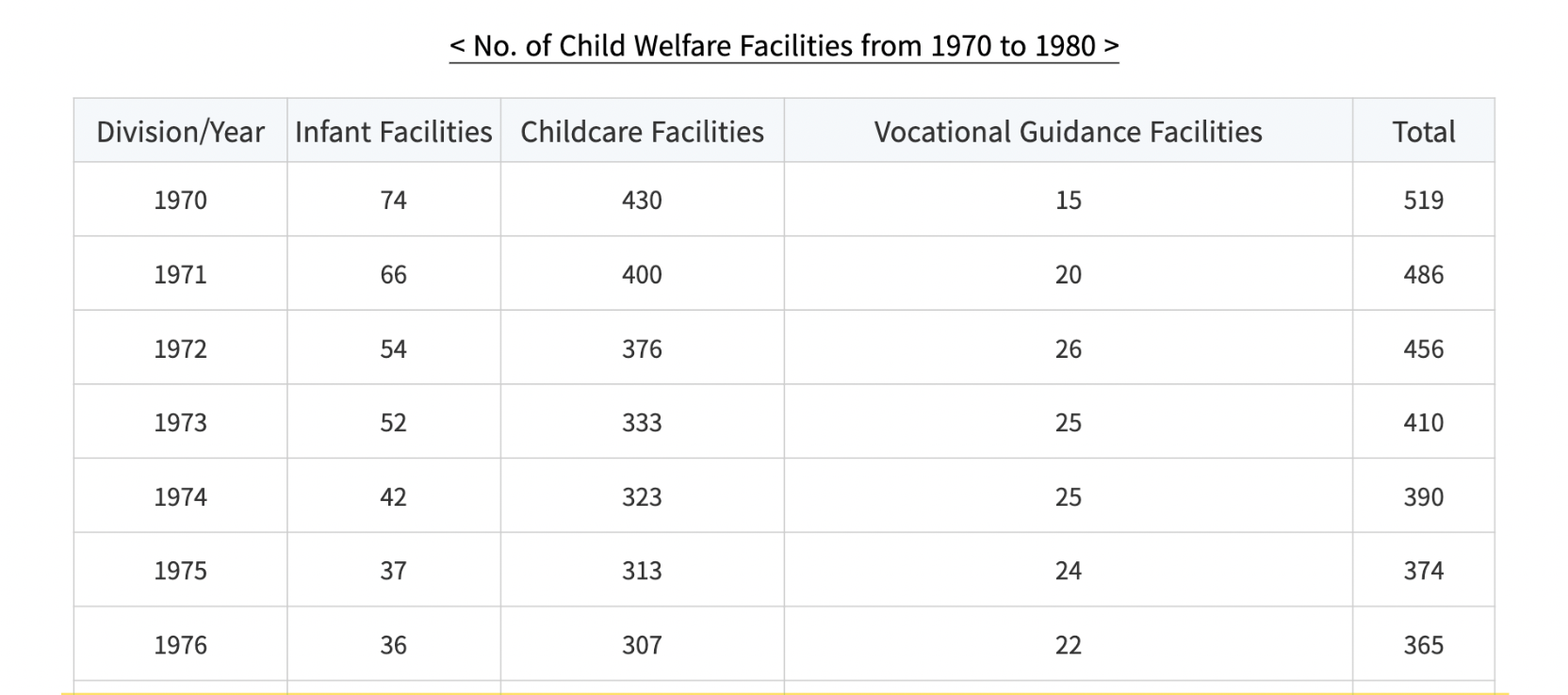
(Text from graph from the original KAS website lost here due to screencapture error)
+
Please note that there was a screencapture error here which interrupted the text from the original KAS website, so the text above may not be complete. Please refer to the full screencapture above to completely understand what we mean.
+
(Text from the original KAS website lost here due to screencapture error)
…the Act on Special Cases Concerning Adoption in 1976 to correct the flaws of The Act on Special Cases
Concerning Orphan Adoption and simplify the procedures for domestic and intercounty adoption of children accommodated in protective facilities, attempting to encourage domestic adoption rather than intercountry adoption. The government also imposed a duty on each intercounty adoption agency to fulfill a quota of domestic adoptions, and introduced a new system of allocating intercountry adoptions according to the number of domestic adoptions, as a way to encourage domestic adoption. The move was aimed at a complet banning on intercountry adoption by 1985, by increasing domestic adoption 10% annually while reducing intercountry adoption 10%, but to little avail.
In 1985, the government established the 5-year plan of adoption and foster care for children with special needs, aiming to stop intercountry adoption. According to the plan, the government founded adoption and counseling agencies, which would carry out the duties of identifying, enlightening, counseling and encouraging prospective adoptive parents. However, ambiguous regulations on duties and standards of establishment, which adoption agencies must fulfill, and performance-oriented adoption projects, hiring amateurs, resulted in lack of professionalism, which in turn probably reinforced the public's negative perception on adoption.
Chapter 3. A Leap into Professional Adoption Projects and Child Services
Trend of Domestic and Intercountry Adoption
-The number of adopted children fluctuated according to the government's adoption policy, but overall the number reached 91,000 in the 1980s with the annual average of 9,182 adopted domestically and abroad The number of domestic adoptions was approximately 26,000 (28.86%) and the annual average was 2,650 (81~90)
The number of international adoptions was approximately 65,000 (71.14%) and the annual average was 6,532 ('81-'90)
instruction to refrain from carrying out intercountry adoption around the 1986 Seoul Asian Games and the 1988 Seoul Olympic Games, considering international attention to this issue.
These measures by the government did not fully regulate international adoption, but were rather implemented occasionally when they might give a negative perception overseas.
Hosting the Olympic Games and the Change of the Adoption Policy
With the 1988 Seoul Olympic Games, many countries around the world started to show interest in Korea. In the meantime, the foreign press focused on the increasing number of children adopted overseas and the continued overseas adoption despite Korea's eye-opening economic growth and the hosting of the Olympic Games. They pointed out that Korea was "the world's top orphan exporter," criticizing that Korean children given up by single mothers made up 60% of foreign children sent to the U.S. in the form of adoption, the number of which exceeded 6,000 a year.
Influenced by the foreign press, the media in Korea started to raise the issue of intercountry adoption, which increased social attention. Accordingly, the government decided to encourage domestic adoption by establishing the Adoption Project Improvement Guideline in June 1989. According to the guideline, the government intended to reduce intercountry adoption every year and eventually ban it with the exception of mixed-race children or disabled children by 1996. But this plan was withdrawn in 1995 due to lack of domestic adoption.
The Establishment of Domestic Adoption Agency, Holy Family Child Adoption Center
Holy Family Child Adoption Center is an agency exclusively for domestic adoption established on May 11th, 1989, after the 24th Olympic Games in Seoul in 1988, as a project of the International Eucharistic Congress with the belief that Korean children must be raised by Korean. While the four previous adoption agencies were launched with the purpose of overseas adoption, this agency has great significance in that it was launched as an exclusive domestic adoption agency.
(Text from the original KAS website lost here due to screencapture error)
+
Please note that there was a screencapture error here which interrupted the text from the original KAS website, so the text above may not be complete. Please refer to the full screencapture above to completely understand what we mean.
+
(Text from the original KAS website lost here due to screencapture error. CHAPTER 4 IS ENTIRELY MISSING).
Chapter 5. The Establishment and Activities of Organizations for Adoptees and Adoptive Parents
(Text from the original KAS website lost here due to screencapture error)
1996 Domestic adoption rose while intercountry adoption naturally fell
End of intercounty adoption except disabled children and mixed-race children
1997 Planned to lower intercountry adoption annually, making it harder to get intercountry adoption permission and establishing The Overseas Koreans Foundation
1998 Postponed the attempt to make it harder to get intercounty adoption permission, helping applicants to get intercounty
adoption permission more easily, enacting enforcement ordinance and regulations on Act on Special Cases Concerning
Adoption Promotion and Procedures, seeking ways to boost adoption of disabled children (after the IMF's bail-out of the
Korean economy), and establishing Global Overseas Adoptees' Link
1999 Established International Korean Adoptee Service (InKAS)
Established Global Adoption Information and Post Services
Established Mission to Promote Adoption in Korea
The Enactment of Act on Special Cases Concerning Adoption Promotion and Procedures
In May 1995, the revised Act on Special Cases Concerning Adoption Promotion and Procedures was enacted by correcting the flaws in the Act on Special Cases Concerning Adoption. For instance, the revised law was aimed at eliminating obstacles to domestic adoption and making post-adoption services for intercountry adoption compulsory. The government also provided adoptive families with housing loans, medical expenses, educational costs, and living expenses. However, with the tradition of valuing blood ties and the reality of keeping adoption secret, the financial support for adoptive families did not act to vitalize domestic adoption. Consequently, with a new plan to accept intercountry adoption as an alternative for domestic adoption, the policy to stop intercounty adoption was withdrawn in August 1995.
IMF and Adoption
As Korea suffered a financial crisis in 1998 and was put under the supervision of IMF, children with special needs increased by 40% within a year, reaching 9,000 children. Most of them were from not only out-of-Service (InKAS).
Moreover, with the national awareness of Korea's long history of intercountry adoption as well as the changing public opinion on domestic adoption, Mission to Promote Adoption in Korea was established by domestic adoptive families to promote and enhance domestic adoption and change the public perception on adoption. In July 1999, Adoption Information Center was established to provide integrated and professional post-adoption services for domestic and overseas adoptees.
Chapter 6. The Enactment of National Adoption Day and Improvement of Domestic Adoption Culture
Trend of Domestic and Intercountry Adoption
Promoted adoption of disabled children by increasing support of child-rearing expenses and medical bills for families adopting disabled children
The Minster of Health and Welfare announced at the National Assembly's inspection of state administration as well as in interviews with the press that intercountry adoption will be completely banned in 2010 Introduced a plan to promote domestic adoption first: Intercounty adoption is allowed only if children fail to be adopted within five months after permission of domestic adoption
Major Events
2002 Established non-profit private organization KoRoot
2005 Enacted National Adoption Day
Partially revised the enforcement ordinance of Act on Special Cases Concerning Adoption Promotion and Procedures
2006 Presented comprehensive countermeasures to promote domestic adoption
Enhancing institutional and financial support for adoptive families
Reinforcing national promotion activities to improve the public perception
Establishing systems to provide efficient post-adoption services
Main Contents
Institutional Support
Implemented Adoption Holiday System, such as maternity leave, for psychological adjustment of adoptees and adoptive parents from 2007, starting with public workers (agreed by the Ministry of Security and Public Administration)
Adoption agencies implemented a plan to promote domestic adoption first for five months after the child was decided to be adopted (2007)
Established and managed Integrated Management System of Children for Adoption, providing comprehensive information on adoptees for families hoping to adopt
Relieved qualifications for adoption: Single and unmarried people were permitted to adopt, the age gap between adoptive parents and children was narrowed from 50 to 60 years, and the regulation limiting the number of children of adoptive parents (currently no more than five) was scheduled to be eliminated
Promoted a plan to include adoptive families of disabled children in the beneficiaries of special provision of national housing in order to stabilize housing for the families (the Ministry of Construction and Transportation)
Improvement of Adoption Culture
Promoted a plan to improve adoption culture by eliminating prejudice, encouraging open adoption, and promoting Education) for adopted children
Reinforcement of Post-Adoption Services
Established a comprehensive support system to find adoptees' roots
Established Homes for Adoptees, which provides all kinds of information, such as information about Korean culture and jobs, as well as long-term or short-term accommodations, for intercountry adoptees while they stay in Korea
Expanded services for intercountry adoptees, such as Korean language education, Korean culture experiences, and employment counseling services
Domestic Adoption Vitalization Effort 2 - The Enactment of National Adoption Day in 2005
To establish a healthy adoption culture and promote domestic adoption, the Ministry of Health and Welfare designated May 11th as the National Adoption Day, indicating that one family (1) adopts one child (1) in the Family Month of May to become a new healthy family (1+1). The week starting from the National Adoption Day was designated as Adoption Week. The government and local organizations have been carrying out appropriate events, starting in 2006. The government, adoption agencies and organizations are carrying out projects of adoption policy establishment, adoption survey and research, post-adoption management, adoption and family support, and education and promotion of adoption to encourage adoption of children with special needs and enable smooth adjustment of family life after adoption. They are also supporting the emotions of adoptive families by providing adoptive family gatherings, camps and contests, while also promoting adoption through broadcast, newspaper, internet and pamphlets.
Chapter 7. 2011-2013 / Revised Act on Special Cases Concerning Adoption and Signed the Hague (Convention)…
(Text from the original KAS website lost here due to screencapture error)
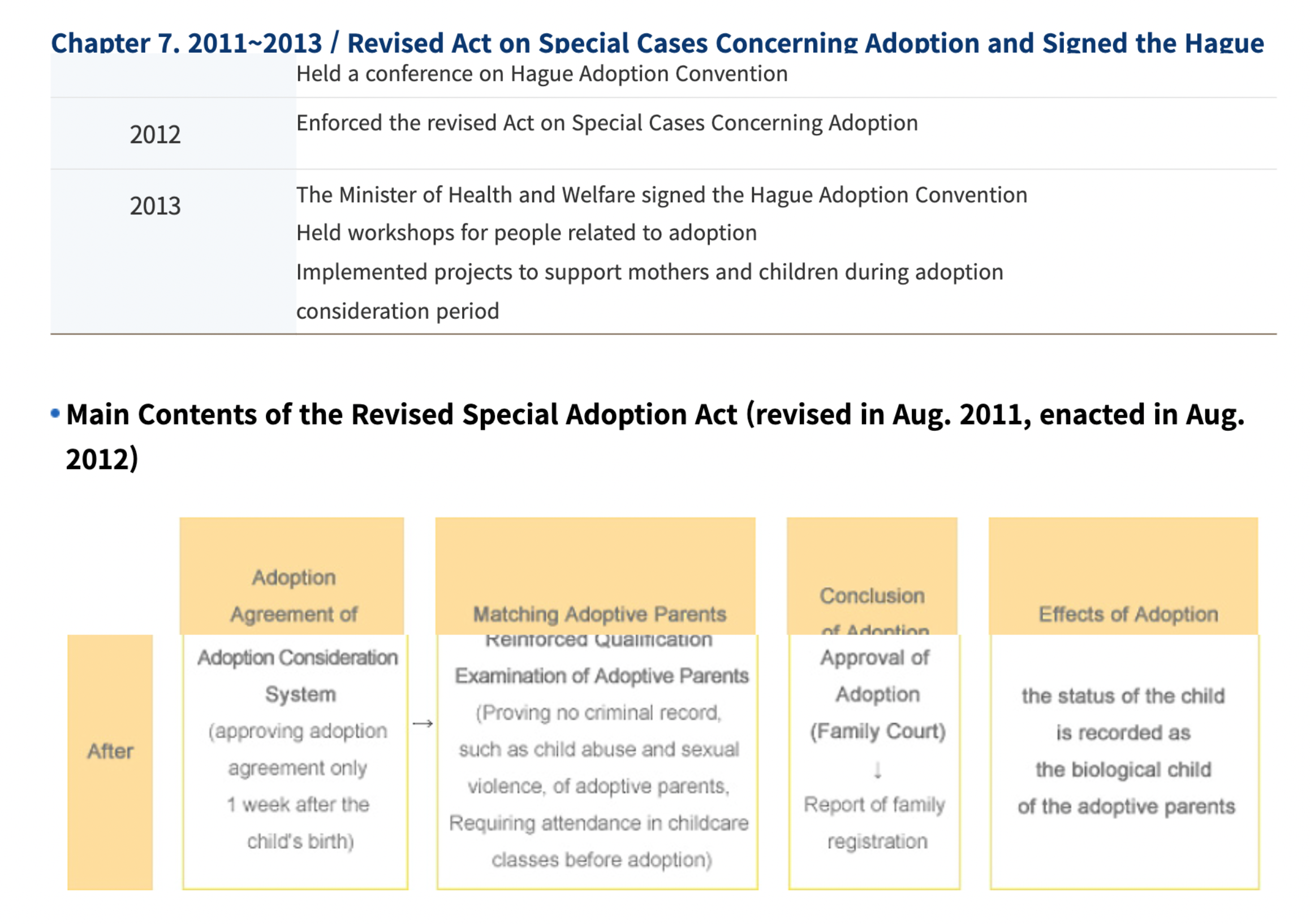
Note: We are not certain, but text saying “2011” may have been cut off by a minor screen capture error in the graphic above.
Implementation of Family Court Approval System: Reinforcing national responsibility and making adoption procedures strict by having the court determine the final completion of adoption
Implementation of Adoption Consideration System of Biological Parents: Providing a week of consideration period for biological parents after the child's birth to preferentially consider the natural family protection for the benefits of the child
Reinforcement of Qualification of Adoptive Parents: Those with criminal records, such as child abuse, family violence, sexual violence or drug addiction(e.g. alcohol), are prohibited from being adoptive parents, and those who will be adoptive parents must attend classes offered by adoption agencies before adoption
Giving the status of Parental Adopted Child: The adoptee approved by the court is given a legal position equal to a biological child by the civil law, reinforcing the legal status of adoptees
System to Promote Domestic Adoption First: Promotion of domestic adoption in order to encourage domestic adoption
Support of Family Search: Guaranteeing the claim of adoption information disclosure for adoptees
(Procedure) Apply to authorized adoption agency or Korea Adoption Services → Receive agreement of biological parents on disclosure of adoption information → Disclose adoption information
+
Please note that there was a screencapture error here which interrupted the REST of the text from the original KAS website, so the text above IS NOT COMPLETE. Please refer to the full screencapture above to completely understand what we mean.