
Pressian: “My husband is a Danish adoptee who was sent for adoption without his biological mother’s knowledge.”
Paperslip Note:
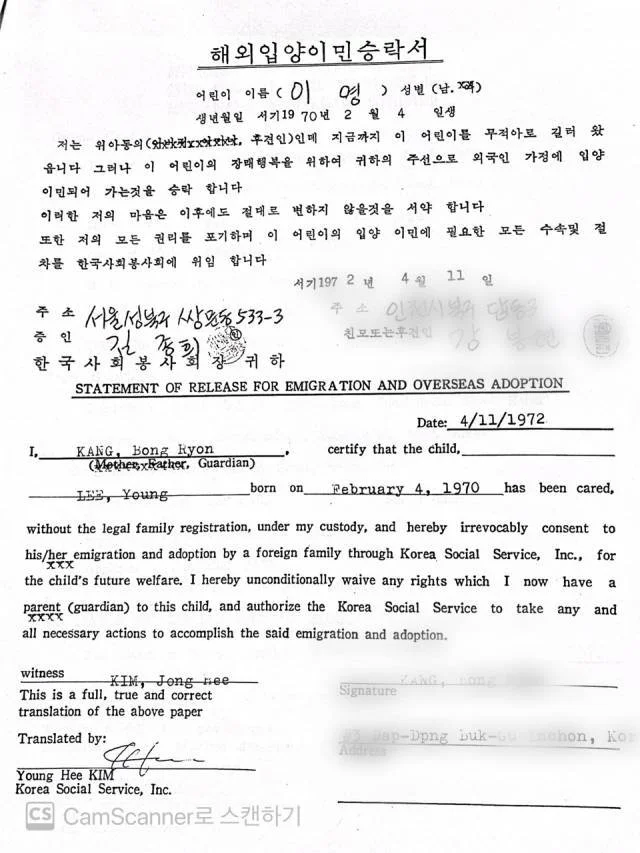
We located this Korean “Pressian” article from January 23rd, 2023 while searching online for examples of the KSS document titled:
“해외입양이민승락서” / “Consent for Overseas Adoption and Immigration”.
We thought it was important to share the article below as it relates to KSS twins (in this case, KSS twin brothers who were adopted together to Denmark) and because it shows how KSS used the specific form linked above in its overseas adoption process.
Please see related:
We have updated our Illustrated Catalog of Known KSS Documents with the “해외입양이민승락서” / “Consent for Overseas Adoption and Immigration” form.
Illustrated Catalog of Known KSS Documents
+
Pressian Article via Daum News:
“My husband is a Danish adoptee who was sent for adoption without his biological mother’s knowledge.”
Originally published in Korea on January 23rd, 2023.
Posted to Paperslip on April 17th, 2026.
Translation via ChatGPT.
Bolds and blue highlighting ours.
Please see original article above for images.
“My husband is a Danish adoptee who was sent for adoption without his biological mother’s knowledge.”
Entered: January 23, 2023, 09:19
[Finding the Truth of 372 Overseas Adoptees] ⑫ A poorly managed adoption system revealed through adoption documents
[Hwang Mi-jeong, spouse of an overseas adoptee]
“I first met my husband in the summer of 2003. That year, the Global Overseas Korean Adoptees Gathering was held in Korea.
My husband is a Danish adoptee. An acquaintance from Denmark came to attend the gathering, and I went to the meeting place briefly to say hello. There, my husband and his twin brother were meeting and talking with my acquaintance and their biological mother. That was how I first met my husband.
My husband and his mother were facing each other, tightly holding hands. I could see that they wanted to ask and answer so many things—how they had been, how they lived, whether he was married, what life in Denmark was like.
But because communication between them was difficult, I could see that they were sharing so much through their eyes and their hands. After such a long time of longing, they held each other’s hands tightly, gently stroking them, as if exchanging greetings with their eyes.
After that, I began a long-distance relationship with my husband. I would often meet his biological mother in Korea and call him. Every time they spoke, they would ask about each other, miss each other, and feel deep pain—it was heartbreaking to witness.
She would always say:
“Be very good to your parents there. I am not even a parent… I sent you away without even knowing, and I searched everywhere for you. Even when I contacted the adoption agency and begged them to return my children, they firmly told me that once a child has left, they can never come back to Korea. All I could do was cry. I am so, so sorry. I am a sinner, my son.”
It was always like that—every time, pain, sorrow, and calling herself a sinner.
His Korean mother had been a single mother. After giving birth to twins, she was abandoned by the man—who she hadn’t even known already had a wife. She struggled every day to raise the two children. At a young age, she had no choice but to give up going to college. She left the children with neighbors and worked day and night in various jobs to support them.
One day, after finishing work and returning home, she found that the children were no longer at the neighbor’s house. The neighbor told her that someone claiming to be the children’s maternal grandmother had come and taken them.
Shocked, she dropped everything, went to the bus terminal, and traveled to her family home. She told them she would raise the children herself and asked them to take care of them just for a short while, then returned to Seoul. As time passed, she worked to create a stable environment to raise them and went back to her family home—but by then, the children had already been sent abroad for adoption.
At the time, her parents could not accept the stigma of having an unmarried daughter with children. Without the biological mother’s consent, my husband and his twin were sent to an adoption agency through an acquaintance.
How could such an absurd thing have been possible? How could children be sent to adoption agencies and adopted overseas without their parent’s consent?
One of the adoption documents, the “Consent to Overseas Adoption and Emigration,” states that my husband was treated as a child without legal guardians and entrusted to a guardian. This guardian then consented to his adoption abroad, arranged by an adoption agency, for the sake of the child’s future happiness. How could this be acceptable?
His biological mother was alive, yet someone else—not her—gave consent for the adoption. This is something that should never happen. It is clearly document falsification.
Among the adoption documents is an English family registry, newly created for adoption purposes, listing both mother and father as “unknown,” effectively making it an “orphan registry.”
Another document shows that a guardian—not the biological mother—consented to the overseas adoption.
There is also a certificate of orphan status, issued by the head of the adoption agency, declaring him an “orphan.”
Overseas adoption began in the 1950s to address the issue of war orphans. Until the 1970s, it was used as a means to reduce social costs related to single mothers and child welfare institutions. In the 1980s, when overseas adoption peaked, more than 1% of all newborns were sent abroad for adoption. It was even regarded as a form of private diplomacy. At the time, the adoption fee for one Korean child was about $3,000—over 2 million won—equivalent to an average annual salary.
My husband has also applied for an investigation by the Truth and Reconciliation Commission into human rights violations in the overseas adoption process. His case has been accepted for investigation and is currently under review.
Since the 1970s, Korea has achieved remarkable development and become a country recognized worldwide. Yet even now, children are still being sent abroad for adoption. How long must we continue to be a country that “exports” its children? This kind of pain must not continue.
Last September, 283 overseas adoptees filed petitions with the Truth and Reconciliation Commission requesting investigations into whether their human rights were violated at the time of their adoption. With three additional rounds of submissions, the number grew to 372. They are requesting an investigation into whether human rights violations occurred in the adoption process of those sent from Korea to Denmark and other countries between the 1970s and early 1990s, and whether government authority was involved. Fortunately, on December 8, the Commission announced that it had decided to begin investigating the “human rights violations in overseas adoption cases.” This marks the first government-level investigation decision in the 68 years since Korea began overseas adoptions. Pressian will continue to publish writings from overseas adoptees who have requested investigations. (Editor’s note)”
[Hwang Mi-jeong, spouse of an overseas adoptee]