
Decoding the KSS Adoption File: A Deep Dive into Its Structure and Three Core KSS Numbering Systems Using the ACQUIRE / COOK / DELIVER Analogy.
Please Note:
This page as well as the other original content on Paperslip.org is subject to official COPYRIGHT. You may not reproduce our content, nor share our content without attribution to Paperslip.org. You may not reproduce our content as “your own”. You may not reproduce our research and publish it as “your own”.
Thank you.
+
Above: AI image generated by Paperslip.org.
PREFACE:
In order for me to understand and be able to explain the structure of a KSS file folder and three of KSS’ major numbering systems (certainly more numbering systems exist than we currently understand), it has taken me over 8 years of time, multiple trips to Korea and to KSS to fight for information, thousands of dollars, tens of thousands of hours of blood, sweat, and tears, and the life-changing discovery in KSS' file room in 2019 of evidence that I once had a twin sister who likely died before she could be adopted in the mid 1970s.
Please honor the inestimable cost of this extremely personal labor, and please do NOT plagiarize or reproduce the information on this or any other COPYRIGHTED page on Paperslip.org without our written permission.
You are welcome to share our links directly.
Thank you.
+
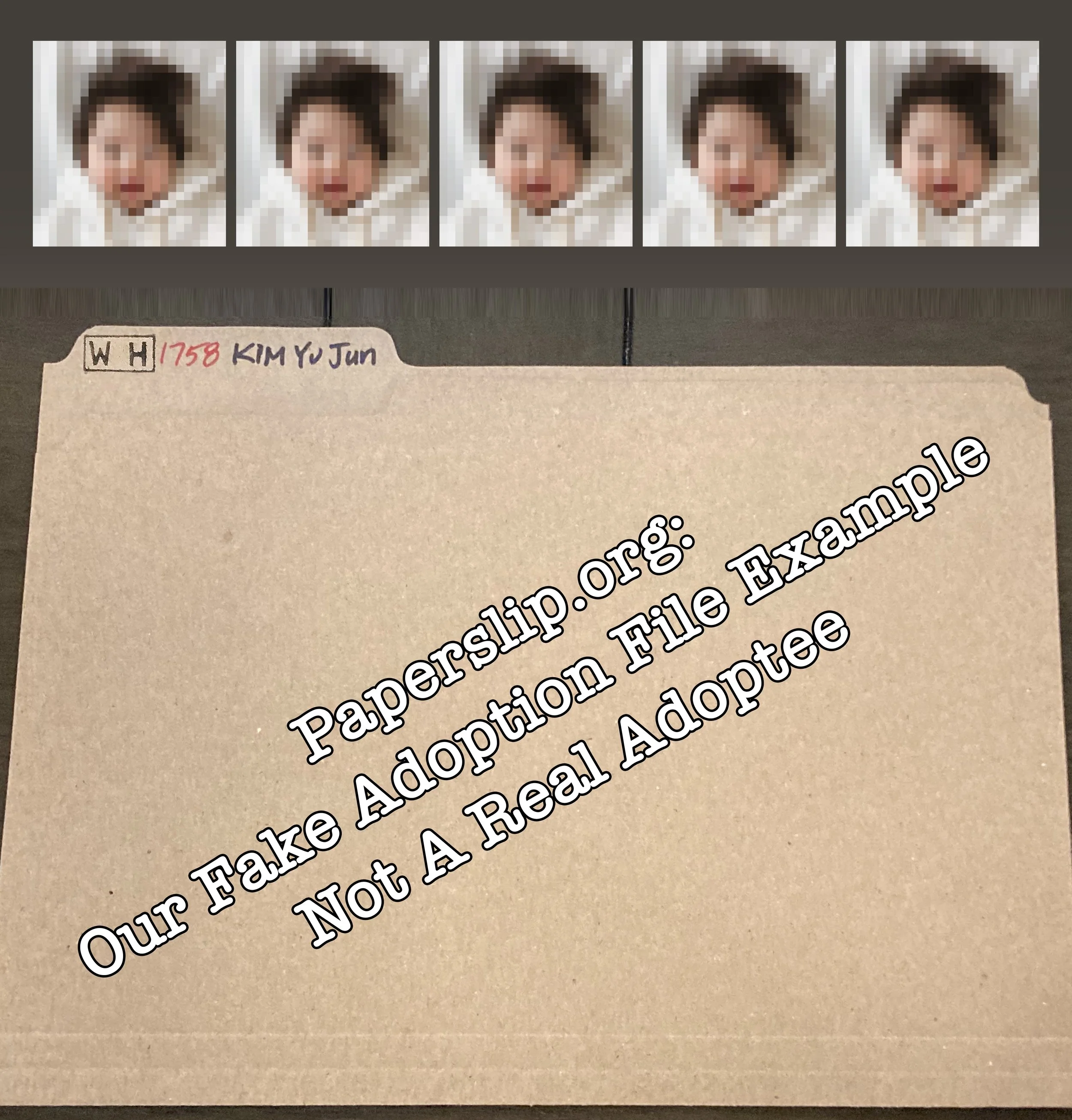
Above: To illustrate what a typical KSS Adoptee’s adoption file looks like, we created a FAKE KSS file folder for a FAKE KSS Adoptee named:
Fake Name:
KIM Yu Jun (Korean CAPITALIZES last names)
Fake Child Number: (We did not create one when we originally created the graphics, but let’s say it’s 7431)
Fake K-Number: K-1758
Fake File Number: 78-5379
(78 = 1978, the year that the child left Korea for adoption — which was sometimes but not always the same year the child was born).
*Please note that these numbers are just randomly made up, but reference the overall style of KSS Child Numbers, K-Numbers and File Numbers.
Every KSS Adoptee between 1964-2012 has a KSS file folder like this. These former KSS files are (as of this writing) stored at NCRC’s Temporary Storage Facility in Goyang, Gyeonggi-do.
In order to request your KSS file and / or a birth family search, you must submit a Petition for Adoption Information Disclosure request to NCRC via the KAS website.
Please CAREFULLY READ the FAQ sections related to NCRC below:
ALL ADOPTEES START HERE! FAQ + SITE NAVIGATION.
+
A KSS Adoption file and its related known numbering systems can be thought of with the following cooking analogy:
ACQUIRE the “ingredients”
(Child Number)
COOK the “ingredients”
(K-Number)
DELIVER the “final product”
(File Number)
In this analogy, the ingredients / final product are Korean children, who were processed through KSS for overseas adoption.
+
Important Background Information about KSS (Korea Social Service).
The K.S.S. Receiving Home in Seoul - The Old KSS Campus.
The photo below is of the K.S.S Receiving Home, the main building of KSS’ former main campus in Seoul.
KSS processed overseas adoptions to the US, Netherlands, Denmark and Switzerland between 1964-2012 through a specific list of Partner Western Adoption Agencies.
Until 2016 when KSS tore down its main campus, ALL KSS Adoptees’ files from 1964-2012 were presumably stored in the office(s) in KSS’ main building — the K.S.S. Receiving Home.
In 2016, KSS converted what appears to have been a storage building on the back edge of its property into what became KSS’ Post Adoption Services building. It was here that in 2016, KSS moved ALL KSS Adoptees’ files, dating from 1964-2012.
KSS Adoptees’ files remained in a storage room in KSS’ now PERMANENTLY CLOSED Post Adoption Services building from 2016 through July 19th, 2025, when ALL former Korean Adoption Agency files — including those of KSS — were transferred to NCRC’s Temporary Storage Facility in Goyang, Gyeonggi-do.
As of this writing, ALL former KSS Adoptees’ files are at NCRC’s Temporary Storage Facility in Goyang, Gyeonggi-do.
In order to request your KSS file and / or a birth family search, you must submit a Petition for Adoption Information Disclosure request to NCRC via the KAS website.
Please CAREFULLY READ the FAQ sections related to NCRC below:
ALL ADOPTEES START HERE! FAQ + SITE NAVIGATION.
For more detailed info about KSS’ old campus, please see:
The KSS Receiving Home in Seoul -The Old KSS Campus.
At various points, the K.S.S. Receiving Home, pictured below, also housed a nursery. Beginning in 1975, it was also home to the Han Hwa Children’s Medical Clinic, which was presumably a one or two room facility.
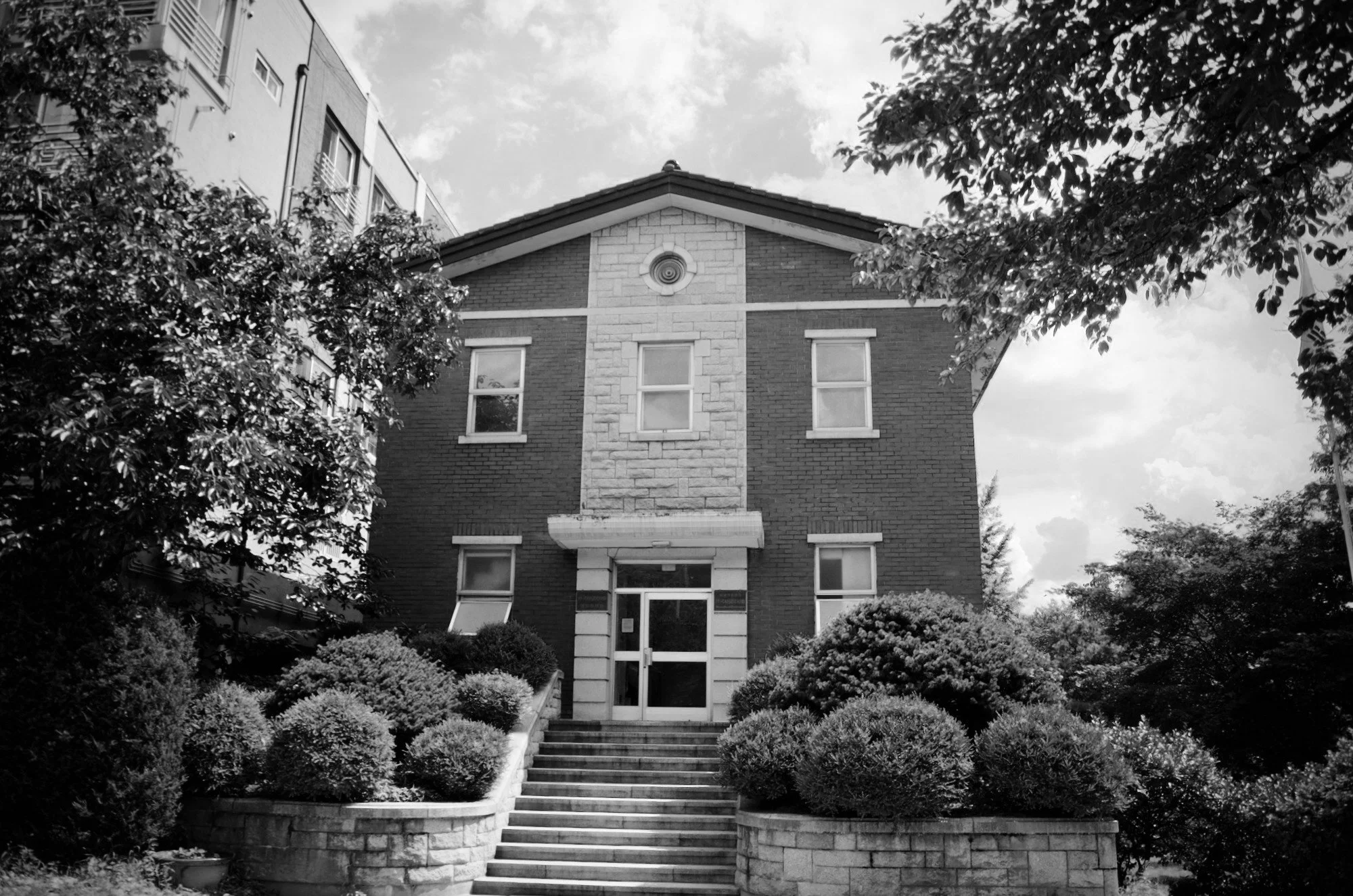
Above: The main building of KSS’ former campus in Seoul, which KSS tore down in 2016. This is what is often referred to as “The K.S.S. Receiving Home” in KSS Adoptees’ documents. Colloquially, the entirety of KSS’ campus may have been referred to by some as “The K.S.S. Receiving Home”. When people generally think of KSS, the building above may be what they are referencing. However, this main building was part of a larger campus which was torn down and sold for apartment development by KSS in 2016.
KSS was founded in 1964, though we are not sure of the exact date of the creation of KSS’ former campus in Seoul. KSS previously had an office building in Seoul at a different location, which pre-dated the one above. We know for certain that KSS’ former campus was built by the early 1970s. It was most likely built in the mid - late 1960s. From the time that KSS’ former campus in Seoul was built until 2016 when it was torn down, ALL KSS Adoptees’ files were stored in the building above.
KSS processed children for overseas adoption between 1964-2012. KSS tore down its former campus in 2016. KSS operated Post Adoption Services out of a small one story white building located on the back edge of KSS’ former campus from 2016 to July 19th, 2025. All former KSS Adoptees’ files are (as of this writing) now at NCRC’s Temporary Storage Facility in Goyang, Gyeonggi-do.
Following the destruction of KSS’ former campus in 2016, KSS moved ALL KSS Adoptee’s files to a small building at the back of the old campus, which may have been used as some kind of garden shed — we are uncertain. KSS appears to have converted this to its Post Adoption Services building in 2016. From 2016 until July 19th, 2025, when ALL former Korean Adoption Agency files — including those of KSS — were transferred to NCRC’s Temporary Storage Facility in Goyang, Gyeonggi-do, ALL KSS Adoptees’ files were stored at KSS’ now PERMANENTLY CLOSED Post Adoption Services building. As of this writing on July 11th, 2026, KSS’ former Post Adoption Services building still exists, but we do not know for how long this will be the case.
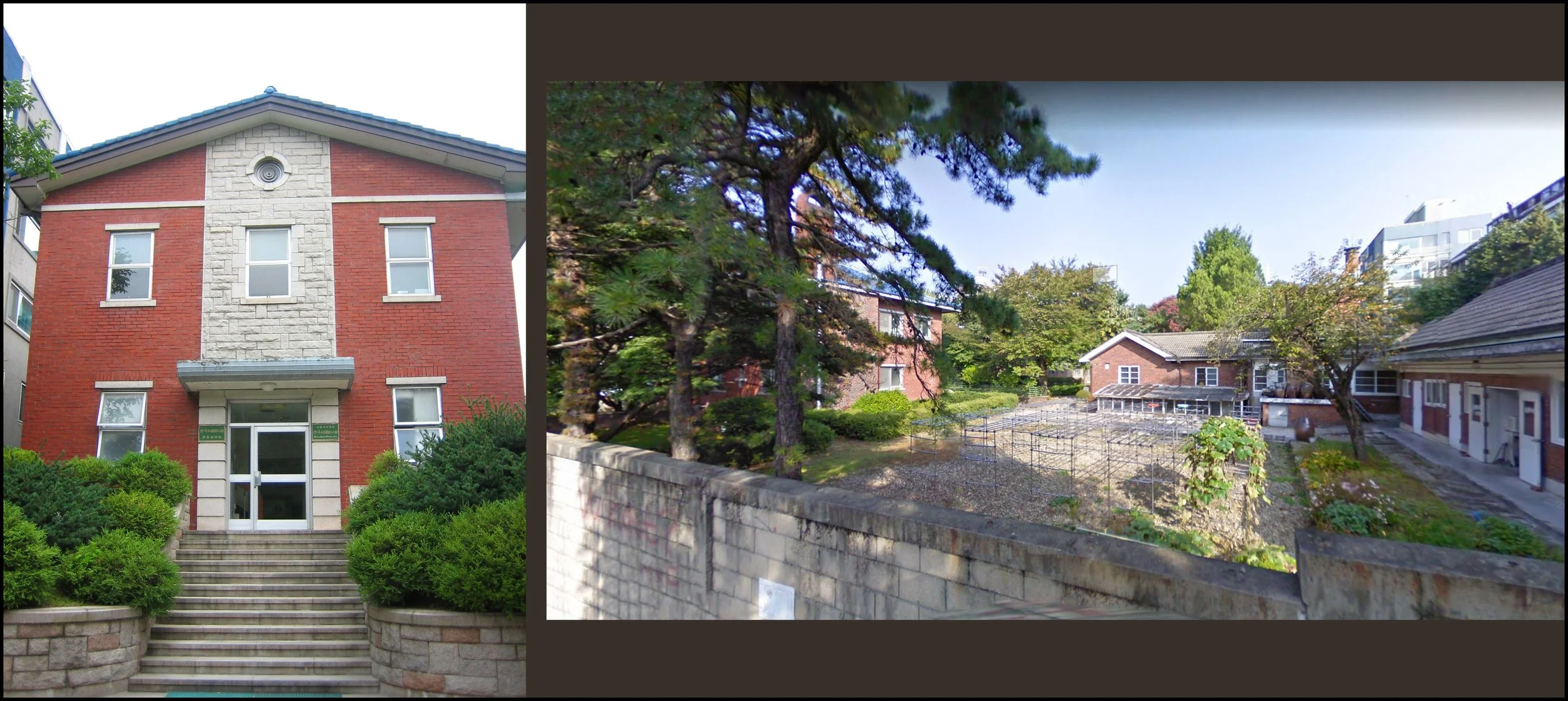
Above — LEFT: “The K.S.S. Receiving Home”.
Above — RIGHT: A view of KSS’ former campus in Seoul. This campus was torn down in 2016.
The image at upper right is from Google Maps’ time machine feature — this is what KSS looked like in the past. Currently, there are apartment buildings in place of the former KSS campus pictured above.
+
Below:
A photo and diagram of KSS’ now PERMANENTLY CLOSED former Post Adoption Services building in Seoul.
For more detailed info, please see:
The KSS Post Adoption Services (PAS) building over the years.
Diagram of KSS's former Post Adoption Services (PAS) building in Seoul.
The KSS File Room at KSS’ Post Adoption Services Building, 2016-2025.
*Contact Info for KSS - Korea Social Service - Korean Adoption Agency
*Please Note:
KSS NO LONGER operates Post Adoption Services. KSS NO LONGER has any KSS Adoptees’ files.
In order to request your KSS file and / or a birth family search, you must submit a Petition for Adoption Information Disclosure request to NCRC via the KAS website.
Please CAREFULLY READ the FAQ sections related to NCRC below:
ALL ADOPTEES START HERE! FAQ + SITE NAVIGATION.
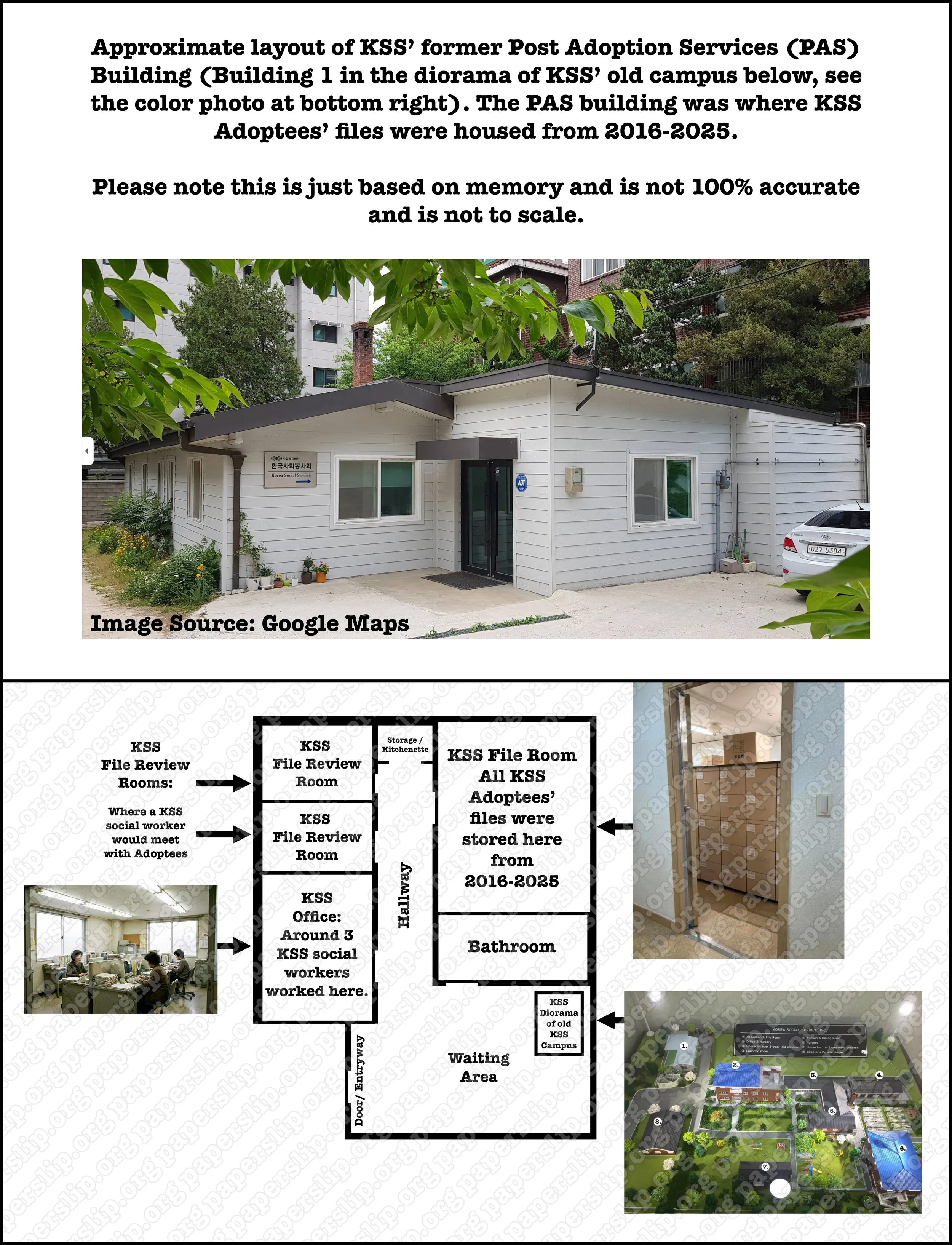
Graphic credit: Paperslip.org
Our images / graphics may not be reproduced without written permission.
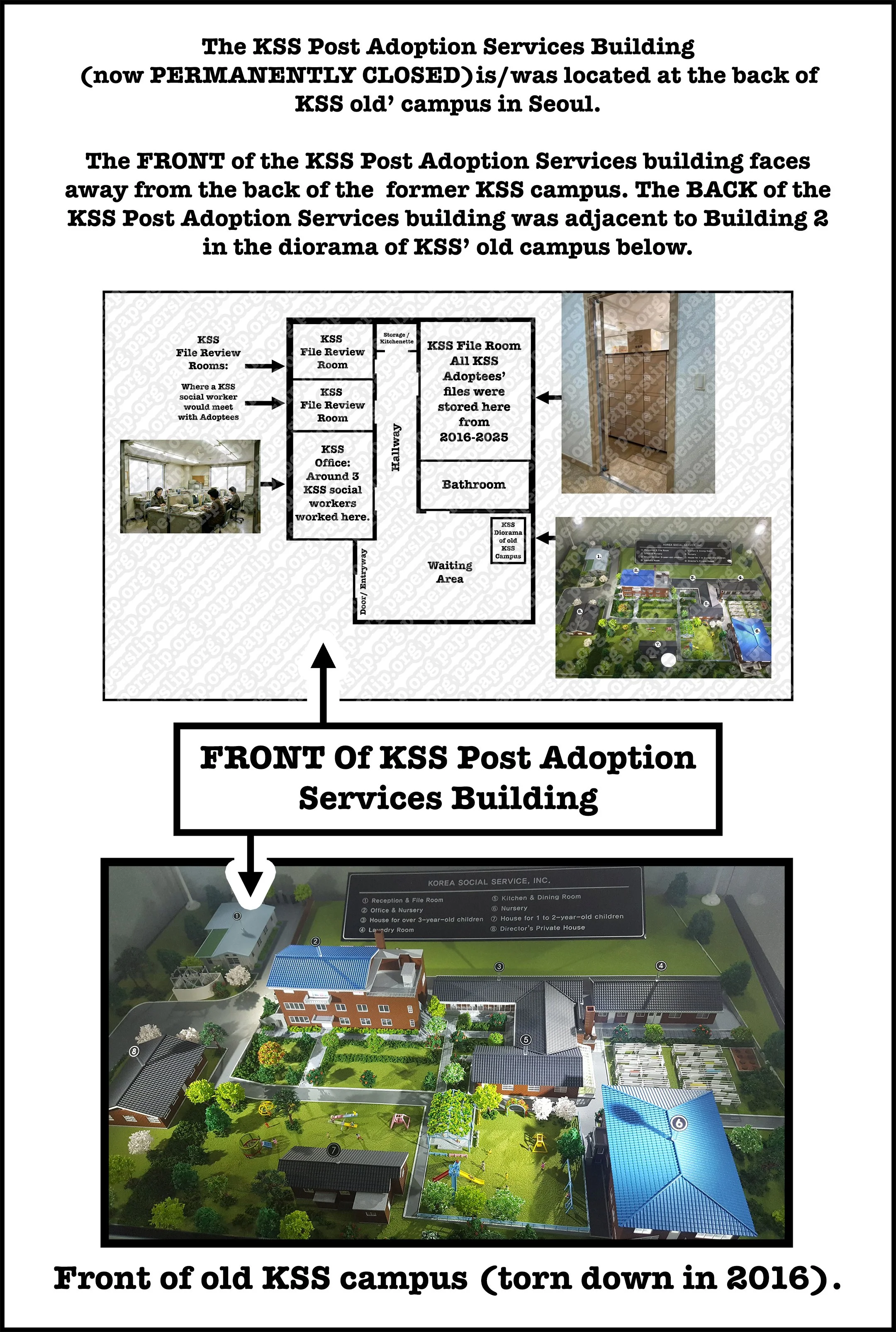
Graphic credit: Paperslip.org
Our images / graphics may not be reproduced without written permission.
+
Below:
A photo and diagram of KSS’ former file room in its now PERMANENTLY CLOSED former Post Adoption Services building in Seoul.
In 2019, I took this photo of KSS’s file room, located within its Post Adoption Services building, just across the hall from the rooms where KSS social workers met with Adoptees for file reviews. Most Adoptees were likely unaware that the file room was even in this building, as KSS kept the door firmly closed during Adoptees’ visits.
When Adoptees would visit for a file review, KSS social workers would often take certain documents out of a KSS Adoptee’s file so that they would not be able to see them. Several KSS Adoptees have reported seeing “different” documents in their KSS file at KSS over the years — whether at the K.S.S. Receiving Home before it was torn down in 2016, or at KSS’ now PERMANENTLY CLOSED former Post Adoption Services building in Seoul, before all of KSS’ files were transferred to NCRC’s Temporary Storage Facility in Goyang, Gyeonggi-do on July 19th, 2025.
KSS stored all Adoptees’ files in this room of its former Post Adoption Services building, likely from 2016 (when KSS tore down its former campus) until July 19th, 2025, when it ceased Post Adoption Services. On July 19th, 2025, all former Korean Adoption Agency files, including those of KSS, were transferred to NCRC. The files you see in this room are (as of this writing on July 11th, 2026) stored at NCRC’s Temporary Storage Facility in Goyang, Gyeonggi-do.
In order to request your KSS file and / or a birth family search, you must submit a Petition for Adoption Information Disclosure request to NCRC via the KAS website.
Please CAREFULLY READ the FAQ sections related to NCRC below:
ALL ADOPTEES START HERE! FAQ + SITE NAVIGATION.
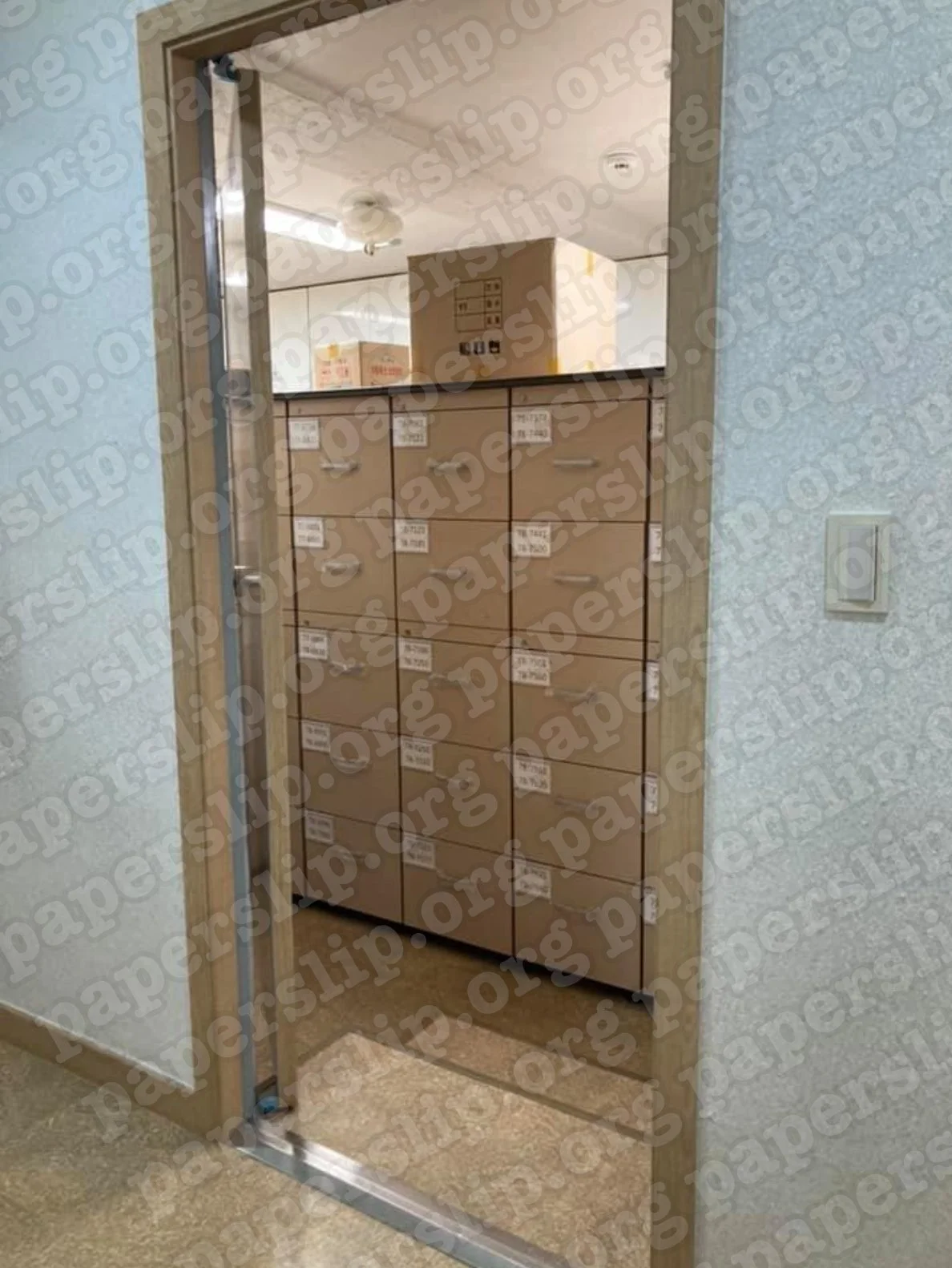
This image belongs to the author and may NOT be reproduced without written permission.
+
Below:
A 2016 photo of KSS files sitting in the hallway of its now PERMANENTLY CLOSED former Post Adoption Services building in Seoul.
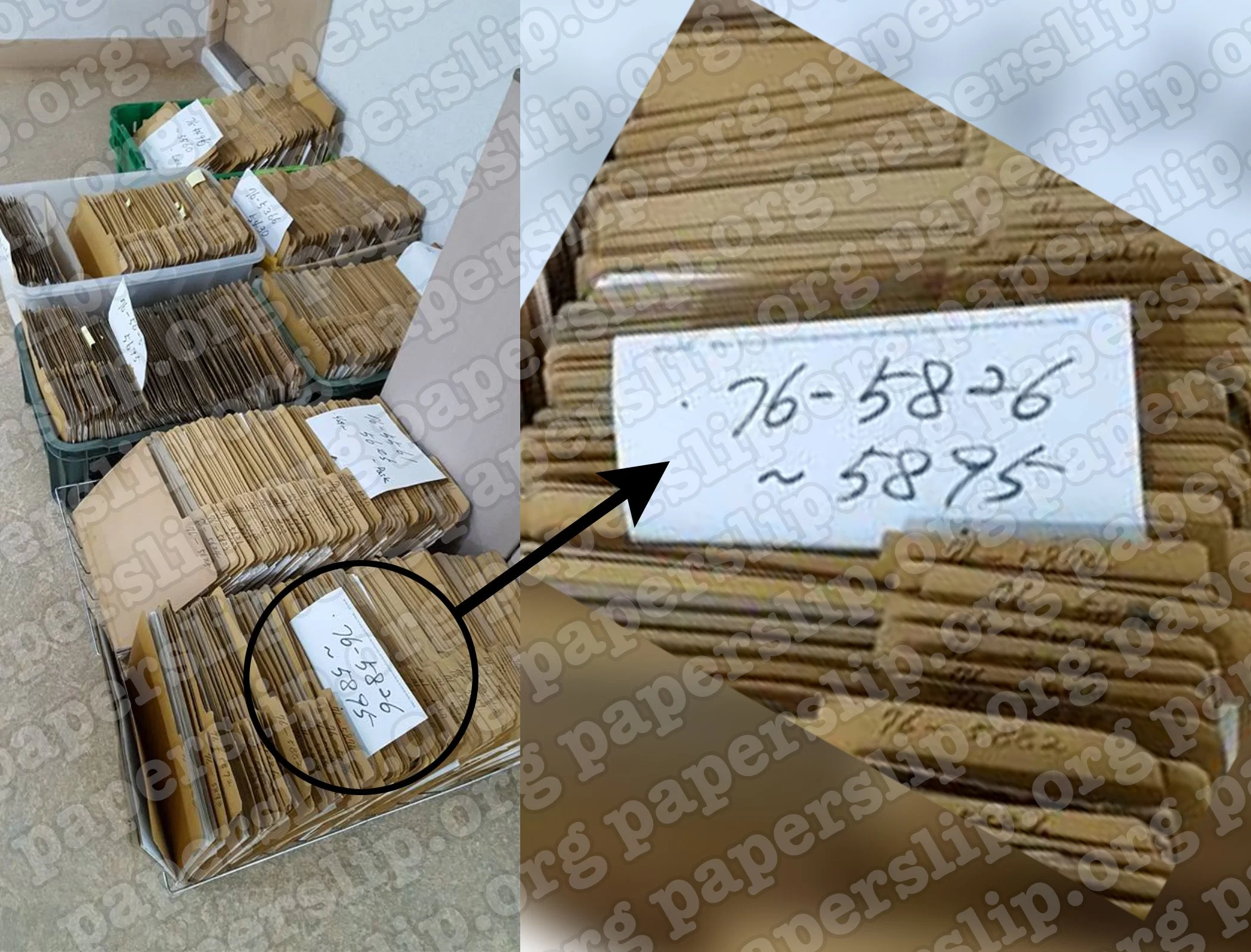
Image credit: Thank you to a KSS Adoptee for sharing the original photo with us.
Our images / graphics may not be reproduced without written permission.
This photo was taken by a KSS Adoptee in 2016 and shows the “File Numbers” of KSS Adoptees who were sent abroad for overseas adoption. Apparently, due to a large Korean Adoptee conference happening in Seoul in 2016, KSS had set these KSS Adoptees’ files out in the hallway.
Most KSS Adoptees and their adoptive parents were unaware of these internal KSS “File Numbers”, since these were part of KSS’ internal filing system for KSS Adoptees’ files in their filing cabinets.
KSS Adoptees who file a Petition for Adoption Information Disclosure request to NCRC via the KAS website will be able to obtain their former KSS “File Number”, as it will be photocopied as part of their KSS file by NCRC.
Please CAREFULLY READ the FAQ sections related to NCRC below:
ALL ADOPTEES START HERE! FAQ + SITE NAVIGATION.
+
Below:
To illustrate what a typical KSS Adoptee’s adoption file looks like, we created a FAKE KSS file folder for a FAKE KSS Adoptee named:
Fake Name:
KIM Yu Jun
(Korean CAPITALIZES last names)
Fake Child Number:
(Not pictured)
7431
Fake K-Number:
K-1758
Fake File Number:
78-5379
(78 = 1978, the year that the child left Korea for adoption — which was sometimes but not always the same year the child was born. (Some children were at KSS for longer than one year). The 5379 number is sequential).
*Please note that these numbers are just randomly made up, but reference the overall style of KSS K-Numbers and File Numbers.
EVERY KSS Adoptee between 1964-2012 has a KSS file folder like this. These former KSS files are (as of this writing) stored at NCRC’s Temporary Storage Facility in Goyang, Gyeonggi-do.
In order to request your KSS file and / or a birth family search, you must submit a Petition for Adoption Information Disclosure request to NCRC via the KAS website.
Please CAREFULLY READ the FAQ sections related to NCRC below:
ALL ADOPTEES START HERE! FAQ + SITE NAVIGATION.
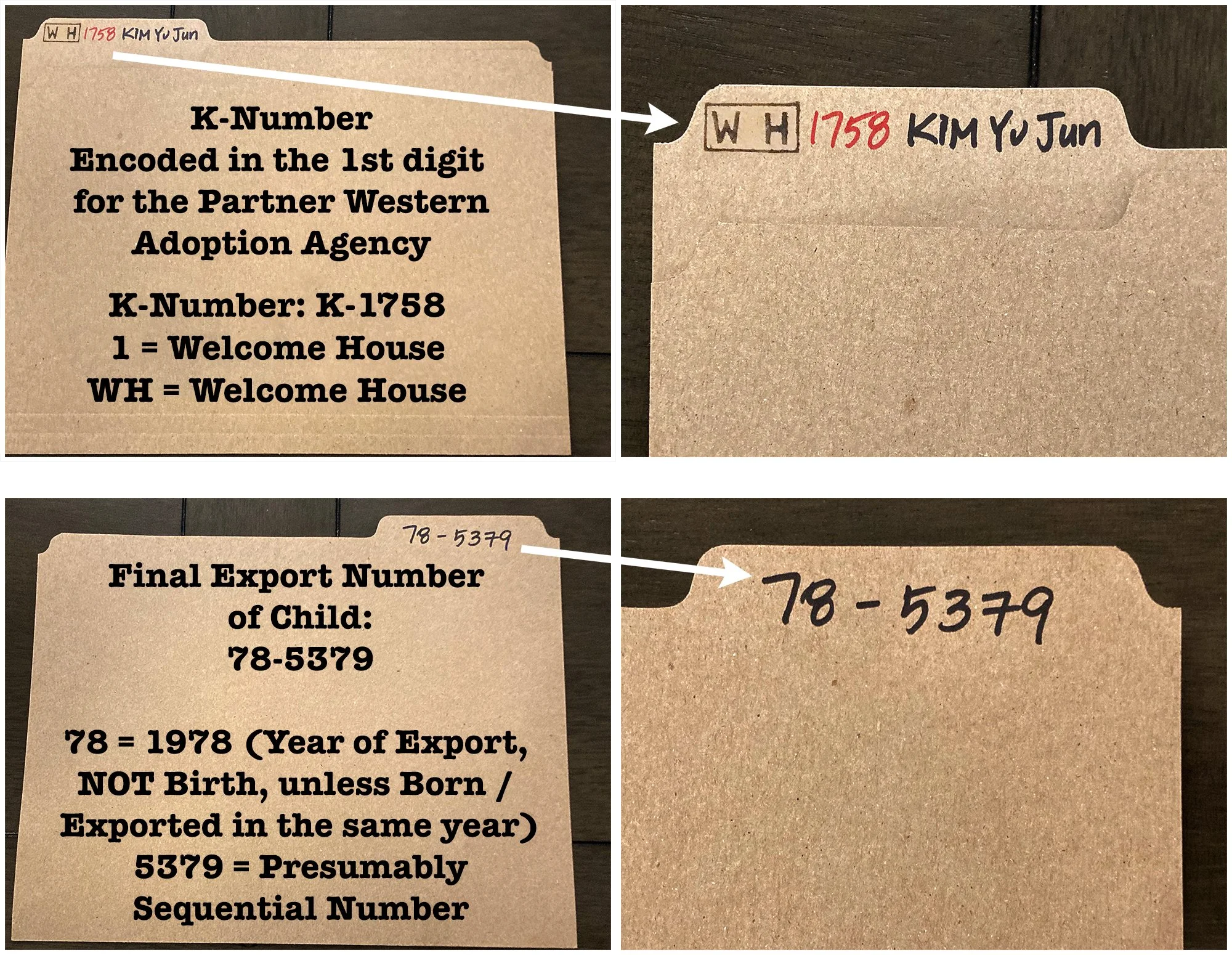
Image credit: Paperslip.org
Our images / graphics may not be reproduced without written permission.
Please note that what we call the “Final Export Number” in the image above (78-5379) is the FAKE File Number. The FAKE K-Number is K-1758.
+
KSS Step 1: ACQUIRE the “ingredients”.
The formerly secret KSS “Child Number”.
+
Below:
To illustrate what a typical KSS file will look like INSIDE, we have created a FAKE file folder image for a FAKE KSS Adoptee.
Real KSS documents have been used for the graphics below.
Taped into the inside FRONT COVER of EVERY KSS Adoptee’s file is the formerly secret document called:
“국내소속서류작성의뢰서”
(Request Form for Preparation of Domestic Affiliation Documents).
This document may (or may not) contain a formerly secret “Child Number” at the upper left.
Paperslip.org is the first and only site to discuss this formerly secret, internal KSS document, and the formerly secret, internal KSS number called the “Child Number”.
Please note that KSS’ former Director told me in person in 2021 that not every child had a Child Number, and that this number was later phased out of use by KSS. I believe it was commonly used in the 1970s for some but not all KSS Adoptees, but was phased out over time. I have personally seen that other Child Numbers exist in other mid 1970s KSS files.
KSS almost NEVER shared this document with Adoptees previously. I only happened to be able to photograph my own in 2018 at KSS’ Post Adoption Services building in Seoul. In 2021, I discussed the “Child Number” with KSS’ former Director on film, in the presence of an Associated Press (AP) reporter, and multiple other witnesses.
This document has a space for information about the person who relinquished the child for adoption. While this may often have been a birth parent, any relinquishing individual’s information may be included on this document. This could be a birth parent, a birth relative, or a person unrelated to the Adoptee.
This document can now be obtained by KSS Adoptees from NCRC through a Petition for Adoption Information Disclosure request.
In order to request your KSS file and / or a birth family search, you must submit a Petition for Adoption Information Disclosure request to NCRC via the KAS website.
Please CAREFULLY READ the FAQ sections related to NCRC below:
ALL ADOPTEES START HERE! FAQ + SITE NAVIGATION.
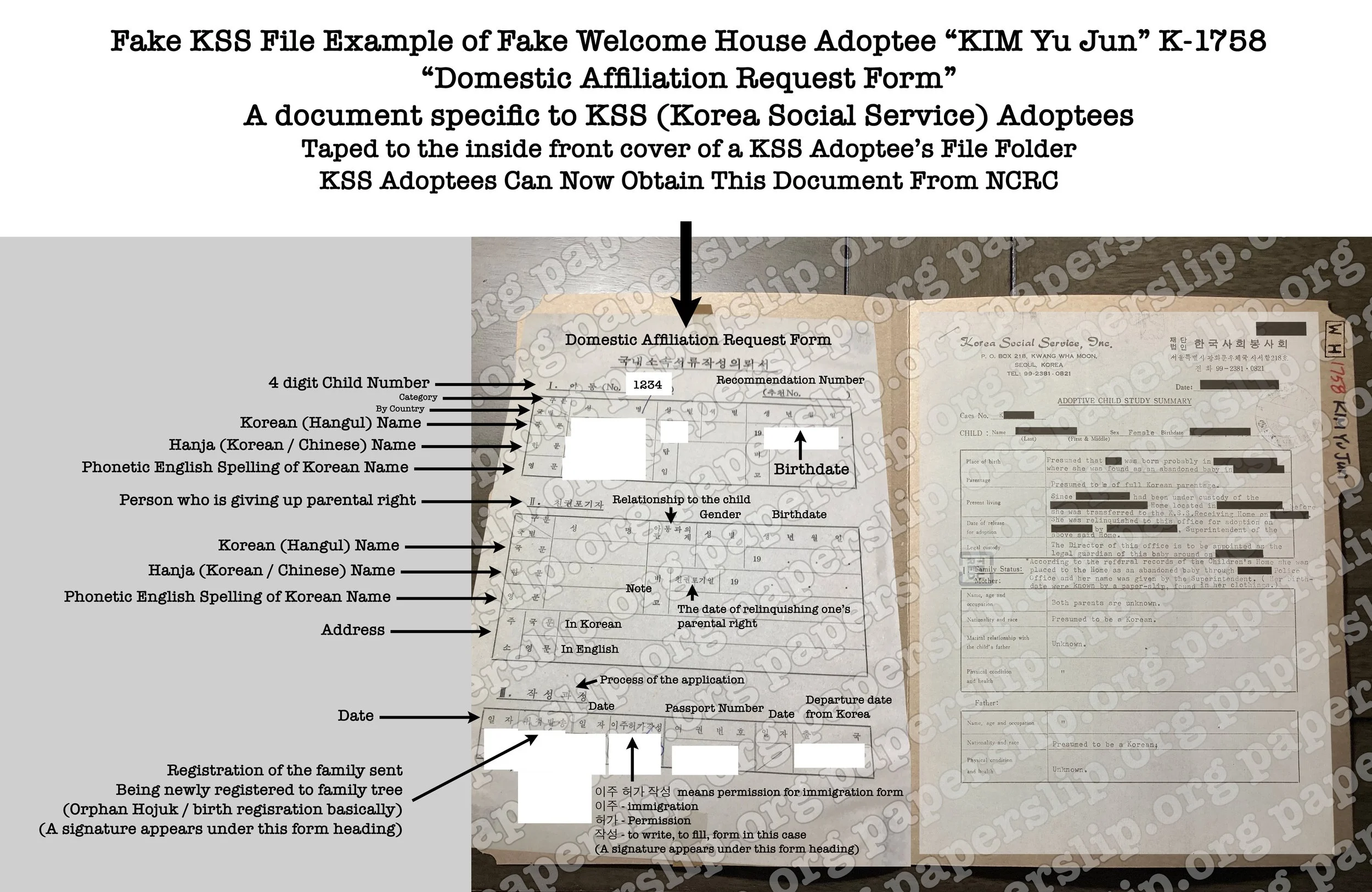
Image credit: Paperslip.org
Our images / graphics may not be reproduced without written permission.
+
KSS Step 2: COOK the “ingredients”.
The secretly encoded KSS “K-Number”.
+
Below:
A portion of a KSS Adoptee’s English Adoptive Child Study Summary. This example is from 1975, and the style of this document changed over time. Please view the link above to see other styles of this document.
KSS recorded the Case (“Caes”) Number — what we call the K-Number — at the top left of this document (or elsewhere on other styles of this document).
*Please Note:
Early 1960s KSS Adoptees’ equivalent documents are called the “Case Study Record”. KSS did not begin an encoded KSS K-Number system until around 1968, so KSS Adoptees who were relinquished to KSS between 1964-1967 typically have unencoded 123 “Case Numbers”.
For some (but not all) Danish Adoptees, this document is called “Information for ADOPTION in Denmark of a foreign child”.

Image credit: Paperslip.org
Our images / graphics may not be reproduced without written permission.
Below:
I figured out KSS’ formerly secret KSS K-Number codes between 2020-2021. This was accomplished by collecting hundreds of KSS Adoptees’ K-Numbers, starting in 2020.
In 2021, KSS’ Director CONFIRMED these codes to me on film in the presence of an Associated Press (AP) reporter at KSS’ former Post Adoption Services building in Seoul.
KSS’ Director also CONFIRMED that KSS K-Numbers in the 1970s REPEATED. I had determined this through my KSS K-Number research beginning in 2020.
+
According to KSS’ former Director, KSS never matched children to prospective adoptive parents. KSS instead matched a child to one of its Partner Western Adoption Agencies.
We do not know exactly how KSS decided which of it’s Partner Western Adoption Agencies to match a child. However, it likely related to quota agreements between KSS and its Partner Western Adoption Agencies, and frankly, random chance.
Once KSS had matched at child to one of its Partner Western Adoption Agencies, that Partner Western Adoption Agency in turn matched a child by proxy to a set of prospective adoptive parents, typically through the following procedure:
KSS mailed the ENGLISH Adoptive Child Study Summary of the child along with her or his (usually black and white) KSS intake photo to the Partner Western Adoption Agency to whom KSS had matched the child, and the Partner Western Adoption Agency in turn matched the child to a set of prospective adoptive parents in the West. The prospective adoptive parents then made the decision about whether or not they would adopt the child whose English Adoptive Child Study Summary and KSS intake photo had been sent to them, and informed the Partner Western Adoption Agency, who then informed KSS. If the adoptive parents consented to adopt the specific child to whom they had been “matched” by proxy, then the remaining adoption procedure would proceed. This is why adoptive parents should have a copy of a KSS Adoptee’s ENGLISH Adoptive Child Study Summary — since it was provided to them in the beginning stages of the proxy adoption process.
(Of course, the ENGLISH Adoptive Child Study Summary could have gotten lost over time. However, it is well worth it for an Adoptee to try to find this document if possible, as it may contain unredacted birth parent information).
*The prospective adoptive parents (for the most part) never had to go to Korea. Children arrived in groups of varying sizes on planes from Korea to the West, typically accompanied by various types of escorts. Escorts could have been a mix of KSS social workers, and various individuals who were given a free plane ticket in exchange for escorting children from Korea to the West.
*Please note that there were some KSS Adoptees whose eventual Western adoptive parents lived in Asia (typically Korea or Japan — such individuals were typically but not always military personnel), who visited KSS directly to select a child for adoption. We know of a few cases of KSS Adoptees whose U.S. adoptive parents were based in Guam, but who visited KSS in Seoul directly in order to adopt. Such adoptions are typically referred to as “named” adoptions, and are more commonly known as “private adoptions”. In such cases, children were NOT adopted through a Partner Western Adoption Agency, but rather directly from KSS. The adoptive parents typically hired a lawyer to handle the paperwork.
Once KSS had decided WHICH of its Partner Western Adoption Agencies in the US, Netherlands, Denmark or Switzerland to match a child, KSS assigned that child with an encoded KSS K-Number (see list below). I decoded KSS’ formerly secretly encoded K-Numbers between 2020-2021.
This encoded K-Number was typed onto each child’s English Adoptive Child Study Summary, which was sent along with a photo of the child to KSS’ Partner Western Adoption Agencies in the US, Netherlands, Denmark or Switzerland as a part of the process of proxy matching.
+
Below is a screenshot of one of my posts to a KSS Adoptee forum from September 11th, 2021. By around January 2021, I had already decoded KSS’ K-Numbers. Hundreds of KSS Adoptees directly witnessed and participated in my informal research for several years, starting in 2020, on a private forum for KSS Adoptees. We kept this research secret for 3 years. I had never intended to make these codes public, but unfortunately unscrupulous Danish and Dutch individuals attempted to take false credit for my years of original research on January 1st, 2023. This research grew out of my very personal search for my deceased twin sister, whom I believe died at KSS in the mid 1970s before she was intended to be adopted. My years long investigation into my and my likely twin sister’s separate KSS adoption cases is the entire basis for the existence of Paperslip.org.
In a repugnant move that I will never understand, a Danish supposed “Korean Rights” group (DKRG) blocked and ghosted me from TRC 2 related forums on December 7th, 2022, after I had already filed my TRC 2 (Second Truth and Reconciliation Commission, Republic of Korea) case through them, so that they could attempt to take credit for my years long work. We had no prior disagreement. At the time, this group had made itself the sole mouthpiece for TRC 2; by blocking and ghosting me, I could not receive updates about the TRC 2 investigation into Overseas Adoption. This supposed "Korean Rights" group and the non-Adoptee Dutch DoKAD, to whom they falsely attributed my work, collaborated to exclude me from the TRC 2 investigation into Overseas Adoption for three years (2022–2025). They later, unsurprisingly, publicly parted ways following disagreements of their own. The Danish group had initially approached me in 2022 to help spread awareness of TRC 2 among U.S. Adoptees — a request which I gladly supported at the time. This was before I learned that the "leader" of the "Korean Rights" group is not actually a lawyer, despite having publicly claimed to be one through the press for years.
Therefore, these KSS K-Number codes are now a public part of Paperslip. Widespread reporting by the Associated Press (AP) in 2024 confirmed that I was the person responsible for this original KSS K-Number research — which had never previously been conducted by any individual or group. I conducted this research in order to attempt to obtain further evidence that I had once had a twin sister, who likely died at KSS. I know both of our K-Numbers, and KSS had intended to separate us for adoption, prior to her likely death in the mid 1970s.
My KSS K-Number research is a major part of why Paperslip’s slogan is: “The Basis of Truth in Adoption is Comparison.”
By comparing my and my likely twin sister’s KSS K-Numbers with the K-Numbers of hundreds of other KSS Adoptees, I was able to reveal greater TRUTHS about the systemic nature of KSS’ decades long program of overseas adoption. I would gladly have presented this evidence to TRC 2 had I not been blocked out of the movement by those claiming to be “defenders” of “Adoptee Rights”.
I am still searching for my likely twin sister through the painstaking work of decoding KSS' records and numbering systems. Paperslip.org is a labor of love, and it is dedicated to the memory of my twin. It is a profound injustice that others attempted to take my work — and the opportunity to obtain justice through TRC 2 for my twin’s formerly secret death — away from me.
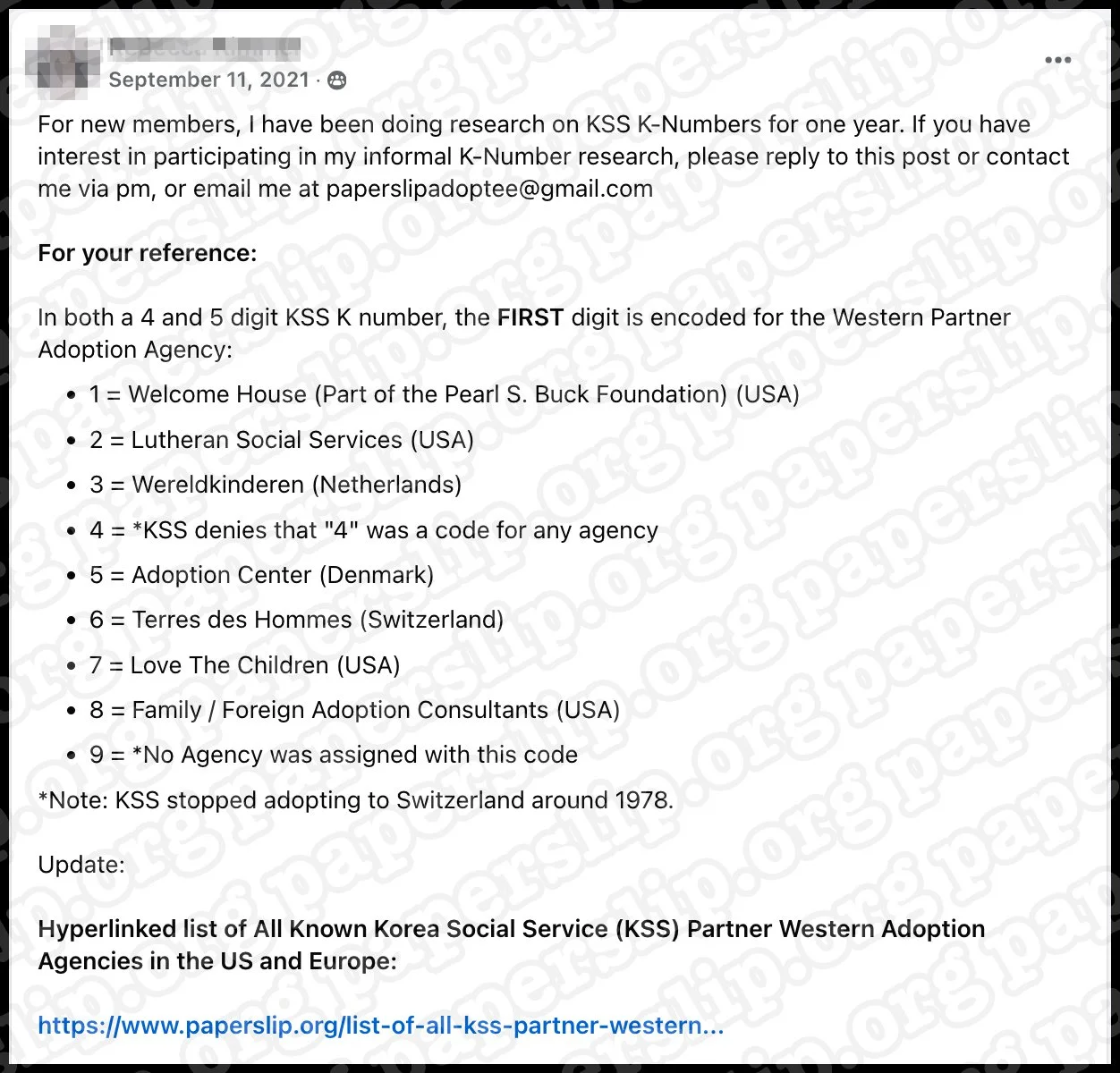
Image credit: Paperslip.org
This image may not be used without written permission.
+
Below:
In the back of each KSS Adoptee’s file is a small square paper envelope, which often contains multiple copies of the KSS intake photo of the child.
Sometimes, this envelope also contains birth parent letter(s) which KSS may or may not have ever shared with the Adoptee to whom they were written.
We have heard of many instances in which KSS never informed an Adoptee that a birth parent had written them a letter. Several KSS Adoptees have happened to visit KSS, whereupon a KSS social worker informed them that a birth parent letter had been written years prior, and stored in the back of a KSS Adoptee’s file. In multiple cases, by the time the Adoptee realized that a birth parent had tried to contact them, the birth parent had already died.
I have personally seen such letters in the backs of a few KSS Adoptees’ file folders from the 1970s, at KSS’ former Post Adoption Services building in Seoul. While rare, these letters still exist in some KSS Adoptees’ files, which are now at NCRC’s Temporary Storage Facility in Goyang, Gyeonggi-do.
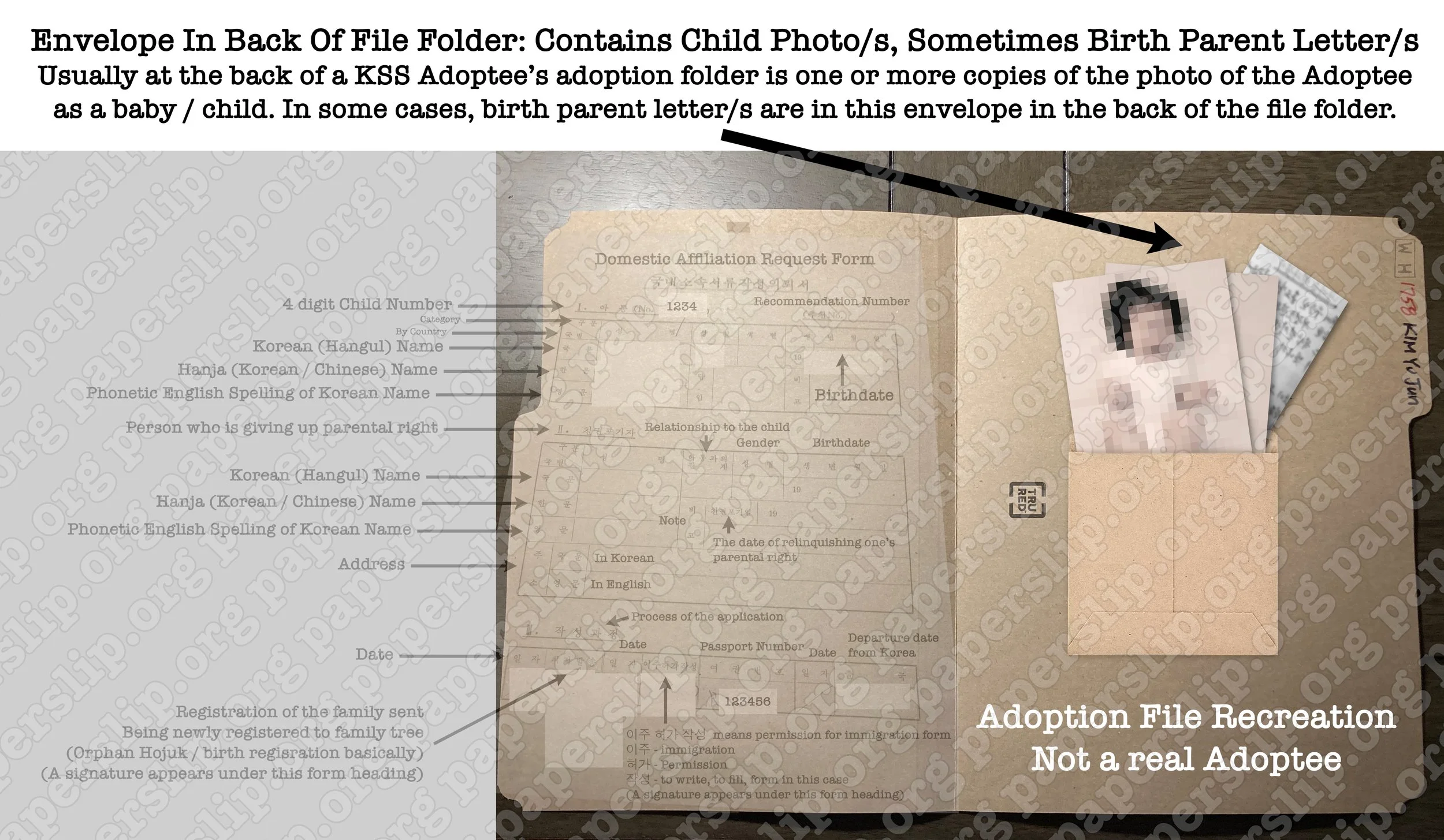
Image credit: Paperslip.org
Our images / graphics may not be reproduced without written permission.
+
KSS Step 3: DELIVER the “final product”.
The formerly internal KSS “File Number”.
+
Below:
KSS files in the hallway of KSS’ former Post Adoption Services building in Seoul.
Once KSS had sent a child to the West for adoption — in other words, once a child had been delivered to her or his adoptive parents in the US, Netherlands, Denmark, or Switzerland — KSS assigned a child’s folder with a “File Number”. Colloquially I call this number the “Exit Folder Number”.
According to KSS’ former Director, who told me this in person in 2021, a “File Number” — while not explicitly secret — was NOT regularly made known to KSS’ Partner Western Adoption Agencies, adoptive parents, or Adoptees. The “File Number” was an internal KSS number used to sequentially organize files within its filing cabinets containing KSS Adoptee’s individual file folders.
I believe KSS needed to have this kind of purely sequential system for filing KSS Adoptees’ files in their filing cabinets, since KSS K-Numbers — at least in the 1970s — REPEATED. I figured this out through my own research starting in 2020, and KSS’ former Director CONFIRMED this to me in person in the presence of an Associated Press journalist and multiple other witnesses at KSS’ former Post Adoption Services building in Summer 2021. KSS Adoptees in the 1970s do NOT have unique K-Numbers. Other KSS Adoptees may also have the same K-Number.
The photo below was taken below by a KSS Adoptee in 2016 at KSS’ former Post Adoption Services building in Seoul.
The “File Number” is NOT the same as the “Child Number” or the “K-Number”.
The “File Number” — such as the 76-5826 “File Number” pictured below — refers to the year (YY) that the child LEFT KOREA (which was sometimes, though not always, the same year that the child was born), followed by a sequential 4 or 5 digit (presumably sequential) number.
For example, a child who was born in 1975 but did not leave Korea for adoption until 1976 would have received a 76-1234 “File Number” around the time of the child’s departure for the West. We do not know the PRECISE moment at which a “File Number” was assigned — but it is known to be associated with a child’s DEPARTURE from Korea to the West.
Please Note:
The “File Number” is written on one side of a KSS Adoptee’s file folder TAB, and the “K-Number” is written on the opposite side of the same TAB. These numbers are NOT the same!
Pictured below are “File Numbers”. The KSS Adoptee’s “K-Number” is written on the opposite side of each file folder’s TAB. These are NOT the same numbers!
The “Child Number” (if present) is written on the upper left of the document taped to the INSIDE FRONT COVER of each KSS Adoptee’s file folder.
Image credit: Paperslip.org
Our images / graphics may not be reproduced without written permission.