
The Wall.
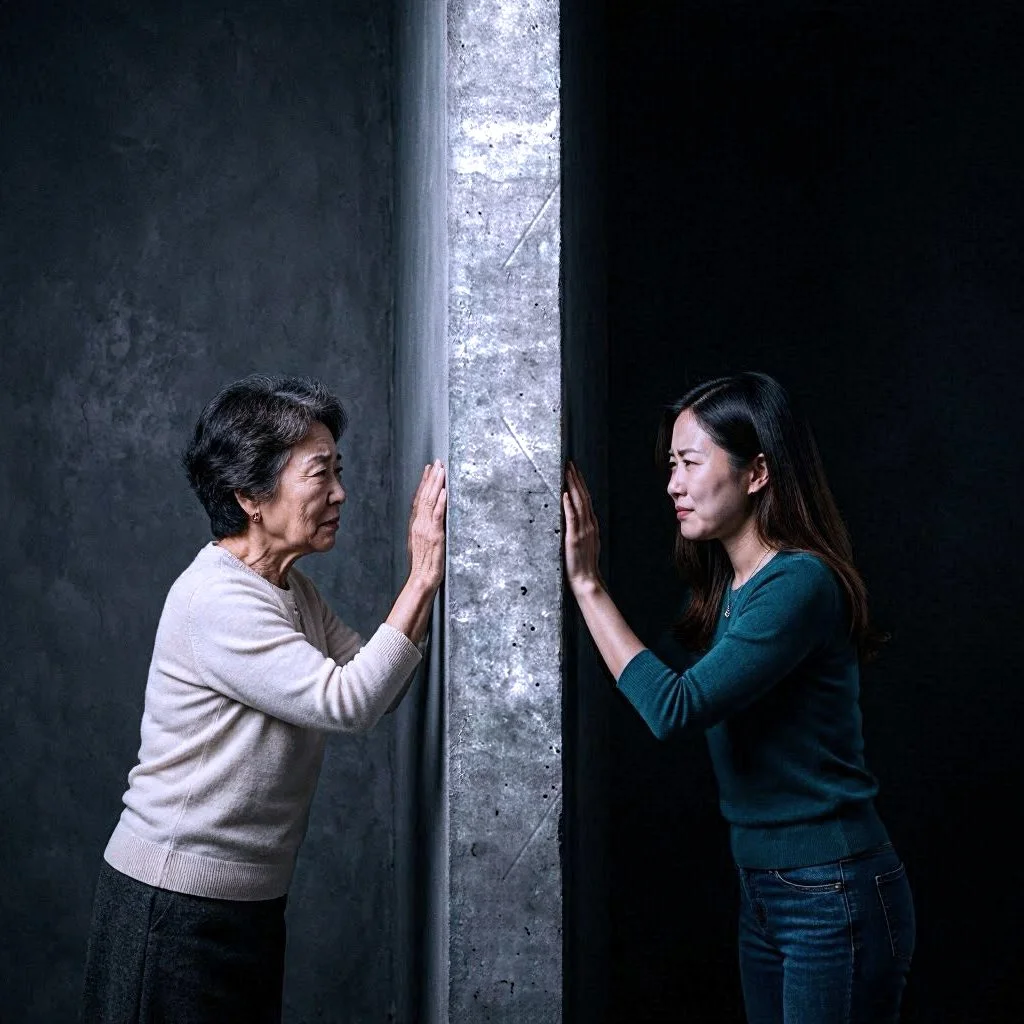
Above: Our AI representation of “The Wall” which separates Korean birth parents from Adoptees.
A recent Korea Times article by a Korean Adoptee highlights the issue we have long recognized as “The Wall”.
+
This metaphorical wall manifests itself in the structures, systems, gaslighting, and assumptions that shape the experiences of both birth parents in Korea and Adoptees in the West.
The Wall stands between birth parents and the children they relinquished for adoption — or who were taken from them and who later became Overseas Adoptees.
I have often imagined birth parents and Adoptees standing on opposite sides of the same wall, each reaching or pushing toward the other, yet unable to see one another or connect because of the barriers between them. The Wall can represent many things, including:
-The S. Korean Government
-Western Governments
-Korean Adoption Agencies
-Western Adoption Agencies
-NCRC / KAS (and their predecessors)
-Korean Police who deny birth parents the right to take the KNPA DNA test, if the birth parents admit that they relinquished their children for adoption.
-Korean Police who deny Adoptees the right to take the KNPA DNA test, if Korean Adoptees admit or it is discovered that the Adoptees have birth parent information in their adoption documents.
-Korean birth parent gaslighting due to lies they have been told by Korean relatives, NCRC / KAS and its predecessors, Korean Adoption Agencies, Korean Orphanages, Single Unwed Mothers Homes, Birth / Maternity Clinics / Hospitals, etc.
-Adoptee fear of looking into the past, due to feelings of abandonment and fear of rejection
-Adoptee gaslighting due to mass orphanization
-Adoptee gaslighting due to their own natural desire to assimilate into the Western cultures into which they were adopted
-Adoptee gaslighting due to adoptive parents’ withholding of information
-Birth parent shame and feelings that they do not deserve to search for their relinquished (or stolen) children
-Language and cultural barriers between Korea and the Western countries to which Korea sent thousands of children for overseas adoption
-Korean cultural and gender barriers which still punish those who relinquished children for adoption
-Time
-Etc.
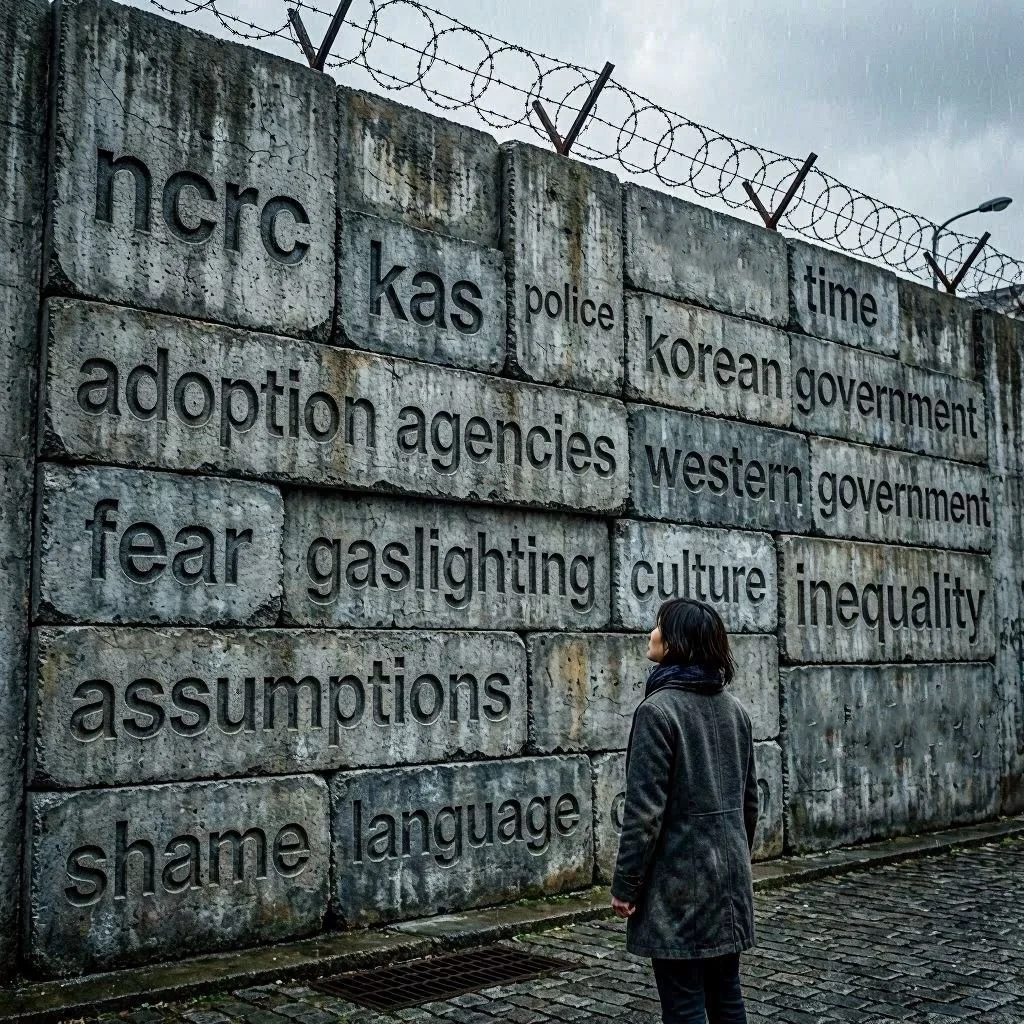
Above: The Wall often prevents Korean birth parents from finding their children, and prevents Adoptees from finding their birth parents.
Adoptees often don’t know that Korean birth parents face “The Wall” on the other side.
Birth parents often don’t know that Adoptees face “The Wall” on the other side.
+
By design, it takes both birth parents and Adoptees years — and usually decades — of time to realize that The Wall even exists.
Korean Adoptees have long wryly mused that the Korean Government just wants us all to die off, so that they no longer have to deal with the issue of overseas adoption.
Even if birth parents in Korea want to find the children they either voluntarily relinquished for adoption or who were stolen from them, they are almost always prevented from doing so by The Wall.
For example, NCRC / KAS and its predecessors, Korean Adoption Agencies and Western Adoption Agencies alike often refuse to share information with birth parents, or outright lie to them.
Korean birth parents who want to take the KNPA DNA test at a police station in Korea are often denied the opportunity to take the test if they admit that they relinquished their children for adoption. Adoptees in turn are often denied the opportunity to take the same test due if they admit or it is discovered that they have birth parent information in their adoption documents.
Meanwhile, most Adoptees grow up believing the often false “abandonment” stories which riddle countless thousands of Korean Adoptees’ documents. This is definitely NOT to say that all Korean birth parents who relinquished their children for adoption are desperate to find them again. But it is to say that there are often far more complicated stories of “relinquishment” — often involving heartbreaking circumstances of poverty, systemic inequality, and colonialism — than most Adoptees grow up being aware of. “Abandonment” is a much harsher word, we believe, than “Relinquishment”. At least “Relinquishment” implies some sort of regret. And we know from hearing countless Adoptees’ stories that far too many Korean birth parents died of regret after relinquishing their children for adoption.
When Adoptees finally come “out of the fog”, the first thing they often do is to try to trace down the little pieces of (often falsified) information in their adoption files. For understandable reasons, Adoptees put great faith in the “truthfulness” of their adoption paperwork. And we want to make clear that Adoptees MUST ASSUME that whatever birth parent information they have in their adoption files is TRUE UNTIL PROVEN FALSE — otherwise, the Adoptee has nothing to go on for a birth family search in terms of paperwork.
However, we call the birth family search process through paperwork alone “The Paper Trail of Tears” for a reason. Thousands of Adoptees hit dead ends due to partially or fully falsified information in their paperwork. The entire purpose of Paperslip is to de-gaslight especially KSS (Korea Social Service) Adoptees by making them aware of systemic falsification within KSS Adoptees’ paperwork.
+
NCRC — the Korean Public Institution which now posseses ALL former Korean Adoption Agency files — has long been part of The Wall.
Adoptees who have beaten their heads against The Wall of NCRC (and its predecessors) for years know how excruciatingly frustrating it can often be to deal with NCRC.
NCRC is deliberately and perpetually understaffed by the Korean Government — specifically, by the Ministry of Health and Welfare (MOHW) under whose jurisdiction NCRC falls.
NCRC’s failures are so legion that we’ve lost count of all of them. They have lost thousands of Korean birth parents’ and Adoptees’ digital records, have badly digitized orphanage records for over a decade, and are so short staffed that Adoptees who now must submit a Petition for Adoption Information Disclosure to NCRC through the never properly functioning KAS website must wait for between 5 months to up to 1 year for fulfillment of their requests by NCRC.
Adoptees who are able to survive the bureaucratic gauntlet it takes to book in person appointments at NCRC’s TWO locations will receive far faster service. However, this means that NCRC has created a class system amongst Adoptees which dictates that only those who can afford to go to Korea in person will be able to obtain copies of their former Korean Adoption Agency files in a timely fashion.
Problematically, NCRC is staffed in large part by former Korean Adoption Agency staff — one of whom, in 2020, bounced between working for NCRC, Holt, and then back to NCRC. This person himself became embroiled in controversy when he allegedly stole NCRC data in order to run a private birth search business on the side. To our knowledge, he still works at NCRC.
NCRC’s laundry list of problems is so long that it’s impossible to mention them all here. However, for years we have been documenting them here on Paperslip, through our IMPORTANT NEWS ARCHIVE (see the dropdown menu on our home page) and more recently through our Paperslip BLOG.
+
So, what can be done in the face of The Wall?
+
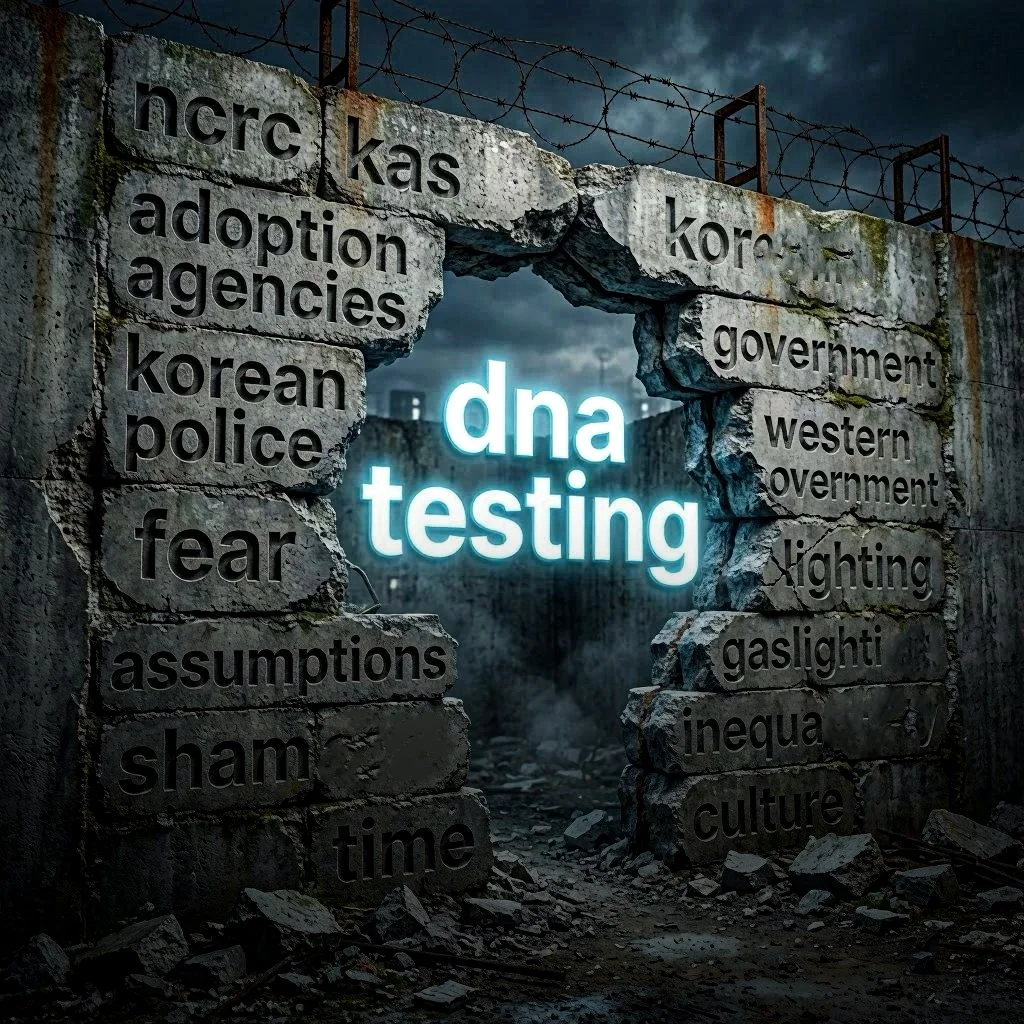
Above: DNA Testing can break down The Wall.
DNA Testing can break down The Wall.
However, DNA Testing faces its own walls, especially in Korea.
+
You will often hear us and many other Korean Adoptees say, “DNA is the only truth.” This statement encapsulates the fact that Adoptees cannot always rely on their paperwork to lead them to their birth families. DNA, on the other hand, does NOT lie.
It’s important to understand that everyone’s case is different, and that trying MULTIPLE PRONGS of birth family search at once is important. Currently, those prongs include:
-Submitting a Petition for Adoption Information Disclosure to NCRC via the KAS website.
-Gumshoe investigation “on the ground” in Korea, based on any information about a birth parent which the Adoptee has in their possession.
-DNA Testing.
+
The Wall which DNA Testing faces — both in Korea amongst Korean birth parents, and in the West, amongst Adoptees.
+
The Wall with respect to DNA testing which is most commonly faced by Adoptees in the West includes:
-In the West, Adoptees often grow up highly unaware of Korean history, and of the systems and processes which shaped their early lives. Most Adoptees believe the often false “abandonment” stories typed onto their Korean and Western adoption paperwork, and many are gaslighted by such stories into believing that no one ever wanted them nor had any second thoughts about giving them up (or losing them). It can therefore take DECADES of time for most Adoptees raised in the West to come “out of the fog” and realize that time may be running out for them to find any remaining birth family members.
-Usually when Adoptees first come out of the fog, they naturally turn to their adoption paperwork to begin their birth family search process. However, given the mass orphanization of children during the process of Korean adoption, many (though certainly not all) Korean Adoptees have partially or fully falsified information in their Korean and Western adoption documents. There is frankly no way to know what is true and false in these documents, short of finding a Korean birth parent to whom the Adoptee turns out to be a DNA match, and having the birth parent confirm or deny the paperwork details in the Adoptees’ paperwork. Even then, it is often difficult to determine the exact “truth” of an Adoptee’s relinquishment circumstances, after so many decades of time.
-Many Adoptees will spend years or even decades ONLY chasing down what we call “The Paper Trail of Tears” — following the often false leads in their Korean and Western adoption paperwork, and never taking any or all DNA tests.
-Many Adoptees only take ONE DNA test — and do not realize that in order to give themselves the greatest possible chance of success in finding birth family, that they must take ALL possible DNA tests — since all of the DNA test databases are siloed (separate from one another). Certainly the cost of DNA testing can be a factor. Legitimate privacy concerns are another.
-Many European Korean Adoptees ONLY take MyHeritage, since this test is heavily marketed in Europe. However, most U.S. based Korean Adoptees tend to take either 23 and Me, Ancestry, MyHeritage, or FTDNA. Because Korean Adoption Agencies often separated siblings and twins, it is so important that Korean Adoptees who have interest in finding birth family take ALL POSSIBLE DNA TESTS.
-Many Korean Adoptees do not realize that putting in their DNA profiles information about their being adopted — or talking about their being adopted to DNA matches too soon — can SCARE OFF even distant DNA relatives. We strongly advise that Adoptees DO NOT include any information about their being adopted in their online DNA profiles.
-Many Adoptees do not realize they can take the Korean Police KNPA DNA test either at a Korean Police Station in Korea, or through a Korean Consulate / Embassy in their Western country of adoption. In order to take this test, however, Adoptees must complete a form to obtain an Adoption Certificate and submit it to NCRC, which can take at least two weeks to respond to such requests.
-Many Korean Adoptees take DNA tests, and then never check in to see if they have matches.
-Many Korean Adoptees change their names or email addresses, making them difficult or impossible to track down by DNA relative matches.
-Adoptees’ level of interest in their personal histories changes over time.
-Etc.
+
The Wall with respect to DNA testing which is most commonly faced by birth parents in Korea includes:
-In Korea, DNA testing is considered taboo. It is associated in the minds of many Koreans with criminality.
-Most Koreans pride themselves on having centuries’ worth of written family history, in the form of family registries / hojuks or jokbos. Why take a DNA test if you can simply crack open the family books to see where you fall in line? (Oops, this doesn’t work so well for women, since up until recently, Korean family histories only traced the male lines).
-Most major commercial DNA tests, such as 23 and Me, Ancestry, MyHeritage, and FTDNA are based in the West. As of this writing, 23 and Me does not even ship to Korea directly.
-Many Korean birth parents are poor and old, and may not have access to the money required to take a DNA test, nor the technology needed to process and check DNA test results online.
-Let’s not forget that Korean culture considers it very shameful to have given up or to have lost a child for adoption. Therefore, many Korean birth parents feel deeply ashamed and that they do not have the right to look for their lost children, and therefore do not take any DNA tests.
-While the Korean Adoptee organization 325Kamra has for years distributed free FTDNA test kits to Korean birth parents in Korea, and Korean Adoptees around the world, FTDNA is a less well known test in the West where most Adoptees reside. 325Kamra also only has a tiny team in Korea, which cannot possibly handle the entirety of the need for DNA testing in the entire country. While 325Kamra does an admirable job and is one of the very few resources for DNA testing of Korean birth parents for Adoptees, they are a volunteer and not a professional organization — and to be frank, sometimes things fall through the cracks (as with any volunteer organization, including Paperslip).
If you experience issues with receiving a free DNA test from 325Kamra (they typically distribute FTNDA tests), we strongly urge you just BUY AND PROCESS YOUR OWN FTDNA test. There are SALES on all the major DNA tests all the time and on every major holiday. FTDNA is NOT an expensive test.
Personally we recommend taking 23 and Me and Ancestry first, and then if you are able to do so, transfer your raw data to FTDNA and MyHeritage. However, if transferring DNA is too hard for you, just outright buy FTDNA and MyHeritage.
-Korean Police have been known to have denied Korean birth parents the opportunity to take the KNPA DNA test in Korea, if the birth parents admit they relinquished a child for adoption. This is because technically the KNPA test is only meant to be for “Missing Children”.
+
All of this probably seems extremely discouraging. Birth family search IS an uphill battle — for both Korean birth parents and Korean Adoptees alike.
However, birth family search is NOT impossible. But it may take a great deal of time, money, sweat equity, and patience.
We do not pretend to believe that the problem of The Wall will ever be solved in full.
However, we believe that if both Korean birth parents and Korean Adoptees can be better educated — both about the systems which deliberately prevent them from connecting and by the DNA tests which can reunite them — at least more reunions of Korean birth parents with their children will be possible in this lifetime.