
What is the objective of submitting as many Adoptee cases as possible to TRC 3, regardless of evidence, given its limited mandate, timeframe, and capacity?
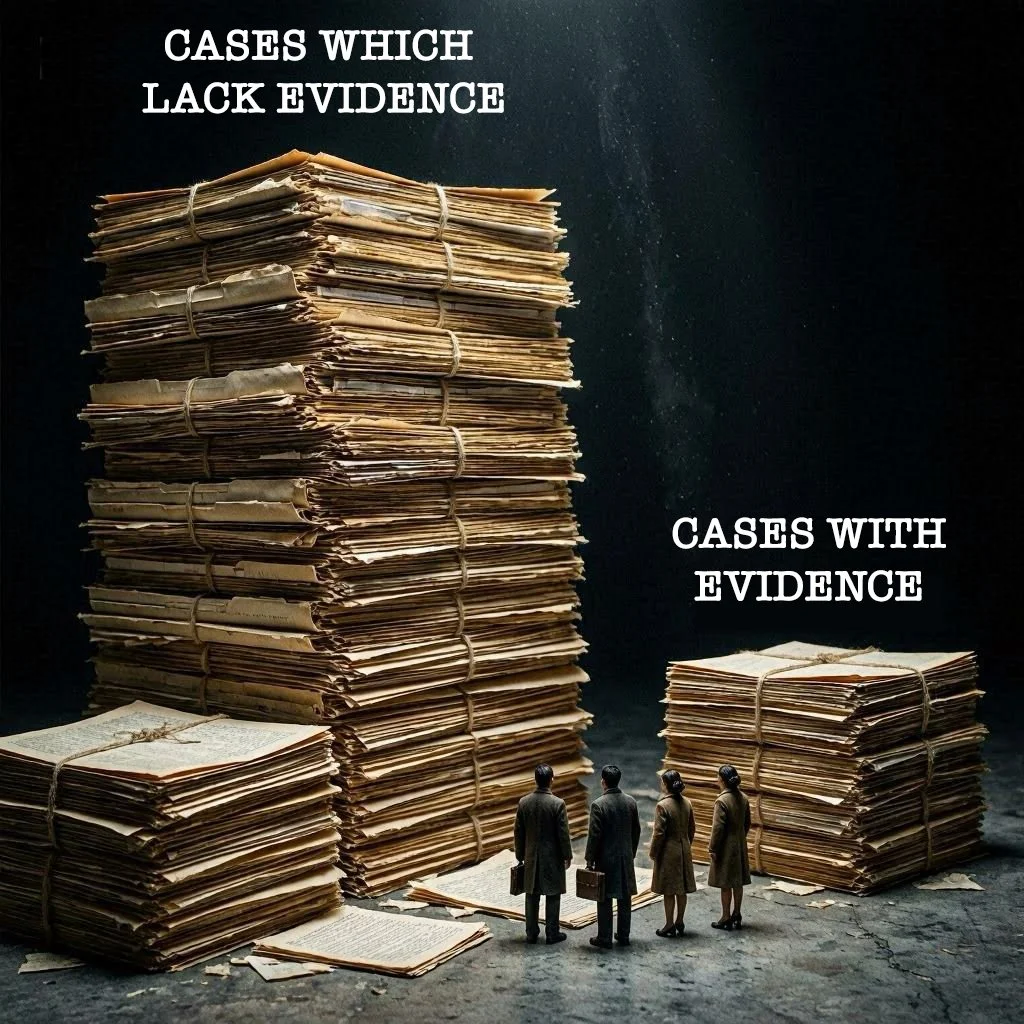
Above: Our AI representation of TRC 3’s Commissioner and Members for Investigation Bureau 3 — which is responsible for institutional confinement facilities and overseas adoption cases — facing the massive and unenviable task of determining whose cases are “worthy” of investigation, based on the amount of available evidence. Please note that as of this writing on July 6th, 2026, TRC 3 has NOT hired any investigators yet — it has only hired Commissioners for the three Subcommittees.
*Paperslip Note: Please note that this article states that there is one Commissioner and three Members of The Third Subcommittee for TRC 3. However, other articles refer to there being 4 Commissioners for the Third Subcommittee.
TRC 3 has a limited amount of time (about 2-3 years) to investigate not only cases of overseas adoption, but also thousands of other cases involving past human rights abuses in S. Korea.
TRC 3 must first resolve the 311 cases left suspended from TRC 2, before it can investigate any newly submitted cases for TRC 3. TRC 3 seeks to hold the Korean Government accountable for past human rights abuses by investigating cases — including those of Overseas Korean Adoptees. However, the burden of proof required for accepting new cases of Adoptees for investigation by TRC 3 is currently under discussion by TRC 3 Commissioners.
“Korean Rights” groups are currently pushing for as many Korean Adoptees as possible to submit their cases to TRC 3 — however, many of these cases may lack much or any evidence (which we understand is in itself a major part of the abuse).
However, we are concerned that many of these newly submitted Adoptee cases, if unsupported by sufficient evidence, may simply be rejected for investigation by TRC 3. We therefore question the strategy of encouraging the submission of an unlimited number of cases to TRC 3, particularly when many may lack the evidentiary basis required and are likely to be rejected for investigation.

Above — Are “Korean Rights” groups which encourage as many Adoptees as possible to submit their cases to TRC 3 just leading sheep over the edge of the cliff of expectations? Adoptee cases without supporting evidence may face rejection by TRC 3.
As someone who submitted my case to TRC 2, and had it accepted as one of the first 34 in 2022 — likely due to the great amount of hard won evidence in my case (though I withdrew my TRC 2 case in 2023 and resubmitted my TRC 3 case in 2026) — I have since the start of TRC 3 wondered the following:
What is the actual strategy for having as many Korean Adoptees as possible apply for TRC 3, when TRC 2 only rendered judgments in 56 of 367 cases over 3 years of time, leaving 311 cases suspended?
In practical terms, I question the value of encouraging a large number of Korean Adoptees to submit cases to TRC 3, particularly when many may have limited or no documentary evidence. I fully recognize that a core harm in thousands of Adoptees’ cases is precisely the absence or concealment of records. However, the July 19th, 2025 transfer of all former Korean Adoption Agency records to the NCRC has, at least in theory, improved access to documentation and addressed this fundamental issue. Unfortunately, in practice, the NCRC process can be a bureaucratic and logistical nightmare.
That being said, many Adoptees — assuming they are able to navigate the gauntlet of the (never improved) NCRC online process, visit NCRC’s two locations in person, or potentially wait up to a year for a response to a purely online request — may have a better chance of obtaining their records through NCRC than through the TRC 3 process.
Adoptees probably also do not understand that in order to even obtain the documents which are uncovered in the course of the TRC 2 or TRC 3 investigation into their cases — even assuming they are accepted, investigated, and a judgment is rendered in the first place — must submit a form to TRC shortly after receiving a judgment IN ORDER to receive any documents uncovered during the course of investigation into their respective cases.
In terms of the TRC process not necessarily being the most effective route for participants to obtain adoption documents, a similar issue arose during TRC 2. However, it is important to note that TRC 2 largely took place prior to the July 19th, 2025 transfer of all former Korean Adoption Agency files to NCRC’s Temporary Storage Facility in Goyang, Gyeonggi-do.
In other words, a major source of long-standing existential and real-world distress for Korean Adoptees — the limited access to their Korean Adoption Agency records — has, in theory, improved since the period covered by the TRC 2 investigation into overseas adoption (2022–2025).
Again, in practice, the NCRC process is designed to make Adoptees fail.
TRC 3, which began on February 26, 2026, and follows the transfer of all former Korean Adoption Agency files to NCRC on July 19th, 2025, is therefore no longer as “exceptional” a mechanism for accessing Adoptee records as it may have been during TRC 2. Though again, TRC 2’s ability to obtain files on behalf of Adoptees is debatable.
In real world terms — and in light of what TRC 3 can realistically accomplish within a limited timeframe, especially with 311 suspended cases carried over from TRC 2 — I am not convinced that a broad push for mass case submissions — unless these cases bear a lot of evidence — is the most effective strategy. And I am not sure why this is being pushed for by some Adoptee “Korean Rights” representative groups. It would be deeply depressing — though certainly not inconceivable — if these groups were encouraging so many Adoptees to submit cases, regardless of how much evidence they do or do not have, simply to keep themselves in the public eye.
Standing Commissioner Jang Young-soo, recently appointed to lead TRC 3 after serving in TRC 2, is a PPP (conservative) appointee who has already expressed skepticism about the evidentiary basis of many long-standing Adoptee cases. As an Adoptee, I 100% understand the argument that a lack of documentation is itself central to the harm being examined. However, within a time constrained legal-administrative framework that typically still requires some evidentiary threshold, I question what a large influx of largely evidence-limited claims would substantively achieve beyond further illustrating the systemic absence of records.
According to a recent Newsis article, during a recent meeting, Standing Commissioner Jang Young-soo commented on investigations into overseas adoption-related human rights violations:
“This is an area that is particularly difficult to address properly. If we apply the same standards used in court proceedings to incidents that occurred decades ago, there will be very few cases that can be substantiated. On the other hand, it would also be unreasonable to recognize every application simply because it has been filed. We need to find an appropriate balance.”
He added:
“The greatest challenge is determining how to conduct the kind of in-depth investigations that have never been attempted before. Since conducting field investigations overseas is not easy, we are considering ways to work through cooperation networks with civil society organizations, but there is still a long way to go.”