
“Adoptee Testimonials of Suffering—Transnational Adoptees and the Issue of Suicidality in Swedish Media Texts, 1988–2025” By Tobias Hübinette, Clara Iversen & Mattias Strand.
Paperslip Note:
KSS (Korea Social Service) did NOT adopt to Sweden.
The Korean Adoption Agency which adopted to Sweden was CPS (Child Placement Services) / SWS (Social Welfare Society) / KWS (Korea Welfare Society).
Please see:
KSS (Korea Social Service) is NOT the same as KWS / SWS / CPS!
+
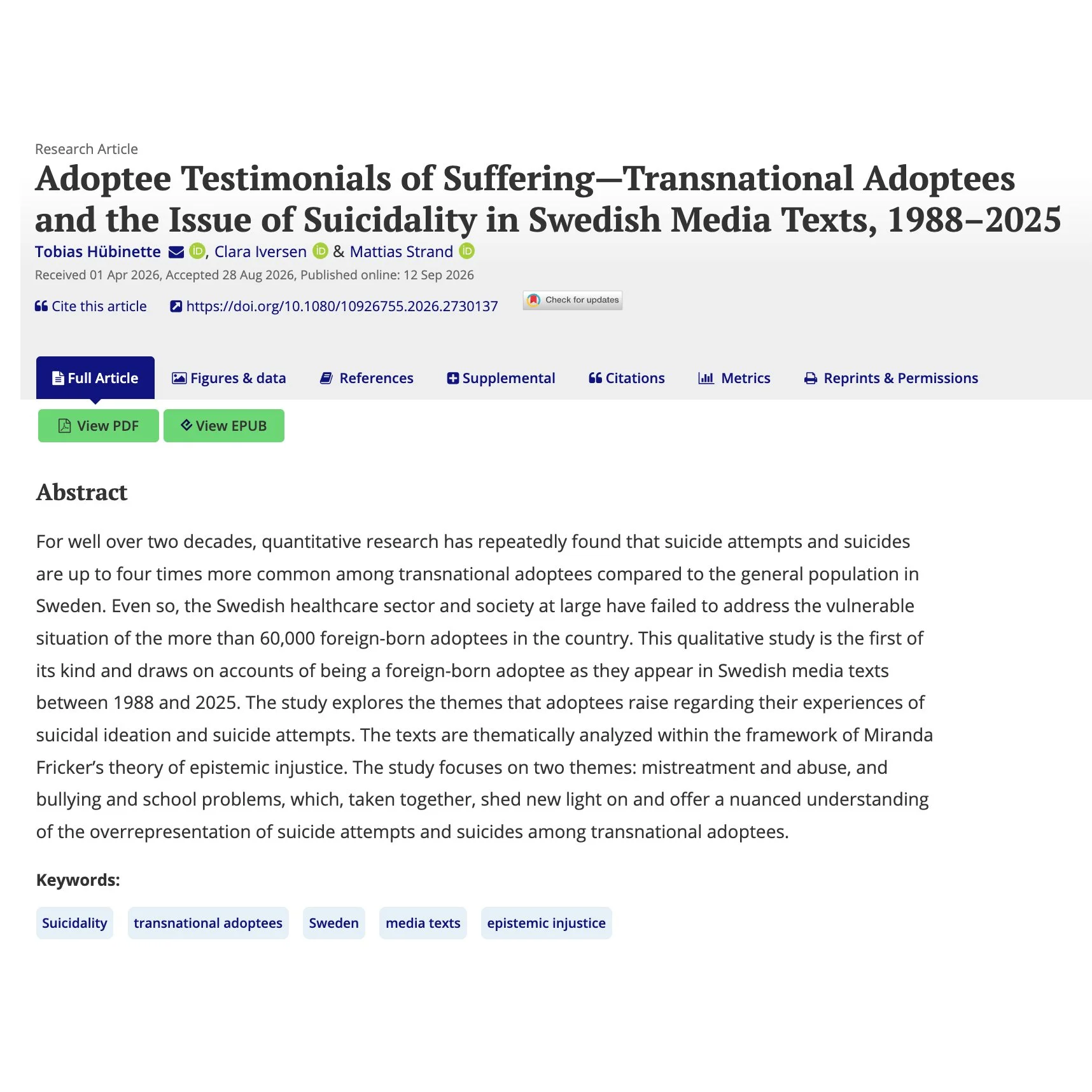
Above: Screenshot of the article Abstract.
New Paper:
“Adoptee Testimonials of Suffering—Transnational Adoptees and the Issue of Suicidality in Swedish Media Texts, 1988–2025” By Tobias Hübinette, Clara Iversen & Mattias Strand.
Swedish Korean Adoptee Tobias Hubinette, along with Clara Iversen and Mattias Strand have published the new paper above.
Tobias Hubinette’s Facebook post (translated from Swedish via ChatGPT):
“The first sub-study from the research project “International Adoption and Mental Health: Understanding and Preventing Suicide Among International Adoptees” has now been published:
Starting this year and continuing for three years (2026–2028), Forte – the Swedish Research Council for Health, Working Life and Welfare – is funding the research project “International Adoption and Mental Health: Understanding and Preventing Suicide Among International Adoptees.” The project’s first sub-study has now been published in the scientific journal Adoption Quarterly.
The research project aims both to understand and to address the substantially elevated risk of suicide attempts and suicide among international adoptees. It is the first qualitative project of its kind, both in Sweden and internationally.
The widespread mental health difficulties and elevated suicide risk among international adoptees have received increasing attention in recent years, not least thanks to the Adoption Commission’s inquiry, which was submitted to the Swedish government in June 2025. Unlike previous research, which has addressed the issue exclusively through quantitative registry studies, this study is based on adoptees’ own accounts of suicidal thoughts and suicide attempts as expressed in Swedish-language media texts from the period 1988–2025. The study highlights how experiences of neglect, abuse, racism, and problems at school constitute a recurring pattern in adoptees’ accounts.
The study further shows that adoptees’ suffering has often been interpreted as an individual problem and met with inadequate support and a lack of understanding from those around them and from society at large. Using the concept of epistemic injustice, the study finds that, because of the historically very positive view of international adoption in Sweden and the high social status held by many adoptive families, adoptees were often not believed for decades when they testified about exposure to neglect, abuse, and bullying. This was particularly the case in their interactions with the healthcare sector.
The article sheds new light on the elevated risk of suicide attempts and suicide among international adoptees in Sweden and offers a deeper and more nuanced understanding of the issue. It further points to the need for a more attentive and responsive approach within healthcare and social care services and other societal institutions, as well as a need for resources that can promote healing.
Given that far too many lives have already been lost within this group as a result of society’s neglect, the hope behind both the research project and the present sub-study is that Swedish society as a whole—and particularly the healthcare sector—will now be prepared to listen to and respond to adoptees’ voices, perspectives, and needs.”
+
Tobias Hubinette’s original Swedish post to Facebook:
“Den första delstudien från forskningsprojektet “Internationell adoption och psykisk hälsa. Att förstå och motverka självmord bland utlandsadopterade” har nu publicerats:
Från och med i år och under tre års tid (2026-28) finansierar Forte – Forskningsrådet för hälsa, arbetsliv och välfärd forskningsprojektet “Internationell adoption och psykisk hälsa. Att förstå och motverka självmord bland utlandsadopterade” och nu har projektets första delstudie publicerats i den vetenskapliga tidskriften Adoption Quarterly
Forskningsprojektet syftar till att både försöka förstå och motverka den kraftigt förhöjda risken för självmordsförsök och självmord bland utlandsadopterade och det är det första kvalitativa projektet i sitt slag och både i Sverige och internationellt.
Utlandsadopterades utbredda psykiska ohälsa och förhöjda suicidrisk har uppmärksammats alltmer under senare år och inte minst tack vare Adoptionskommissionens utredning som överlämnades till regeringen i juni 2025. Till skillnad från tidigare forskning som enbart har belyst problematiken genom kvantitativa registerstudier bygger den här studien på adopterades egna berättelser om suicidtankar och suicidförsök sådana de kommer till uttryck i svenskspråkiga medietexter som härrör från perioden 1988-2025. Studien synliggör hur erfarenheter av omsorgssvikt, övergrepp, rasism och skolproblem är ett återkommande mönster i de adopterades berättelser.
Studien visar vidare att adopterades lidande ofta har tolkats som individuella problem och mötts av ett bristande stöd och en oförståelse från omgivningens och samhällets sida. Med hjälp av begreppet epistemisk orättvisa finner studien att på grund av den tidigare så positiva synen på internationell adoption i Sverige och den höga sociala status som många adoptivfamiljer innehar så blev de adopterade under årtionden ofta inte trodda på när de vittnade om utsatthet för vanvård, övergrepp och mobbning och särskilt gäller det i relation till hälso- och sjukvårdssektorn.
Artikeln kastar nytt ljus över överrisken för självmordsförsök och självmord bland utlandsadopterade i Sverige och erbjuder en både mer fördjupad och mer nyanserad förståelse av den rådande problematiken. Den pekar vidare på behovet av ett mer lyhört bemötande inom vård- och omsorgssektorn och andra samhällsinstitutioner samt av ett behov av resurser som kan främja läkning. Med tanke på att alltför många liv redan har gått förlorade inom gruppen på grund av samhällets försummelse så är förhoppningen med både forskningsprojektet och den aktuella delstudien att det svenska samhället i stort och särskilt hälso- och sjukvårdssektorn nu ska vara beredd att lyssna på och hörsamma de adopterades röster, perspektiv och behov.”