
51 years ago, on or around October 24th, 1975, my likely twin “Baby A” was first photographed on the day of her first day of intake to my Korean Adoption Agency, KSS in Seoul. According to her medical records, she would die there sometime between December 24th, 1975 and early February, 1976.
KSS then sent another child in my likely twin’s place for adoption. I only discovered this by accident in 2019. I was never meant to know about my twin sister or her death at KSS.
I have been searching for my deceased twin sister through KSS’ K-Number system since that time. In the process of researching KSS between 2020-2021, I decoded KSS’ K-Numbers, and discovered that KSS had secretly encoded these numbers in the first digit for KSS’ Partner Western Adoption Agencies.
Others have tried to steal credit for my research. But on the 51st Anniversary of my twin’s first day of intake at KSS, I have been given public credit for the second time by a journalist for my work.
+
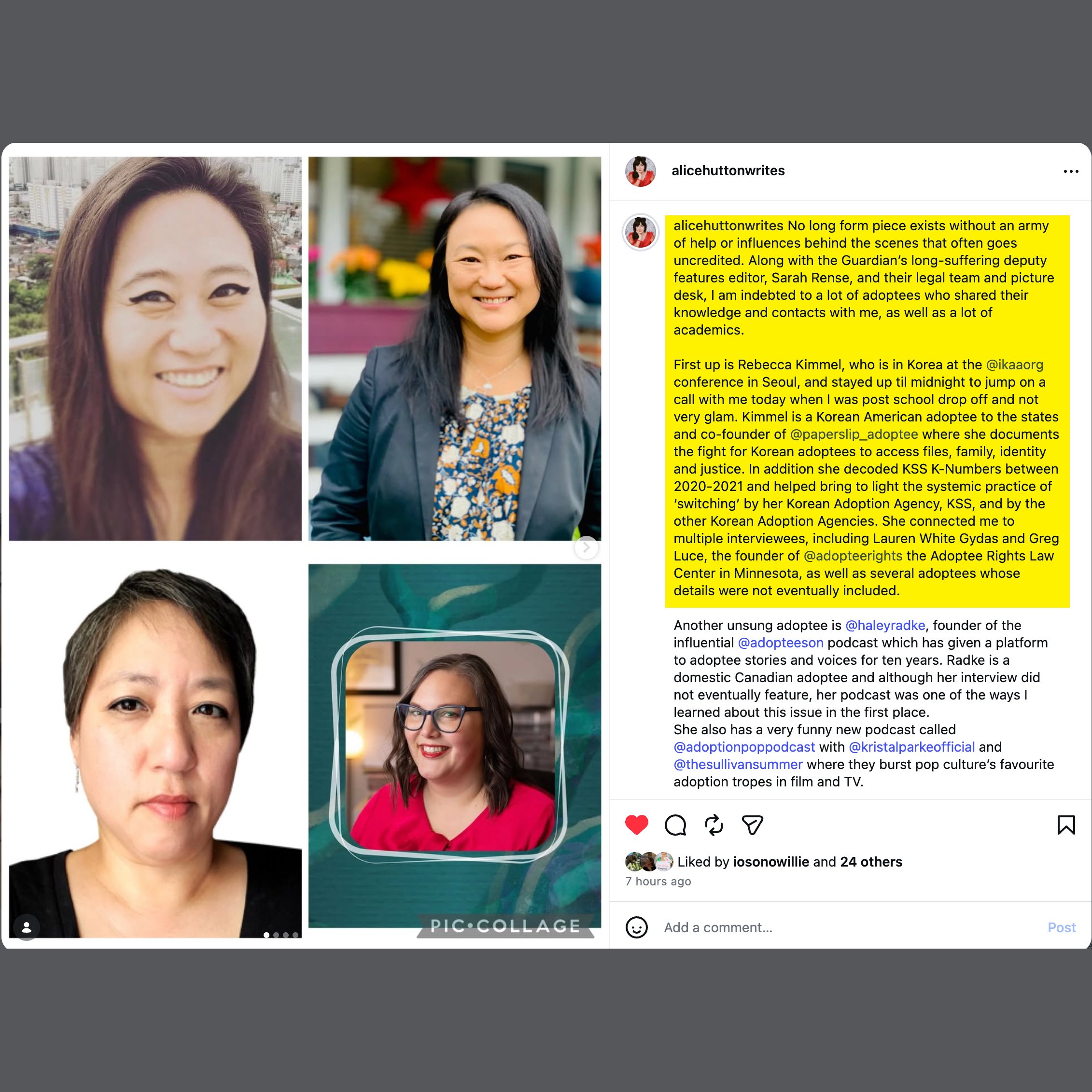
Thank you to journalist Alice Hutton of The Guardian for publicly crediting my contributions to her recent article, “Adoptees from Korea say they were abused and isolated in the US. Were they also ‘stolen’ from their birth parents?” in her recent Instagram post.
Alice reached out to me around May 2025, after she was referred to me by a Korean Adoptee friend. For a while I debated about whether or not I wanted my story to be in the press again. Ultimately, I decided not to have Alice write about my case despite our having a great Zoom conversation, during which I shared extensively about my case, but I was happy to refer her to multiple Adoptees for her story, including Korean Adoptee Lauren White-Gydas and domestic white U.S. Adoptee Greg Luce, amongst others.
I am pleased that today, following her article’s release in The Guardian, Alice acknowledged my KSS K-Number research, in which I decoded the first digit of KSS K-Numbers between 2020-2021 in the context of my investigation of my deceased twin sister’s switch case. I am still searching for my twin through KSS’ multiple numbering systems.
Unfortunately, others have egregiously attempted to take credit for my work in the past, and there appear to be continued attempts by a former would be plagiarist Bastiaan Flikweert’s affiliates to co-opt my original research. During IKAA, this affiliate had the audacity to advertise itself through IKAA channels using an email employing the phrase which directly referenced my KSS K-Number research. The female affiliate is well aware of my KSS K-Number research, which I have previously discussed with her through a Zoom at 10 am on Tuesday, July 29th, 2025 KST (Korea Time). She advised that I should publish a formal research study about my KSS K-Number research. For the record, I do not need to do any such thing — my work has already been extensively documented in the media. Yet when I spoke with this affiliate in person at IKAA recently, she denied any knowledge of my research. Her close friend Bastiaan Flikweert was previously given false credit for my work by DKRG’s Peter Moller on January 1st, 2023. It took over one year for Bastiaan Flikweert to finally publicly admit he had NO role in my KSS K-Number research or in the decoding of KSS K-Numbers. I had thought that this matter was permanently settled, but it seems clear that there may be yet another attempt to plagiarize my work by Bastiaan Flikweert’s close affiliates.
I do not need to do a formal research study about my KSS K-Number research, or any of my other original research into KSS history and practice. The Associated Press has already acknowledged my research into KSS’ numbering systems in the article which was published about my case on October 15th, 2024, and has acknowledged my role in the website I co-founded in 2020, Paperslip.org. Additionally, my KSS K-Number research is officially Copyrighted under U.S. Copyright Law as of January 2021.
+
Alice Hutton of “The Guardian” writes in her Instagram post:
“No long form piece exists without an army of help or influences behind the scenes that often goes uncredited. Along with the Guardian’s long-suffering deputy features editor, Sarah Rense, and their legal team and picture desk, I am indebted to a lot of adoptees who shared their knowledge and contacts with me, as well as a lot of academics.
First up is Rebecca Kimmel, who is in Korea at the (IKAA) conference in Seoul, and stayed up til midnight to jump on a call with me today when I was post school drop off and not very glam. Kimmel is a Korean American adoptee to the states and co-founder of (Paperslip.org) where she documents the fight for Korean adoptees to access files, family, identity and justice. In addition she decoded KSS K-Numbers between 2020-2021 and helped bring to light the systemic practice of ‘switching’ by her Korean Adoption Agency, KSS, and by the other Korean Adoption Agencies. She connected me to multiple interviewees, including Lauren White Gydas and Greg Luce, the founder of @adopteerights the Adoptee Rights Law Center in Minnesota, as well as several adoptees whose details were not eventually included.”
+
Supposed Adoptee “Rights” activists meanwhile continue to support and enable the person who attempted to plagiarize my work.
During IKAA’s Research Symposium in Seoul on October 24th, 2026, a Korean Adoptee “Rights” activist — who is a close associate and supporter of the person whose affiliates continue to attempt to take credit for my work — gave a presentation about Omma Poom, a park for Adoptees in Paju.
During her presentation, she feigned ignorance about how Associated Press (AP) reporter Tong-hyung Kim first became connected to the Korean Adoptee community in order to investigate adoption corruption — a journalistic effort that ultimately culminated in the FRONTLINE/AP documentary South Korea’s Adoption Reckoning.
I took the opportunity to set the record straight: I was the one who first approached the AP reporter in January 2021. Despite my role in initiating this connection, I was subsequently cut out of the documentary and remain uncredited for my contribution.
Given this IKAA presenter’s purported support for the Adoptee “Rights” movement and an individual who has participated in an apparent attempt to plagiarize my research on KSS K-Numbers, I took the opportunity to question her following her presentation at the IKAA Research Symposium.
She declined to answer, stating only that the topic should be addressed in a broader setting. In effect, she refused to engage with the question.
Yet in the past, she advocated that Adoptees should boycott the film “Blue Bayou”, due to perceived plagiarism of a Korean Adoptee’s story by the media.
My, how times have changed…
+
Date — October 24th, 2026.
Place — IKAA Research Symposium in Seoul.
Coincidental Occasion — The 51st anniversary of when my now deceased twin sister presumably first entered KSS in Seoul.
I asked the presenter:
“This is a question for (Redacted Korean Adoptee presenter). I am addressing this to you since you previously mentioned in your talk about Omma Poom the importance of the creation of art by Adoptee artists, and in the same vein, you also asked that we not photograph the quotes you assembled by researcher T. Yejon Kim, due to their yet to be published research. This implies that you have a respect for the provenance of Adoptee research and a respect for the attribution of proper credit.
Today — October 24th — is the first day in 1975 that my twin sister likely first entered KSS as an infant, where she would later pass away, and be replaced by KSS with another child for adoption.
KSS gave both children the same name and K-Number. This is known as switching, and I helped to bring systemic switching to public attention through an SBS documentary in 2022 and the FRONTLINE documentary in 2024. I first approached AP reporter Tong-hyung Kim in 2021 to request that he write a story about systemic switching. This ultimately led to the creation of the FRONTLINE / AP documentary South Korea’s Adoption Reckoning. I was subsequently cut out of the documentary, and never given any credit in the film.
In the process of researching my twin’s switch case, I decoded KSS K-Numbers between 2020-2021. This research is now officially under U.S. Copyright.
Why is it that there appears to be an issue of giving proper credit within the journalism, Korean Adoptee and DoKAD (Descendants / Children of Korean Adoptees) community?”
For context:
The person whose media affiliates continue to try to take false credit for my work is a DoKAD — the child of two KSS Adoptees who both witnessed my KSS K-Number research over years of time, and who both privately pressured me to allow their son to keep the FALSE credit assigned to him by DKRG for my work — even though they knew that I was the one responsible for decoding KSS K-Numbers in the context of the investigation of my deceased twin sister’s case.